


You apply for a checking account and get a denial letter naming a company you have never dealt with. What does that company know about you?
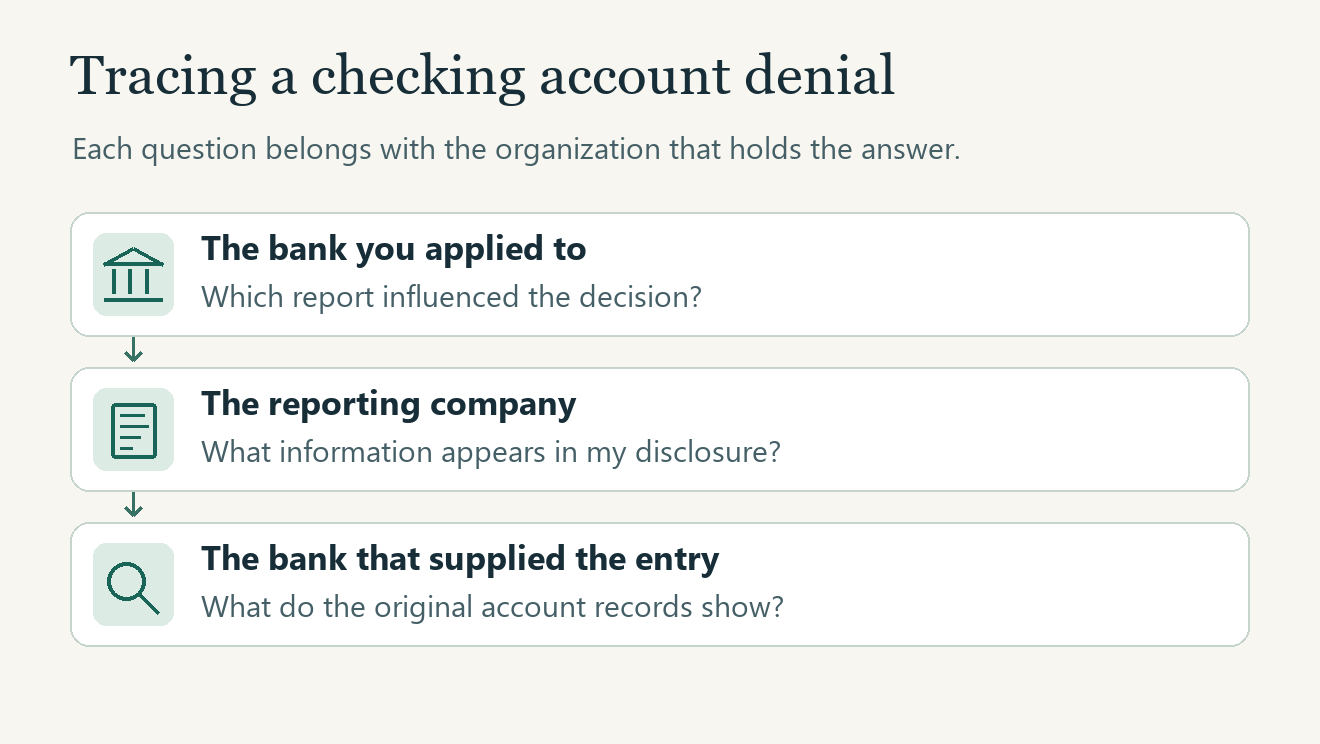
The answer depends on which entry the bank saw. A request for your information, an old balance, and an account opened by someone else leave different trails.
Overview
Start with the company named on the notice
The CFPB’s guide to checking account reports explains how to request the file from the company that compiled it. Your regular credit report is a different document.
If the letter names Early Warning Services, start there. A perfectly accurate disclosure from a different company might tell you nothing about this particular decision.
Read the heading above the unfamiliar name
In the ChexSystems sample disclosure, an inquiry identifies a business that requested information. A reported account has different fields, including a source and a closure status.
Your first question might be who requested the lookup. Your second might be whether an account ever existed. One answer does not automatically supply the other.
Set aside three records before making calls
- Keep the denial notice, including any pages that explain where the bank obtained information about you.
- Keep the dated disclosure with its headings intact so you can distinguish the company that compiled it from the institution that supplied an entry.
- Set aside receipts or statements tied to that entry. Leave unrelated financial records out of the packet you prepare to send.
Follow the decision back to the record
Imagine that you have just moved and want a checking account near your new apartment. The branch declines your application, even though your credit card payments are current.
The CFPB’s account denial guidance lists involuntary closures and problems on joint accounts among potential reasons. Some banks also consider traditional credit reports.
When a consumer report contributes to a denial, the adverse action notice identifies the reporting company. You can request a free copy because of that decision.
Request that free disclosure within 60 days after you receive the adverse action notice. Federal law ties this deadline to receipt of the notice.
The CFPB’s ChexSystems directory entry links to the company’s consumer channels. Use the company’s disclosure request when the notice names ChexSystems.
If the branch told you only that you did not qualify, ask whether a consumer report played a part and where to find the notice.
Keep the date of the application separate from the date shown beside the disputed item. An entry about an account closed years ago can appear in a current decision.
Write down what the notice actually says. “We considered information from a reporting company” is different from “you owe money,” even when both statements mention the same bank.
The CFPB also describes a free disclosure available from nationwide checking account reporting companies every twelve months upon request. Request each company’s report separately when needed.
Match the entry to a useful question
| What you see | What to ask |
|---|---|
| An inquiry from an unfamiliar company | Which application or other activity prompted this request? |
| An old account with a disputed status | Which payment or settlement did the bank report? |
| A closed account you never opened | Which institution can verify the account’s origin and investigate the attribution? |
Sometimes the bank that turned you down also provided the old entry. Identify both roles when you ask for help so the right staff receive the question.
For example, a branch employee might explain the new application policy while lacking access to documents from a previous account. Ask how to reach the group maintaining that record.
How to read an unfamiliar entry without jumping to conclusions
First match the heading, source institution, date and identifying fragments. Treat a bank name printed at the top of a page differently from one beside a particular entry.
The ChexSystems specimen shows an original charge-off amount alongside a separate closure status and status date. The historical amount and current payment status answer different questions.
A figure of $80 in an original amount field does not tell you whether $80 remains due today. Look for a status and a dated statement from the source.
The specimen distinguishes inquiries other businesses may see from inquiries visible only to the consumer. ChexSystems says the latter can include activity the consumer did not initiate.
Suppose an unfamiliar company appears under inquiries on June 7. The report gives you a date to investigate, but it supplies neither an opening balance nor a closure date.
Check whether you were applying for a deposit account around that date. Look for a confirmation showing your application and its timing before deciding the entry matches.
An inquiry in the sample can identify one company acting on behalf of another. Read both names before dismissing an entry or assigning it to a familiar application.
If your own application looks like a possible match, ask the institution to confirm that it requested the lookup. A similar date alone cannot settle the question.
Now imagine the same unfamiliar name appears as the source of a closed account, alongside a closing date and a negative balance. Here the question concerns an actual account record.
Ask the named bank whether it attributes a deposit account to you and how to reach its identity theft team. An unexplained application should not become an admission of ownership.
Three examples that change what you ask for
An inquiry appears after a comparison-shopping visit
Riley visited two bank websites on Monday. One emailed an application confirmation, while the other displayed rates without requesting personal details. On Friday, an unfamiliar inquiry appeared.
Riley checks the confirmation for the institution’s full name, compares the inquiry date, and asks the institution whether someone requested a report in connection with that application.
A confirmation from the first bank would explain its own lookup. It would not explain a separate entry naming another company unless the two organizations can establish the connection.
If neither bank can connect the inquiry to Riley’s application, Riley can challenge the unexplained item and ask the listed inquirer what happened. There is still no known balance.
The most useful note at this point records the unresolved question. Describing a fraudulent account as already open could send the next investigator looking for the wrong event.
The account was yours, but its payment status looks wrong
Avery remembers closing a joint checking account after moving out of a shared apartment. The disclosure shows an unpaid closure, but Avery kept the bank’s settlement confirmation.
Avery compares the closure date and identifying digits with the confirmation. An email thanking someone for a payment on a different account would not establish this one was settled.
ChexSystems explains that paying or settling a reported account does not necessarily erase an accurate closure. The source should update its record to reflect the appropriate payment status.
Avery’s request identifies the status field and the supporting letter. The narrow question is whether the institution reported the settlement correctly, not who caused the original overdraft.
If the bank confirms that the letter covers only a partial payment, Avery needs the underlying explanation. Changing the request to identity theft would misdescribe an acknowledged account.
A closed account belongs to a bank you never used
Jordan sees a closure associated with an address where Jordan never lived. No remembered bank relationship, account transfer or joint arrangement accounts for the entry.
Jordan starts with the source institution’s independently verified contact information. The first task is to find out whether it actually maintains a record under Jordan’s identity.
If the bank confirms an unauthorized account, ask its fraud department about closing or flagging it and obtaining written confirmation. Ask which reporting company received the original information.
If the bank finds a record belonging to somebody else, request correction of the attribution. An incorrectly matched record and a fraudulent application can produce similarly alarming disclosures.
The CFPB’s dispute instructions recommend challenging an inaccurate item with both the reporting company and the institution that supplied it. Identity theft can also be reported to the FTC.
What to Do When You Find a Checking Account Report Error
- Mark the exact entry on a working copy. Keep the original and preserve enough of the surrounding page to identify the heading, source institution and date.
- Describe what you recognize and what you challenge. Give the reporting company a precise reason to investigate a field or an account linked to your identity.
- Send the source institution a separate request about its original information. Ask it to identify what it investigated and whether it supplied a correction.
- Follow each organization’s current identification instructions. Keep copies of what you sent and record the destination and date for each submission.
- Compare both written outcomes with the original entry. Check whether the response addresses the account, status or date you disputed, and retain the corrected disclosure when available.
Write a request another person can investigate
For an incorrect status, a useful explanation would be “I held this account and settled the balance shown here, but the closure status still says unpaid.”
For an unfamiliar account, state that you did not open it and identify the entry you mean. Leave guesses about who used your information out of the request.
Create a short list of enclosures so somebody opening the case can tell why each document is there. A closure letter and a payment confirmation serve different purposes.
A photograph of an envelope can show when a notice arrived. It cannot establish that an account was settled, even if the mailing dates fit your recollection.
Some identity theft disputes require additional proof of identity. The CFPB notes that a company may request a Social Security card copy in such a case.
Read the organization’s instructions before sharing sensitive information. A secure upload destination published by the company is different from an unsolicited email offering to process a dispute.
Keep identifying documents out of ordinary correspondence when the company offers a specific protected route. Your personal copy of an attachment list usually needs filenames, not complete account numbers.
How Early Warning handles a disputed item
Early Warning’s written instructions ask for the consumer ID from the disclosure, the disputed item, a reason and copies of supporting documents. Colorado residents have a telephone option.
The company offers mail, fax and a secure transfer portal. Its own reinvestigation form remains optional for filing. Use the transfer portal for documents rather than sending questions there.
A file containing two disputed accounts deserves two clear descriptions. Otherwise a bank could resolve the first mismatch while nobody can identify which second record you meant.
Early Warning sends the information to the contributing institution and reviews its response alongside the documents. An item can remain, change or be removed after investigation.
Its published schedule generally allows thirty calendar days, subject to applicable state law. It says it sends written results within five business days after completion.
Enter the date the company received your dispute next to your dispatch date. Recording when you mailed a packet and when it arrived avoids confusion about elapsed time.
Read the outcome against your original request
Suppose the bank replies that your old account closed in March. If you disputed an unpaid status after an April settlement, the closure date answers a different question.
Reply with the narrow discrepancy and the relevant evidence. A longer retelling of the move, roommate arrangement or branch visit may obscure the date that actually matters.
If the bank changed the account balance internally, ask whether it communicated the change to the reporting company. Next compare the revised status with your settlement confirmation.
If the reporting company removed an entry, retain that response alongside the institution’s letter. Each document identifies a different action and can explain future discrepancies.
If an Early Warning dispute remains unresolved, its instructions explain how to request information about the reinvestigation and submit a brief rebuttal for the specific entry.
The CFPB describes the right to add a statement of disagreement to the file when the investigation leaves a dispute unresolved. It also provides a consumer complaint route.
A statement explaining disagreement serves a different purpose from new evidence. If you later find a letter showing payment, identify it as new material and explain what it changes.
Each institution decides what banking history it accepts. Once the entry is resolved, ask the deciding bank what it needs for reconsideration or whether another account type is available.
Frequently Asked Questions
Could a strong credit score coexist with a checking account denial?
Yes, deposit screening and credit scoring draw on different information. The deciding bank’s notice identifies the reporting company when its report contributed to the decision.
Does the lack of a reported closure clear every bank?
No single disclosure establishes that every institution checked for an account. If a specific bank has independently confirmed a problem, follow up with it even when no entry appears.
What if an unfamiliar withdrawal appears on my real account?
Report the transaction promptly to the bank maintaining that account. An investigation into a debit you never authorized is separate from correcting a deposit screening entry.
Can a former joint owner explain an unfamiliar entry?
An institution may report problems involving a joint account. Compare the account identifiers with your own paperwork before treating a former joint owner’s recollection as the final answer.
Should I pay someone who guarantees they can remove the entry?
A promise cannot establish that the entry is wrong. The reporting company and source institution can investigate a specific dispute using the documents you provide through their official channels.
What should I keep after an account is corrected?
Keep the original disclosure, the specific challenge, the written outcome and the version showing the change. Record which institution confirmed closure if another person opened the account.
The Bottom Line
Start with the reporting company named on the denial notice. Find the entry, identify its source, and decide precisely what part of the record you can challenge.
If someone opened an account in your name, involve the source bank promptly. Keep that bank’s answer alongside the reporting company’s result so you can verify both changes.

Join the discussion
0 commentsShare your experience or ask a question about this article.
Community experiences
Did this happen to you?
Your experience could help someone recognize the same scam. Submit a private report for our team to review.
I experienced this tooReports are reviewed before publication. Sharing publicly is always your choice.
Discussion
Start the conversation
Have a question or something useful to share? Add the first comment.