

Clarity Blue Glasses are being promoted online as “auto-adjusting” eyewear that can supposedly replace multiple pairs of prescription glasses, reduce blue light exposure, protect against UV rays, and provide clear vision for both near and far distances. The offer is advertised with a 50% discount, “limited time” urgency, and claims that over a million people already use the glasses.
The marketing sounds impressive, but the offer raises serious concerns.
Clarity Blue Glasses appear to follow the same dropshipping pattern seen with many questionable products previously covered on MalwareTips.com: exaggerated social media ads, AI-looking images or videos, cheap generic products from China, fake-looking testimonials, inflated “regular” pricing, no real returns, and claims that go far beyond what the product can realistically prove.
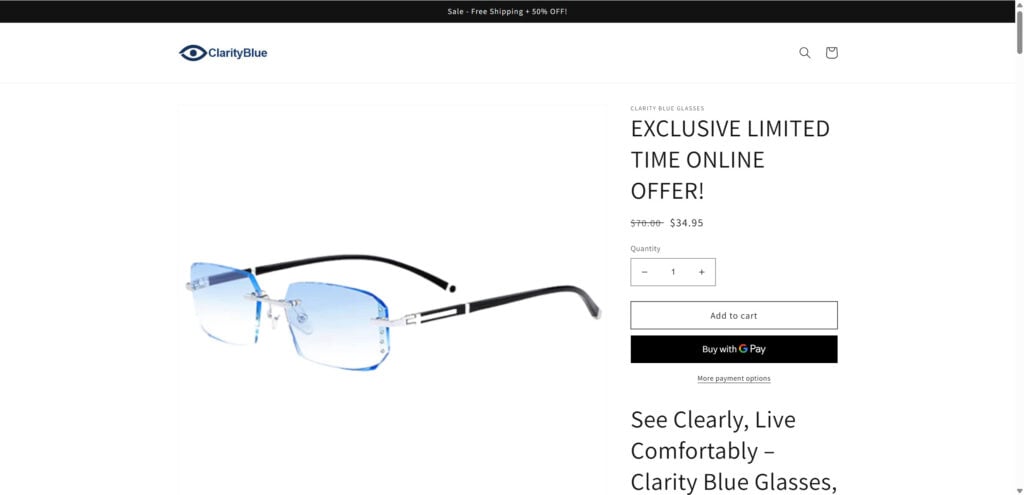
The biggest issue is not simply that the glasses may ship. The issue is that they are being marketed as a futuristic vision solution while the policy pages make refunds extremely limited. Buyers may end up paying $34.95 for a generic adjustable-focus product that appears similar to low-cost glasses sold in bulk from China for a fraction of the price.
What Are Clarity Blue Glasses?
Clarity Blue Glasses are advertised as adjustable vision glasses that claim to automatically adjust from 100 to 700 diopters. The sales page says they can provide clear vision at any distance, reduce the need to switch between reading glasses and distance glasses, and offer blue light and UV protection.
The page presents the product as a convenient alternative for people tired of updating prescriptions or carrying multiple pairs of eyewear.
The main claims include:
- Automatic vision adjustment
- Clear vision for near and far objects
- Blue light protection
- UV protection
- Lightweight frame
- Impact-resistant design
- All-day comfort
- No need to constantly update prescriptions
- Use for reading, screens, outdoor activity, and driving
Those claims are extremely broad for a cheap online eyewear product.
Prescription glasses are medical devices customized to a person’s eyes. They require proper measurement, prescription accuracy, pupillary distance, lens quality, optical alignment, and professional fitting. A generic pair of “auto-adjusting” glasses sold through a viral website should not be treated as a replacement for an eye exam or proper prescription eyewear.
Why Clarity Blue Glasses Raise Scam Concerns
Clarity Blue Glasses raise scam concerns because the marketing appears designed to make a simple low-cost product look like advanced optical technology.
The product page claims the glasses are “the future of your eyesight,” “revolutionizing” vision, and able to adjust automatically for clear vision at any distance. It also claims users do not need to worry about constant prescription updates, while adding a small disclaimer that buyers should confirm the glasses correspond to a prescription previously indicated by an optician.
That is a major contradiction.
The main sales copy tells users the glasses are hassle-free and can reduce prescription problems. The disclaimer admits that prescription suitability still matters.
Major red flags include:
- Exaggerated “auto-adjusting” vision claims
- “100 to 700 diopters” language that may confuse buyers
- Claims that the glasses provide clear vision at any distance
- Claims that they reduce the need for prescription updates
- Blue light protection claims that are often overstated in online ads
- Fake-looking testimonials with first names only
- “Over a million users” claim without clear proof
- A 50% discount from a crossed-out $70 price
- No normal return policy
- All sales final except damaged or missing orders
- Long international shipping times
- Generic product appearance
- Similar China-sourced adjustable glasses available for far less
This looks less like a serious eyewear company and more like a dropshipping funnel.
Exaggerated Vision Claims
The strongest red flag is the claim that Clarity Blue Glasses can automatically adjust to provide clear vision at different distances.
That sounds like advanced technology, but the site does not provide the kind of evidence a buyer should expect for such a major claim.
There is no clear proof of:
- Independent optical testing
- Lens power accuracy
- Safety testing
- Prescription compatibility
- Manufacturer details
- Laboratory certification
- Optician verification
- Clinical trial data
- Detailed lens technology explanation
- Real product-specific performance reports
The page uses broad claims like “perfect clarity,” “clear vision at any distance,” and “no need to switch between glasses,” but those statements are not enough.
Eyesight is not one-size-fits-all. People may have nearsightedness, farsightedness, astigmatism, presbyopia, eye muscle issues, cataracts, retinal disease, glaucoma, diabetes-related eye problems, or other medical conditions that cannot be solved by a generic pair of adjustable glasses.
Any product that suggests people can avoid regular prescription updates or replace professional eye care should be treated with caution.
The “100 to 700 Diopters” Claim Is Confusing
The sales page repeatedly says the glasses adjust from 100 to 700 diopters.
That wording is unusual. Standard prescriptions are usually written in diopters such as +1.00, +2.00, -1.50, and so on. Marketing that says “100 to 700 diopters” may be referring to reading strength ranges like +1.00 to +7.00, but the wording can confuse consumers.
This matters because a buyer may not understand whether the glasses match their prescription.
A person with astigmatism, different prescriptions in each eye, prism needs, strong myopia, or other optical requirements may not get safe or comfortable vision from generic adjustable readers.
The product page itself includes a disclaimer telling buyers to confirm that the glasses correspond to a type and prescription previously indicated by an optician. That disclaimer weakens the broader “automatic adjustment” sales pitch.
Blue Light Claims Are Often Overstated
Clarity Blue Glasses also promote blue light protection as a major benefit.
Blue light glasses are heavily marketed online, but many claims around digital eye strain are exaggerated. Eye strain from screens is often caused by long periods of focusing, reduced blinking, glare, poor lighting, dry eyes, and screen habits, not simply blue light exposure.
A pair of glasses may include tinted or filtering lenses, but that does not prove they will prevent digital eye strain, protect the eyes from screen damage, improve sleep, or solve headaches.
This is a common tactic in dropshipping eyewear ads. The seller combines “adjustable vision” with “blue light protection” to make the product sound more valuable, even if the actual lenses are basic and low-cost.
AI Images, Videos and Fake-Looking Ads
Clarity Blue Glasses are the type of product commonly promoted through AI-generated social media ads and fake-looking advertorial pages.
These ads may use:
- AI-generated older adults
- Fake “news report” layouts
- Synthetic voiceovers
- Fake doctor-style explanations
- Before-and-after vision stories
- Edited product demonstrations
- Fake user testimonials
- Stock images presented as real buyers
This matters because eyewear is a trust-based product. People may believe they are seeing real users or real expert reviews when they are actually seeing scripted advertising.
The Clarity Blue page itself contains an advertorial disclaimer stating that the site is an advertisement, not actual news, and that the story is not real news. That is a major warning sign. It means the promotional format may be designed to look informative while functioning as a sales page.
Fake or Unverifiable Testimonials
The product page includes testimonial-style reviews from users such as “Glen E.,” “Adam N.,” and “Nick G.” These reviews claim the glasses improved daily life, reduced the need to switch glasses, helped with blurry vision, and reduced eye tiredness during screen use.
The problem is that these testimonials are impossible to verify from the page alone.
Common red flags include:
- First names and initials only
- No independent review platform clearly shown
- No verified purchase proof
- Perfectly positive wording
- Claims that repeat the sales pitch
- No prescription details
- No optician confirmation
- No proof the images are real customers
- No balanced negative reviews
Testimonials are not optical evidence. A product making strong vision claims should provide professional testing and transparent product specifications, not just emotional customer quotes.
Cheap China Dropshipping Concerns
One of the strongest red flags is the price gap.
Clarity Blue sells the glasses for $34.95 with a crossed-out $70 price. But similar “auto-focus” or “adjustable diopter 100-700” glasses appear on Chinese wholesale platforms at extremely low prices, sometimes around $0.80 to $1.13 per unit in bulk.
That does not prove every Clarity Blue unit comes from a specific supplier. But it strongly supports the dropshipping concern.
The product category appears to be flooded with generic adjustable-focus reading glasses from China. A seller can buy or source low-cost glasses, create a polished Shopify site, add exaggerated claims, run social media ads, and sell the product at a large markup.
That is a classic dropshipping operation.
The customer is not necessarily paying for advanced optical technology. They may be paying for the ad funnel, landing page, and markup.
The “Limited Time” Discount Looks Like a Sales Tactic
The page advertises “Free Shipping + 50% OFF” and shows a regular price of $70 reduced to $34.95.
This kind of pricing is common in dropshipping funnels. The crossed-out price creates the impression of a major deal, while the actual product may be inexpensive to source.
The offer also uses urgency language such as:
- Exclusive limited time online offer
- Get 50% off now
- Order now and save 50%
- Sale
- Free shipping
These phrases are designed to make buyers act quickly before comparing prices or reading the refund policy.
A legitimate eyewear brand should compete on product quality, transparent optical specifications, verified reviews, and clear return terms—not mainly on urgency and fake-looking discount pressure.
The Refund Policy Is a Major Red Flag
The refund policy is one of the most concerning parts of the Clarity Blue offer.
The site says there is a 30-day guarantee only if the product fails to arrive or arrives damaged. It also says all sales are otherwise final.
That means buyers should not expect a normal satisfaction refund.
If the glasses do not work for your eyes, feel uncomfortable, cause headaches, do not match your prescription, look cheap, or fail to perform as advertised, the policy may not allow a return. Refunds are considered only for missing or damaged products, and even then the customer must provide proof.
This is a major risk because the product is marketed as vision-related eyewear. A customer cannot know whether glasses work properly until they try them.
A no-return policy on a product making strong eyesight claims is a serious warning sign.
Cancellations May Be Difficult
The cancellation terms are also restrictive.
The policy says that once an order is in the system, it cannot be edited, and the company usually cannot stop the warehouse from completing the shipping process once it starts. It also says customers should be sure they want the product before placing an order.
This is common in dropshipping operations because orders may be sent quickly to a fulfillment partner or overseas supplier. Once the order is processed, the seller may claim it cannot be changed.
That creates risk if a customer:
- Ordered by mistake
- Chose the wrong quantity
- Entered the wrong address
- Changed their mind
- Realized the product was not what they expected
- Found the same item cheaper elsewhere
- Wanted to cancel after reading reviews
The site’s own terms make it clear that cancellation is not guaranteed.
Shipping Times Suggest Overseas Fulfillment
The shipping policy says orders ship within 48 hours and typical delivery takes 7 to 20 days. It also mentions international shipping, customs inspections, import duties, local taxes, and delays caused by customs procedures.
This does not prove the product ships directly from China, but it is consistent with many dropshipping-style operations.
A customer may believe they are ordering from a domestic eyewear company, but the shipping timeline and customs language suggest the order may involve overseas logistics.
The policy also says the customer is responsible for clearing customs and covering applicable fees if goods are detained. That adds another risk for buyers.
Lost or Stolen Package Risk Is Shifted to the Customer
The shipping policy says the company cannot be held accountable for packages lost or stolen after being confirmed as delivered.
That is another problem for customers.
If tracking says delivered but the package is missing, the buyer may be told to contact the local post office and file a claim. The seller may not take responsibility once tracking shows delivery.
For a low-cost item, this may not sound like a major issue. But combined with all-sales-final terms, limited refunds, and long shipping windows, it makes the purchase riskier.
“Advertorial” Disclosure Is a Major Warning Sign
At the bottom of the sales page, Clarity Blue includes an advertorial disclosure.
It says the page is an advertisement, not actual news, blog post, or consumer protection update. It also says the story is not real news and that the results shown are illustrative and may not be the results buyers achieve.
That disclosure is important.
Many scam-style funnels use advertorial pages that look like independent reviews, news stories, or consumer reports. The goal is to make the buyer feel like they discovered a trusted recommendation, when the page is actually designed to sell the product.
When a page admits the story is not real news and that it may receive compensation for clicks or purchases, buyers should be skeptical of every claim on the page.
The Product May Not Replace an Eye Exam
Another risk is that buyers may delay proper eye care.
The product page says the glasses can reduce the hassle of prescription updates and that users do not need to worry about regular eye exams, although it adds that eye exams are still a good idea.
That is not responsible messaging.
Regular eye exams can detect more than blurry vision. They can identify glaucoma, cataracts, macular degeneration, diabetic eye disease, retinal problems, inflammation, and other conditions that may not be obvious at first.
Generic adjustable glasses cannot diagnose eye disease. They cannot replace an optometrist or ophthalmologist. They cannot safely correct all prescriptions.
People with changing vision, eye pain, headaches, flashes, floaters, double vision, eye pressure, diabetes, or sudden vision changes should seek professional care instead of relying on viral online glasses.
Risk of Receiving More Units Than Ordered
Dropshipping eyewear funnels often use quantity selectors, cart upsells, post-purchase offers, and bundle discounts.
Even if the Clarity Blue page reviewed shows a single quantity option, buyers should still be careful during checkout. Some Shopify stores add post-purchase offers after payment details are entered, and some buyers may accidentally increase quantity.
Possible order risks include:
- Ordering more than one pair by mistake
- Clicking a one-click upsell
- Being charged before reviewing the final amount
- Receiving extra pairs
- Being unable to cancel
- Being unable to return non-damaged glasses
- Getting stuck with a product that does not work for your eyes
Before ordering, customers should screenshot the cart, checkout page, final total, and confirmation email.
Is Clarity Blue Glasses Legit or a Scam?
Clarity Blue Glasses should be treated as a high-risk dropshipping offer.
The product may ship. Some buyers may receive a pair of glasses. The glasses may provide basic magnification or a form of adjustable focus for some users.
But the marketing is the concern.
The page makes broad claims about automatic adjustment, clear vision at any distance, blue light and UV protection, and reduced need for prescription updates. It uses unverifiable testimonials, urgency discounts, and advertorial-style language. The refund policy says all sales are final except missing or damaged items, which means customers may have little recourse if the glasses do not work as expected.
The cheap China sourcing concern is also serious because similar adjustable diopter glasses are listed on wholesale platforms for a fraction of the price.
For these reasons, Clarity Blue Glasses are not something we would recommend buying from social media ads.
What To Do If You Already Ordered Clarity Blue Glasses
If you already ordered Clarity Blue Glasses, take these steps:
1. Check your confirmation email
Confirm the quantity, final price, shipping address, billing name, and order date.
2. Save screenshots
Save the product page, refund policy, shipping policy, advertorial disclosure, and checkout confirmation.
3. Request cancellation immediately
If you want to cancel, contact support as soon as possible. Use clear wording:
“I want to cancel this order immediately. I do not authorize any additional charges, upsells, subscriptions, or future shipments.”
4. Watch for shipping and tracking issues
The policy says tracking may take time to update. Keep all tracking emails and screenshots.
5. Inspect the product on arrival
If the glasses arrive damaged, take photos and videos outside the box, as the refund policy requires proof.
6. Contact support within 30 days
Refund requests for damaged or missing items must be made within the stated window.
7. Contact your bank if needed
If you were charged for more than expected, cannot cancel, or believe the product was misrepresented, ask your card issuer about a chargeback.
8. Do not use them as a substitute for prescription glasses
If the glasses cause headaches, blurry vision, dizziness, eye strain, or discomfort, stop using them and speak with an eye-care professional.
9. Get an eye exam if your vision is changing
Do not rely on viral adjustable glasses if you have worsening vision or medical eye symptoms.
How To Avoid Similar Blue Light Glasses Scams
Before buying eyewear from a social media ad, watch for these warning signs:
- Claims that one pair replaces prescription glasses
- Claims of automatic vision adjustment without clear proof
- “100 to 700 diopters” language with no proper prescription explanation
- Fake-looking doctor or customer videos
- AI-generated images or testimonials
- Huge user-count claims with no proof
- “As seen on” or advertorial-style pages
- Crossed-out prices and 50% discounts
- Similar products available from Chinese suppliers for much less
- No normal return policy
- All sales final except damaged or missing items
- Long international shipping windows
- No clear company address or optical manufacturer details
- No independent optical testing
A legitimate eyewear purchase should be based on an accurate prescription, transparent lens specifications, professional fitting guidance, and a return policy that protects the buyer if the product does not work.
Final Verdict
Clarity Blue Glasses have too many red flags to recommend.
The product is promoted as a futuristic vision solution that automatically adjusts from 100 to 700 diopters, provides clear vision at any distance, reduces the need for prescription updates, and protects against blue light and UV exposure. But the evidence on the page does not support treating these glasses as a serious replacement for prescription eyewear.
The sales page uses exaggerated claims, unverifiable testimonials, a 50% discount, and an advertorial disclosure stating the page is an advertisement and not real news. The refund policy is especially concerning because all sales are otherwise final unless the product fails to arrive or arrives damaged.
The dropshipping concern is strong. Similar adjustable-focus glasses are available from Chinese wholesale suppliers at extremely low prices, while Clarity Blue sells them for $34.95.
For consumers, the main risks are overpaying for cheap generic glasses, believing exaggerated social media ads, receiving a product that does not match your prescription, being unable to return it, and delaying proper eye care.
Clarity Blue Glasses are best avoided unless the seller can provide real optical testing, transparent manufacturer information, verified independent reviews, clear prescription limitations, and a normal return policy.








