

Clima Pest Guard is promoted as a compact UV mosquito killer lamp that promises fast, chemical-free protection from mosquitoes at home, outdoors, and while sleeping.
The product looks simple, affordable, and convenient. But the sales page raises several concerns, especially when compared with similar low-cost mosquito lamps sold in bulk under generic listings.
This review looks at the product, the marketing claims, the warning signs, and what buyers should know before ordering.
Overview
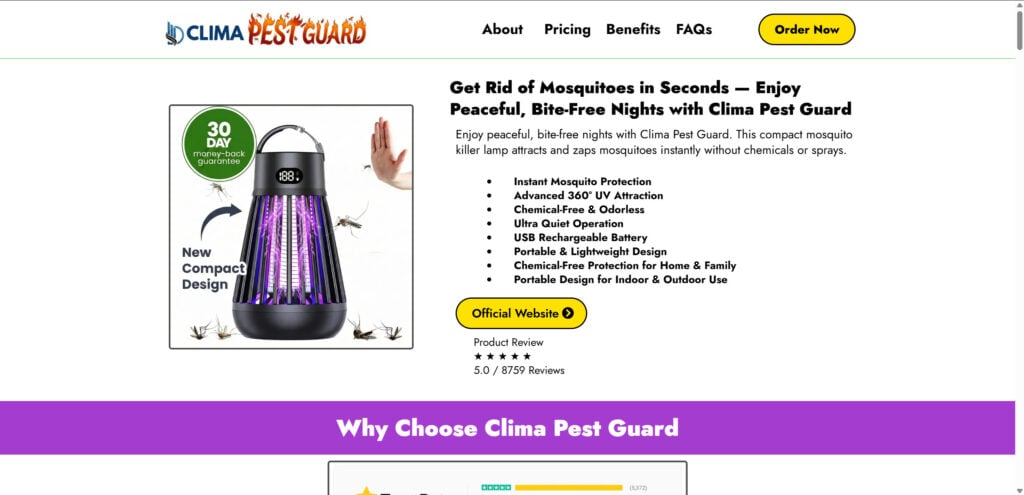
Clima Pest Guard is advertised as a portable mosquito-control device that uses UV light and an electric grid or trapping system to attract and eliminate mosquitoes. The website claims it offers “instant mosquito protection,” “advanced 360° UV attraction technology,” quiet operation, USB rechargeability, and safe use around kids and pets. It also displays a 5.0 rating with 8,759 reviews.
At first glance, this looks like a normal bug zapper.
But there are several problems.
The product appears nearly identical to generic electric mosquito killer lamps sold by Chinese suppliers for around $5–$7 per unit. The Clima Pest Guard page then repackages the device as a premium “must-have” solution with large review numbers, strong mosquito-killing claims, and a 30-day guarantee.
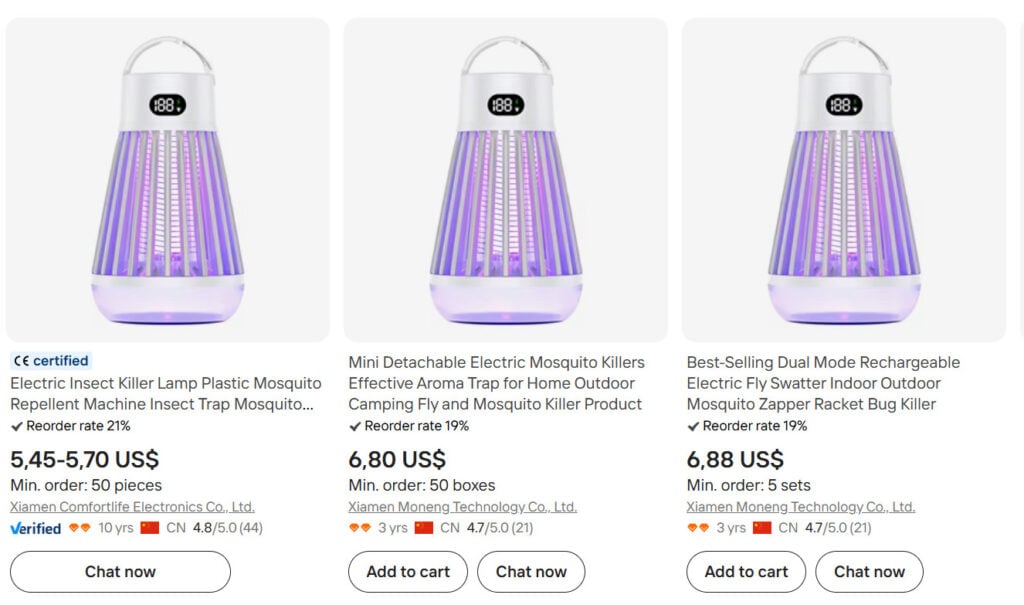
That combination points toward a likely dropshipping-style operation.
What Clima Pest Guard Claims
The website claims the device can:
- Eliminate mosquitoes fast
- Provide peaceful, bite-free nights
- Work without chemicals, sprays, or odors
- Use advanced 360° UV attraction technology
- Operate silently during sleep
- Be safe around kids and pets
- Work indoors and outdoors
- Recharge by USB
- Deliver instant mosquito protection
The page also says the device attracts mosquitoes with ultraviolet light and then eliminates them using an internal electric grid or trapping system.
What it likely is
Based on the visuals and supplier matches, Clima Pest Guard appears to be a generic rechargeable mosquito zapper lamp.
That does not mean it cannot kill some insects.
It means the product is probably not unique, advanced, or proprietary. It appears to be a low-cost device sold with premium marketing.
Major Red Flags
1. The same device appears to be sold wholesale for a few dollars
Identical mosquito killer lamps listed by suppliers for roughly:
- $5.45–$5.70
- $6.80
- $6.88
That strongly suggests Clima Pest Guard is not a newly developed pest-control technology. It looks like a generic product that can be bought in bulk, rebranded, and resold through a high-conversion landing page.
The issue is not that the product exists.
The issue is that the marketing makes it look more special than it likely is.
2. UV bug zappers are often weak against mosquitoes
This is the biggest practical problem.
The American Mosquito Control Association says bug zappers do kill some mosquitoes, but controlled studies found mosquitoes made up only 4.1% and 6.4% of the daily catch over a season, with no significant difference in mosquito numbers in yards with or without zappers. It also cites a backyard study where only 0.13% of insects killed were female mosquitoes.
Rutgers also states that bug zappers kill many insects, but mosquitoes make up a very small percentage of zapper collections, and comparison trapping found no significant difference in mosquito populations in yards with and without traps.
That does not mean a small UV zapper can never kill a mosquito. It can.
But claims like “bite-free nights” and “instant mosquito protection” are much stronger than what buyers should expect from a basic UV lamp.
3. Mosquitoes are more attracted to people than to UV lamps
The marketing implies mosquitoes will naturally fly into the device because of UV attraction.
In reality, mosquitoes use several cues to find humans, including carbon dioxide, body heat, moisture, odors, and other chemical signals. The AMCA notes that mosquitoes continue to be more attracted to humans than to bug zappers.
This matters because a device can glow, zap random insects, and still fail to reduce bites in a meaningful way.
A room may still have mosquitoes even if the device is running.
4. The page makes broad “safe for kids and pets” claims
Clima Pest Guard says it is safe for homes with kids and pets, chemical-free, and protected by an outer casing that prevents accidental contact with the grid.
That may be true for normal use if the grid is properly enclosed.
But buyers should still be cautious because this is an electric insect-killing device with a battery, UV light, and internal grid. A serious product page should provide clear details about:
- voltage
- battery capacity
- certifications
- waterproof rating
- cleaning safety
- child safety instructions
- indoor vs outdoor limitations
- charging safety
- replacement parts
The sales page focuses more on benefits than on verifiable safety specifications.
5. The review count is not independently verified
The page claims:
- 5.0 / 8759 reviews
- multiple “Verified” customer testimonials
- strong claims about better sleep and bite-free nights
But these reviews appear to be controlled by the seller’s own website. The page does not provide independent review verification, third-party review links, or transparent review sourcing.
Large review counts are common in dropshipping funnels. They create instant trust, but they are not proof that thousands of real buyers had the claimed results.
6. The order links are suspiciously inconsistent
One of the strangest red flags is the site’s own links.
The parsed page shows “Order Now” and “Official Website” links pointing to greencbdgummies.com, while another “GET YOUR PEST GUARDS TODAY” link points to mweboro.com.
That is not normal.
A legitimate brand selling a mosquito zapper should not have order buttons pointing to unrelated-looking domains. This suggests the site may be part of an affiliate funnel, redirect network, or reused landing-page system.
7. The site contains irrelevant health disclaimers
Near the bottom, the page includes medical-style disclaimer text saying the information is not intended to replace consultation with a medical professional, that FDA statements have not been evaluated, and that products are not intended to diagnose, treat, cure, or prevent disease
That is odd for a mosquito lamp.
This kind of disclaimer is more typical for supplements, not a rechargeable insect zapper. Its presence suggests the page may have been copied from a generic funnel template and not fully cleaned up.
That is a trust issue.
8. BuyGoods appears as the retailer, not a clear product manufacturer
The page says BuyGoods is the retailer of products on the site and that BuyGoods’ role does not constitute endorsement, approval, or review of the product claims.
This means the page is likely part of a performance-marketing or affiliate-style sales system rather than a straightforward manufacturer website.
That does not automatically make it a scam.
But it makes accountability more complicated.
9. The “30-day money-back guarantee” may not be as simple as it sounds
The page says buyers can send the package back within 30 days for a full refund, “no questions asked.”
But the visible page does not clearly explain:
- where returns must be sent
- who pays return shipping
- whether opened or used products are eligible
- whether bundles must be returned in full
- how long refunds take
- whether international buyers face different conditions
For a likely low-cost imported product, return shipping can sometimes cost more than the item is worth.
What You Are Probably Buying
If the product arrives, you are likely getting:
- a small rechargeable UV mosquito lamp
- a generic plastic bug zapper design
- basic USB charging
- limited coverage
- possible effectiveness against some small flying insects
- weaker mosquito control than the marketing suggests
You should not expect:
- full-room mosquito elimination
- guaranteed bite-free sleep
- strong outdoor protection
- professional pest-control results
- meaningful mosquito population reduction
A UV zapper may kill insects. That is not the same as solving a mosquito problem.
Why This Product Sells
It targets a real frustration
Mosquitoes are annoying. People want a simple solution that does not involve sprays, odors, or chemicals.
Clima Pest Guard uses that frustration well.
The pitch is easy to understand
The message is simple:
- turn it on
- mosquitoes fly in
- the device zaps them
- you sleep peacefully
That story is much simpler than real mosquito control.
The product looks harmless and modern
The purple light, rechargeable battery, and compact design make it feel like a smart household gadget.
The price feels low enough to risk
Many buyers may think:
“It’s not that expensive. I’ll try it.”
That is exactly why these dropshipping gadgets spread quickly.
Is Clima Pest Guard a Scam?
Not necessarily a fake-product scam
The device likely exists. A buyer may receive a rechargeable UV insect zapper.
But the operation looks high-risk
The concerns are:
- generic wholesale product appearance
- exaggerated mosquito-control claims
- weak scientific basis for UV zappers as mosquito protection
- unverifiable review numbers
- suspicious redirect links
- unrelated health disclaimers
- unclear return logistics
- affiliate-style retailer structure
The most accurate classification is:
Clima Pest Guard appears to be a high-risk dropshipping-style mosquito zapper marketed with exaggerated claims and weak transparency.
Should You Buy It?
For most buyers, caution is warranted.
Reasons to avoid it
- Similar devices are available cheaply elsewhere
- UV zappers are often poor mosquito-control tools
- The review numbers are not independently verified
- The order links appear inconsistent
- The return process is not clearly explained
- The page contains template-like health disclaimers
If you still want a mosquito-control device
Look for products from reputable retailers with:
- verified reviews
- clear return policy
- proper electrical safety certifications
- transparent specs
- realistic claims
- removable tray or easy cleaning
- proper indoor/outdoor rating
Also use proven mosquito-control basics:
- remove standing water
- use window screens
- use EPA-registered repellents when needed
- use fans outdoors
- wear protective clothing during peak mosquito times
What To Do If You Already Ordered
1. Save screenshots of the page
Capture:
- “5.0 / 8759 reviews”
- “instant mosquito protection”
- “bite-free nights”
- “30-day money-back guarantee”
- order links
- checkout total
- product images
- shipping promises
This can help if the product does not match the claims.
2. Check the merchant name on your receipt
Because the page references BuyGoods and uses redirect links, check your receipt carefully.
Look for:
- Clima Pest Guard
- BuyGoods
- another merchant name
- a third-party checkout processor
- an unfamiliar domain
Save the transaction details.
3. Inspect the product before use
When it arrives, check:
- charging port
- battery condition
- cracks or loose parts
- grid enclosure
- UV light function
- cleaning tray or access point
- instructions
- safety labels
- certification markings
Do not use it if it looks unsafe, damaged, or poorly assembled.
4. Test expectations realistically
Use it in a small enclosed room, away from competing light sources, and see whether it actually reduces bites.
Do not assume dead insects in the tray mean mosquitoes are being controlled. Many zappers kill mostly non-mosquito insects.
5. Request a refund early if dissatisfied
Do not wait until the 30-day window is almost over.
Send a clear message:
I am requesting a refund for order #[number]. The product does not perform as advertised. Please provide the return address, return instructions, and refund timeline in writing.
6. Dispute the charge if needed
If support is unresponsive, the return process is unreasonable, or the product is materially different from the advertising, contact your payment provider.
Use evidence showing:
- what was advertised
- what you received
- what you were charged
- how support responded
The Bottom Line
Clima Pest Guard is not clearly a fake product. It may arrive and it may zap some insects.
But the marketing is the problem.
The product appears to be a generic rechargeable UV mosquito lamp sold through a funnel with exaggerated claims, unverifiable review numbers, suspicious redirect links, and template-like disclaimer language. More importantly, independent mosquito-control experts have long warned that bug zappers are generally poor tools for reducing mosquito bites.
The safest conclusion is simple:
Clima Pest Guard looks like a dropshipping-style mosquito zapper marketed as a powerful mosquito solution, even though the product category itself has limited value for real mosquito control.








