

A bottle promising support for people who drink can feel like a practical compromise. Cloud9 Daily Restore asks an even bigger question: what are you buying along with that reassurance?
We examined the product page, recurring-order offer, and return policy. The details matter more than the cheerful promise on the front of the bottle.
Overview
What Cloud9 Daily Restore is selling
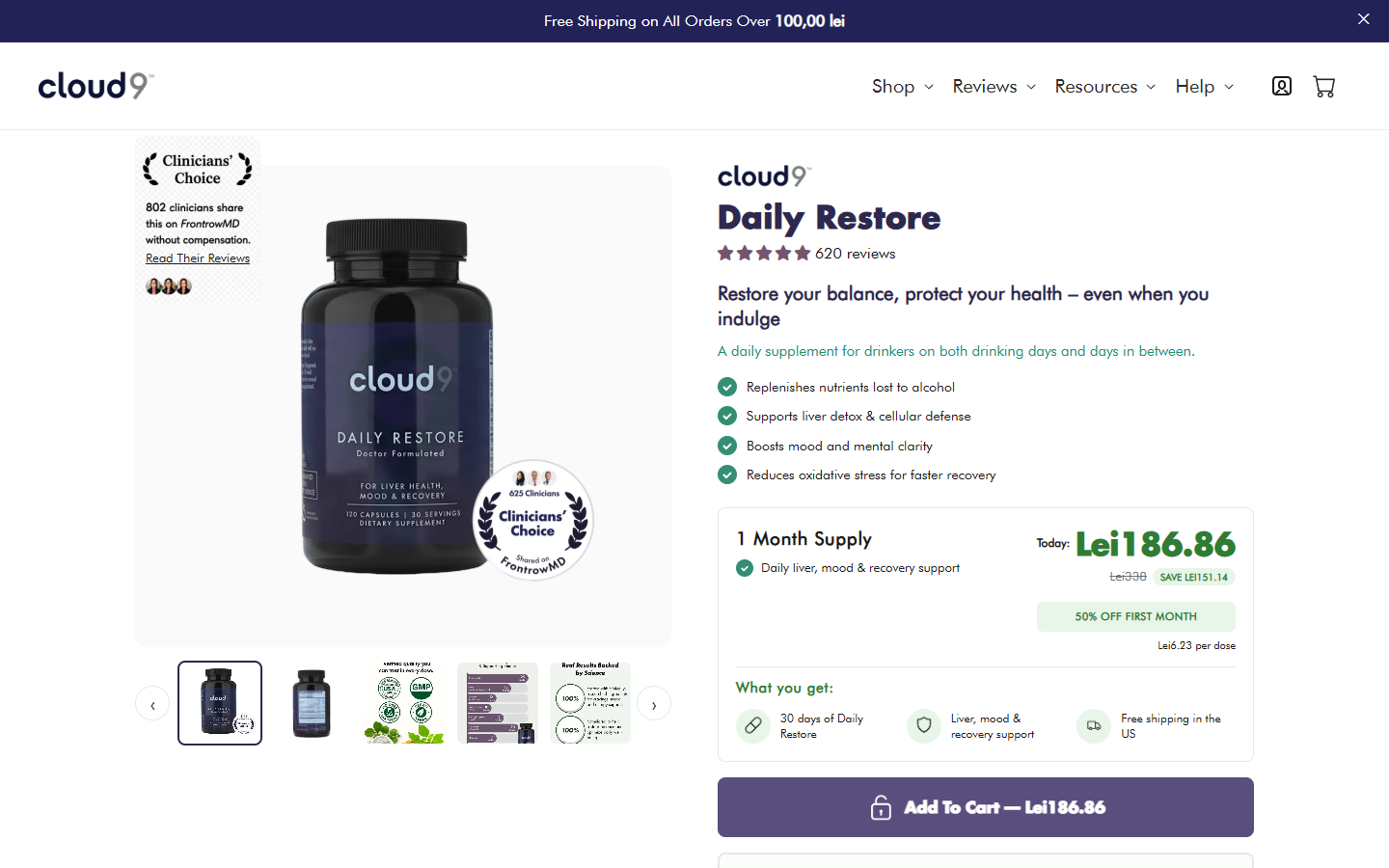
Cloud9 Daily Restore is a dietary supplement marketed to adults who drink alcohol. Its page promises support for the liver, mood, nutrients, and recovery.
The pitch does not simply say the capsules contain vitamins. It invites buyers to feel more protected when they indulge, a framing worth examining carefully.
The bottle shown on the seller’s site contains 120 capsules for a 30-day supply. Read the current label before considering ingredients or dosage.
Why this review focuses on the offer, not a disappearing page
The product could appear through new ads, landing pages, or promotions. A buyer’s risk depends on the actual checkout and policy attached to an order.
Our review concerns the Cloud9 Daily Restore offer we examined, not every website using similar words or every supplement for drinkers.
- The page presents a $27 first-month subscription offer alongside a larger localized product price.
- Subscribe and Save is marked recommended, with monthly auto-refills after the first order.
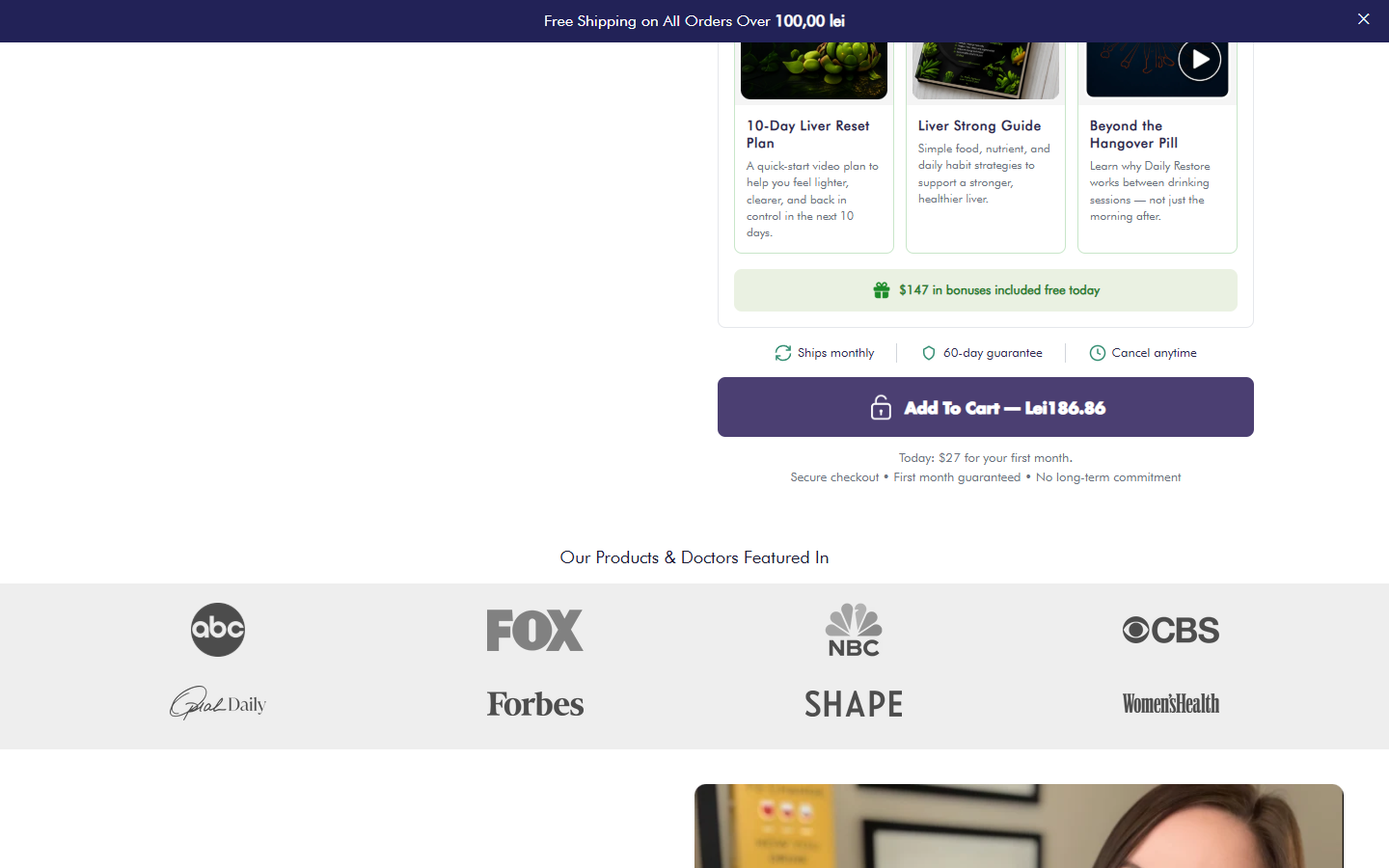
- The marketing offers $147 in digital bonuses when a recurring plan is selected.
- The return page describes a longer window than one guarantee badge on the product page.
Our finding at a glance
We found a real storefront with published contact and return information. We did not establish that Cloud9 is a fraudulent company or that every charge is unauthorized.
The concern is the combination of broad health reassurance and a first-month discount tied to repeat billing. Buyers should understand both before paying.
Most importantly, no supplement should be mistaken for protection against the medical risks of heavy drinking. That distinction can affect real health decisions.
How the Cloud9 Daily Restore Sales Funnel Works
Step 1: The message addresses a familiar worry
A person might see an ad after searching for hangovers, liver health, or ways to cut back. We did not trace a specific ad to every checkout.
The product page itself speaks directly to that anxiety. It promises to replenish nutrients, support liver detox, and reduce oxidative stress after alcohol exposure.
Those ideas sound scientific because they mention genuine biological processes. But a plausible mechanism is not proof that this finished product prevents alcohol-related injury.
The phrase about protecting health while indulging is especially consequential. A worried reader could hear permission to keep drinking at a risky level.
According to the National Institute on Alcohol Abuse and Alcoholism, there is no scientific evidence that anything prevents liver damage from too much alcohol.
Step 2: A professional setting lends credibility
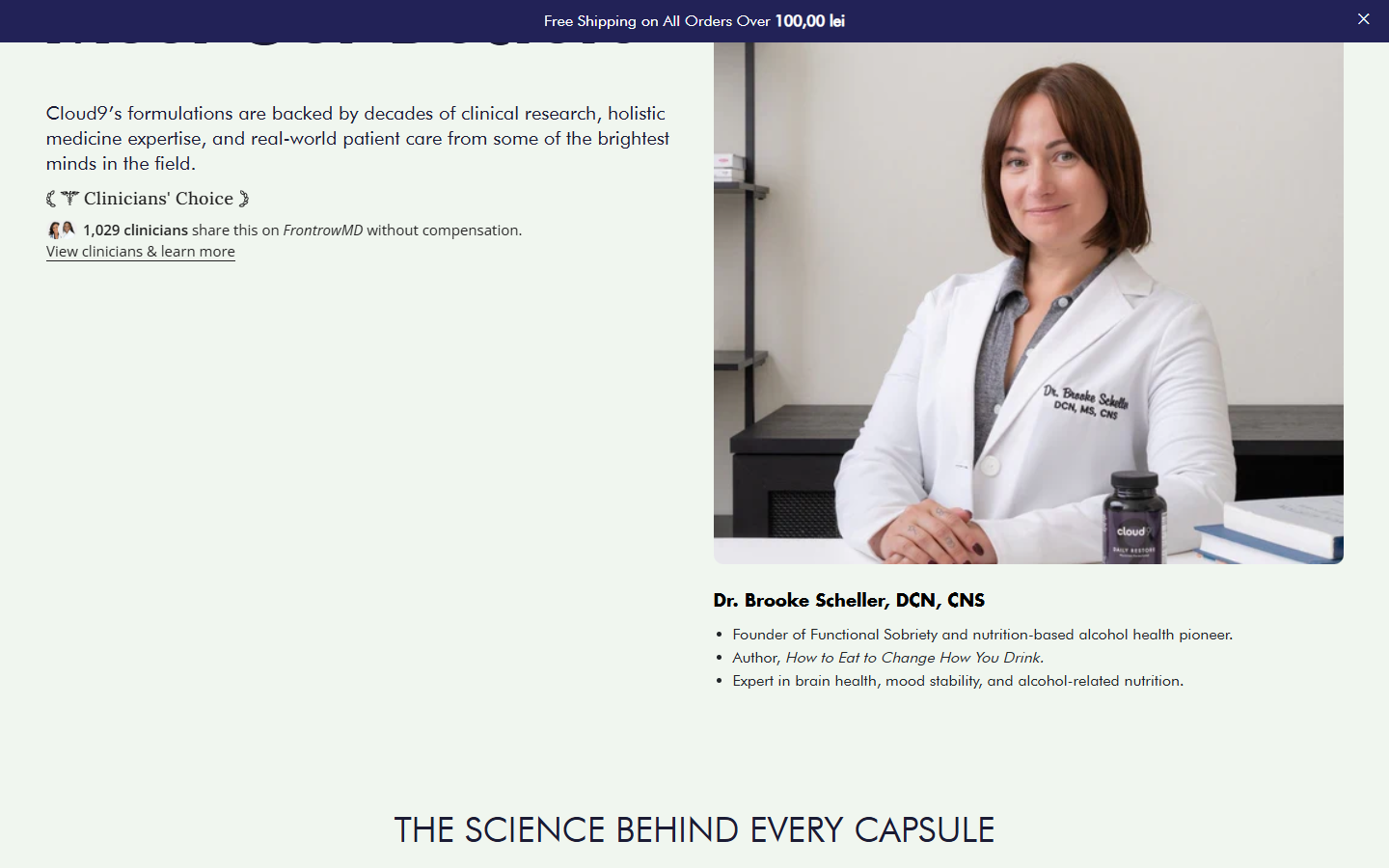
The page shows a clinician photograph, professional titles, and claims about doctors or clinicians sharing the product. It also displays recognizable media logos.
None of those elements by itself establishes that the exact capsules were clinically proven to protect people who drink. A media appearance is not product approval.
One area of the live page showed 802 clinicians, while another showed 1,029. Those figures may be dynamic or refer to different measures.
The site does not explain that difference in the screens we captured. Ask for the underlying source before treating either number as independent evidence.
Read the names and qualifications, then ask a narrower question: was Daily Restore itself tested in a controlled study with relevant outcomes?
Step 3: Ingredient explanations make the promise feel settled
The product text discusses benfotiamine, NAC, milk thistle, DHM, vitamin B12, 5-HTP, L-tyrosine, and ashwagandha. Each gets a short benefit story.
A page can accurately describe an ingredient’s biochemical role while overstating what a mixed capsule will do for a particular drinker.
Some ingredients may matter for specific deficiencies or conditions. Others may interact with medications or be inappropriate for certain people.
Check the Supplement Facts panel, doses, warnings, and actual studies of the finished formula. Broad counts of studies across separate ingredients are not equivalent.
For someone with liver disease, relying on a wellness claim instead of medical evaluation could be especially risky.
Step 4: The attractive first-month price changes the buying decision
The offer says customers can get their first month for $27. That number sits beside a larger displayed amount that can vary with storefront location.
Our screenshots displayed a localized price beside the $27 subscription offer. Verify the final currency and total at checkout.
The page labels Subscribe and Save as recommended. It also advertises $147 in bonus guides and videos when that option is selected.
Digital extras may be useful, but their stated value is the seller’s valuation. They should not distract from the price of bottles shipped later.
If you only want one bottle, locate the one-time choice and inspect the cart before entering card details.
Step 5: Auto-refills begin after the promotional month
The subscription text says bottles auto-refill monthly after the first month at 10% off. The page also says cancel anytime.
A recurring plan is not inherently deceptive. It becomes a problem when a buyer notices only the introductory price or expects future shipments to require another click.
The FTC advises shoppers to check renewal terms, future prices, and cancellation steps before accepting an introductory offer.
Look at the order review page, not only the product card. Save a screenshot showing whether the cart says one-time purchase or subscription.
Set a calendar reminder well before the next processing date. The word “anytime” does not mean an already shipped bottle can be pulled back.
Step 6: A guarantee badge and the written policy require comparison
The product page displays a 60-day guarantee near the order button. Its shipping and refund page describes a 180-day return window.
That may reflect a newer or broader policy, but the difference should be reconciled by the seller. Ask which promise governs your exact order.
The written page says opened products can be returned. That is more generous than many supplement storefronts and matters to a fair assessment.
The same policy says return postage is the customer’s responsibility and original shipping charges are not refunded. A free-shipping offer may change that calculation.
It also tells customers who missed a cancellation to email support for a resolution. We cannot infer the outcome of any individual request from that sentence.
What the Health Claims Can and Cannot Tell You
A supplement is not a shield against alcohol
Cloud9’s page uses phrases about protecting health and drinking with peace of mind. Those words are likely to carry more weight than an ordinary wellness statement.
The CDC explains that drinking less or not drinking lowers alcohol-related health risks. A capsule cannot substitute for that decision.
Do not increase alcohol consumption because a label mentions detoxification, liver support, or antioxidant defense. Those claims do not establish a safe drinking level.
If you have abnormal liver tests, persistent symptoms, or difficulty controlling drinking, speak with a qualified clinician rather than self-treating.
Evidence for ingredients is not evidence for this exact bottle
Marketers often move from “this ingredient has been studied” to “our combination works.” The second statement needs its own evidence.
Ask for a published study identifying the exact formula, dose, comparison group, duration, and outcomes. A list of papers on isolated ingredients is different.
Pay attention to whether studies used people, animals, or laboratory cells. The setting matters when a seller promises a benefit after drinking.
Testimonials about improved bloodwork deserve similar care. Many things can change between tests, including alcohol intake, weight, medication, and timing.
Potential interactions deserve a real check
Daily Restore lists several active botanicals and compounds, not just a simple multivitamin. Medication, pregnancy, liver disease, and mental health treatment can alter suitability.
For example, anyone taking medicines that affect mood or serotonin should ask a clinician about 5-HTP before using a product that contains it.
A professional can also distinguish a nutrient deficiency from a condition that needs different treatment. Do not stop prescribed care for a supplement trial.
Save the label and share it with your clinician. “Doctor formulated” marketing is not a personalized safety assessment for your medical history.
Social proof cannot answer a clinical question
The seller displays 620 reviews on the product page we examined. Those stories may reflect honest experiences, but the page controls their presentation.
We cannot verify from a review alone how much a person drank, what else changed, or whether a reported laboratory result was caused by Daily Restore.
Professional photographs and network logos should be judged the same way. Ask what the relationship actually was, rather than assuming endorsement or proof.
A credible clinical claim should be traceable to methods and results, not merely impressive design.
Company, Address, and Fulfillment Checks
There are named contact routes
Cloud9 publishes contact, order tracking, subscription management, and refund pages. That is materially different from an anonymous landing page with no support route.
Test the contact channel before ordering if the renewal terms worry you. Ask for the full subsequent charge and how far ahead cancellation must occur.
Keep the response, including its date and the representative’s name if provided. A general promise in an advertisement is weaker than order-specific confirmation.
A mailing address does not prove manufacturing location
The site’s policies list a Sheridan, Wyoming mailing address and refer to Scottsdale, Arizona offices. Those addresses are business contacts, not automatic evidence of a factory.
We found no basis to call either address fake or to claim the capsules are manufactured in China. The visible offer does not establish that.
Ask for the manufacturer, lot number, and testing information if production details affect your decision. A fulfillment warehouse may be separate from all three.
Check the actual payment and subscription operator
The account area links to a subscription-management service. That can be normal for an online store, but it adds another place to keep records.
Compare the merchant name on the checkout, confirmation email, and card statement. If those names differ, ask the seller how they relate.
Do not use a support number found in a sponsored search result without checking it against the seller’s own site and receipt.
The written policy is more useful than a badge
Cloud9’s 180-day written return policy includes opened products, but it excludes original shipping refunds and assigns return postage to the customer.
The product page’s 60-day badge creates uncertainty about which period a representative will use. Save both pages and request an answer in writing.
For a subscription, confirm whether a refund request also cancels future deliveries. Those are separate actions and should receive separate confirmations.
What to Do If You Ordered Cloud9 Daily Restore
- Check the receipt today. Identify the product quantity, actual currency, first payment, and whether you enrolled in monthly auto-refills.
- Record the next charge date. The $27 introductory offer does not describe every later bill. Ask support for the exact ongoing total.
- Cancel separately if you want one bottle. Use the official subscription portal or contact page, then save the completed cancellation confirmation.
- Ask about an order already processing. A future renewal can be stopped even when the current shipment cannot. Get both answers in writing.
- Request the applicable return window. Point to the 60-day badge and 180-day written policy, and ask which one covers your purchase.
- Keep the bottle and tracking evidence. If returning, photograph the lot and packaging, obtain the correct destination, and keep the carrier receipt.
- Separate medical care from customer service. If alcohol use or liver symptoms concern you, talk to a clinician instead of waiting for a supplement refund.
- Challenge an unresolved unauthorized charge. After contacting the seller, give your card issuer the receipt, cancellation proof, and support correspondence promptly.
A billing problem can be stressful, but it is manageable with dated records. Do not let a promotional claim determine how you handle a health concern.
Frequently Asked Questions
Is Cloud9 Daily Restore a confirmed scam?
We did not establish that. The storefront publishes policies and support information. We do see meaningful questions about health framing and recurring billing.
Does Daily Restore prevent liver damage from drinking?
No evidence on the page establishes that result. NIAAA says nothing has been scientifically shown to prevent liver damage from too much alcohol.
Is the $27 price a one-time purchase?
The offer we saw ties $27 to the first month of Subscribe and Save. Check the current cart for an alternative one-time option.
How often are subscription bottles shipped?
The page says auto-refills occur monthly after the first order. Check your confirmation for the next date and the price in your currency.
Can opened bottles be returned?
The written refund page says opened products are eligible within its stated 180-day window. Confirm your specific order and return instructions before shipping.
Why does one page mention 60 days and another 180?
We cannot resolve that mismatch from the public pages alone. Save both promises and ask the seller which policy applies to your transaction.
The Bottom Line
Cloud9 Daily Restore combines a persuasive alcohol-health message with an introductory subscription price. The offer is not proof that the capsules protect against drinking risks.
Read the renewal terms, preserve the return policy, and put medical questions to a clinician. A comfortable checkout should not replace an informed choice.

Join the discussion
0 commentsShare your experience or ask a question about this article.
Discussion
Start the conversation
Have a question or something useful to share? Add the first comment.