

Hair thinning makes tiny changes feel enormous. A roll-on that promises a fuller crown and a sharper hairline can seem easier than another appointment.
ThryveAura’s page offers exactly that hope. Its checkout choices and return policy deserve just as much attention as the before-and-after story.
Overview
A bold regrowth pitch
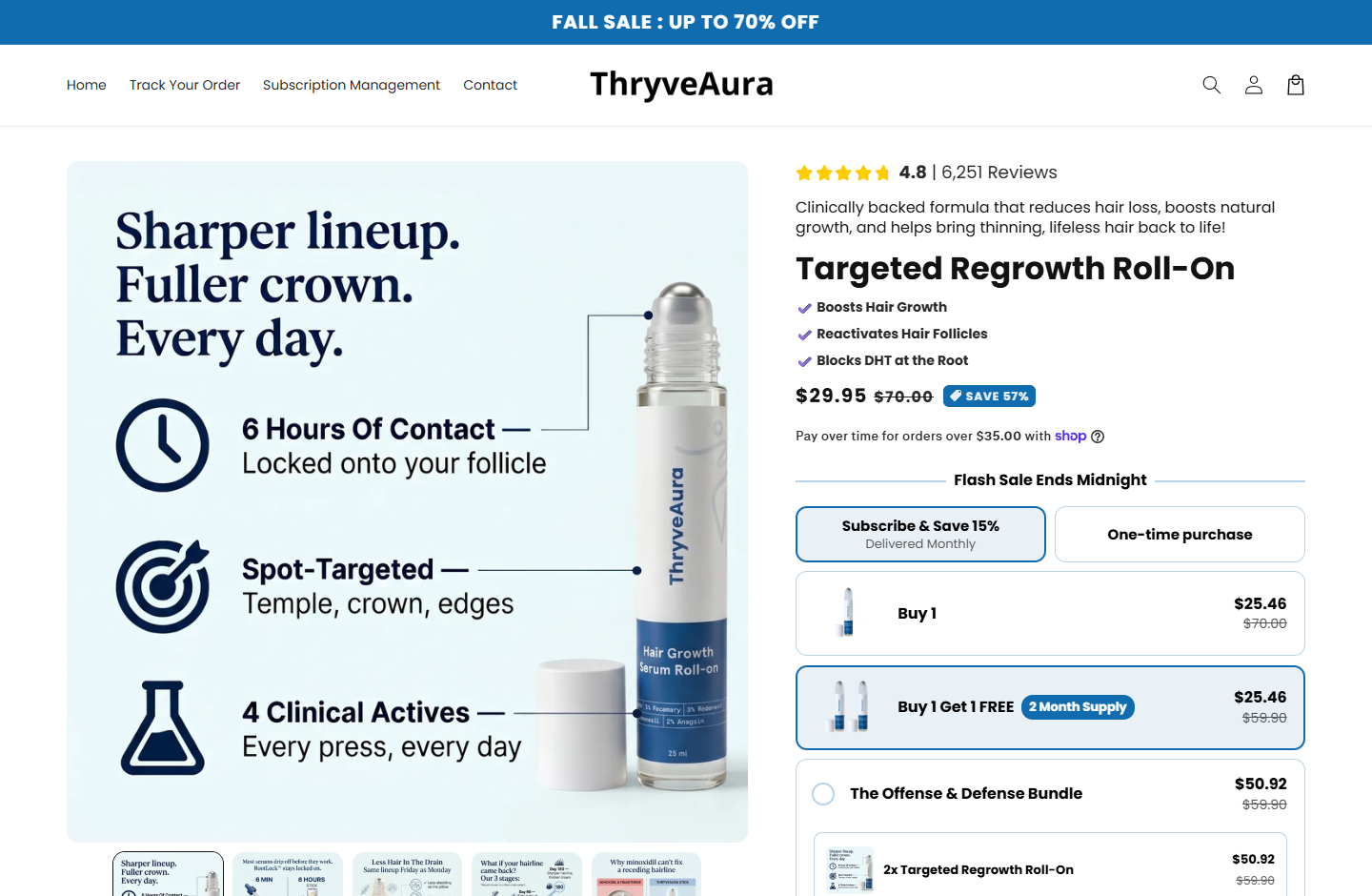
ThryveAura markets a Targeted Regrowth Roll-On with claims that it reactivates follicles, blocks DHT, reduces shedding, and brings back visible density.
The page describes the formula as clinically backed and displays a high review score.
Those are seller-presented claims; we did not independently verify the review count or a trial of this finished product.
Its imagery and timelines encourage shoppers to picture a transformed hairline. Hair loss has many causes, so the same bottle cannot reasonably promise identical results for everyone.
- The product page we captured showed a monthly Subscribe & Save selection.
- A separate one-time purchase option was visible.
- The page promoted a “no-risk” guarantee.
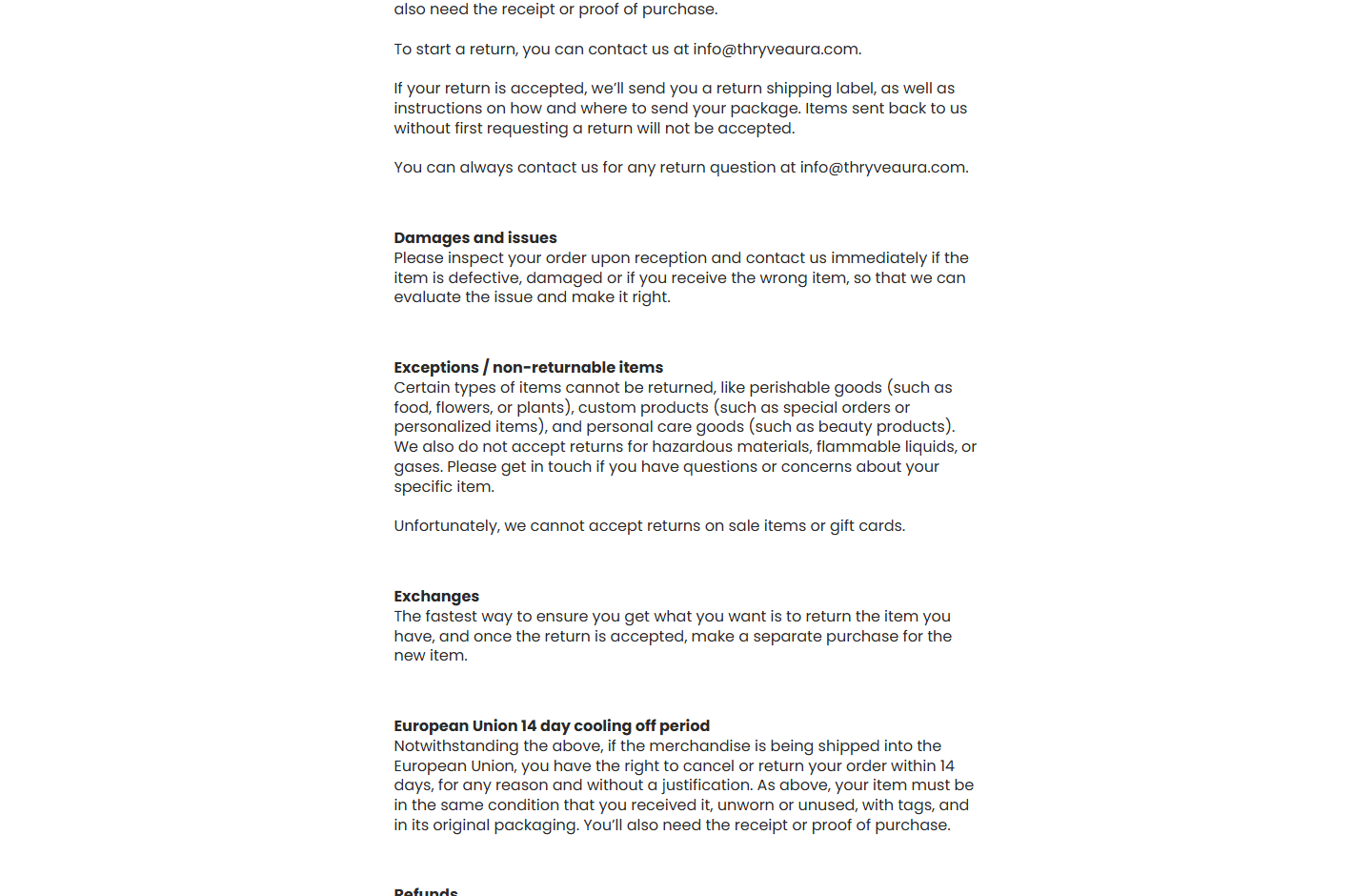
- The general return policy excludes personal-care and sale items.
The subscription choice is visible but easy to overlook
The selected offer on our screenshot was Subscribe & Save, with delivery described as monthly. A shopper can switch to the one-time option, but must notice the control.
Recurring delivery means another charge and another bottle unless canceled. The seller’s subscription policy says customers may change or cancel through order links.
Do not assume the lower first price applies forever. Confirm the renewal amount, date, and any shipping charge on the final checkout screen.
The return promise has important exceptions
The product page advertises a risk-free guarantee. The general refund policy says items must be unused and in original packaging.
That same policy says personal-care goods, including beauty products, cannot be returned. It also excludes sale items, while the product page displays a sale discount.
Those clauses create an obvious question: how does a buyer test a hair serum and still qualify for a promised refund? We cannot answer it from the policy alone.
Why Hair-Regrowth Claims Need Context
Hair shedding can follow stress, illness, medication changes, thyroid problems, or traction from styling. Pattern hair loss is another possibility, but it is not the only one.
The American Academy of Dermatology says identifying the cause is central to effective treatment. A product page cannot do that for you.
ThryveAura compares its roll-on with minoxidil and finasteride. Such comparisons may be persuasive, but they do not establish equivalent clinical outcomes for this formula.
The FDA explains that claims about restoring hair growth can affect how a product is regulated. That does not by itself determine this particular product’s legal status.
Ask for published testing of the exact finished product, not just studies on individual ingredients. Dosage, delivery, participants, and study design all matter.
How the ThryveAura Offer Works
Step 1: A personal before-and-after story creates urgency
The advertisement focuses on the frustration of seeing more scalp or a retreating hairline. Testimonials describe regrowth over weeks or months.
That narrative can feel more relevant than a clinical description. Yet a photo or anecdote does not show whether other treatments, styling, lighting, or time changed the appearance.
If an ad makes a claim stronger than the product page, preserve both. The exact promise matters when assessing whether the purchase met expectations.
Step 2: The product page borrows scientific language
The site uses terms such as follicle activation, DHT blocking, and clinical actives. These phrases sound precise even when the underlying evidence is not shown beside them.
Look for studies on this exact roll-on, with the same ingredients and concentrations. A reference to one ingredient does not validate every promised result.
Beware of claims suggesting one cause explains all shedding. Different diagnoses require different approaches, and delaying assessment can matter.
Step 3: A steep sale price frames the decision
The page we captured displayed a discounted price against a higher struck-through price. It also used a flash-sale message and multiple bundle choices.
A displayed discount does not establish the usual market value. Compare actual product size, ingredients, and total checkout cost rather than the crossed-out number.
Bundles can increase the first charge substantially. Count the units selected before paying, especially when a promotion says “buy one, get one free.”
Step 4: Monthly delivery can be selected by default
Our screenshot showed the subscription option highlighted, with one-time purchase alongside it. The current state on your own device may differ.
Read the word beside the selected control, not just the price. A recurring purchase is a different commitment from a single test bottle.
Save the checkout summary showing purchase type, quantity, delivery frequency, and renewal charge. Those details are difficult to reconstruct later from a generic confirmation email.
Step 5: The guarantee meets the policy exceptions
The product page says a disappointed buyer can email support. The general policy requires unused condition and excludes personal-care and sale goods.
Because a hair-growth roll-on is a personal-care item promoted at a sale price, ask support in writing whether the specific product qualifies for a satisfaction refund.
Request the answer before opening the package. Do not assume a friendly guarantee phrase overrides a written exclusion or, conversely, that support will necessarily reject every claim.
Step 6: Refill cancellation and return are separate
The subscription policy says repeat deliveries continue until canceled. Managing future shipments will not automatically settle a dispute about the first bottle.
Use the order link or account controls to stop unwanted refills. Then write separately about a refund, referencing the product-page promise and the policy language.
Keep the confirmation of both requests. A single “please cancel” message may not clearly state whether you mean the subscription, current order, or both.
Is the ThryveAura Roll-On a Scam?
The available evidence supports a serious consumer warning, not a blanket claim that every shipment is fake. The site offers a visible one-time option and publishes contact information.
The concern is the combination of aggressive regrowth promises, a highlighted subscription, and a guarantee whose practical reach is unclear under the general return exclusions.
We did not verify a clinical study of the finished roll-on or an independent review audit. That is an evidence gap, not proof the liquid contains nothing useful.
A shopper should also question testimonials about rapid transformation. Hair biology is slow, and results depend on the cause of loss and the treatment used.
If the product disappoints, the published exceptions could make a return harder than “no-risk” suggests. Get a product-specific answer before ordering.
Company, Address, and Fulfillment Checks
Compare the brand with the legal seller
The site’s contact information lists the trade name “ThryveAaura,” with an extra letter compared with the storefront name. That spelling discrepancy deserves clarification.
Check the entity named on the receipt and card statement. A typo does not prove deception, but support should be able to identify the responsible seller.
A Miami address does not identify the factory
The contact policy lists a Miami Beach suite address. We did not verify it as a manufacturing site or returns depot.
Ask where the roll-on is made and where returns go. Do not mail a parcel to a contact address without written authorization.
Test the email and subscription controls
The site lists an email address and a subscription-management link. Use them early if you need to cancel or clarify the guarantee.
Ask for the next charge date, current subscription status, and product-specific refund eligibility. Keep each response and account screenshot.
Look for a traceable formula
Check the label for full ingredient names, concentrations, lot number, manufacturer or distributor, directions, and warnings. Ask whether finished-product testing is available.
Do not assume a country of manufacture or contamination without evidence. The relevant issue is whether a buyer can verify what touches their scalp.
Questions to Ask Before Using the Roll-On
Ask whether the promotional guarantee applies to an opened bottle. The site’s general policy and product-page promise should have a clear, consistent answer.
Ask whether a sale price makes the item nonreturnable. If the answer is no, request that exception in writing.
Check whether the selected purchase type is monthly or one-time. A 15% subscription discount does not help if you wanted only a single bottle.
Test a small area as directed on the label and stop if irritation occurs. People with scalp disease or sudden patchy loss should seek professional advice.
Do not abandon an evidence-based treatment because an advertisement compares it unfavorably. A dermatologist can explain options for your actual diagnosis.
Why the Return Wording Matters
Imagine following the product page’s instruction to apply the roll-on for several weeks. That is the ordinary way a buyer would test a hair-care claim.
The general policy, however, says returned items must be unused. It does not explain how a used roll-on fits the separate satisfaction promise.
Now consider the discount shown on the product page. The general policy excludes sale items, but it does not clearly say whether a promotional roll-on is exempt.
These are not minor technicalities. They determine whether a buyer can actually invoke the guarantee after doing what the sales page encourages.
Some merchants honor product-specific promises even when a generic policy is narrower. Others apply the generic exceptions. Only the seller can clarify its present practice.
Ask support a direct question: “If I open and use this discounted roll-on, can I still obtain the advertised satisfaction refund?”
Then ask whether you must return the bottle, who pays postage, and what date starts the window. Save the written response with the receipt.
If the answer differs from the public policy, request a link to the applicable product-specific terms. A support message can be useful evidence but may not settle every dispute.
For subscriptions, ask whether a renewal bottle receives the same treatment as the first order. A “first purchase” exception could matter even if not obvious on a banner.
Make a calendar reminder before the next refill is scheduled. Testing a hair product often takes longer than one billing cycle, so a second order could arrive first.
Do not rely on a bank-card replacement alone to stop a subscription. Cancel with the merchant, confirm the status, and then address unauthorized charges with the issuer.
Keep the product packaging even if it seems disposable. Lot numbers and ingredient details can matter for a health question, a return, or a payment dispute.
Finally, judge the outcome with realistic expectations. Visible hair changes can be hard to measure. Consistent photos can help you discuss progress with a clinician.
A promise of “no risk” should be easy to understand in practice. When its conditions are unclear, written clarification is more valuable than another testimonial.
What to Do if You Have a Problem With ThryveAura
- Save the exact offer. Capture the product-page guarantee, selected subscription state, total price, receipt, and refund policy before the page changes.
- Cancel future refills promptly. Use the subscription-management link and ask support to confirm the final billing date. Keep a screenshot of the canceled status.
- Ask about the current order separately. Explain whether the bottle is unused, opened, defective, or not as described. Request a written decision under the product-specific guarantee.
- Clarify the exceptions. Ask whether the personal-care and sale-item exclusions apply to this roll-on. Do not ship it back until you have a return authorization and address.
- Escalate a wrong charge. If the site billed a recurring order or bundle you did not knowingly select, provide your checkout records to the card issuer and ask about dispute deadlines.
- Get clinical advice when needed. A dermatologist can investigate sudden or progressive shedding. Seek help for irritation, and bring the bottle and full ingredient list.
- Check security only where relevant. Malwarebytes can scan a device after a suspicious download, while AdGuard can block malicious ads. Neither cancels a legitimate merchant subscription.
Frequently Asked Questions
Is the ThryveAura roll-on automatically a subscription?
The page we captured had monthly Subscribe & Save selected, but a one-time option was visible. Confirm the final selection before paying.
Does the 60-day guarantee cover opened bottles?
The product page suggests satisfaction protection, while the general policy requires unused condition. Ask for a written product-specific answer.
Are sale items eligible for a return?
The general policy says sale items are excluded. Because the product page advertises a discount, clarify how the seller applies that rule.
Is this clinically proven to regrow hair?
We did not verify a trial of the finished product establishing the advertised outcomes. Studies on individual ingredients are not the same proof.
Can I cancel future deliveries without returning a bottle?
Yes, future subscription management is a separate issue from a refund request for a bottle already delivered. Confirm both statuses in writing.
What if my hair loss is sudden?
See a dermatologist or other qualified clinician. Sudden shedding or patches can have causes a cosmetic advertisement cannot identify.
The Bottom Line
ThryveAura’s roll-on is sold through a polished page with bold regrowth claims and a visible monthly subscription choice. The general refund policy raises serious questions about the promoted guarantee.
Check the purchase type and ask how opened, sale-priced personal-care items are handled before ordering. If already charged, preserve the evidence and deal with renewals and refunds separately.

Join the discussion
0 commentsShare your experience or ask a question about this article.
Discussion
Start the conversation
Have a question or something useful to share? Add the first comment.