

The video makes it look wonderfully simple: spray a stained surface, wait a moment, and watch the grease give up.
That promise is easy to appreciate after a Saturday scraping an old stovetop. Before ordering Bull Shot Degreaser, though, there are details worth seeing beyond the demonstration.
Overview
A real cleaner behind a dramatic demonstration
Bull Shot Degreaser is a foaming aerosol cleaner sold through an active product website. Its page displays ingredients, directions, a safety data sheet, customer reviews, and purchase choices.
That matters because a flashy advertisement alone cannot tell you whether a product exists. In this case, the cleaner does. The more useful question is what the advertisement leaves out.
The page describes grease melting away with little scrubbing. Its directions are more measured: allow several minutes, wipe or rinse, and sometimes reapply and scrub.
A kitchen hood or tool coated in old oil may need repeated work. A short before-and-after video cannot establish how the cleaner performs on every finish or stain.
The purchase choice most people could miss
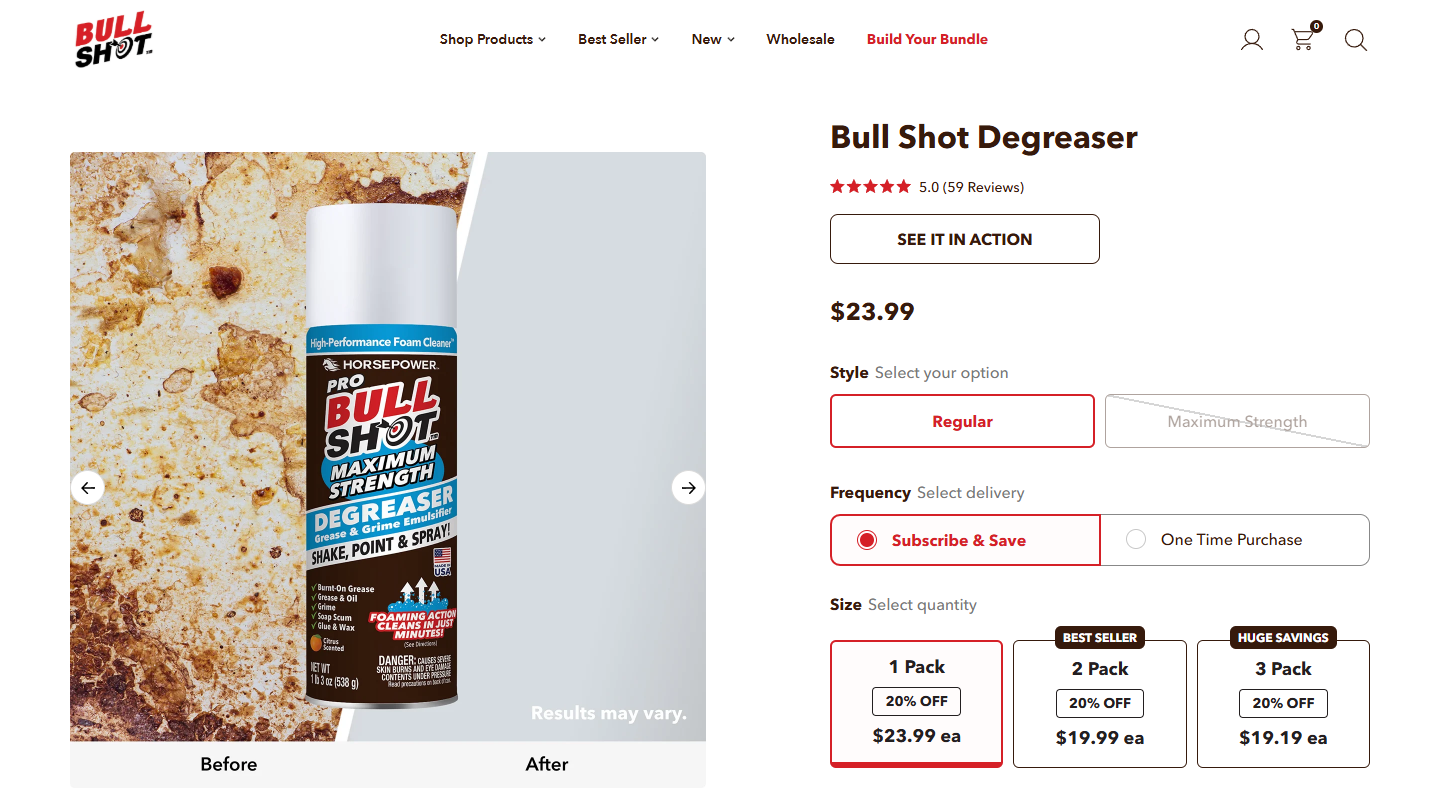
On the product page we reviewed, “Subscribe & Save” was selected. “One Time Purchase” appeared beside it as a separate choice.
The recurring option advertised 20% off, free shipping, and the ability to cancel. The one-time option did not present the same discounted price.
This is not proof that every shopper is enrolled without consent. It does mean you should inspect the selected delivery option before pressing Add to Cart.
Pack size is another independent choice. A two-pack or three-pack is not the same thing as a subscription, and a discounted per-can price is not the full order total.
- Choose Regular or Maximum Strength only after confirming which can and formulation the page actually displays.
- Select one, two, or three cans, then read the full charge rather than only the price marked “each.”
- Switch to “One Time Purchase” if you do not want repeat deliveries.
- Check the renewal interval, shipping, tax, and cancellation route before paying.
- Save the final checkout screen and confirmation email for later comparison.
The ingredient and safety details change the picture
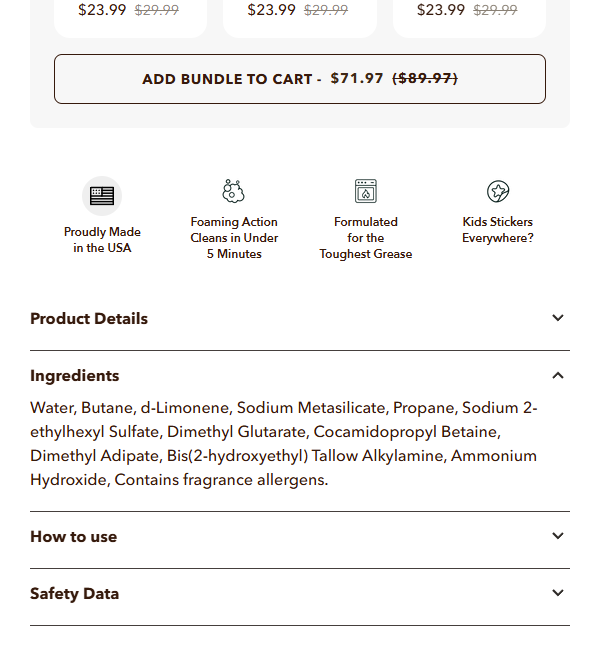
The seller lists water, d-limonene, sodium metasilicate, aerosol propellants, and other components. This is a formulated chemical cleaner, not a harmless mist that fits every surface.
Its linked safety data sheet identifies the degreaser by name and provides hazard, handling, and supplier information.
The sheet classifies it for serious skin and eye hazards and lists protective equipment. That deserves more attention than a satisfying stain-removal clip.
There is no evidence in this review that the cleaner is counterfeit or secretly made overseas. The documentation instead names a U.S. supplier and manufacturer.
What the Sales Video Does Not Show
A quick demonstration can be useful, but it is designed to compress a cleaning job into a few seconds. It usually leaves out surface compatibility and cleanup.
Bull Shot’s own directions say to hold the can 6 to 8 inches away and let the foam work. Tough buildup can require 5 to 10 minutes and scrubbing.
That is not necessarily a failure. It is an ordinary difference between a demonstration and a real household job with older, uneven, or baked-on grime.
The product page says the cleaner can be used on certain pan exteriors, stove hoods, tools, and other hard surfaces. It also lists important exclusions.
Do not use it on pan interiors, heating elements, oven gaskets, painted or polished finishes, or other excluded materials. Some plastics require a test first.
The page contains both broad language about cleaning kitchens and narrower directions against food-contact surfaces. Follow the more restrictive instruction where these messages seem to conflict.
If a sprayed area might touch food, do not assume a quick dry wipe is enough. Consult the actual can label and rinse instructions for that surface.
Similarly, “safe on most surfaces” in a FAQ cannot replace the specific do-not-use list. A painted appliance trim and stainless-steel exterior are not interchangeable.
The can shown in one product-page image reads Maximum Strength while the Regular option appears selected. That visual mismatch is another reason to inspect the selected variant.
It does not establish that the wrong product will ship. It shows why the checkout description and confirmation matter more than a rotating product photograph.
How the Bull Shot Offer Works
Step 1: The short video sells an effortless result
A shopper may encounter Bull Shot through a social-media clip, television-style demonstration, search result, or sponsored placement. The memorable moment is grease appearing to disappear.
The demonstration can make a cleaner look like a universal solution. Yet the age of a stain, surface coating, temperature, and amount applied all affect the outcome.
Watch for editing that skips dwell time or the wiping stage. A video can be authentic while still omitting the slower parts of the task.
The sensible comparison is the seller’s written directions, not the most dramatic few seconds of an ad. Those directions disclose waiting, wiping, and possible repeat treatment.
Step 2: The landing page presents several product versions
The site offers a Regular style and a Maximum Strength style. Those are different selections, and the product photograph may not always mirror the highlighted button.
Before selecting a version, read the can size, label, ingredients, and instructions shown for that exact variant. Do not assume two blue-and-brown cans are identical.
A buyer looking for the item in a video should compare its label with the checkout line item. If they differ, stop and ask support before ordering.
The page’s ingredient accordion and safety document are useful here. They provide more identifying information than a broad promise of “professional” cleaning power.
Step 3: A pack price becomes the order total
One-, two-, and three-pack buttons appear on the page. Larger packages highlight a lower per-can price, which can draw attention away from the total charged.
That is familiar retail pricing, not proof of fraud. It becomes a problem when a shopper thinks “$19.99 each” means the cart will cost $19.99.
Read the number of cans and extended price together. A three-pack is three physical units, not one large can, and shipping calculations may change with the selection.
Inspect the cart again after any upsell, bundle, or quantity suggestion. Do not rely on the original product tile once the order has been assembled.
Step 4: The delivery setting determines whether refills can follow
The page showed “Subscribe & Save” selected when we inspected it. The neighboring one-time button was available for a buyer who wanted a single purchase.
The 20% discount can be attractive. It also changes the transaction from one order into an arrangement for future shipments, subject to the interval selected.
Do not infer the refill schedule from the word “save.” Open the interval selector and read when the next order would be created and charged.
If you intend a one-off test, select “One Time Purchase” and verify that the cart repeats that choice. A screenshot can settle a later billing disagreement.
“Cancel Anytime” is a promise on the sales page. Before relying on it, locate the account controls or obtain written instructions for cancellation and cutoff dates.
Step 5: Checkout terms and shipping finish the transaction
The product page promotes free shipping with the subscription choice. A separate shipping page describes free standard shipping on eligible orders over $75.
These may reflect different offers rather than a contradiction. The only dependable number for your order is the shipping line shown immediately before payment.
Check the billing name, delivery address, pack count, taxes, shipping, and recurring status. If any line surprises you, return to the product page before paying.
Do not accept a vague “total today” as the entire cost of a subscription. Future charges need their own timing and amount.
Save the final order summary, not just the promotional page. The summary is the clearest record of what the merchant says you purchased.
Step 6: Delivery reveals the practical limitations
When the cans arrive, compare the label and quantity with your receipt before using them. Keep packaging until you know whether an exchange is needed.
Read the actual warning panel and directions on the can. Online copy can be shorter, and the exact product variant may have distinct instructions.
Try any permitted surface in an inconspicuous spot first. Do not experiment on painted finishes, food-contact interiors, or materials listed as unsuitable.
If the product disappoints, ask the seller for the written return process promptly. Do not assume an opened aerosol can can simply be mailed back.
Also check whether a subscription remains active. A return request for one shipment does not necessarily cancel future deliveries.
Company, Address, and Fulfillment Checks
The documentation names real business entities
The degreaser’s safety sheet identifies Telebrands Corp., doing business as BulbHead, as supplier. It names Chase Products Co. as manufacturer for that listed formulation.
Those details are more meaningful than a brand logo alone. They support product traceability, but do not tell you which company will appear on your card statement.
Match the receipt, checkout merchant, support contact, and can label. If the names differ, ask which entity handles charges, cancellations, returns, and safety questions.
Do not automatically equate every Bull Shot-themed website with the current store. Different campaigns can have different merchants, prices, and policies.
A listed address is not a return authorization
The safety sheet lists a supplier address in Fairfield, New Jersey, and a manufacturer address in Broadview, Illinois. Neither is automatically a consumer return depot.
Sending an aerosol can to a manufacturing or corporate address without instructions may create a lost package and a missed refund deadline.
Ask the selling merchant for the exact return destination and any authorization number. Keep its written answer with the original order record.
If a different address appears on the package, that alone does not prove deception. Warehouses and fulfillment centers often ship products for other companies.
Support should answer a precise question
The product page displayed an order-help phone number when reviewed. A phone number on a page is useful only if staff can resolve your particular transaction.
Ask whether your order is recurring, when the next charge is scheduled, and how to cancel before it ships. Request a confirmation number or email.
The site links to a returns help center, but the detailed return text did not load reliably in our review. Do not invent a refund period from an older campaign.
Instead, obtain the current policy in writing before ordering. Ask about opened cans, shipping charges, restocking fees, and whether subscription shipments qualify.
Traceability includes the exact formulation
The manufacturer and product code on the safety sheet are useful if you need to identify a can. Save the document alongside a photograph of your label.
Check whether you received Regular or Maximum Strength and whether the ingredient list matches the version you expected. Similar branding can hide meaningful differences.
Do not assume a safety sheet for Bull Shot Carpet or another cleaner covers this degreaser. Use the document linked from the exact product listing.
The available documentation undermines the notion that this is an anonymous imported mystery spray. It does not remove the need to read the warnings.
Safety Matters More Than the Five-Minute Pitch
The seller’s safety sheet classifies the degreaser for severe skin and eye effects and possible allergic skin reaction. It also warns about pressurized gas.
Those are material warnings, not fine-print trivia. A product that cuts through stubborn grease may demand more care than an ordinary damp cloth.
Use it only as labeled, with ventilation and the protective equipment specified in the safety sheet. Keep children and pets away while applying and storing it.
Avoid deliberately breathing the spray mist. Keep cans away from heat and flame, and never leave a pressurized container in a hot vehicle.
Do not mix it with other cleaners. If you already used another chemical on a surface, follow the label and seek expert guidance before layering products.
If it reaches your eyes or causes a serious reaction, follow the product’s first-aid directions and contact a poison center or medical professional promptly.
The safest shopping decision may be not to buy it for a surface the seller explicitly excludes. No discount compensates for damage to an appliance finish.
For a permitted test, work on a small patch and allow the stated dwell time. Record the result before applying the foam across an entire countertop.
What to Do if Your Bull Shot Order Goes Wrong
- Check the order confirmation now. Identify the exact style, quantity, today’s charge, and whether the purchase is one-time or recurring. Save screenshots of the checkout and receipt.
- Cancel an unwanted refill in writing. Use the merchant account and customer-support channel. State that you revoke future shipment authorization, request the effective date, and keep the response.
- Ask for a return decision before shipping anything. Give the order number, explain whether cans are opened, and request the current policy, authorized address, and shipping instructions.
- Compare delivered items with your receipt. Photograph the box, can labels, and packing slip. Report a wrong variant, missing can, or unexpected extra unit as a specific order error.
- Escalate unresolved charges to your card issuer. Explain which charge or shipment you dispute, provide cancellation evidence, and ask about stopping future recurring charges. Act within the issuer’s deadlines.
- Handle exposure as a safety issue. Follow the can and safety-sheet first aid. For eye contact, breathing trouble, or a significant reaction, contact a poison center or clinician promptly.
- Report misleading advertising with evidence. Send the ad, product page, receipt, and support correspondence to the relevant consumer-protection authority if a material promise remains uncorrected.
- Secure accounts if a suspicious lookalike site was involved. Change reused passwords. Malwarebytes can scan a device after an unsafe download, while AdGuard can reduce exposure to deceptive ads.
You do not need to prove the cleaner is fraudulent to challenge a wrong quantity, an unrequested renewal, or a refusal inconsistent with written terms.
Keep your complaint factual and narrow. “I selected a one-time purchase, but was charged again” is stronger than guessing what every other customer experienced.
Frequently Asked Questions
Is Bull Shot Degreaser a fake product?
No evidence in this review shows it is fake. The active store provides product details and a named safety sheet. Judge the offer and your order separately.
Does buying one can automatically mean a subscription?
Not necessarily. The page we reviewed displayed both Subscribe & Save and One Time Purchase. Confirm which option remains selected at the final checkout.
Why does the price change when I choose a pack?
The page shows per-can prices and different bundle totals. Compare the full cart total, taxes, shipping, and any future delivery charges before paying.
Can I spray it on every kitchen surface?
No. The seller excludes food-contact interiors, heating elements, painted or polished finishes, and other materials. Check the exact label and test permitted surfaces cautiously.
Who makes the degreaser?
The linked safety sheet lists Chase Products Co. as manufacturer and Telebrands Corp. doing business as BulbHead as supplier for the identified formulation.
What if the merchant has not explained returns clearly?
Ask for the current policy in writing before ordering. For an existing order, request authorization and instructions promptly, while preserving your receipt and correspondence.
The Bottom Line
Bull Shot Degreaser is a real cleaner with traceable documentation, not an anonymous spray that must be labeled a scam. Its advertisements still deserve careful reading.
The practical risks are simpler: selecting recurring deliveries unintentionally, mistaking a per-can price for the whole charge, and overlooking firm surface and safety limits.
Choose the exact variant and purchase type, save the final terms, and follow the label. A good cleaning result should never depend on a surprise refill or a damaged surface.

Join the discussion
0 commentsShare your experience or ask a question about this article.
Discussion
Start the conversation
Have a question or something useful to share? Add the first comment.