

A notice bearing the Connecticut Superior Court name says a traffic matter needs your attention. There is a reference, a deadline, and a way to settle it.
Before rearranging your day or reaching for a card, separate what the document claims from what the court can actually confirm.
Overview
The court’s name gives an unfamiliar demand borrowed authority
The Connecticut Superior Court scam uses a trusted institution’s identity to make a payment or information request feel compulsory. It can arrive through messages, calls, or documents.
The real institution is not the sender of these fraudulent demands. A logo, reference number, or court-style heading cannot connect an outside contact to your case.
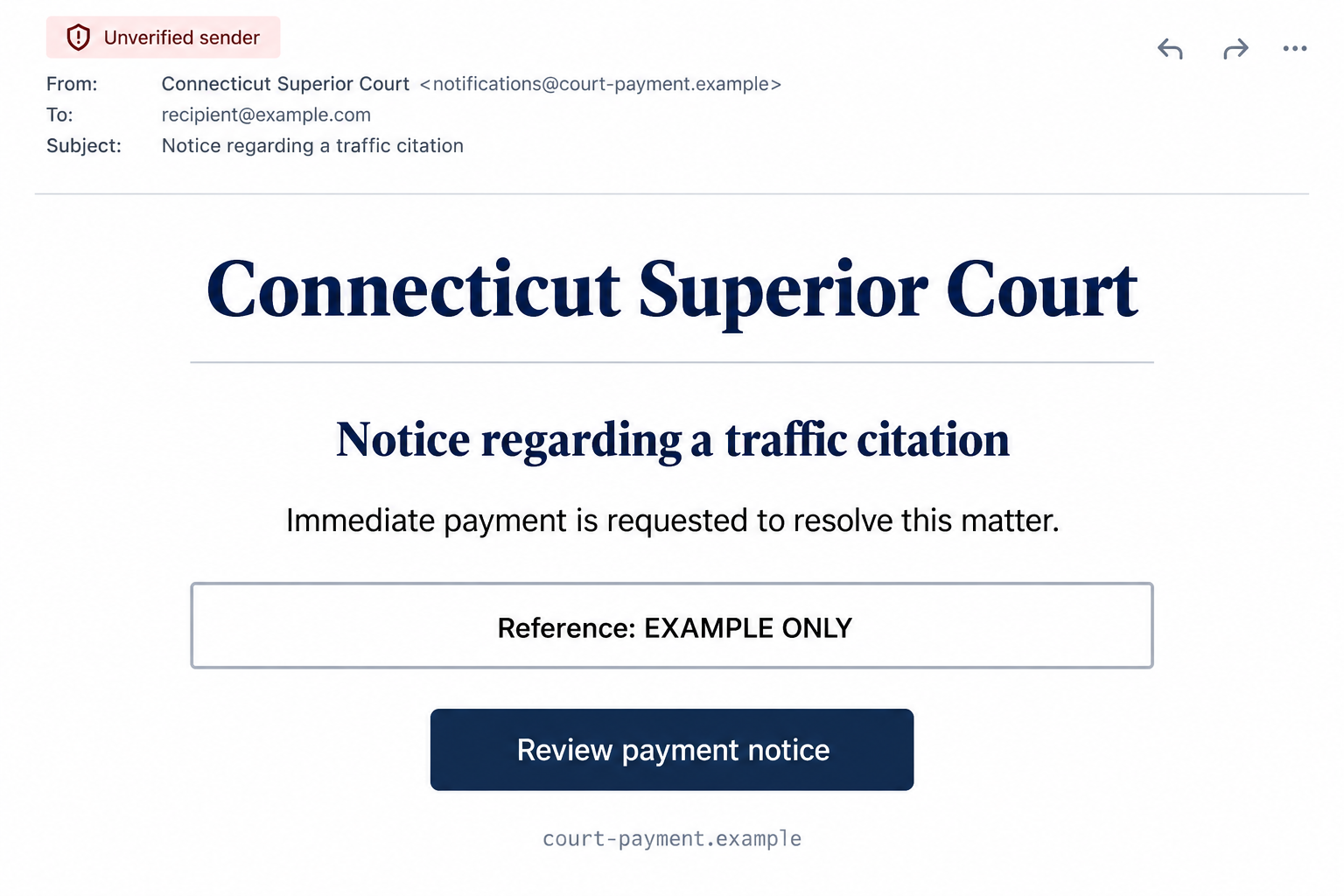
The lead image is an illustrative interface, not a received notice or an official court template. Its reference and example address cannot be used for a payment.
The Judicial Branch has warned about the impersonation
The Connecticut Judicial Branch’s scam alert identifies fraudulent contacts claiming to represent it, including Superior Court, and seeking immediate payment.
That warning concerns the demand, not every digital court service. A genuine online process and an imitation can look similar while sending information to entirely different recipients.
A real record needs a separate route
Start with the actual court service rather than the contact that introduced the problem. Organize the notice around a few concrete questions:
- What case or ticket does it claim to concern?
- Does it demand money, documents, login details, or a code?
- Which official office should hold the relevant record?
- Can that office explain the issue without using the sender’s link?
- Have you already disclosed anything that needs protection?
Why the Notice Can Feel More Convincing Than a Random Text
You start trying to explain the accusation
Perhaps you drove through Connecticut recently. Perhaps you moved and worry that something went to an old address. A serious-looking notice gives those ordinary uncertainties a frightening explanation.
Trying to remember a possible mistake is understandable. It still leaves a gap between your worry and the specific obligation the sender wants you to accept.
Do not fill that gap by supplying a license photograph or more personal history to the same contact. Ask the real office what its records show.
A notice reaching the wrong person also does not prove identity theft. Preserve it, but avoid assuming that the sender has accessed a government database.
Paying looks easier than questioning a court
The word court can make a modest payment feel safer than a disagreement. You may imagine time away from work or a hearing you are unprepared to attend.
That is why the destination matters as much as the document. Paying the wrong recipient cannot resolve a genuine case, however official the payment screen appears.
You are not challenging a judge by refusing an unverified link. You are checking whether a stranger’s request has any connection to the institution named.
A genuine deadline deserves attention through genuine channels. Keep authentic paperwork in view instead of allowing a new, more dramatic message to replace it.
How the Connecticut Superior Court Scam Works
Step 1: An unexpected contact introduces an alleged court problem
The approach presents a citation, fine, warrant, or other claimed issue as something requiring your response. You have not independently found that issue in a reliable record.
A short message may direct you to a longer document. That extra layer can make the demand feel more substantial without making it more trustworthy.
Keep the distinction clear: a document is something the sender supplied. It is not an independent answer to whether the sender represents the court.
Do not use a reply, callback, or attachment merely to ask if the notice was meant for you. Move the inquiry outside that contact.
Step 2: Official-looking details discourage a second look
A court name and a structured reference can make a generic allegation seem tied to a particular case. Readers may focus on the consequence before checking the source.
Those details can be copied or invented. An address you recognize confirms that the building exists, not that this message came from someone inside it.
Likewise, a real person’s name on the page does not identify its author. Do not accuse an official whose identity may simply have been borrowed.
When you contact the actual office, describe the document as suspicious. That helps keep the sender’s claimed reference separate from any genuine case identifier.
Step 3: The sender makes its deadline feel binding
The demand places a short window between you and a bad outcome. Checking independently begins to feel like a delay you cannot afford.
The FTC describes traffic-hearing scams that offer a choice between appearing at a supposed hearing and scanning a code to pay.
That framing leaves out the useful first step: establish whether the matter exists. Do not choose either option solely because the sender presented them as mandatory.
If you already have real hearing paperwork, ask the responsible office about that paperwork. A fraudulent message does not cancel an authentic appearance requirement.
Step 4: A payment route or form becomes the proposed solution
The contact supplies a link, code, or instruction to make the alleged problem disappear. You are being asked to trust the route before verifying the obligation.
A matching heading on the destination page only repeats the first claim. It does not add an independent connection to Connecticut’s court system.
A form may seek payment or identifying information. The risk depends on what you enter or approve, not simply on whether the page eventually displays success.
No single address or checkout layout covers every version. There is no need to enter sample information to discover which version you received.
Other Court-Related Traps Documented in Connecticut
A supposed attorney supplies a fraudulent resolution
The Judicial Branch also describes separate scams involving people with real cases. These are not documented later stages of the citation-message scheme.
A PDF can look complete enough to stop you from asking further questions. If it says the matter is resolved, you may put the genuine paperwork aside.
The Judicial Branch documented a defendant who paid $700 to a supposed attorney found on Facebook. A WhatsApp-delivered PDF claimed the motor-vehicle case was resolved.
At the clerk’s office, the defendant learned otherwise: no resolution, offer, or fine matched the document. The official alert identifies the PDF as fraudulent.
The practical lesson is to confirm the outcome with the office holding the case. A payment receipt and a court disposition answer different questions.
Save both documents if you have them: the original case paperwork and the promised resolution. The clerk can check the claimed outcome against the actual record.
A fake sheriff offers paid help with pretrial release
A separate Judicial Branch warning concerns callers posing as sheriffs and offering pretrial release or services for a fee. That is not a legitimate shortcut.
The alert describes contacts after arraignments or bond modifications. Knowing the situation can make a caller persuasive, but it does not establish their authority to collect money.
If someone you care about is in custody, speak with their established lawyer or the responsible verified office. Do not let fear select a stranger as your intermediary.
Write down exactly what the caller offered and how they wanted payment. Preserve that information without continuing the conversation to investigate who they really are.
Check the Case, Not the Sender’s Version of It
Use the Judicial Branch’s traffic-ticket information
For a genuine Connecticut traffic ticket, begin with the Judicial Branch traffic FAQs and follow its official service links.
The page describes payment and response options, including the Online Ticket Review Program. Use the instructions that fit your actual ticket, not the option a stranger recommends.
A real ticket carries its own response date. If you lost the paperwork or cannot match the reference, ask the Centralized Infractions Bureau through the contact route listed there.
Paying a genuine ticket can have legal consequences. Do not submit a payment just to test whether a reference is valid or choose a plea based on scam advice.
Keep a licensing question separate from a court question
The CT DMV’s citation-text warning rejects a payment demand threatening registration penalties. A DMV label does not turn that text into court paperwork.
If you need to check a license or registration record, use DMV’s genuine service. If you need to check a court matter, use the Judicial Branch.
A message can blur those responsibilities. Naming several agencies in one paragraph does not explain which office supposedly made a decision or where a payment belongs.
Legitimate texts and QR codes require context
Connecticut’s Jury Administration offers opt-in cancellation and deferral text alerts. That is different from an unexpected demand to pay a court fine.
The official court-forms page also explains that some forms contain QR codes pointing to information. A QR code is not automatically evidence of fraud.
What matters is the whole interaction: how you obtained the material, what action it requests, and whether the responsible office confirms it independently.
Do not scan a suspicious payment code to investigate its source. You can find the actual service without opening the sender’s destination.
What to Do if You Have Fallen Victim to This Scam
-
Stop using the unverified payment or legal-help contact. Do not send another document, verification code, or fee to complete the supposed resolution.
Keep the conversation available as evidence. If the sender pressures you to delete it, do not let that instruction remove your record of what happened.
-
Write down the exposure before making reports. Note whether you only received a notice, opened a page, entered information, authorized payment, or received a supposed settlement document.
Include approximate dates and the method used. You do not need a perfect account immediately; mark uncertain details rather than presenting guesses as facts.
-
Contact the financial institution involved. Explain the court impersonation or fake legal-service payment and ask which protections, recall requests, or dispute options apply.
Reach the institution through an existing trusted channel. Tell it if you supplied card details even when the page showed an error and no charge appeared.
The FTC’s recovery guidance distinguishes payment methods. Give the provider an accurate account and retain its reference number; reimbursement is not assured.
-
Ask the real court about the genuine record. Explain that you received suspicious instructions or a document claiming a resolution, and ask what the actual case requires.
Do not assume the scam payment satisfied a real obligation. Equally, do not change an authentic response or appearance plan based only on the fraudulent message.
If you already have counsel, send the suspicious material through your established contact route. Seek case-specific advice about any approaching real deadline.
-
Secure accounts and identifiers you disclosed. Change an exposed password at the genuine service, address reuse, and review sign-in sessions and recovery information.
Tell the provider about any verification code or approval involved. If identity documents or a Social Security number were supplied, use IdentityTheft.gov for relevant next steps.
A caller already knowing your name is not the same as a confirmed account takeover. Focus the response on what was actually shared or misused.
-
Preserve and report the useful material. Save the original notice, sender details, visible destination, PDF, messages, and transaction records before blocking or deleting the contact.
For unwanted texts, the FTC’s reporting instructions include messaging-app controls and forwarding to 7726. Report suspected fraud through its genuine reporting service.
Local police may also need a report when money or identity misuse is involved. Avoid posting complete documents, private case information, or payment details in public warnings.
-
Reject strangers offering a paid cure. Someone promising a refund, a cleared record, or special access must not become trusted merely because they mention the earlier incident.
Keep official case questions with the actual court and financial questions with your provider. A second payment to an unverified person only adds another unresolved transaction.
Frequently Asked Questions
Is every Connecticut court-related text a scam?
No. Opt-in jury updates exist. That does not authenticate an unexpected payment demand or a threatening message using the Superior Court name.
Does a court seal prove that a PDF is genuine?
No. A seal can be copied. Ask the office responsible for the case to confirm the document’s claimed action or outcome.
Are QR codes banned from Connecticut court documents?
No. Official forms can use them for information. Do not confuse that feature with an unsolicited code demanding payment to avoid a threatened consequence.
What if I really have an unresolved traffic ticket?
Use the genuine ticket and Judicial Branch service to determine your options. A real obligation does not authorize an impersonator to collect it.
Can a supposed attorney’s receipt prove that my case is closed?
No. Confirm the actual case status and any required action independently. Paying someone and obtaining a court outcome are not the same event.
Should I go to the hearing location printed in the suspicious notice?
Verify the claimed appearance with the real court first. Do not follow invented instructions, but continue complying with any genuine notice the responsible office confirms.
The Bottom Line
Do not pay a Connecticut Superior Court scam contact or accept its paperwork as a case outcome. Verify the underlying matter with the real Judicial Branch.
If you already paid or shared information, protect that exposure promptly and preserve the evidence. Handle any authentic deadline separately, through the court or your established lawyer.

Join the discussion
0 commentsShare your experience or ask a question about this article.
Discussion
Start the conversation
Have a question or something useful to share? Add the first comment.