

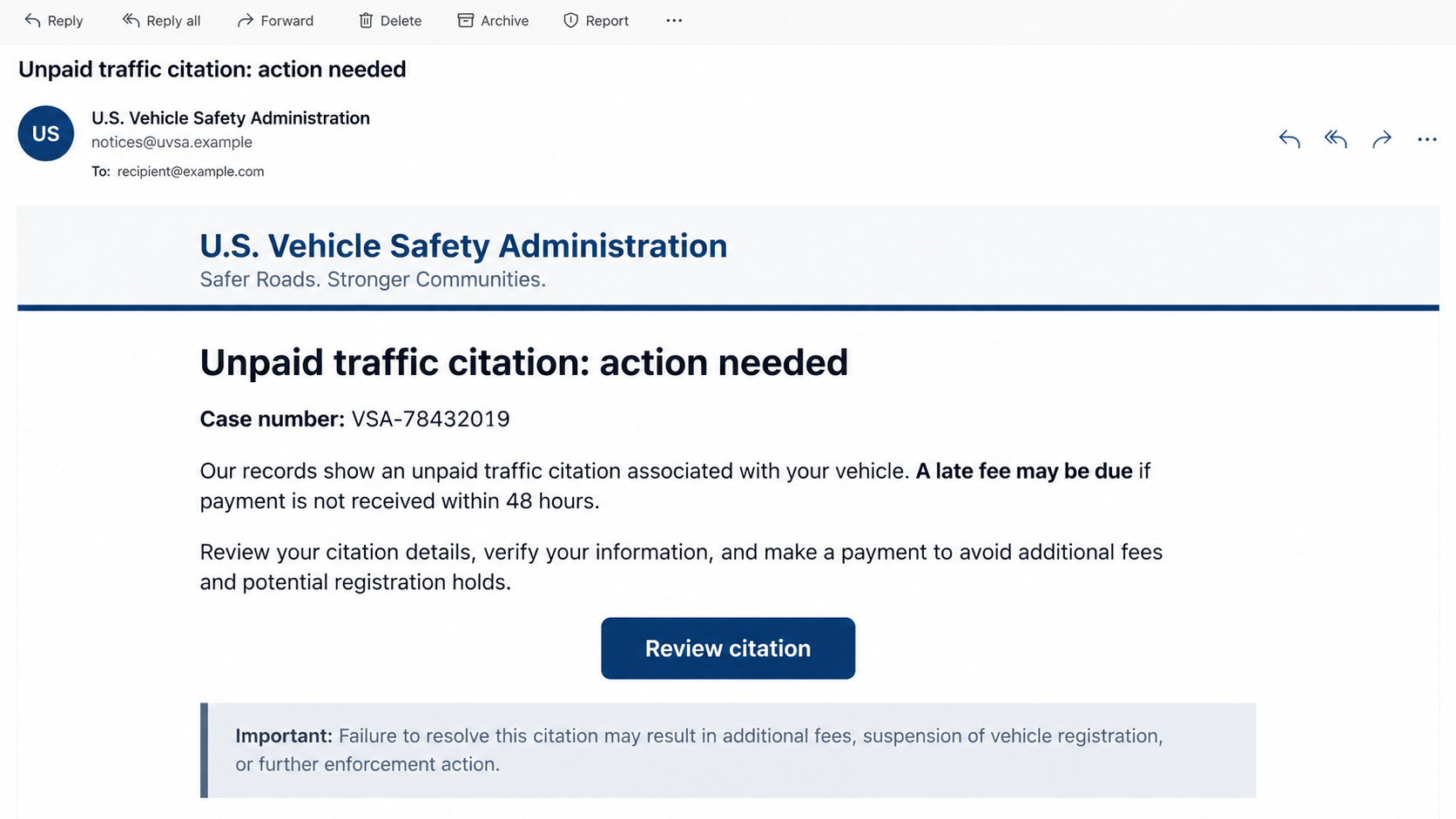
A message says you have an unpaid traffic ticket, but the sender appears to be a federal vehicle safety agency. The notice supplies a case number and a deadline, making the claim feel official enough to worry about.
It is the kind of warning that can interrupt an ordinary day. Before paying, there is one important question to answer about who actually issues traffic citations.
Overview
The NHTSA traffic ticket scam impersonates a real agency
The National Highway Traffic Safety Administration, or NHTSA, is a real U.S. federal agency focused on road and vehicle safety. Scammers have used its name to pressure people into paying supposed traffic fines.
In a public warning, NHTSA says impersonators have contacted people about alleged unpaid tickets, sometimes invoking fake judges, case numbers, and penalties. The agency states plainly that it does not issue traffic tickets or text people to collect fines.
The notice turns a fake case into a payment demand
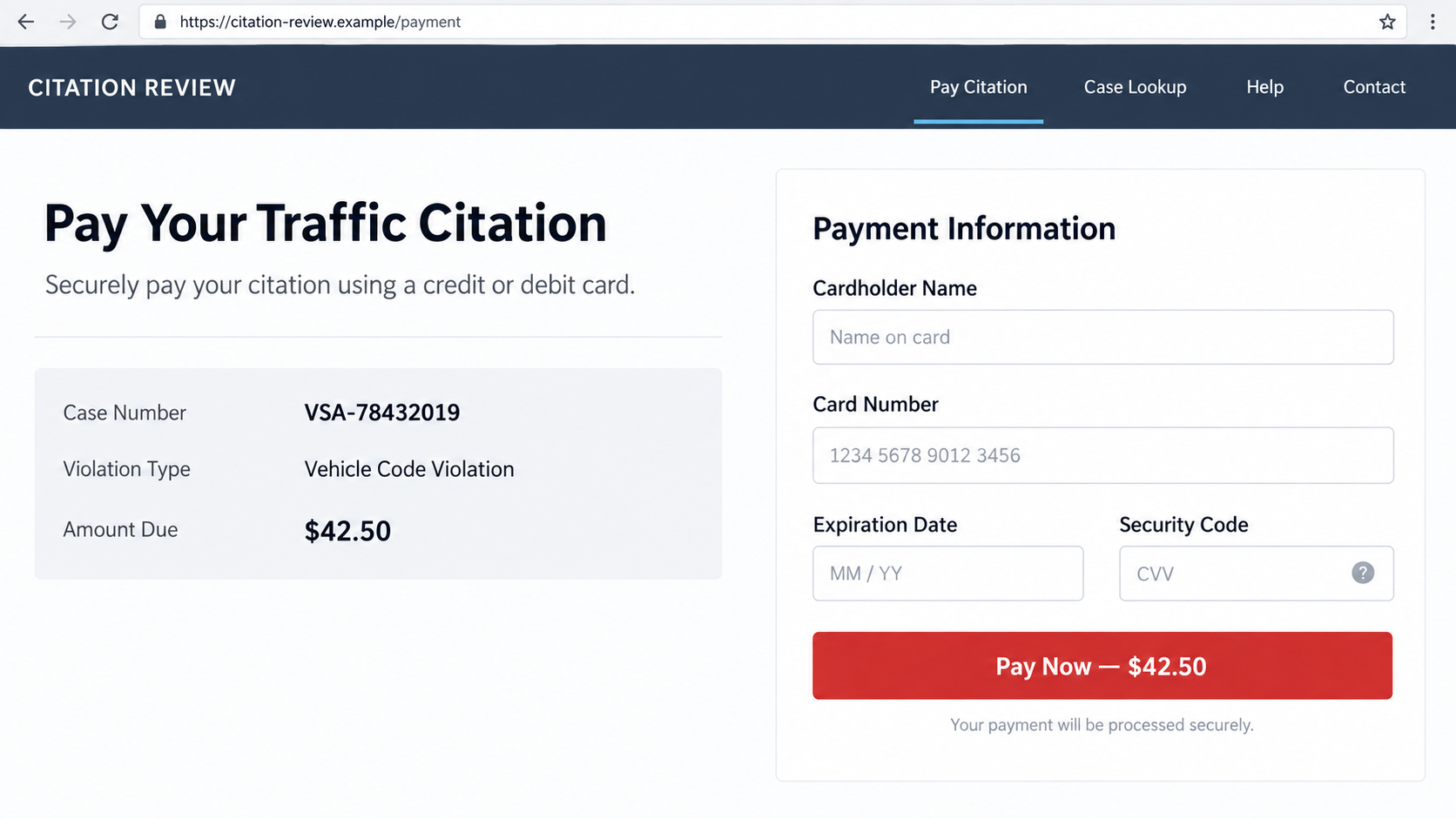
A message may display a citation number, a short deadline, and a link to “review” or “resolve” the matter. The linked page can collect a card number and personal information while pretending to be an official payment portal.
The example above is an illustrative reconstruction, not a captured message. Wording, amounts, and contact channels can change. A convincing layout does not repair the central contradiction: NHTSA is not the office collecting your traffic fine.
The safest response is independent verification
If you are concerned about a real citation, look up the court or issuing authority from a document you already have or from the jurisdiction’s official website. Do not let a link inside the surprise message choose the payment site for you.
Common warning signs include:
- A notice claims NHTSA issued or will collect a traffic ticket.
- It demands immediate payment by text, email, or phone.
- A judge’s name or case number appears without verifiable court details.
- The payment link uses a domain you cannot independently connect to an issuing authority.
- The sender threatens arrest, registration action, or extra fees to force a quick decision.
Why the Agency Name Makes the Story Convincing
Many drivers have heard of NHTSA through vehicle recalls, crash tests, and safety campaigns. That recognition is useful to a scammer. A familiar federal name can make an unfamiliar ticket process seem like a special national enforcement program.
Traffic enforcement, however, is not the same job as vehicle safety oversight. A speeding ticket or parking citation normally comes from a local, state, or other relevant enforcement authority. Payment instructions should be verified with that issuer.
Scammers may add a fake court case number to bridge the gap. Numbers look precise, but anyone can generate a plausible string. A case number only matters when the named court can locate it through its own official records.
Urgency makes that check less likely. A message can say the payment window closes today or that failure to act will trigger a suspension. The reader may focus on avoiding consequences before noticing that the named agency does not issue the ticket.
The scam may arrive by text, email, or a phone call. Caller ID and sender names can be spoofed, and links can carry official-sounding words. NHTSA’s warning covers impersonation; it does not mean every notice about vehicles is fake.
Real recall notices are a separate matter. NHTSA provides an official recall lookup by VIN, and manufacturers can use several channels to reach owners. A recall communication should not be confused with an alleged NHTSA traffic-fine demand.
How the NHTSA Traffic Ticket Scam Works
Step 1: The sender invents an unpaid citation
The scammer sends a notice that claims a traffic offense is tied to the recipient’s vehicle. It might include a generic violation, a case identifier, or an amount due. Details create the impression that an actual record exists.
A broad message can reach many people because most drivers can imagine having missed a letter or camera notice. The attacker does not need to know whether you were ever stopped by an officer.
Step 2: Federal branding supplies false authority
The sender presents the demand as coming from NHTSA or another official-sounding vehicle safety office. A logo, formal wording, and a reference to a court can make the notice look more serious than an ordinary unpaid-bill scam.
NHTSA’s actual role is the decisive check. The agency says it does not issue traffic tickets. A fine demand cannot become legitimate because a page includes federal colors or a realistic header.
Step 3: A deadline makes hesitation feel costly
The message warns of late fees, court action, license or registration trouble, or an escalating balance. Some versions may mention a judge or warrant. These claims are designed to produce action before a person checks the underlying case.
A real legal matter should be confirmed through the issuing authority’s published contact details. Do not use the phone number or site inside the threat to verify the same threat. That keeps the entire conversation inside the attacker’s control.
If the message names a city you have never visited, that is useful evidence, but a familiar location is not proof either. Mass-sent scams can mention common destinations, and personal data from other sources can make an invented notice seem tailored.
Step 4: The link opens a payment or information page
The button may say “Review citation,” while the destination asks for a card and identifying details. A page can show an HTTPS padlock and still be fraudulent. Encryption protects the connection to that site, not its claim of government ownership.
Some pages may ask for a driver’s license number or address before showing a balance. Others may demand a small “processing” payment. Either route can expose information the attacker can use in later fraud.
Step 5: Payment does not resolve a real ticket
Entering a card may produce a receipt or confirmation number. Those can be generated by the fraudulent site without any court receiving payment. A victim might later discover unauthorized charges or that a genuine ticket, if one exists, remains unpaid.
Do not interpret a polished receipt as proof that the issuing jurisdiction was involved. Confirm a case and payment status with the actual court or authority using independently found details.
If the page charged your card under an unfamiliar merchant name, write that descriptor down. It can help your card issuer locate the transaction even when the fake website disappears or changes its address.
Step 6: Follow-up messages keep the pressure on
The scammer may say the first charge failed, an additional validation fee is due, or a supervisor must be called. Each new step creates another opportunity to collect card details or personal information.
Once you recognize the impersonation, stop responding. Preserve the messages and contact your card issuer if you paid. A real authority’s independent contact route is the place to settle any uncertainty about an actual citation.
Agency, Case, Address, and Payment Checks
Check the named agency’s role
NHTSA handles vehicle safety issues, including recalls and safety information. It says it does not issue traffic tickets or text fine-collection demands. That statement is stronger evidence than a logo in an unsolicited message.
If the notice claims another agency issued the citation, identify that specific authority. Do not assume one government name can collect fines for every jurisdiction. A legitimate case should have a traceable issuer and process.
Verify the case through the real court
Use the official website or phone number of the court or ticketing authority for the location where the alleged offense occurred. Search by a reference on your original paper notice, if you have one, or ask staff how to check a case safely.
A made-up case number can be formatted to look official. It should not influence you until the court’s own records confirm it. If the message never identifies a location or issuing officer, that absence is another reason to question it.
Read the final web address
Inspect the link destination before entering any details. Scammers can register domains with “citation,” “federal,” or “safety” in the name. The presence of an official word does not establish government control.
Do not rely only on a search result for verification, because sponsored results can also mislead. Start from a known jurisdiction site or a government directory, then navigate to its payment or case-search service.
Match payment instructions to the issuer
Real citation payment methods vary by location. A card portal, check, in-person counter, or contracted processor may be legitimate when the issuing authority confirms it. The difference is independent confirmation, not the presence of a payment form.
Be especially cautious if a caller demands gift cards, cryptocurrency, a wire transfer, or a payment to an individual. Those methods make recovery harder and are not a substitute for documented court payment instructions.
If You Also Received a Vehicle Recall Message
Do not merge a recall alert with a ticket demand. A legitimate recall can require safety action, but repairs are generally arranged through the manufacturer or dealer process, not by paying NHTSA a traffic fine.
Enter your VIN at NHTSA’s official recall lookup to check open safety recalls. If a message claims a specific recall, compare the campaign number and vehicle details with the official result. Contact the manufacturer or dealer through known numbers if anything differs.
Manufacturers may use mail, email, or other outreach, so a text is not automatically fraudulent merely because it mentions a recall. What matters is whether the recall exists and whether the action requested matches an official remedy.
Do not pay a third party to “release” a recall, and do not give card details to a link sent in an unexpected notice. A scammer can combine two familiar vehicle topics to make a demand seem more credible.
If you have both a real ticket and a real recall, handle them as separate matters through their respective official channels. The presence of one genuine issue does not validate the other message.
What to Do if You Have Fallen Victim to This Scam
- Save the full notice and payment page details. Keep screenshots, the sender address or number, case identifier, URL, amount, receipt, and time of payment. Do not send the scammer more information while trying to prove the message is fake.
- Call your card issuer or bank immediately if you paid. Explain that the payment was made on a site impersonating a government agency. Ask whether the charge can be disputed and whether the card should be replaced. Review statements for further transactions.
- Check the alleged citation independently. Contact the court or ticketing authority for the place named in the message using its official website or publicly listed number. NHTSA says it does not issue traffic tickets, but an unrelated real citation should still be handled through its actual issuer.
- Protect identity details you entered. If you provided a driver’s license number, date of birth, or other sensitive information, document exactly what was shared. Consider the tailored steps at IdentityTheft.gov and ask the relevant agency whether a replacement credential or fraud alert is appropriate.
- Secure any account credentials. If the page asked you to sign in, change that password through the legitimate service and review recent sessions. Do not reuse the password elsewhere. A payment page ordinarily should not require an unrelated email or bank password.
- Check the device only if a file was involved. A fake fine page may be a payment trap without malware. If you downloaded and ran an attachment, scan with Malwarebytes and follow the result. AdGuard can help reduce exposure to malicious links later, but neither tool cancels a card charge.
- Report the impersonation. Forward scam texts to 7726 where supported, report the message to your provider, and file a report with the FTC. Include the impersonated agency and payment site. Ignore anyone who promises a guaranteed refund for an upfront fee.
Frequently Asked Questions
Does NHTSA issue traffic tickets?
No. NHTSA says it does not issue traffic tickets. A message demanding payment for an alleged NHTSA citation is using the agency’s name falsely.
Will NHTSA text me to collect an unpaid fine?
No. NHTSA’s scam warning says the agency does not text people to collect traffic fines. Do not pay through a link in such a message.
Can a real ticket arrive by mail or electronically?
Notification rules vary by issuing jurisdiction and violation type. Check the actual court or ticketing authority through its official route rather than assuming every electronic notice is real or fake.
Does a case number prove the notice is genuine?
No. A scammer can invent a number. It becomes meaningful only if the named court or issuing authority can locate the case in its own records.
Is a recall notice the same as a fine?
No. A vehicle recall concerns a safety issue and remedy. Verify it with NHTSA’s VIN lookup or the manufacturer; do not pay an unexpected traffic-fine link because it mentions a recall.
What if I already entered my card?
Contact the card issuer promptly, explain the impersonation, and ask about disputes and replacement. Save the page and any receipt, then monitor the account for additional charges.
The Bottom Line
The NHTSA traffic ticket scam borrows a real safety agency’s name to make a fabricated fine look authoritative. A case number and payment portal can be convincing, but they do not change what the agency actually does.
NHTSA does not issue tickets or collect fines by text. Verify any alleged citation with its true issuing authority before sharing personal details or paying.

Join the discussion
0 commentsShare your experience or ask a question about this article.
Discussion
Start the conversation
Have a question or something useful to share? Add the first comment.