

The Doreve Cloudfaser Pillow is promoted as a specialized pillow for tinnitus relief, cervical support, and deeper sleep.
The product page presents it as a premium sleep solution with a 120-night trial, thousands of customers, and strong claims about reducing morning ringing.
This review examines the product, the marketing, the red flags, and what buyers should know before ordering.
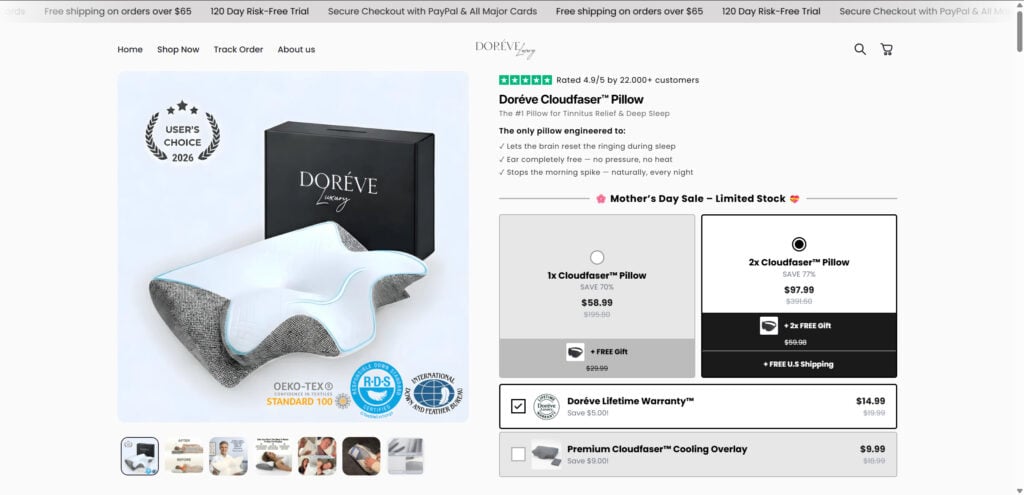
Scam Overview
Doreve sells the Cloudfaser Pillow as “the #1 pillow for tinnitus relief and deep sleep.” The page claims it is designed to help the brain “reset the ringing” during sleep, keep the ear pressure-free, stop the morning tinnitus spike, and improve deep sleep. The site also claims it is rated 4.9/5 by more than 22,000 customers.
That is a very aggressive pitch for a pillow.
A pillow can help with comfort, neck positioning, heat, and pressure relief. It may help some people sleep better. But Doreve goes much further by linking the product to tinnitus relief, brain sound-processing reset, morning ringing reduction, and deep neurological recovery during sleep.
That is where the concern begins.
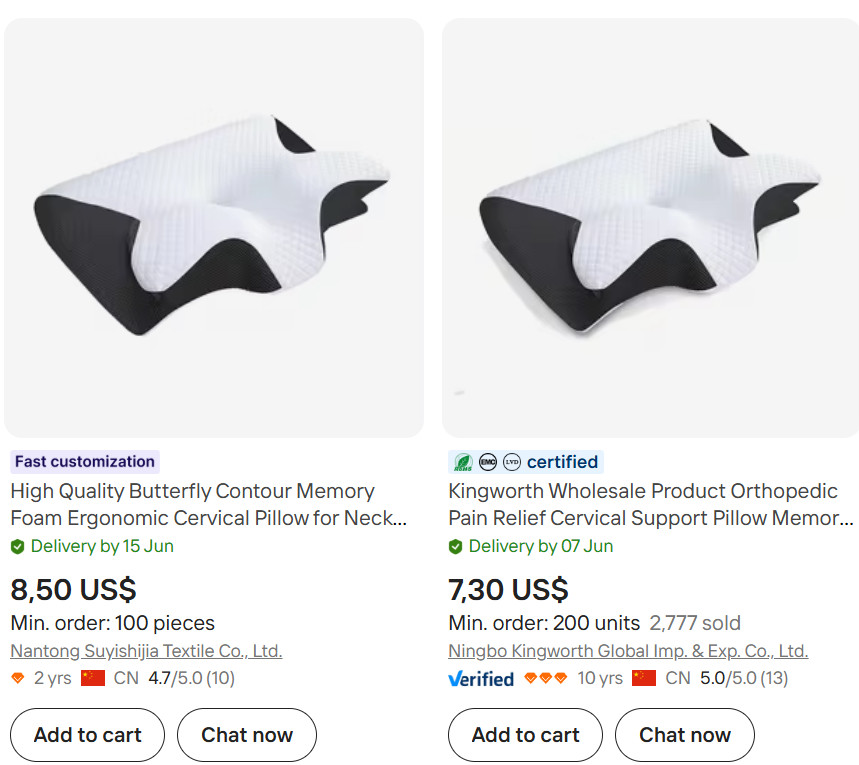
The product itself appears to be a butterfly-style contour memory foam pillow, a product type that is widely available from generic suppliers. Similar contour cervical pillows listed for roughly $7.30–$8.50 wholesale. Doreve then brands the same kind of design as a premium tinnitus-support pillow with a strong medical-style narrative.
That does not prove the pillow is fake.
It does suggest the marketing may be doing far more work than the product itself.
What Doreve Claims
The product page claims the pillow can:
- Help the brain “reset the ringing” during sleep
- Keep the ear pressure-free and heat-free
- Stop the morning tinnitus spike
- Help users sleep through the night
- Reduce neck pressure
- Improve focus and clarity
- Reduce morning ringing
- Provide better deep sleep
- Help tinnitus sufferers who have tried supplements, sound machines, and ENTs
The page also claims that tinnitus is not generated in the ears, but inside the brain when deep sleep is disrupted, specifically referencing the Dorsal Cochlear Nucleus as the brain’s sound-processing center.
That sounds scientific. But a sales page saying this does not make it clinically proven.
Major Red Flags
1. The tinnitus claims go beyond what a pillow can realistically prove
The biggest red flag is the link between the pillow and tinnitus relief.
The site claims the pillow can help reduce morning tinnitus by allowing the brain to reset during deep sleep. It also suggests standard pillows disrupt sleep and keep the auditory system active all night.
That is a serious health claim.
Tinnitus is complex. The National Institute on Deafness and Other Communication Disorders says there is currently no cure for tinnitus, though symptoms can sometimes be reduced through approaches such as sound therapy devices, behavioral therapies, hearing aids, and medications.
The American Tinnitus Association also states that there is no scientifically proven cure for most cases of chronic tinnitus.
So when a pillow is marketed as a product that can meaningfully quiet tinnitus, buyers should be cautious.
A pillow may improve comfort. It may reduce ear pressure. It may help sleep quality.
But that is not the same as proving it can reduce tinnitus.
2. The page uses neurological language to make the product sound medical
The Doreve page discusses:
- deep sleep
- brain reset
- sound processing centers
- Dorsal Cochlear Nucleus
- auditory system activity
- morning tinnitus spikes
This language makes the product feel like a medical sleep intervention rather than a pillow.
The issue is that the product is still just a pillow.
If a brand claims its pillow affects brain sound-processing patterns, it should provide strong independent clinical evidence. Instead, the page mainly relies on marketing copy, testimonials, and self-reported survey results.
3. The site’s own disclaimer walks back the medical impression
At the bottom of the page, Doreve states that the Cloudfaser Pillow is not a medical device and is not intended to diagnose, treat, cure, or prevent any disease or condition. It also says statements have not been evaluated by the FDA and that testimonials may not reflect typical results.
That creates a major contradiction.
The sales page strongly suggests tinnitus relief.
The disclaimer says it is not a medical product.
That is a common pattern in aggressive wellness marketing: bold claims on the sales page, legal caution in the footer.
4. The customer numbers are hard to verify
The page claims:
- 22,000+ customers
- 4.9/5 rating
- 1,000 survey participants
- 82% reduced morning tinnitus spike
- 89% improved sleep quality
- 94% deeper, uninterrupted sleep
- 76% better focus and clarity
These are powerful social proof numbers.
But they appear to be self-hosted on the seller’s own website.
There is no obvious independent review platform, third-party survey provider, or transparent methodology shown directly on the product page. The page says the results came from a private survey after 30 days, which is not the same as a controlled clinical trial.
5. The testimonials feel highly curated
The page includes testimonials claiming:
- “3 years of tinnitus – nothing helped”
- “This pillow actually worked”
- “Less pressure in my head”
- “Better than any therapy”
- “The tinnitus is still there but much quieter”
- “NO medication or anything else helped this much”
These testimonials are emotionally powerful.
But testimonials are not proof. They can be selected, edited, incentivized, translated, or dramatized.
When a product uses testimonials to imply health results, buyers should ask whether those results are typical and independently verified.
6. The same type of pillow appears to be available cheaply from suppliers
Your supplier screenshot shows similar butterfly contour cervical pillows sold in bulk for around $7.30–$8.50.
That matters because the Cloudfaser Pillow does not appear to be a unique product category. It looks like a common ergonomic contour pillow design with added branding and tinnitus-focused marketing.
This is typical of dropshipping-style products:
- source a generic item
- rebrand it
- write a strong medical or wellness story
- run ads
- sell it at a premium price
The product may be real. The positioning may still be exaggerated.
7. The “120-night risk-free trial” has conditions
The product page repeatedly says “120-night trial,” “risk-free,” and “full refund.”
But the refund policy says the trial is subject to return eligibility conditions and inspection. Items must be lightly used, with no stains, odors, or tears, and must include all accessories and original packaging. Customers also need to email support, wait for return authorization, and ship the return within 14 days of approval.
For U.S. and international change-of-mind returns, the customer is responsible for return shipping costs. Refunds are only issued after the returned item is received and inspected, and refunds may be denied or partially reduced if eligibility requirements are not met.
That is not necessarily unfair.
But it is not as simple as “try it risk-free and get every cent back no questions asked.”
8. The product is sold as health-related, but the company transparency is limited
The footer lists Doréve Luxury as operated by MP Ecommerce LLC at an address in Sheridan, Wyoming, with support handled through an email address.
That is better than no company information at all.
But for a product making tinnitus and neurological sleep claims, buyers should expect more:
- independent clinical data
- named medical advisors
- product manufacturing details
- foam certifications
- lab testing reports
- clear proof of survey methodology
- transparent review platform
The site does not provide enough of that on the product page.
How This Operation Appears to Work
Step 1: Take a common pillow design
The base product appears to be a butterfly-style cervical pillow with a hollow area for the ear and side cutouts for the arms or shoulders.
This design is not unique.
Step 2: Attach a medical-style problem
Instead of simply selling the pillow for neck support, the page connects it to tinnitus, brain reset, morning ringing, and deep sleep disruption.
This makes the product feel more serious and more urgent.
Step 3: Use scientific-sounding explanations
The page references the Dorsal Cochlear Nucleus and deep sleep as part of the tinnitus story.
That gives the page a clinical tone, even though the product is not a medical device.
Step 4: Add testimonials and survey percentages
The page uses large customer counts, private survey percentages, and emotional user stories to create trust.
Step 5: Reduce hesitation with a long trial
A 120-night trial makes the purchase feel safe. But the refund policy still requires authorization, packaging, return shipping for some buyers, and inspection before approval.
Is Doreve Cloudfaser Pillow a Scam?
Not necessarily a fake-product scam
The product likely exists. A buyer may receive a contoured pillow.
But the marketing is high-risk
The main concerns are:
- strong tinnitus-relief claims
- neurological “brain reset” language
- self-hosted review and survey numbers
- a generic pillow design sold as a specialized solution
- the site’s own disclaimer saying it is not a medical device
- refund conditions that are more detailed than the “risk-free” pitch suggests
The most accurate classification is:
Doreve Cloudfaser looks like a high-risk wellness pillow funnel using strong tinnitus-relief marketing around what appears to be a generic-style cervical pillow.
Should You Buy It?
For most buyers, caution is warranted.
Reasons to be careful
- No pillow is a proven tinnitus cure
- The claims go beyond normal comfort or neck-support claims
- The survey results are seller-controlled
- Similar pillows appear available from generic suppliers
- The refund policy has eligibility and shipping conditions
- The product is not a medical device
If you still consider buying it
Treat it as a pillow, not a tinnitus treatment.
Do not buy it expecting:
- guaranteed tinnitus relief
- brain reset
- reduced ringing within 7–14 nights
- replacement for sound therapy, hearing care, or medical evaluation
- a cure for morning tinnitus
What To Do If You Already Ordered
1. Save the product page
Take screenshots of:
- “#1 pillow for tinnitus relief”
- “brain reset”
- “stops the morning spike”
- “22,000+ customers”
- survey percentages
- “120-night trial”
- refund policy
- product images
- checkout total
This matters if you later need to dispute the purchase.
2. Review the return policy immediately
Do not wait until the 120-day period is almost over.
The refund policy requires return authorization, original packaging, acceptable condition, and inspection before refund approval. U.S. and international buyers may also need to pay return shipping for change-of-mind returns.
3. Inspect the pillow when it arrives
Check:
- foam quality
- smell or off-gassing
- stitching
- cover material
- shape and firmness
- whether it matches the images
- whether packaging and accessories are included
Keep all packaging until you are sure you will keep it.
4. Do not rely on it for tinnitus care
If your tinnitus is new, worsening, one-sided, pulsing, or associated with hearing loss, dizziness, headache, ear pain, or neurological symptoms, seek medical advice.
Tinnitus can have many causes, including hearing loss, ear injury, circulatory issues, or other underlying conditions. Mayo Clinic notes that tinnitus is usually caused by an underlying condition and may improve when the underlying cause is treated or when symptoms are reduced or masked.
5. Test it only as a comfort product
If you try it, judge it realistically:
- Does it support your neck?
- Does it reduce ear pressure?
- Does it help you sleep better?
- Does it feel comfortable after several nights?
Do not assume any change in tinnitus is guaranteed or permanent.
6. Start a return early if dissatisfied
If it does not match the claims, contact support in writing.
Use a clear message:
I am requesting a return for order #[number]. The product does not match the results and claims advertised. Please provide the RMA number, return address, and refund timeline in writing.
Do not send it back without authorization, because the refund policy says unauthorized returns may not be refunded.
7. Dispute the charge if necessary
If support stalls, refuses a reasonable return, or the product is materially different from what was advertised, contact your payment provider.
Use evidence showing:
- what was advertised
- what arrived
- the refund policy
- your support emails
- tracking information
The Bottom Line
Doreve Cloudfaser Pillow may be a real contoured cervical pillow.
But the marketing is the problem.
The site presents it as a tinnitus-focused sleep solution that can help the brain reset ringing during deep sleep, while the footer and terms state the product is not a medical device and is not intended to diagnose, treat, cure, or prevent disease.
The safest conclusion is simple:
Doreve Cloudfaser looks like a generic-style contour pillow sold through strong tinnitus-relief marketing, self-hosted testimonials, large unverifiable review claims, and a “risk-free” trial with real return conditions. Buyers should treat it as a pillow, not a proven tinnitus treatment.









most excellent advice and feedback.
-I’d looked at their “street address” and it’s the equivalent of a private PO Box company; small building, etc. nothing like a manufacturing /distribution, or even company offices.
Thanks for digging into that, A.C. – the address check is one of the fastest tells. A mail-drop or virtual office where a manufacturer should be means there is no operation behind the brand, just a shipping account and an ad budget. Anyone can repeat what you did: put the address into Street View, then search it as a phrase and see how many unrelated brands share the same suite number. When dozens do, you’re looking at a rented mailbox.