

A soft-spoken Japanese doctor billed as Dr. Yumi Takahashi has been promising people with type 2 diabetes a kitchen recipe that works better than their medicine.
The videos have run in English, Spanish and Portuguese, and people keep searching her name to find out whether she is real. The answer starts with a fake newscast.
Overview
Who the ads say Dr. Yumi Takahashi is
The sales video presents Dr. Yumi Takahashi as a 53-year-old nutrition doctor, a 1996 Johns Hopkins graduate and head of research at the University of California.
She supposedly found that apple cider vinegar and a Japanese compound can reverse type 2 diabetes within weeks, without metformin, insulin injections or restrictive diets.
None of those credentials comes with a license number, a campus, a department or a single published study. The persona exists in ads, a Facebook page and copied video scripts.
What the campaign looks like now
The English video opens as a fake World News Tonight segment, with Elon Musk, Tom Hanks and Sylvester Stallone written into the script as supporters and patients.
Spanish and Portuguese ads have pushed a 17-second Japanese ritual from Dra. Yumi Takahashi. Meta has removed several Takahashi ads and disabled pages running them for breaking its advertising rules.
The domains behind the 2025 and 2026 versions keep changing. Some have already expired, and the product sold at the end changes with them.
What to do if you saw or bought from these ads
Do not follow the Dr. Yumi Takahashi recipe or buy anything the video sells. If you already bought a supplement from it, stop taking it.
- Keep taking your prescribed diabetes medicine exactly as your clinician ordered.
- Show the bottle or box to your doctor or pharmacist so they can check what you took.
- Check your card statement for repeat or duplicate charges from the order.
- Report the ad to the platform that showed it, using its scam or misleading-health option.
Is Dr. Yumi Takahashi a Real Doctor?
The Dr. Takahashi in these ads can’t be traced to any real medical career. Her biography exists only in the sales script and on social media pages built around it.
In the script she says she was born in Nagano, moved to the United States at 13 during an economic crisis, and has practiced medicine for 28 years.
A Facebook page called Dr. Yumi Takahashi repeats that story. It calls her a board-certified specialist in nutrition and metabolic health with over 28 years of clinical experience.
The page has about 8,800 followers, no reviews and a profile picture added in June 2025. It lists no hospital, clinic, license or publication that anyone could check.
There is no English Wikipedia article about a Dr. Yumi Takahashi. Wikipedia mentions of the name include a sailor, a Nintendo music composer and a wheelchair basketball player.
Yumi Takahashi is a common Japanese name carried by real people, including researchers in unrelated fields. None of them is tied to this campaign or should be blamed for it.
Some recipe ads borrow real experts instead. The Dr. Ania Jastreboff baking soda recipe ads used a genuine Yale specialist, while this campaign invents a doctor no one can find.
A real physician leaves a paper trail you can check in minutes. In the US, DocInfo, run by the Federation of State Medical Boards, shows licenses and disciplinary actions.
Japan’s health ministry offers a public physician license search as well. The ads give no license state, hospital or registration number to check.
Yumi Takahashi is a common name, so a registry search may turn up real doctors. A matching name doesn’t connect any of them to these ads.
The Fake News Segment Behind the Recipe
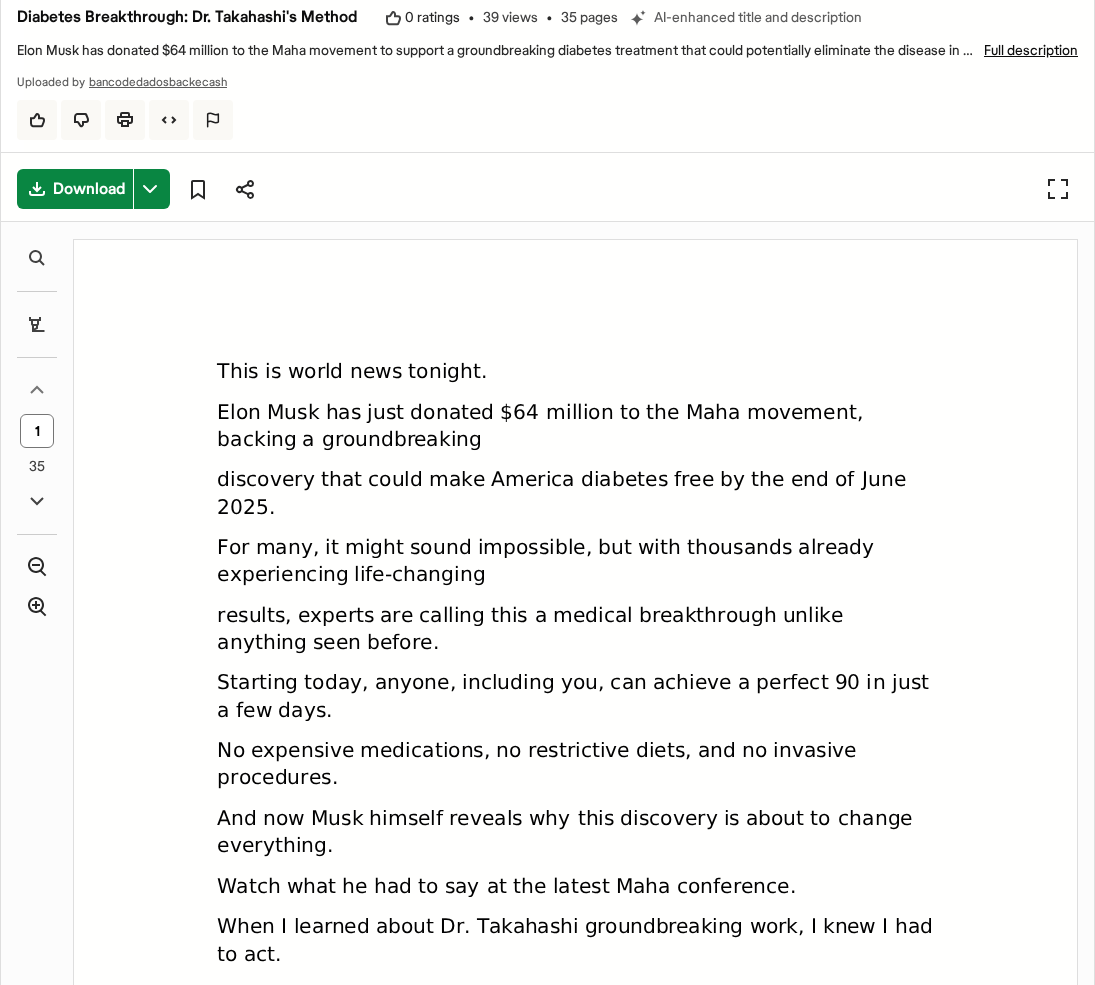
A copy of the English sales script, uploaded to Scribd under the title Diabetes Breakthrough: Dr. Takahashi’s Method, runs 35 pages. It opens like an evening network newscast.
The narrator claims Elon Musk donated $64 million to the MAHA movement to make America diabetes-free by June 2025. A scripted Musk then hands the stage to Dr. Takahashi.
The central promise follows: she “has discovered a way to reverse diabetes at any age.” No study, trial or medical body is ever named to support it.
The script casts Tom Hanks and Sylvester Stallone as diabetes patients helped by her method. One speaker says he was diagnosed in 2013, the year Hanks announced his diagnosis.
Hanks really has type 2 diabetes, which makes him an easy target. In August 2024 he warned that ads using his name, likeness and voice for miracle cures weren’t his.
Hanks said he treats his diabetes only with his board-certified physician. That’s the opposite of what the script has him saying about a kitchen remedy.
A respected newscast, a billionaire’s donation and a famous patient are borrowed props. We’ve documented the same set in the fake Fox News Elon Musk diabetes ads.
The scripted Musk even says his space missions mean nothing if he can’t save lives on Earth. The line is written to make a fake endorsement feel personal.
Dra. Yumi Takahashi Ads in Spanish: The “Diabetes Tipo 2” Ritual
If you saw Dra. Yumi Takahashi linked to “diabetes tipo 2,” you met the campaign’s Spanish-language version. It moved into Spanish and Portuguese ads in late 2025.
Meta’s Ad Library lists about 590 ads containing the exact name Yumi Takahashi. A few involve unrelated people, such as a music-video credit, but most come from campaign pages.
Those pages use names like Yumi Takahashi, Dra. Yumi Takahashi and Nutri Yumi Takahashi. Another page, Dra. Aline, ran versions in both Spanish and Portuguese.
The Dra. Aline ads open with two sensible tips, drinking more water and cutting refined carbohydrates. The Takahashi discovery slips in as step three, borrowing credibility from the first two.
At least one advertiser used an ordinary personal name instead of a brand, so its ads read like a friend’s tip. A page name doesn’t prove who runs it.
The Spanish copy avoids the word cure. It sells a Japanese ritual of 17 seconds, a natural mix of 15 seconds and common ingredients that thousands supposedly use at home.
None of the ads explains what happens during those seconds, or why one version needs two seconds more than the other. The precise number exists to sound scientific.
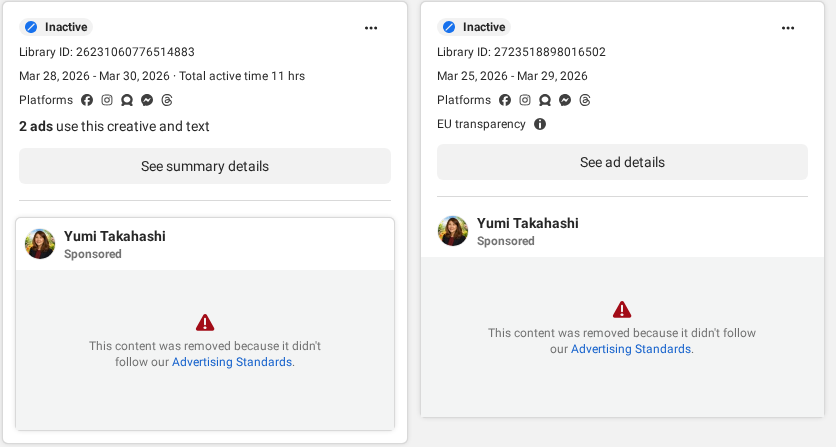
Meta has stepped in more than once. Several Yumi Takahashi ads from March 2026 show as removed for breaking its Advertising Standards.
Other ads, run in March, April and September 2026, are marked as coming from an account or page that Meta later disabled for the same reason.
The links point to short-lived domains. Glucopeso.com was registered on October 28, 2025, two days before ads pointing to it began, and now blocks visitors.
Glucosalt.com now points to a domain-parking service. The japasecrets.com and secretodejapon.com addresses used in other ads are no longer registered at all.
What the Video Sells: Glucosense and GF Caps
The recipe never arrives. Near the end of the English script, Dr. Takahashi reveals the “Japanese compound” as Glucosense, a capsule sold in packs of two, three or six bottles.
The script prices them at $79, $69 and $49 a bottle and promises a 180-day refund. It says ClickBank runs the payment page, which takes cards or PayPal.
It also dangles a free Mediterranean cruise for the first 10 buyers each day who order three or six bottles within 20 seconds. The countdown is there to rush you.
Our 2025 coverage named GF Caps as the bottle behind these videos. Its 2025 store at gfcaps.com used the same $79, $69 and $49 price ladder.
That store is gone. Gfcaps.com lapsed and was registered again on June 15, 2026, and it now shows unrelated adult Chinese-language fiction, so don’t visit it.
The persona and the newscast stay while the bottle and domain change. We’ve also covered a GlucoSense bottle sold with fake Elon Musk endorsements.
Can a Japanese Recipe Reverse Type 2 Diabetes?
No recipe, ritual or capsule has been shown to reverse type 2 diabetes on its own. Remission does happen, mostly after major weight loss managed with a medical team.
The script blames a “diabetes parasite” in the pancreas and calls cutting carbs counterproductive. Type 2 diabetes isn’t caused by a parasite, and cutting refined carbs is standard advice.
Apple cider vinegar has been studied in small trials for after-meal blood sugar. The effects are modest and brief, and daily vinegar can irritate the throat and wear tooth enamel.
“Asian metformin” isn’t a medical term. Ads use it to suggest a natural swap for a tested drug. Berberine is sometimes nicknamed nature’s metformin, but it isn’t a substitute either.
Metformin has decades of trial data, known doses and known side effects. A video recipe with secret quantities offers none of that.
If metformin upsets your stomach, ask about the extended-release version, which many people tolerate better. If cost is the worry, generic metformin is one of the cheapest diabetes medicines available.
Those are conversations for your prescriber or pharmacist. They solve the real problems the video exploits, without gambling your blood sugar on a stranger’s recipe.
The biggest risk is quitting treatment. Stopping metformin or insulin because a video promised a cure can send blood sugar high enough to cause dehydration, confusion or a hospital emergency.
The FDA has warned companies about illegally sold diabetes treatments, from supplements to unapproved drugs. It says it hasn’t evaluated or approved them as safe and effective.
Regulators haven’t issued a notice that names Dr. Yumi Takahashi or GF Caps. The evidence against the campaign comes from its own script, its ads and Meta’s removals.
How the Dr. Yumi Takahashi Scam Works
Step 1: A short ad promises a doctor’s secret
A Facebook or Instagram ad shows a Japanese doctor or a cup of herbal tea. The English versions promise diabetes reversal, while the Spanish ones promise energy and balance.
Step 2: A fake newscast supplies the authority
The click opens a long video framed as a network news segment, so the pitch feels like reporting rather than advertising. The celebrity cameos arrive before the doctor does.
Step 3: The doctor’s backstory builds trust
Dr. Takahashi tells a personal story about losing a loved one to diabetes and leaving Japan as a child. The emotional detail stands in for credentials that never arrive.
Step 4: The recipe turns into a product
The video teases apple cider vinegar and a Japanese compound but never gives quantities. The 2025 English script ends by selling Glucosense capsules in two-, three- and six-bottle packs.
Step 5: The pages and domains vanish
Ads run for days, pages get disabled and domains expire. Buyers who need a refund later may find no working site and no named company.
Pages, Domains and Payment Trails
None of the Takahashi ads names a company or an address, and their landing pages now block visitors or have expired. Your receipt and card statement are the lasting record.
The name on your statement matters more than the brand in the video. It tells your bank which merchant to dispute and helps regulators connect complaints.
The landing pages change every few weeks, so a screenshot of the ad and of the page where you paid is valuable evidence for a dispute.
The same playbook appears in other recipe scams we’ve covered, including the Japanese plant diabetes cure and the Japanese Mounjaro recipe ads.
What to Do If You Responded to a Dr. Yumi Takahashi Ad
- Stop taking any supplement, drink or capsule you bought through the Takahashi video. Don’t finish the bottle to see whether it works.
- Keep taking your prescribed diabetes medicine. Never stop metformin, insulin or other treatment because of the video.
- Show the bottle and box to your doctor or pharmacist, and tell them how much you took and for how long.
- Get urgent care for confusion, heavy thirst, vomiting, fainting or very high or very low blood sugar readings.
- If you had side effects, file a report with FDA MedWatch in the US or with your country’s medicines regulator. Keep the packaging for them.
- If your statement shows CLKBANK or ClickBank, request a refund through ClickBank’s order support site, clkbank.com. Most ClickBank products allow refund requests for 60 days.
- Otherwise, find the merchant name on your card statement and ask your card issuer about a dispute for a misrepresented product. Mention the fake newscast and the invented doctor.
- Watch your statement for new charges over the next few months, and cancel the card if unfamiliar charges appear.
- Report the ad on Facebook or Instagram and file a complaint with the FTC or your national consumer agency.
- Be wary of follow-up calls or emails offering a refund for a fee. Legitimate refunds never require you to pay first.
Frequently Asked Questions
Is Dr. Yumi Takahashi a real doctor?
The doctor in these ads can’t be verified, and her biography exists only in the sales script. Real people named Yumi Takahashi have no known link to the ads.
Is there a Dr. Yumi Takahashi Wikipedia page?
No. English Wikipedia has no article about a doctor by that name. The name appears there only for unrelated people, such as a sailor and a video game composer.
What are the Yumi Takahashi 4 ingredients?
The ads never publish a usable recipe. They tease apple cider vinegar, a Japanese compound and kitchen ingredients, and the English script ends by selling that compound as Glucosense capsules.
Is the Spanish “Dra. Yumi Takahashi diabetes tipo 2” video the same scam?
Yes. The Spanish ads talk about energy and balance instead of a cure, but they lead to the same kind of video and the same invented doctor.
Did Elon Musk or Tom Hanks endorse Dr. Yumi Takahashi?
Nothing shows either man endorsed her. Their names appear in a scripted sales video, and Tom Hanks has said ads using his likeness for miracle cures aren’t his.
Does apple cider vinegar lower blood sugar?
Small studies show a modest dip after meals, nothing close to a medicine. Never drink it undiluted, and don’t use it as a reason to skip prescribed treatment.
The Bottom Line
Do not follow the Dr. Yumi Takahashi recipe or buy any bottle the video sells. The doctor can’t be verified, the newscast is staged, and the celebrity patients are scripted.
If you bought a bottle from the video, stop taking it, keep your prescribed medicine, show the box to your pharmacist and seek a refund through ClickBank or your bank.
Real progress with type 2 diabetes comes from a care team you can name. A kitchen remedy sold by a doctor nobody can find is not part of that plan.

Join the discussion
0 commentsShare your experience or ask a question about this article.
Discussion
Start the conversation
Have a question or something useful to share? Add the first comment.