

Recently, thousands of UK residents have received alarming texts or emails claiming they haven’t submitted their application for the 2024–2025 energy allowance. The message often promises a government grant of £200 to £300 under the Energy Support Scheme. It urges recipients to act fast, includes a suspicious link, and even requests a £1 payment to verify bank details. It seems official, but here’s the truth: it’s a scam.
This article breaks down everything you need to know about this fraudulent scheme, how it works, what to do if you’ve been targeted, and how to protect yourself moving forward. If you or someone you know has received one of these texts, keep reading.
Scam Overview
The so-called “DWP Energy Support Scheme” message is a phishing scam designed to trick individuals into surrendering personal and financial information. Disguised as a message from the Department for Work and Pensions (DWP), it plays on people’s financial stress and trust in government support systems. The scam has been widely reported across social media platforms, particularly on Reddit, where users have flagged its deceptive nature.
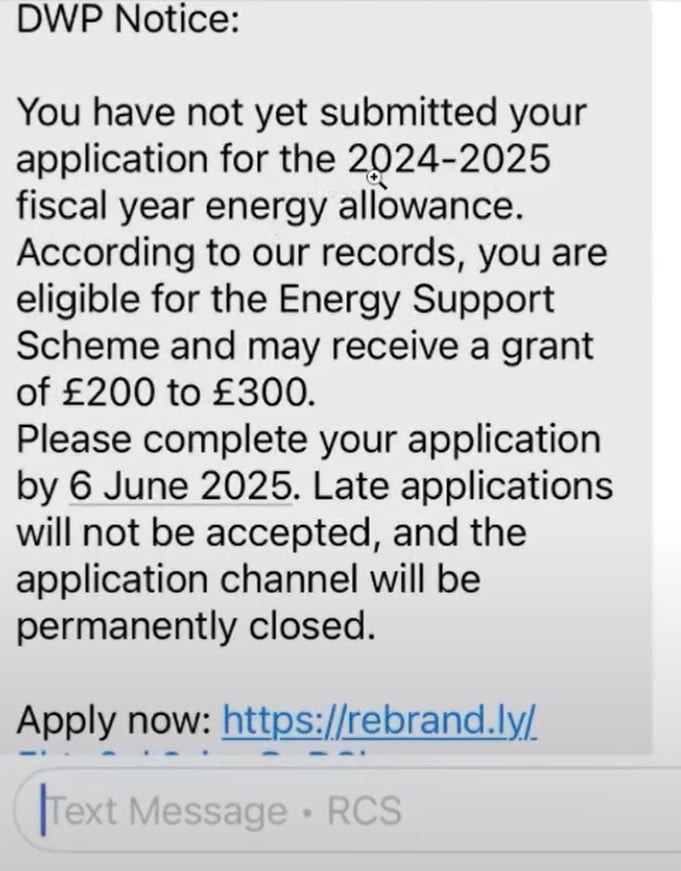
The message typically reads:
“You have not yet submitted your application for the 2024–2025 fiscal year energy allowance. According to our records, you are eligible for the Energy Support Scheme and may receive a grant of £200 to £300. Please complete your application by 6 June 2025. Late applications will not be accepted, and the application channel will be permanently closed.”
It ends with a shortened link that appears harmless but redirects to a phishing site. Here, users are asked to provide personal information, including their name, address, bank account details, and to pay a £1 “verification” fee. The fake urgency and professional tone are intended to lower your guard.
This particular scam operates on a psychology of fear and opportunity. It mimics genuine government messages in tone, structure, and urgency. The fact that energy bills are a pressing concern for many only increases the likelihood that a recipient might respond without questioning the legitimacy of the message.
Why People Fall for It
Scammers exploit urgency and legitimacy. The message mimics official communication formats, complete with deadlines, application language, and grant offers. For those already receiving government support or struggling with rising energy costs, the offer seems both timely and genuine.
Many people are conditioned to trust texts that appear to come from known institutions. The Department for Work and Pensions is a name most UK citizens recognize and respect. When such a message uses familiar branding and a convincing tone, it’s easier for users to miss red flags. Additionally, some recipients may be under stress or experiencing financial hardship, making them more vulnerable to manipulation.
Another factor is the use of trusted branding. By invoking the DWP, the scam immediately taps into a recognized institution. The text also avoids obvious grammar mistakes that often mark less sophisticated scams, making it harder to detect.
Scammers are skilled at using persuasive techniques to override a person’s critical thinking. The seemingly small payment request (£1) feels insignificant, lowering resistance and making it easier for someone to proceed. Once the initial step is taken, it becomes easier to fall deeper into the scam.
Telltale Red Flags
- No .gov.uk domain: Official government websites always use
.gov.uk. Scam links usually redirect from shortened URLs likerebrand.lyor similar services. - Unusual sender format: Many of these texts are sent through group chats or anonymous numbers.
- Requests for payment: The UK government will never ask you to pay upfront to receive benefits.
- High-pressure tactics: Deadlines like “6 June 2025” are meant to induce panic and bypass your skepticism.
- Sensitive information request: No legitimate institution asks for your bank details over text.
- Lack of official verification: Real government communications offer ways to verify through official channels.
Social Media Reports
Reddit users have widely shared their experiences, noting how the scam preys on people’s trust. Many flagged the suspicious use of a £1 verification fee and group text format as clear indicators that something was off. Others forwarded the texts to the National Cyber Security Centre (NCSC) or reported them via 7726, a number dedicated to reporting SMS scams.
One user reported receiving the message through a group chat that included strangers, which immediately raised suspicions. Others shared that the tone of the message was uncharacteristically pushy for an official government agency, which helped them identify it as a fraud.
Major news outlets have also issued warnings, noting that the scam is especially harmful because it targets financially vulnerable individuals. The combination of urgency, financial reward, and seemingly official language makes it one of the more dangerous phishing attempts in recent times.
How The Scam Works: Step-by-Step Breakdown
Step 1: Initial Contact
The scam starts with a mass text or email blast. These messages are often sent via group chat or from numbers that appear random or international. The message claims to be from the DWP and includes personalized-sounding details to make it seem credible.
Scammers may use spoofing techniques to make the number appear more legitimate or even look like it’s coming from a UK government source. This deception increases the likelihood of engagement.
Step 2: Hook With a Financial Incentive
The message states you are eligible for a £200 to £300 energy allowance. This sum is carefully chosen—not so large as to seem implausible, but significant enough to grab attention, especially for individuals facing high energy bills.
By referencing a believable and desirable financial benefit, scammers bait recipients into engaging. This technique relies on the principle of reciprocation: you’re being “offered” something, so you feel inclined to take action.
Step 3: Fake Urgency
To push the recipient into action, the message includes a hard deadline, such as “apply by 6 June 2025.” It claims the application channel will close permanently if you don’t act, creating a sense of scarcity and fear.
Urgency is a classic scam tactic. People are less likely to verify information when they feel time is running out. This step is designed to cut through logical analysis and push recipients into a reactive state.
Step 4: Suspicious Link
The message includes a shortened URL, often using services like rebrand.ly. This conceals the true destination of the link, which leads to a fake website designed to resemble an official government page.
These pages are often near-identical to real government websites, complete with logos, colors, and phrasing that mimic authenticity. Some even use SSL certificates to appear secure.
Step 5: Data Harvesting
Once on the site, users are prompted to enter personal details, including full name, address, and phone number.These are later sold or used for identity theft.
This harvested data can be used for a wide variety of fraudulent activities. From opening bank accounts to filing tax returns or applying for government aid, the value of such data on the black market is high.
Step 6: Payment Request
A final step often involves asking for a nominal fee (£1) to “verify” your bank account. This is a common tactic used to gather card details under the guise of a minor charge.
The psychological trick here is simple: the amount is so small that it doesn’t raise alarms. But once the scammer has your card details, they can quickly make unauthorized transactions or sell the information.
Step 7: Financial and Identity Theft
Once scammers have your data, they can:
- Withdraw funds from your account
- Open credit cards or loans in your name
- Commit benefit fraud
- Sell your information on the dark web
- Attempt further scams using your identity
In many cases, victims don’t realize the extent of the theft until weeks or months later. By then, the damage may already be severe.
What To Do If You Have Fallen Victim
If you clicked the link, entered details, or made a payment, act immediately. Here’s what you should do:
- Contact Your Bank Immediately
- Report the incident.
- Freeze your card or bank account.
- Monitor transactions and request chargebacks if needed.
- Ask if they can issue a new card or account number.
- Report to Action Fraud
- Visit actionfraud.police.uk
- Provide all details of the scam.
- Retain any emails, texts, or screenshots for your report.
- Forward the Message to 7726
- This helps mobile providers block the number.
- It contributes to national scam tracking databases.
- Notify the National Cyber Security Centre (NCSC)
- Forward phishing emails to
report@phishing.gov.uk. - Their analysts may use the data to bring down the scam site.
- Forward phishing emails to
- Change Affected Passwords
- If you reused passwords elsewhere, update them with strong, unique credentials.
- Consider using a password manager to generate and store secure passwords.
- Enable Two-Factor Authentication (2FA)
- Add 2FA to all accounts that support it, especially email and banking.
- This adds a layer of protection even if passwords are compromised.
- Monitor Credit Reports
- Use services like Experian or Equifax to check for fraudulent activity.
- Consider placing a fraud alert or credit freeze.
- Inform Family and Friends
- Warn others so they don’t fall victim to the same scam.
- Share this article or similar resources for awareness.
- Stay Alert for Follow-Up Scams
- Scammers may try to contact you again posing as fraud recovery agents.
- Always verify the identity of anyone who contacts you about fraud.
The Bottom Line
The DWP is not contacting people via text to apply for an energy grant. Any message claiming so, especially one that asks for a payment or personal information, is a scam. Always verify URLs, avoid clicking suspicious links, and never share sensitive details via text.
Scammers are becoming more sophisticated, blending urgency with familiarity to trap victims. By staying informed and cautious, you can avoid falling into these traps and help others do the same. This scam highlights the importance of digital literacy and critical thinking in today’s connected world.
If in doubt, contact the official agency directly. It only takes a few minutes to verify, but it could save you a lot of trouble. Government institutions like the DWP will never ask for sensitive information or payments via text message.
Stay safe, stay skeptical, and always double-check.
Frequently Asked Questions (FAQ) About the DWP Energy Support Scheme Scam
What is the DWP Energy Support Scheme scam?
The DWP Energy Support Scheme scam is a phishing attempt where fraudsters send fake texts or emails pretending to be from the Department for Work and Pensions (DWP). These messages claim you are eligible for a £200 to £300 energy grant for the 2024–2025 fiscal year and urge you to apply through a suspicious link. The goal is to collect personal and financial information, often requesting a £1 fee to “verify” your bank account.
How can I tell if a DWP energy grant message is a scam?
Look for these red flags:
- The link does not contain
.gov.uk. - It comes from an unknown number or group chat.
- It asks for sensitive information or a payment.
- It uses urgent language like “apply now” or “channel will close permanently.”
- It offers a grant or benefit you didn’t apply for.
Legitimate DWP messages will never ask for payments or sensitive data via text.
Is the government really giving out a £200–£300 energy allowance?
While the UK government has provided energy support in the past, these programs are always announced on official websites such as GOV.UK. They do not require any upfront fees or verification payments. Always verify any new support schemes through official government channels before acting.
What should I do if I clicked on a suspicious link?
If you clicked on the link but didn’t enter any information, you may still be safe. However, you should:
- Run antivirus or antimalware software.
- Clear your browser cache and history.
- Avoid visiting the link again.
If you entered any personal or financial information, follow the steps outlined in the “What To Do If You Have Fallen Victim” section of this article.
Where do I report a scam DWP message?
You can report the scam to:
- 7726 by forwarding the message from your phone
- Action Fraud at actionfraud.police.uk
- National Cyber Security Centre (NCSC) via
report@phishing.gov.uk
These agencies work to shut down scam operations and protect the public.
Why do scammers ask for £1?
The £1 fee is a psychological trick. It feels small and harmless, but the real goal is to steal your debit or credit card details. Once you enter them, scammers can make unauthorized purchases or sell your data online.
Can scammers steal my identity with just my name and address?
Yes. When combined with other details like your bank account number or National Insurance number, scammers can commit identity theft. They may open accounts in your name, apply for loans, or access government services fraudulently.
What is the safest way to check if a message is really from DWP?
Always check:
- The sender’s contact information.
- The link’s domain (it should end in
.gov.uk). - Official announcements on gov.uk
If in doubt, contact DWP directly using a verified phone number or website.
Are there other similar scams I should be aware of?
Yes. Common scams in the UK include:
- HMRC tax rebate scams
- TV licensing refund scams
- Royal Mail delivery fee scams
- Bank text messages asking to verify suspicious transactions
Always treat unexpected messages asking for personal or payment info with caution.








