

Ellie Seattle looks like the kind of small, heartfelt brand you want to support.
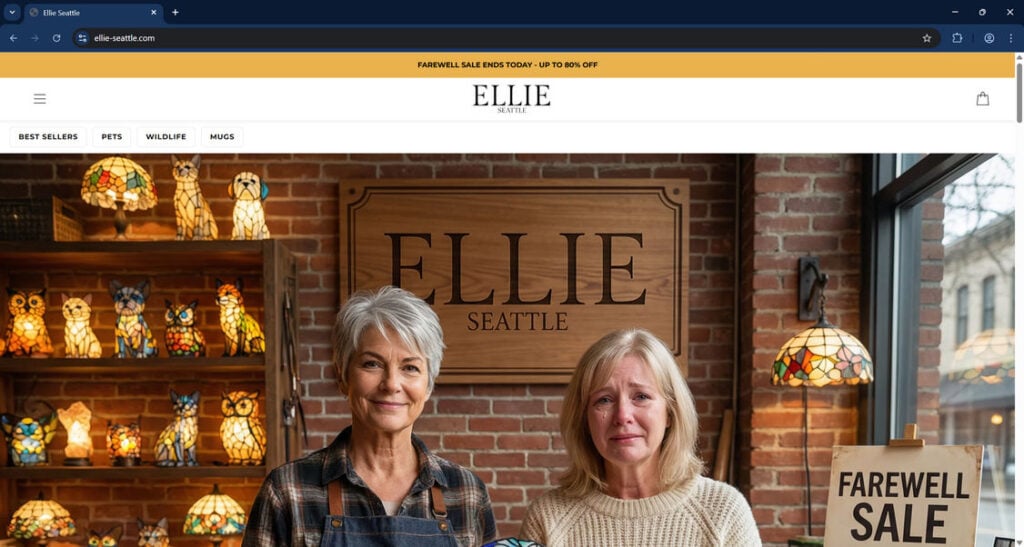
A polished website. Warm “family studio” vibes. Beautiful lamp photos that feel handcrafted. Then the hook: a farewell sale, anniversary sale, or special event sale offering up to 80% off, sometimes “ending today.”
If you felt tempted to buy quickly because the deal looked rare, that reaction is normal.
These campaigns are designed to create urgency first and answers later. And in many cases, the experience shoppers report afterward is not a charming boutique purchase. It is a familiar e-commerce trap: dramatic discounts, stunning images, vague brand details, slow overseas shipping, and a return process that quietly becomes impractical.
This guide explains the Ellie Seattle Lamps Sale scam pattern, how it usually works, what red flags to look for, and what to do if you already ordered.
Scam Overview
The “Ellie Seattle Lamps Sale” model fits a broader category of pop-up storefronts that spread fast through social ads.
They are built to convert impulse purchases, not to operate like a stable retail brand.
The formula is consistent across many names and niches: clothing boutiques, jewelry “final collections,” furniture blowouts, and now “handmade” decor like stained-glass style lamps. The brand name changes, but the mechanics remain familiar.
The story you are sold: a real studio saying goodbye
On the surface, the Ellie Seattle pitch tends to include:
- A sentimental origin story (often family-run, sisters, mother and daughter, or a small studio)
- A reason for extreme discounts (farewell sale, anniversary sale, special event sale, closing sale)
- Scarcity language (“ends today,” “limited stock,” “only a few left”)
- Trust symbols (money-back guarantee, fast shipping, secure checkout icons)
- A catalog full of visually striking products that feel “too good for the price”
That combination is powerful because it appeals to both logic and emotion:
- Logic: “I’m getting a premium product at a huge discount.”
- Emotion: “I’m supporting a small maker before they disappear.”
The problem is that scammers and low-accountability dropshipping networks know exactly how well this story converts.
They do not need a real studio. They need a convincing page.
What shoppers often report after ordering
When a sale site is legitimate, it behaves like a normal retailer:
- Clear shipping timelines
- A stable customer service presence
- Straightforward returns with realistic addresses and instructions
- Consistent product quality that matches the photos
With high-risk pop-up sale sites, the pattern buyers often describe looks different:
- Shipping takes far longer than implied (often weeks)
- Tracking updates are slow, confusing, or inconsistent
- Products arrive from overseas, commonly from China-based fulfillment networks
- The item looks cheaper than expected or does not match the listing photos
- Customer support stalls, offers partial refunds, or makes returns difficult
The returns problem is one of the biggest tells.
Many of these operations technically “allow returns,” but the process can be designed to discourage you:
- You must ship back internationally at your expense
- The return address is overseas
- You must use tracked shipping
- Refund happens only after inspection
- Support keeps pushing partial refunds instead of a full refund
In practice, that can make returning a low-cost item irrational.
If the product was discounted to $44.95, but return shipping costs $25 to $60, many buyers give up. That is not an accident. It is part of the business model.
Why the images are the real sales engine
With lamp scams and decor scams, images do most of the persuasion.
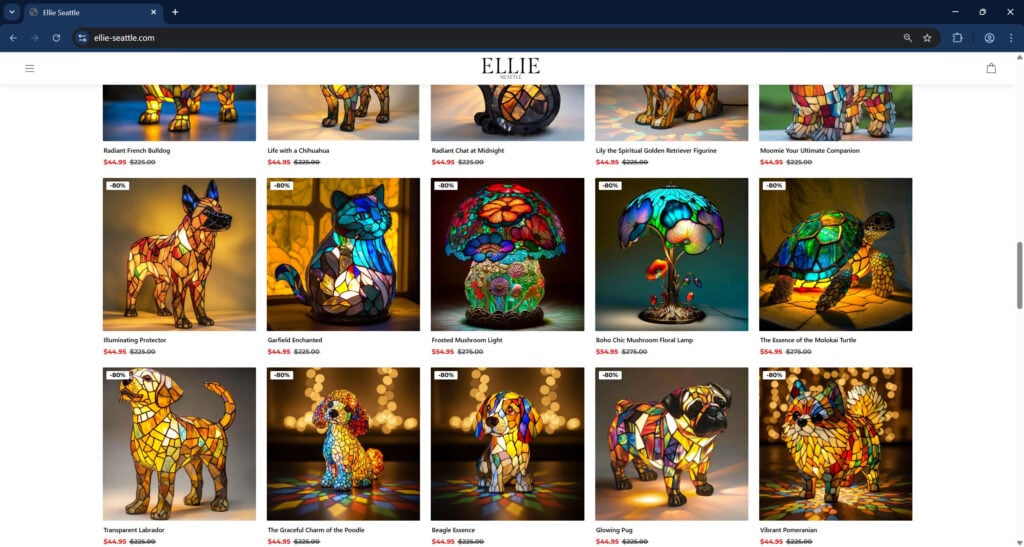
Ellie Seattle-style listings often show vivid, “handcrafted” stained-glass animal lamps with perfect lighting, perfect color balance, and flawless surfaces. Some catalogs also mix themes like pets, wildlife, and gift items, which creates the feel of a curated studio collection.
But photos can be misleading in several ways:
- Borrowed images from other stores, artist portfolios, or marketplaces
- Supplier catalog images that do not reflect what ships
- Heavily edited images that make cheap materials look premium
- AI-generated product images that present an item that does not exist in real form
Even when something arrives, it may be a cheap plastic lamp, a printed acrylic panel, a low-grade imitation, or a smaller version than expected.
This is why “it arrived” does not automatically mean “it was legitimate.”
Why the discounts are so extreme
A normal discount encourages comparison.
A farewell sale encourages reaction.
When you see “up to 80% off,” your brain does this fast math:
“If the original price was $225 and it’s now $44.95, even if it’s only decent, it’s still worth it.”
That mental shortcut is what these campaigns want.
In many questionable storefronts, the “original” price is inflated or meaningless. The entire purpose of the crossed-out price is to create a sense of winning.
Common price anchoring signals include:
- Large markdowns on almost every item, not just a few
- The same “percentage off” repeated across the catalog
- A countdown banner that resets or always shows urgency
- “Ends today” messaging that seems permanent
Legitimate clearance sales exist, but they usually come with verifiable context:
a known retailer, a clear business footprint, real inventory constraints, and consistent customer service history.
Pop-up sale sites often provide the opposite: big claims, thin proof.
Reviews that feel reassuring, but do not prove anything
High-risk storefronts know most shoppers do not read policies.
People look for quick safety signals:
- “4.7/5 based on 9,000+ reviews”
- “Excellent”
- Customer photo thumbnails
- Trust badges like “30-day money back guarantee”
The problem is that on a standalone store site:
- Review widgets can be imported, recycled, or generated
- Review counts can be displayed without verifiable sources
- Review text can be generic and non-specific
A real review trail typically looks different:
independent platforms, long time ranges, critical feedback mixed in, and consistent brand naming across the web.
If everything positive lives only on the store’s own pages, you should treat it as marketing, not verification.
Why these stores appear and disappear
A common question is: “Why would a company run a ‘farewell sale’ if they can make money?”
Because the “farewell” narrative is often not about truth. It is about conversion.
The underlying model often looks like this:
- Launch a new storefront using a polished template.
- Run aggressive ads on Facebook, Instagram, TikTok, and similar networks.
- Convert impulse traffic with steep discounts and emotional storytelling.
- Fulfill orders cheaply through overseas suppliers.
- Handle complaints with partial refunds and delay tactics.
- Rebrand or shut down when reputation catches up.
That cycle can repeat with new names, new domains, and similar designs.
So the goal of this article is not just to warn about one name.
It is to help you recognize the entire pattern before you pay.
How The Scam Works
This style of shopping scam is often not “steal your card instantly” fraud.
It is more subtle: engineer a purchase that becomes hard to undo.
Below is a step-by-step breakdown of how the Ellie Seattle Lamps Sale scam pattern typically plays out.
Step 1: Social ads create urgency before you can research
Most people discover Ellie Seattle-style sites through ads, not search.
Common placements include:
- Facebook feed ads
- Instagram story ads
- TikTok-style video ads
- “Shop now” placements that look like influencer content
The messaging is rarely calm.
It pushes urgency:
- “Farewell sale ends today”
- “Anniversary event”
- “Special event sale”
- “Up to 80% off”
- “Limited stock”
- “Final hours”
This approach matters because urgency reduces your likelihood of doing basic checks like:
- searching for independent reviews
- verifying the company address
- comparing images across other sites
Step 2: The website looks “real enough” on the first screen
Once you land on the site, the first page is designed to feel established:
- a clean brand logo
- professional navigation
- category tabs (pets, wildlife, mugs, best sellers)
- big sale banner at the top
- a warm story or emotional imagery
It is not hard to build a site that looks legitimate.
Modern storefront templates make it easy to create a boutique aesthetic in a weekend.
That is why design quality alone is not evidence.
Step 3: The founder story replaces real verification
A typical tactic is to present a personal, wholesome narrative:
- small studio
- family-run
- two sisters
- “handmade with love”
- “with full hearts” language
- a farewell announcement
A story can be sincere, but it can also be a conversion tool.
When a story is used as a substitute for business transparency, you will often notice missing details like:
- unclear company ownership
- no verifiable physical location
- vague contact information
- generic policy pages
In other words, you are asked to trust the emotion, not the receipts.
Step 4: Price anchoring does the heavy lifting
Once you start browsing products, the pricing structure often looks similar across many items:
- large crossed-out prices
- big percentage savings like 70% or 80%
- “was $225, now $44.95” style markdowns
- consistent discounts across nearly the entire catalog
This is called price anchoring, and it is extremely effective.
It frames the purchase as a rare opportunity, even if the underlying product is inexpensive wholesale inventory.
Step 5: Trust badges and “guarantees” reduce hesitation
Next comes the reassurance layer:
- “secure payment”
- “fast shipping”
- “30-day money back guarantee”
- “24/7 support”
- payment icons like Visa, Mastercard, Apple Pay
These elements are easy to display and hard to verify in the moment.
They are there to move you from “maybe” to “buy” without leaving the page.
Step 6: Checkout is optimized for speed, not clarity
At checkout, questionable stores often add friction in the wrong places.
They make buying fast, but clarity slow:
- vague shipping windows (“delivery times vary”)
- policies hidden behind links
- upsells and bundles
- “buy more save more” offers
- scarcity prompts (“only a few left”)
The key detail is usually the least obvious: where the product ships from, and what returning it will require.
Step 7: Fulfillment comes from overseas suppliers
This is where expectations often break.
Despite the boutique story, many of these orders are routed to supplier fulfillment networks. Common signs include:
- tracking numbers that originate overseas
- long gaps between tracking updates
- packages arriving with unfamiliar labeling
- delivery timeframes that stretch beyond what the site implied
If the seller is dropshipping, they may never touch the inventory.
They are acting as a marketing layer between you and a supplier.
Step 8: The product arrives, and the quality mismatch shows up
A recurring complaint across this category is the “gap” between:
- what the product page suggested
- what the buyer actually received
With lamps and decor, that gap may show up as:
- cheaper materials than expected
- a smaller size than the photos implied
- rough finishing
- low-quality electrical components
- an item that looks like a simplified imitation of the original photo
- something that resembles the listing category but not the listing quality
Again, the point is not that nothing arrives.
The point is that what arrives may not match what you thought you were buying.
Step 9: Support becomes a negotiation loop
When shoppers complain, customer support often follows a predictable script:
- Apologize and ask for photos.
- Offer a partial refund like 15% to 30% if you keep the item.
- If you insist on a full refund, introduce obstacles:
- return shipping is your responsibility
- return address is overseas
- you must use tracked shipping
- refund only after inspection
This is not a customer-first process.
It is complaint containment.
The business goal is to reduce chargebacks and keep as much revenue as possible.
Step 10: Delay tactics try to push you past dispute windows
Card issuers and payment services have dispute deadlines.
Some high-risk sellers rely on delay to make the problem “expire.”
Common delay tactics include:
- “Please wait 3 to 5 more business days”
- “The warehouse is processing”
- “Your package is in transit”
- “Tracking will update soon”
- “We can offer a bigger partial refund”
If you are in this situation, the most important concept is simple:
Do not let politeness cost you your dispute window.
What To Do If You Have Fallen Victim to This Scam
If you already ordered from an Ellie Seattle-style sale site, focus on two priorities:
- protect your payment method
- build a clean paper trail
Here is a practical checklist you can follow without panic.
- Save evidence immediately
- Screenshot the product page, price, and photos.
- Screenshot the sale banner and any guarantees.
- Save the order confirmation page and email.
- Save the shipping policy and return policy.
- Document the charge on your statement
- Note the merchant name as it appears on your bank statement.
- Record the amount, date, and any extra charges.
- Watch for small “test” charges.
- Contact support with one clear request
Keep it short and specific:- “I am requesting a full refund.”
- “Please provide the refund timeline and return instructions.”
- If the order has not shipped, request cancellation
Even if they claim it is “processing,” ask in writing:- “Cancel this order immediately and confirm the refund.”
- If the item arrives and is not as described, document the mismatch
- Take clear photos in good lighting.
- Photograph packaging labels and inserts.
- Compare against your saved screenshots.
- Use the phrase “not as described” in your email.
- Do not accept a partial refund if you want a full refund
Partial refunds are commonly used to end complaints cheaply.
If you want a full refund, repeat:- “No partial refund. Full refund only.”
- Set a deadline
Example:- “If I do not receive confirmation within 48 hours, I will dispute the charge.”
- Escalate to a dispute or chargeback
- Contact your bank or card issuer.
- Provide screenshots and your email trail.
- File within the allowed dispute window.
- If you paid via PayPal, open a PayPal dispute
- Use the dispute process inside PayPal, not email promises.
- Upload screenshots and communication records.
- Watch for follow-up scams
After purchases like this, some buyers receive:
- fake delivery issue texts
- fake refund emails
- “verify your card” messages
Do not click unexpected links. Go directly through your bank or PayPal.
- Report the ad
Report it on the platform where you saw it (Facebook, Instagram, TikTok).
This does not fix your purchase, but it helps limit reach and creates a record.
The Bottom Line
The Ellie Seattle Lamps Sale pattern checks many boxes associated with high-risk pop-up storefronts: emotional storytelling, extreme discounts up to 80%, urgency banners that push fast decisions, and trust badges that are easy to display but hard to verify.
In many shopper complaints across this category, the real problems show up after checkout: slow overseas shipping, quality that does not match the images, and return policies that are technically possible but practically discouraging, especially when returns require shipping to China.
If you have not ordered, pause and verify the brand outside its own website. If you already ordered, save evidence now and escalate promptly if support delays or pushes partial refunds.
FAQ
Is Ellie Seattle legitimate?
“Ellie Seattle” is presented like a small studio brand, but the farewell sale and up to 80% off marketing style matches a common high-risk pattern used by pop-up storefronts. Treat it as high risk until you can verify independent reviews, business ownership, and a real operational footprint outside the site.
Is this a scam or just dropshipping?
Often it behaves like dropshipping dressed as a boutique brand. For shoppers, the practical impact can be the same: long shipping times, inconsistent quality, and difficult returns. If support pushes partial refunds instead of a clean return process, that is a major warning sign.
Why do they run farewell sales, anniversary sales, and event sales?
Because these “special sale” narratives create urgency. A farewell sale, anniversary sale, or event sale gives the seller a reason to advertise massive discounts like 70% to 80% off and pressure you to buy before you research.
Are the stained-glass lamp images real?
Sometimes product images are heavily edited, reused from other sources, or even AI-generated. A quick test is reverse image searching product photos. If the same image appears across unrelated sites, that is a red flag.
Why are the discounts so extreme, like 80% off?
Extreme discounts trigger impulse buying and reduce comparison shopping. In many questionable stores, the “original” prices are inflated to make the discount look bigger than the real value.
Where do these orders usually ship from?
Even when the site looks local, many orders in this category ship from overseas suppliers. That often means longer delivery windows and limited tracking transparency.
How long does shipping usually take?
Overseas fulfillment can take 2 to 6 weeks, sometimes longer. Tracking may update slowly or show confusing carrier handoffs.
What if my order never arrives?
Save your order confirmation, product screenshots, and all emails with support. Set a short deadline. If they stall, file a dispute or chargeback through your card issuer or PayPal before your dispute window closes.
My item arrived but looks cheap or different from the photos. What should I do?
Take clear photos of the item and packaging labels. Compare it to the product page screenshots. Then request a full refund using “not as described” language. If they offer 15% to 30% back to keep it and you want a refund, decline and escalate to a dispute.
Why do they offer partial refunds and tell you to keep the product?
Because returns cost them money and increase dispute risk. Partial refunds are a common tactic to reduce chargebacks while keeping most of the revenue.
Can I return it for a full refund?
Some buyers are told yes, but the return process may be made difficult: overseas return address, customer-paid tracked shipping, and delays. If you return anything, get instructions in writing and keep proof of shipment. If the costs are unreasonable, dispute the charge instead.
What should I say to customer support?
Keep it short:
- “The item is not as described. I am requesting a full refund.”
- “Please confirm the refund timeline and provide return instructions.”
If they push partial refunds, repeat: - “No partial refund. Full refund only.”
Should I contact my bank right away?
If support delays, refuses a refund, or creates obstacles, yes. Do not wait weeks. Dispute windows vary, and delay is often used to run out the clock.

Join the discussion
4 commentsShare your experience or ask a question about this article.
Community experiences
Did this happen to you?
Your experience could help someone recognize the same scam. Submit a private report for our team to review.
I experienced this tooReports are reviewed before publication. Sharing publicly is always your choice.
Discussion
Hopefully, this information will help if you are having problems with a return.
As it shows on the Ellie-Seattle web page, Logos Ecom LLC is actually the company. Logos Ecom LLC is a Domestic Limited-Liability Company organized under the laws of the State of Wyoming. The business was filed on June 24, 2025 and is currently listed as Active with the Wyoming Secretary of State. The official file number for this entity is 2025-001707265. The principal office address is located at 5830 E 2nd St Ste 7000 #26054 Casper, WY 82609. Mailing correspondence may be sent to 5830 E 2nd St Ste 7000 #26054 Casper, WY 82609.
Logos Ecom has created layers to keep you from reaching anyone to help, including a registered agent, who is like a legal firewall.
The Registered Agent on file is Republic Registered Agent LLC, located at 54 state street, Suite 804 Albany, New York 12207
I always check sellers on line that are not connected to a larger market, like Amazon.
Thanks for a great article Thomas!
In reply to Mia Roberts
Hi Mia, thank you for adding this information.
That kind of detail can be very helpful for people who are trying to understand who may be behind the site or where complaints can be directed. A lot of these online stores create layers between the customer and the real operator, which makes returns and accountability much harder.
And yes, checking sellers independently before ordering is one of the best ways to avoid getting caught by these kinds of sites. I appreciate you sharing this.
There is no “elle Seattle” store anywhere in Seattle or WA state. The “About us” page results in a 404 error. Not legit!
In reply to Jen
Great catch. A missing business footprint (no real store presence) plus broken pages like a 404 on “About Us” are strong signs of a fake shop. This is exactly the kind of quick verification that prevents losses.