

In recent months, a new wave of deceptive online stores has flooded social media platforms, each one pretending to be a long-established family jewelry business offering a once-in-a-lifetime “closing sale.” Among them, the so-called Ethan & Lara boutique has caught special attention. Their story seems heartwarming at first glance: a charming elderly couple, decades of craftsmanship, a final retirement sale, and spectacular jewelry pieces supposedly marked down from $139 to $0, requiring only a small shipping fee. But behind that polished façade lies a carefully engineered scam that traps thousands of shoppers into fraudulent subscription charges and stolen payment information.
This article exposes the full truth behind the Ethan & Lara scam: how it operates, why it works so effectively, what red flags consumers should look for, and — most importantly — what steps to take if you have already fallen victim. With a detailed investigation supported by real examples, domain records, checkout-page evidence, and behavioral analysis, the goal is simple: to help readers stay informed, avoid similar schemes, and protect their finances from predatory online frauds.
Scam Overview
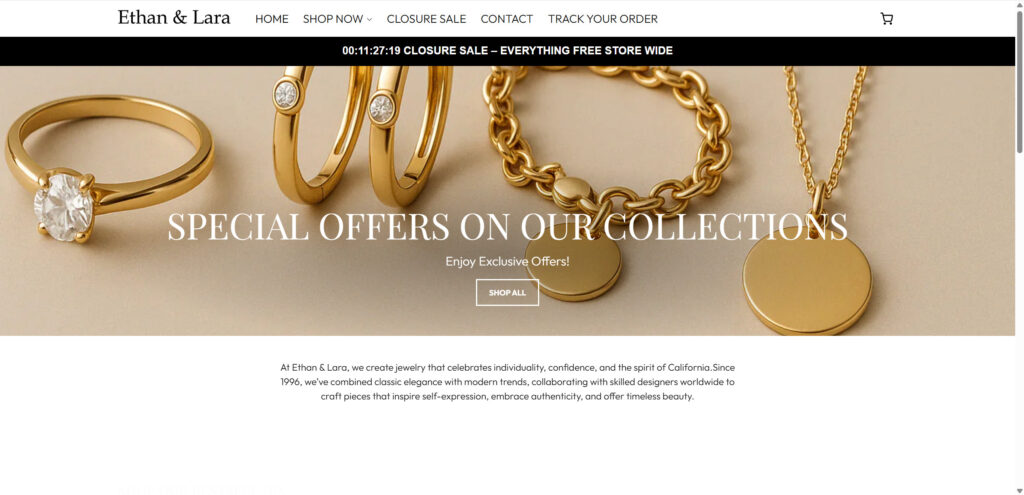
The Ethan & Lara Closing Sale Scam is a sophisticated, multi-layered operation designed to appear legitimate while quietly extracting money from unsuspecting victims. The scam revolves around the illusion of a nearly 30-year-old jewelry boutique that is supposedly shutting down and liquidating all inventory. The website displays professional photographs of rings, necklaces, earrings, and various pieces of ornate jewelry — often sourced from wholesale platforms or stolen from legitimate designers. The storefront shows massive discounts, usually reducing items from well over $100 to $0, with the user asked only to cover shipping costs.
At face value, this resembles a classic “too good to be true” deal. But what makes Ethan & Lara particularly dangerous is the hidden trap within the checkout process: the site quietly enrolls customers into a monthly jewelry club membership costing $29.99 per month, often without clear disclosure. Many victims never realize they’ve subscribed until multiple charges appear on their bank statements.
The Illusion of a Long-Running Business
The entire storefront is built around emotional storytelling:
- A heartwarming tale of Ethan and Lara, an elderly husband-and-wife team who supposedly handcrafted jewelry for decades.
- Professionally staged photographs of grandparents in a boutique workshop.
- “Since 1996” banners, suggesting nearly 30 years of operation.
- Testimonials showing happy customers from places like Chicago and Phoenix.
- Claims of being a “Proud American brand” — even though the domain is hosted on Icelandic servers.
This narrative intentionally targets emotions. Emotional marketing is one of the strongest persuasion tools in commerce — and scammers exploit it to override logic and skepticism.
Yet the domain ethan-lara.com was registered on October 21, 2025 — just days ago.
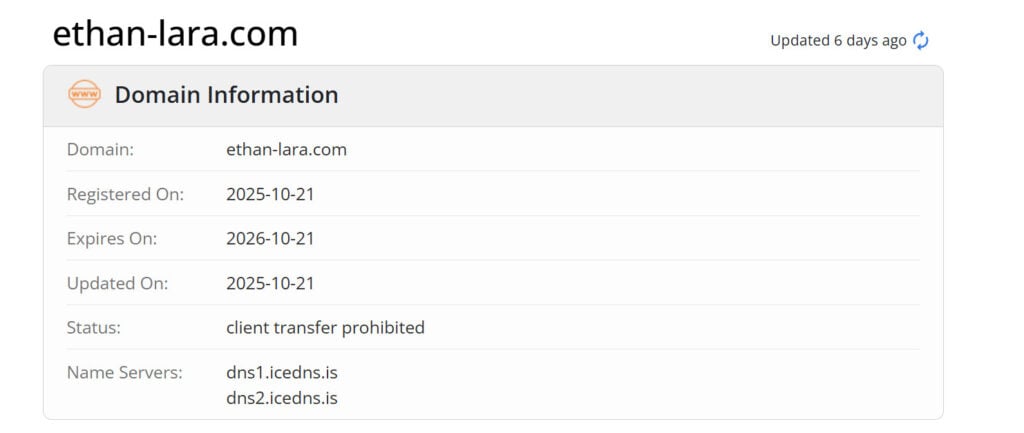
Nothing about this brand existed before that date.
That alone exposes the entire business story as fabricated.
The Fake “Free Jewelry” Promotion
The main hook of the scam is simple but extremely effective: offer high-quality jewelry at $0.
This technique works because:
- Consumers love freebies.
Behavioral studies show that “free” triggers irrational purchasing decisions. - $10–$12 shipping seems harmless.
Victims believe they are getting a $140 ring for only a small delivery fee. - The scammer profits instantly.
The shipping fee itself is pure profit because the jewelry does not actually ship from the United States — if it ships at all. - It lowers suspicion.
People think: “Worst case, I lose $10.”
But the real danger is not the $10 — it is the hidden subscription charges that follow.
The Real Trap: Forced Subscription Enrollment
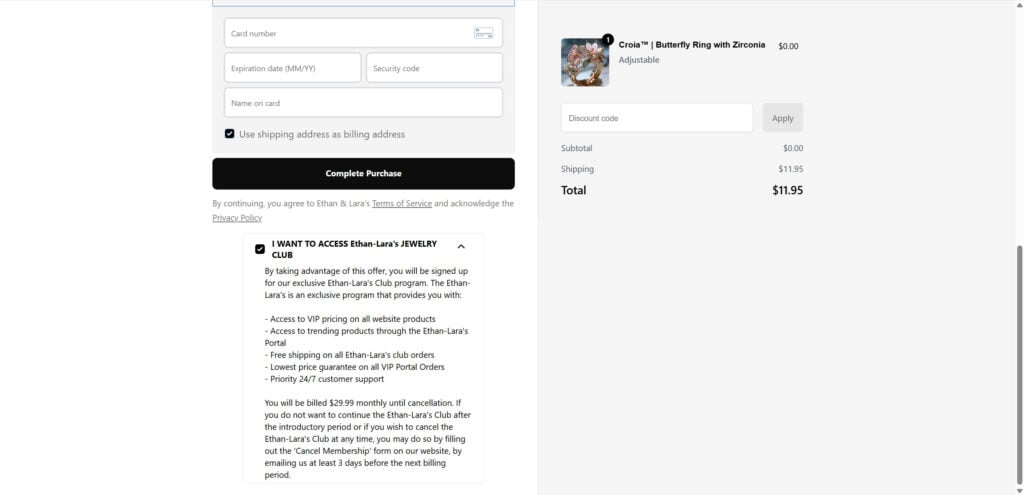
The checkout page reveals the scam’s true mechanism: a pre-checked box labeled “I WANT TO ACCESS Ethan-Lara’s Jewelry Club.”
Inside that box — often collapsed or disguised — lies the subscription agreement:
- $29.99 monthly charge
- Automatic recurring billing
- Must cancel at least 3 days before renewal
- No phone number available
- Cancellation only accepted through a vague email process
Many users never see this fine print. In fact, the website is designed to obscure it:
- The checkbox is pre-selected.
- The description is minimized or hidden behind a dropdown arrow.
- The page layout draws the eye toward the payment fields instead.
This deceptive design is known as a dark pattern, a manipulative UI tactic engineered to trick users into actions they wouldn’t normally agree to.
False Scarcity and Countdown Timers
Throughout the website, multiple urgency triggers are used:
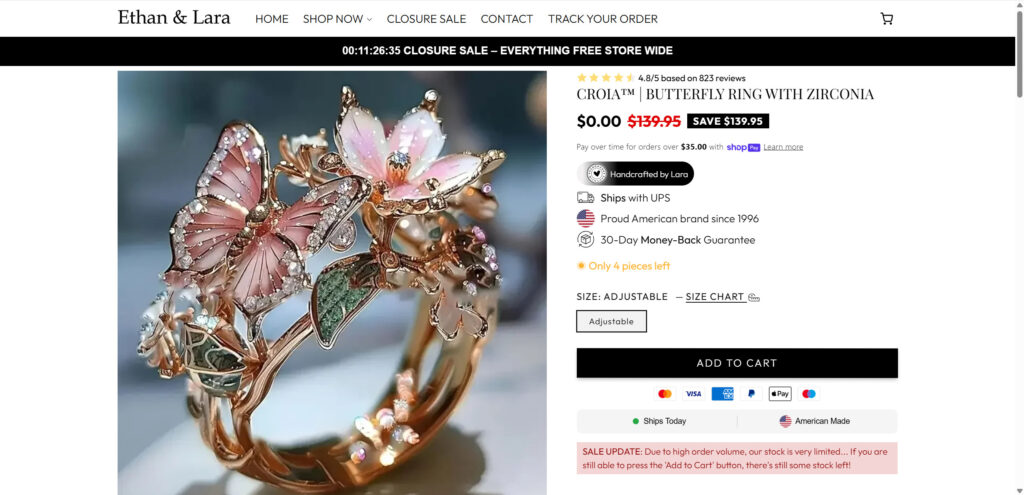
- “Only 4 pieces left”
- “Closure Sale: Everything Free Store Wide”
- Countdown timers suggesting the sale ends in hours
- “High order volume” warnings
- Red banners claiming “Last chance”
These psychological tricks are built to push shoppers into immediate action, bypassing rational evaluation.
Fake Customer Reviews and AI-Generated Photos
Nearly all reviews on Ethan & Lara are fabricated:
- Reviewers include generic names like “Olivia M.” or “Sophie C.”
- Photos appear to be AI-generated faces with vague, blurry features.
- The same reviews appear on dozens of identical scam stores.
- Star ratings remain fixed for every product.
The “Happy Customers” carousel — showing old, smiling people in a jewelry shop — is also AI-generated or stock photography.
The False “American Brand” Claim
Despite heavily promoting itself as a U.S.-based, family-run boutique, the domain is hosted on Icelandic nameservers:
- dns1.icedns.is
- dns2.icedns.is
This same hosting structure is used for hundreds of scam stores.
The business address “Mission Boulevard, San Diego” is also randomly inserted and often does not correspond to any actual jewelry shop.
- No business license.
- No corporate registration.
- No publicly verifiable identity for Ethan or Lara.
It is all fabricated.
How the Scam Works
The Ethan & Lara Jewelry Closing Sale Scam follows a highly strategic, step-by-step operation designed to look legitimate at every stage. Each element is carefully engineered to manipulate emotions, build trust, and guide victims into an unexpected subscription trap. The process is not random — it follows the same pattern used by hundreds of similarly structured websites.
Below is a detailed breakdown of how the scam works and why it is so effective at deceiving consumers.
Step 1: The Scam Begins With Aggressive Social Media Ads
Nearly every victim first encounters Ethan & Lara through a paid advertisement on Facebook, Instagram, TikTok, or YouTube. These ads are optimized using stolen photos, dramatic emotional stories, and free jewelry offers.
Common advertising patterns include:
- “Store Closing Forever — Everything Must Go”
- “Family Jewelry Shop Closing After 30 Years”
- “All Items $0 — Just Pay Shipping”
- “Grandmother-Owned Boutique Shutting Down”
- “Handcrafted Rings — Free Today Only”
Each ad features eye-catching product photos, typically high-end rings with gem-like materials. These pictures are not from the scammers — they are lifted from legitimate jewelers, artists on Etsy, Alibaba wholesalers, and Pinterest creators.
Because the images are visually stunning and the story emotionally compelling, consumers quickly click through.
Step 2: Victims Land on a Professional-Looking Jewelry Store
Despite being fraudulent, the Ethan & Lara website appears incredibly polished:
- Large hero images of rings, earrings, and necklaces
- Stylish fonts and well-lit product photography
- A heartwarming story about a couple running a boutique for decades
- Testimonials from alleged “customers”
- American flags and “since 1996” branding
- Countdown timers to create urgency
Scammers intentionally build sites that look cleaner and more modern than legitimate boutique shops — because appearance is the single most effective tool in online deception.
Key illusion elements include:
1. The “Ethan & Lara Story”
The website presents a touching narrative:
- A husband and wife started their shop in the 1990s.
- They handcrafted jewelry for years.
- “Lara” recently retired or passed away.
- “Ethan” is closing the shop in her memory.
- They are liquidating inventory to finalize retirement.
This emotional manipulation drives sympathy purchases.
2. Fake craftsmanship claims
The site insists each ring is:
- Handcrafted
- Made with love
- Ethically sourced
- Individually polished
- Packaged with care
None of this is true. Most never ship at all, and if an item does ship, it’s a cheap mass-produced ring from a drop-shipping platform.
3. Fake shop photos of elderly jewelers
Images of senior “owners” in a jewelry store are often AI-generated or stock photography. You may notice:
- Unnatural lighting
- Background inconsistencies
- Blurred hands
- Odd facial features
- No matching identities anywhere online
The couple does not exist.
Step 3: Products Are Listed at $0 to Lower Risk Perception
The hook is the outrageous $0 item price:
- “WAS $139.95 — NOW $0”
- “FREE TODAY ONLY”
- “YOU ONLY PAY SHIPPING”
Scammers know that “free” bypasses rational thinking.
Victims assume:
- “Even if the quality is bad, it was free.”
- “Worst case, I waste $10 on shipping.”
- “It’s sentimental, so maybe it’s legit.”
But the shipping price is irrelevant — the real danger is the pre-checked subscription box hidden in the checkout stage.
Step 4: The Checkout Page Hides a Subscription Trap
Once a victim clicks “Add to Cart,” they are taken to a checkout page that looks like every standard e-commerce checkout:
- Name
- Shipping address
- Billing address
- Credit card fields
- Order summary
But below the payment fields is the key element of the scam:
A preselected checkbox enrolling the customer into a jewelry subscription club
It is labeled something like:
“I WANT TO ACCESS Ethan-Lara’s JEWELRY CLUB”
The details are intentionally buried in collapsed text:
- $29.99 recurring monthly charge
- Charges continue until manually canceled
- Must cancel 3+ days before next billing
- No phone number for cancellation
- Must use an unreliable email form
- No guarantee of reply beyond automated messages
Most shoppers never expand the details.
Why the trap works:
- The checkbox is pre-checked.
- The text looks like a harmless upsell.
- The real billing terms are small and visually minimized.
- The user is focused on the “free” item, not fine print.
This is a classic negative option billing scam, where consumers are enrolled automatically unless they take explicit action to decline
Step 5: The Order Confirmation Email Provides No Real Information
After making a purchase, victims receive a “Thank you for your order” email. It often includes:
- Order number
- Estimated shipping time
- Links to tracking pages that never update
- A generic customer service email address
- No mention of the subscription charge
This encourages victims to believe the transaction was legitimate.
Within 24–72 hours, the first $29.99 charge appears.
Step 6: Recurring Charges Begin Every Month
Victims report:
- Multiple charges of $29.99 per month
- Charges occurring even after unsubscribing
- No response to customer service requests
- No working phone number to call
- Emails returned with vague or automated replies
Some victims are even charged multiple times in a single month.
At this point, the victim begins searching online for answers — and discovers they were scammed.
Step 7: The Store Eventually Disappears
Once enough complaints accumulate or the scam reaches a preset profit target, the website shuts down.
But the scammers are not done.
They simply:
- Register a new domain
- Copy the same site template
- Change the store name and story
- Launch the same ads again
Examples of similar clones include:
- LarasBoutique
- RoseElla Jewelry
- GoldenEraCraft
- ClaraHartMinnesota
- Bella’s Gems
- Henry’s Caps (different items, same structure)
- ByHenrysCaps
Every site follows the same structure, images, checkout dark patterns, and domain registration patterns.
The Ethan & Lara site is simply the latest version.
What To Do If You Have Fallen Victim
If you made a purchase on Ethan & Lara or a similar “free jewelry + shipping + subscription” scam, take immediate action. The longer you wait, the more money you risk losing to recurring charges.
Follow these steps carefully.
1. Contact Your Bank or Credit Card Provider Immediately
Explain the situation:
- You were misled into a subscription.
- The terms were hidden or unclear.
- You did not authorize recurring charges.
Ask for:
- Chargeback or dispute for fraud
- Blocking of future charges from the merchant
- Issuance of a new card number if needed
Banks deal with these scams frequently — many will refund the charges.
2. Cancel the Subscription Through the Website (If Possible)
If the site is still online:
- Access the cancellation form (even if it’s unreliable)
- Fill it out with your email address, order number, and cancellation request
- Save screenshots as proof
This documentation strengthens your chargeback case.
3. Take Screenshots of Everything
Document:
- Product page
- Checkout page with pre-checked box
- Hidden subscription text
- Ads you saw
- Emails from the company
- Domain WHOIS information (shows the domain was just registered)
- Payment receipts
This evidence is extremely helpful when disputing charges.
4. Monitor Your Bank Statements for 3–6 Months
Scammers often continue billing even after cancellation attempts.
Look for:
- Ethan & Lara charges
- Names like “Jewelry Club” or similar variations
- Unknown international charges
- Rebilling under new merchant names
Alert your bank if any appear.
5. Report the Scam to Relevant Authorities
Reporting helps bring the scam to the attention of regulators.
You can report to:
United States
- FTC Complaint Assistant
- IC3.gov (FBI Internet Crime Center)
- BBB Scam Tracker
- Your state attorney general
Europe
- Your national consumer protection agency
- Local police cybercrime units
Global
- econsumer.gov
The more reports these scammers receive, the faster authorities can respond.
6. Change Your Passwords
If you used the same email/password combination as other sites, change your passwords immediately. Scammers often attempt credential stuffing attacks.
7. Install Anti-Scam Protection Tools
To avoid future scams, consider:
- Malwarebytes Browser Guard
Helps block scam websites and prevents malicious scripts. - AdGuard
Reduces exposure to fake ads on Facebook, Instagram, and random websites.
These tools drastically reduce the likelihood of falling for similar scams again.
The Bottom Line
The Ethan & Lara Jewelry Closing Sale Scam is one of the most deceptive subscription-trap scams currently circulating on social media. It combines emotional storytelling, sophisticated dark patterns, and aggressive advertising to lure consumers into a fake “free jewelry” scheme that hides costly recurring fees.
Despite its polished appearance, the operation is built on lies:
- The business is not decades old.
- Ethan and Lara do not exist.
- The jewelry is not handcrafted.
- The store is not American-owned.
- The “free” items are not gifts — they are bait for membership enrollment.
- The domain was registered only recently.
- The checkout page intentionally hides the subscription.
Consumers must be cautious, skeptical of offers that appear too good to be true, and proactive in verifying the legitimacy of any online store — especially those offering luxury goods for free.
If you have fallen victim, swift action can stop future charges and recover lost funds. And by reporting the scam, you help prevent others from being targeted.
This scam is part of a growing global trend of temporary, fast-launching e-commerce frauds. Awareness is the strongest defense.
FAQ
Are the Ethan & Lara jewelry pieces real?
No. The jewelry shown on the website is typically stolen product photography or AI-generated imagery. Customers either receive nothing or receive extremely cheap, poorly made rings from bulk suppliers.
Why is everything priced at $0 on Ethan & Lara?
The $0 price is bait. Scammers use the promise of free jewelry to lure victims into paying a shipping fee and enrolling—often unknowingly—into a $29.99 monthly subscription.
Is Ethan & Lara a real family-owned business?
No. The story of a couple who ran a boutique for decades is fabricated. The domain was registered in October 2025, and no historical business record exists.
What is the Ethan-Lara Jewelry Club?
It is the hidden subscription victims are enrolled in at checkout. The box is preselected and designed to be overlooked, leading to recurring monthly charges.
Why is the checkout box pre-selected?
The pre-selection is intentional. It is a dark pattern designed to trick shoppers into agreeing to a subscription without realizing it.
How do scammers get away with this?
They frequently shut down their websites and relaunch under new names and domains. By the time enough complaints accumulate, the site disappears and a new one takes its place.
I already placed an order. What should I expect?
Expect:
- A confirmation email with vague shipping information
- No real tracking
- Delays or no delivery at all
- Monthly charges appearing on your bank statement
Act quickly to stop recurring charges.
Will my bank refund the charges?
In many cases, yes. If you explain that the subscription was hidden or deceptive, banks often consider it unauthorized and issue a chargeback.
How can I prevent falling for similar scams in the future?
Always check:
- The domain registration date
- Real, verifiable business information
- Independent reviews
- Whether discounts are suspiciously large
- Whether product images appear elsewhere online
Additionally, installing tools like Malwarebytes Browser Guard and AdGuard can block scam sites and fake advertisements before you ever see them.









well, I guess I fell for this ad. How do I recoup my money?
Personally I would try to contact your bank and see if they can do anything about it. Possibly change your card and move all of your money to the new one. Lock your card so nobody can use it until you unlock it. I hope this helps ❤️
That is sound advice and largely what we would recommend, so thank you for taking the time to help another reader. Two refinements worth adding, because they are the details that decide whether the money actually comes back.
Ask the bank for two separate things rather than one: a dispute or chargeback on the charges, and revocation of the merchant’s recurring authorisation. Locking or replacing the card alone is often not enough, because the card networks operate an account-updater service that automatically passes new card details to merchants holding a subscription – which is why people get billed again on a brand-new number. The wording that works is “revoke the merchant’s recurring authorisation and block this merchant”, and then ask for a new card number as well.
Moving money to a new account is worth doing only if bank login details or account numbers were exposed, rather than just a card – for a card-only problem, a new card number is enough and moving everything creates a lot of work with direct debits.
The card lock feature in banking apps is genuinely useful, though, and underused. Two other free things worth mentioning to anyone in this position: switch on transaction alerts for every purchase, and place a security freeze with all three credit bureaus if identity details were given out.
Hi,
I’m sorry this happened. The good news is that many people can still recover their money, especially if they act quickly.
Because these overseas shopping scams often use rotating company names and hard-to-use return policies, the best path is usually your payment provider, not the seller.
Here’s what to do:
Contact your bank or card issuer today
Ask for a dispute/chargeback. Use the reason that fits your situation:
“Item not received” (if nothing arrived)
“Item not as described / counterfeit / misleading advertising” (if what arrived is low quality or different than the ad)
“Canceled but charged” (if you tried to cancel and they billed you anyway)
If they keep charging you, ask the bank to block the merchant and consider issuing a new card number.
If you paid with PayPal
Open a dispute immediately and escalate it if the seller delays. Upload evidence:
screenshots of the ad and product page claims
your receipt and order confirmation
any emails where you asked to cancel or requested a refund
photos of what you received and the packaging label
Important: Don’t accept a small partial refund if it would close your PayPal case unless you are completely satisfied.
Don’t pay extra “fees”
Ignore requests for restocking fees, cancellation fees, customs fees, or “refund processing” payments. That’s a common scam tactic.
Be careful with returns
Many of these sellers provide return steps designed to fail (expensive overseas shipping, vague addresses, long delays). Only return the item if PayPal or your bank specifically requires it, and only with tracking plus proof of posting.
Save evidence now
Take screenshots of the website’s refund policy, the listing, and your order details. Scam sites often disappear or change quickly.
If you need more help, just reply. The fastest single step is starting the dispute with your bank/PayPal using the merchant name shown on your statement.