

The ad says a familiar-looking store is closing after decades. Leather bags, tools, jewelry, or furniture that supposedly cost hundreds are now marked down by 70% or 80% for one final day.
Facebook clearance sale ads turn that sad little business story into a checkout rush. The names and products change, but the closing clock has a habit of restarting tomorrow.
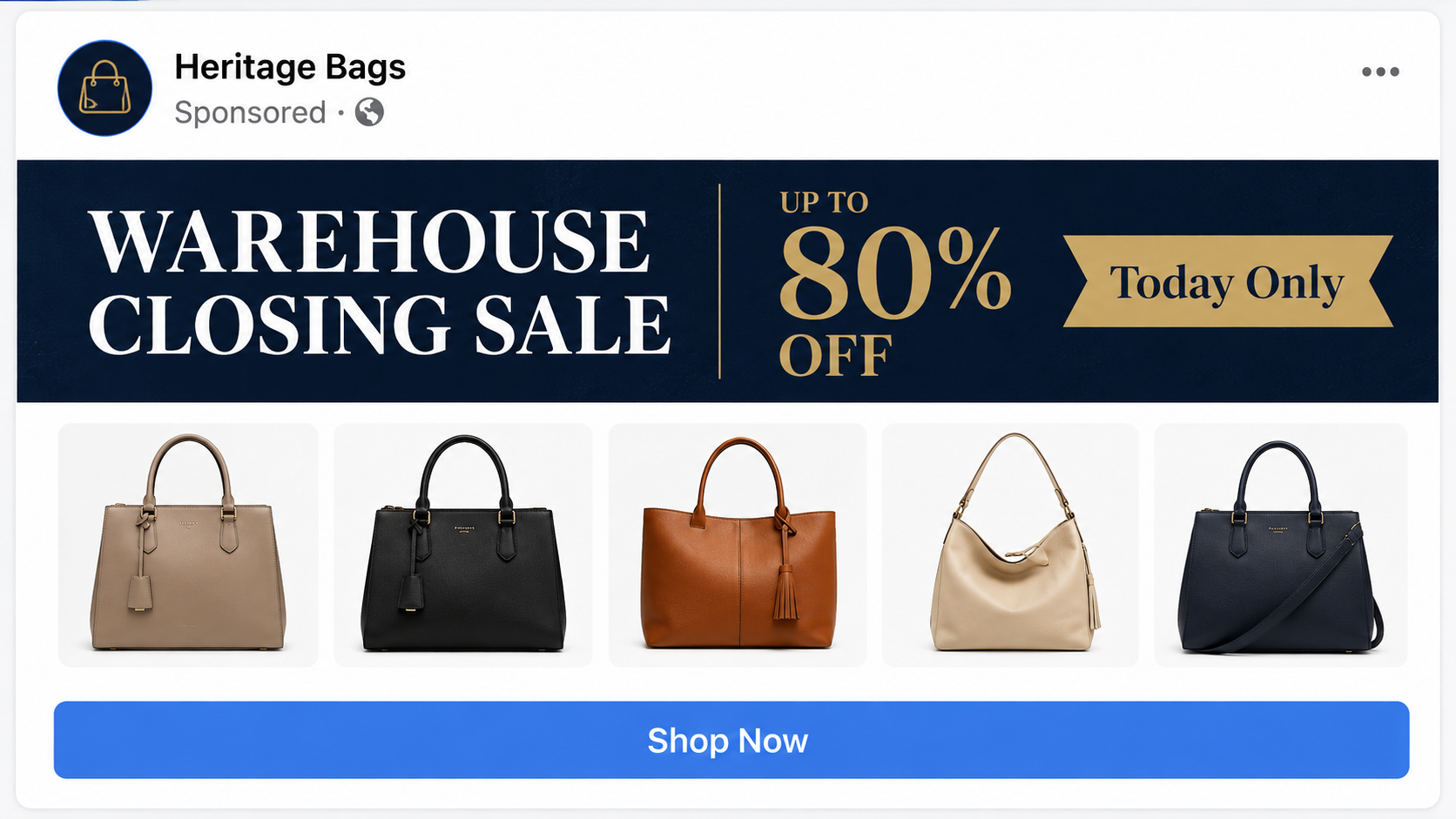
The photographs may be real. They can be copied from a designer, wholesaler, marketplace seller, or another shop that has never heard of the sale.
The store page may also look complete, with reviews, shipping promises, and a family history. None of those sections prove that the advertiser owns the products or can deliver the order.
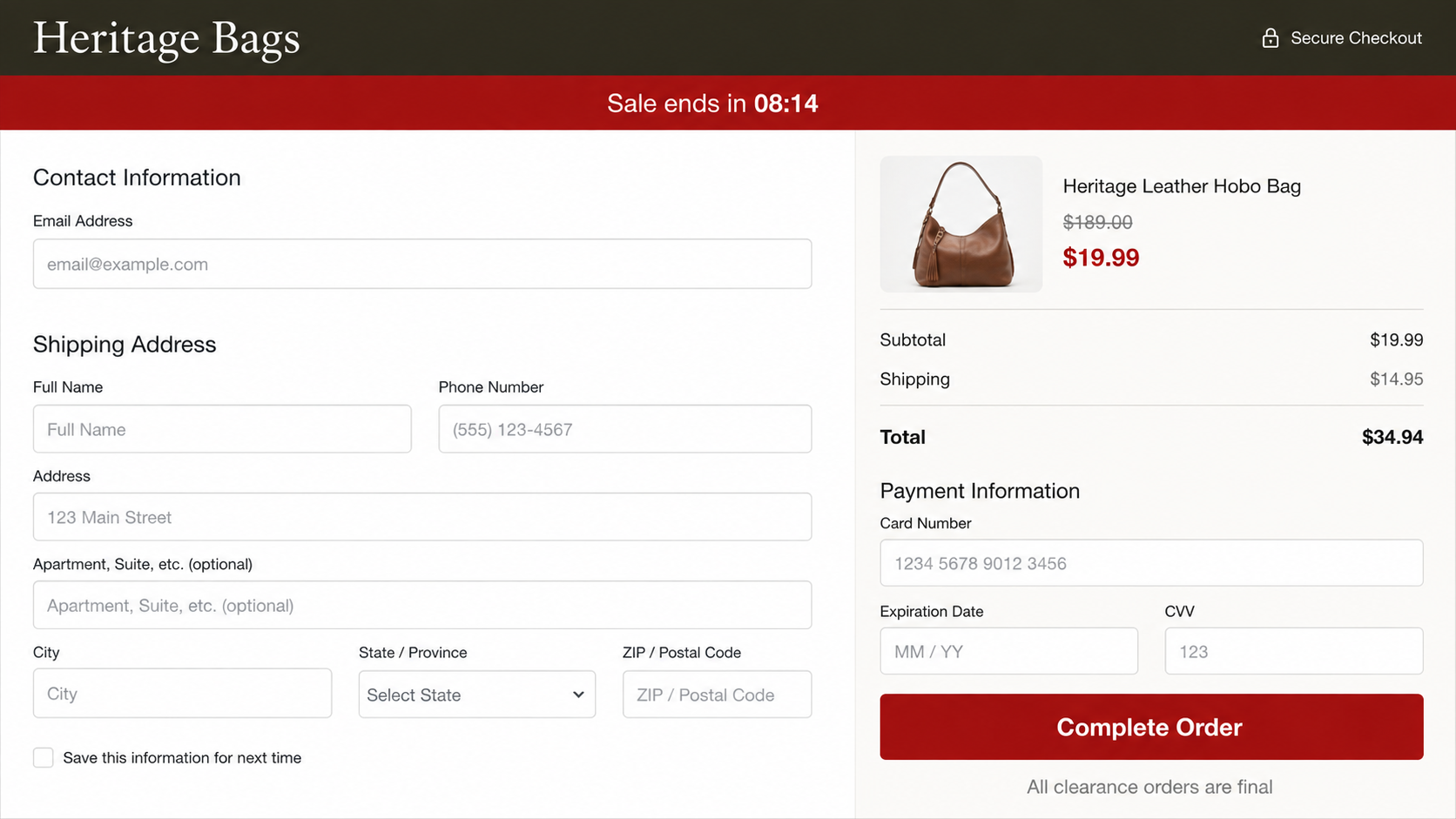
The decisive moment comes at checkout, where the huge discount is joined by shipping, final-sale language, and a card form controlled by a store that may be disposable.
Overview
The advertisement sells a story before it sells a product
The most effective ads do not simply say cheap bags or cheap tools. They describe retirement, a warehouse closure, a family emergency, or a local shop forced out of business.
That story explains the impossible price and discourages comparison. A buyer who thinks the inventory will disappear today is less likely to search the photos, company name, and domain history.
The storefront can be replaced as quickly as the advertisement
The same product feed, review text, policy template, and checkout layout can appear under many shop names. When complaints accumulate or an ad account is disabled, another domain can take its place.
Common elements include:
- a 70% to 90% closing discount;
- a countdown that resets on refresh;
- stolen product photographs and descriptions;
- a recently created shop with an invented history;
- all-sales-final or vague return wording;
- unexpected shipping added at checkout;
- tracking that never progresses or shows another destination;
- a cheap substitute instead of the advertised item.
The scale is far larger than one disappointing order
The FTC reported that people lost more than $95 million in 2025 to scams that began after ordering something through a social-media advertisement. Because many losses are never reported, the actual total is likely higher.
That figure does not mean every Facebook or Instagram ad is fraudulent. It shows why placement inside a trusted feed cannot replace checking the seller.
Why the Closing-Sale Story Converts So Well
A genuine closure sale is plausible. Real stores retire, lose leases, clear seasonal stock, and liquidate warehouses. Scammers borrow that familiar event because it answers the buyer’s first question: why is this so cheap?
The emotional version adds a founder’s photograph, a farewell letter, or a claim that a small family team cannot compete with large retailers. The reader is encouraged to help while getting a bargain.
Scarcity then shortens the investigation. The ad may say the last batch is almost gone, the discount ends at midnight, or thousands of shoppers are viewing the same item.
These counters are easy to script. Refreshing the page or returning the next day may reset them.
Personalized advertising makes the product feel well chosen. Someone who recently searched for handbags, garden equipment, or pet supplies may receive a matching fake closure ad.
The targeting does not mean the platform verified the merchant. It means the advertiser paid to reach an audience likely to respond.
How the Facebook Clearance Sale Ads Scam Works
Step 1: The advertiser copies a desirable product catalog
Images and descriptions can be lifted from brands, marketplaces, review videos, and wholesalers. The copied material gives a new store an instant inventory and professional appearance.
The advertiser may remove visible logos while leaving recognizable product shapes and photography.
Step 2: A business-ending story justifies the price
The ad announces a warehouse closure, retirement, anniversary liquidation, or final family sale. The narrative changes with the product and target market.
The discount is framed as inventory disposal, not as a price that should raise questions.
Step 3: Social targeting delivers the ad at scale
The campaign purchases placement in Facebook, Instagram, or another social feed. It can test different videos, shop names, and emotional hooks across thousands of impressions.
Positive-looking comments may be planted, copied, or selectively displayed. Critical comments can be hidden.
Step 4: The landing page manufactures reassurance
The store displays star ratings, customer photographs, secure-checkout badges, and an About page describing years of trading.
Those claims may have no independent record. Some pages use review counts that remain identical across unrelated products.
Step 5: Checkout turns a bargain into a recoverable card charge
The product price can be joined by high shipping, package protection, or currency conversion. Final-sale language may appear only near the payment button.
Paying by card gives the buyer dispute rights, but the seller may delay until tracking or chargeback deadlines become harder to manage.
Step 6: Delivery problems create the final delay
Some buyers receive nothing. Others get a low-value substitute, an item unlike the advertisement, or tracking that shows delivery to another city.
Support may offer a small partial refund, demand expensive international return shipping, or stop responding.
Step 7: The campaign returns under a new storefront
Once the name becomes searchable alongside complaints, the operator can duplicate the template on another domain and launch new ads.
The closure story survives because it was never tied to a verifiable local shop in the first place.
Company, Address, and Fulfillment Checks
The shop name may not identify a legal company
Look for the legal entity in the terms, privacy policy, receipt, and card statement. A brand name alone is difficult to verify or pursue.
Conflicting company names across policies suggest the storefront was assembled from reused templates.
The address may be copied, virtual, or unrelated
Check whether the listed address belongs to the claimed store. A residence, mailbox, shared office, or unrelated retailer does not prove inventory or local operations.
A return depot in another country is not the same as the hometown workshop described in the advertisement.
Support often becomes a negotiation after payment
Test the contact method before ordering. A form with no published email, phone, or response history leaves little leverage.
After a complaint, template replies may offer 10% or 20% back while discouraging a full card dispute.
The product supply chain must match the advertisement
Search the product image and exact description. If the same item appears on wholesale marketplaces for a fraction of the claimed original price, the artisan or designer story may be false.
Country of origin alone is not the verdict. The issue is whether the seller truthfully identifies the manufacturer, materials, inventory, shipping point, and return route.
How to Check a Social-Media Store Before Buying
- Search the shop name, domain, email address, and policy phrases.
- Check when the domain was registered and whether that fits the claimed history.
- Reverse-search product images and compare wholesale listings.
- Read one-star reviews outside the seller’s own website.
- Open the return policy and locate the actual return address.
- Check whether the countdown resets after a refresh.
- Calculate product price, shipping, protection, and currency together.
- Prefer a credit card or PayPal Goods and Services over irreversible payment.
A discount can be genuine. A verifiable company should still exist after the timer reaches zero.
Do not let comments under the ad settle the question. Visit the page directly, search independently, and compare the legal details before supplying a card.
What Happens After the Order
The absence of an immediate problem can be part of the delay. A confirmation email and tracking number make the order feel active while the seller gains time.
Some tracking shows only that a label was created. Other numbers belong to low-value mail, another customer, or a shipment delivered somewhere in the same postal area.
A carrier may be able to confirm whether the package weight and delivery city match the order without revealing another customer’s private address.
If an item arrives, compare it with the exact advertisement. Material, size, brand marks, packaging, accessories, and country of dispatch can show whether the seller substituted a different product.
The support sequence often follows a predictable negotiation:
- wait several more business days;
- ask the local post office despite unusable tracking;
- offer a replacement for another shipping charge;
- offer a small partial refund;
- require tracked return to an overseas address;
- stop replying near the dispute deadline.
A partial refund can be reasonable in a genuine dispute, but it should not be used to erase a materially false advertisement. Keep the original promise visible when speaking with the payment provider.
Do not wait indefinitely because support says the package is moving. Write down the card issuer’s dispute deadline and the marketplace or payment processor’s protection period.
Why Fake Comments and Reviews Feel Persuasive
Comments under the ad provide social proof at the exact moment of doubt. A row of people praising delivery can feel more current than an independent review page.
The advertiser may hide criticism, limit comments, or populate the thread with generic praise. Stolen customer photographs can make those accounts appear connected to the product.
On the store itself, review dates may predate the domain. The same wording and customer names may appear across unrelated products or several shop templates.
Search a distinctive sentence in quotation marks. A review copied across multiple stores is evidence of a shared template, not several independent purchases.
Also check whether the review distribution looks natural. Hundreds of perfect ratings with no detailed criticism deserve more scrutiny than a smaller, mixed record on an independent platform.
A page with active comments is not automatically safer. Look at account age, posting history, and whether the commenters discuss specific details that match the item shown.
Search the store’s customer-service email and policy address separately. A single support identity serving many unrelated closing stores is a strong sign that the local-business stories are interchangeable.
Keep in mind that a real product can still be used in a false advertisement. The question is whether this seller owns the offer, can deliver it, and provides an honest return route.
That distinction keeps the investigation focused on verifiable conduct instead of assuming every inexpensive product or overseas shipment is fraudulent.
What to Do if You Have Fallen Victim to This Scam
- Save the complete sales trail. Capture the ad, landing page, product description, checkout total, confirmation, policies, tracking, emails, and card-statement descriptor. Ads and domains can disappear quickly.
- Send a clear written cancellation or refund request. State what was promised, what happened, the amount, and the remedy requested. Keep the message even if support does not answer.
- Open a payment dispute promptly. Contact the card issuer or PayPal and explain whether the item never arrived, was materially different, or was sold through deceptive advertising. Provide the saved evidence.
- Do not pay a second release or redelivery fee. A follow-up message may claim customs, insurance, or address verification is needed. Verify tracking through the carrier’s official site.
- Watch the card for new charges. Ask the issuer whether replacement is appropriate if card details were entered on an untrusted checkout. Dispute unfamiliar descriptors immediately.
- Secure the browser and device. Remove notification permissions or extensions installed by the store. Run Malwarebytes if a file or app was downloaded. AdGuard can help block known scam ads, trackers, and malicious destinations during future browsing.
- Report the advertiser and store. Use the ad’s reporting controls, then report the transaction to the FTC and relevant consumer authority. Include the advertisement ID and domain if available.
- Ignore recovery offers. A stranger who promises a guaranteed refund for an upfront fee is starting another scam. Work directly with the payment provider and official reporting channels.
Frequently Asked Questions
Are all Facebook clearance sale ads scams?
No. Real businesses advertise genuine sales. Verify the company, domain history, address, policies, and independent reputation instead of judging only the discount or platform placement.
Why does the same product appear under several store names?
Product images and templates are easy to copy. Multiple storefronts may use the same wholesale catalog, or a scam network may relaunch after one name attracts complaints.
Does a secure checkout badge protect my order?
No. A badge can be an image, and HTTPS only encrypts the connection. Neither proves that the seller has inventory, honors returns, or accurately describes the product.
What if tracking says delivered but nothing arrived?
Ask the carrier to confirm the delivery city, weight, and address when possible. Provide that evidence to the card issuer if the tracking number belongs to another shipment.
Should I return a cheap substitute overseas?
First ask the payment provider what evidence it requires. Expensive tracked return shipping can exceed the purchase value, and an unclear address may create another delay.
What payment method offers the best protection?
A credit card generally provides stronger dispute options than crypto, wire transfers, gift cards, or person-to-person payment. PayPal Goods and Services may also provide purchase protection under its terms.
The Bottom Line
Facebook clearance sale ads can combine stolen product photos, an invented closing story, a disposable storefront, and a checkout designed to convert urgency into card payments.
The ad platform is not the seller’s guarantee. Verify the legal company, address, product source, and return route before paying. A real shop can survive one independent search and one night without a countdown.

Join the discussion
0 commentsShare your experience or ask a question about this article.
Discussion
Start the conversation
Have a question or something useful to share? Add the first comment.