


The banner said the owner was sad to be shutting the shop for good. Prices started at $4.99, and electric dirt bikes cost less than a pair of jeans.
If you’re asking whether Finessven is legit, or you’re still waiting for an order, here’s what the store’s own pages and its buyers show.
Overview
A clearance sale that never ended
Finessven.com was a Shopline clothing store that traded through September and October 2025. Besides tracksuits and casual sets, it listed off-road e-bikes and electric motorbikes.
Its homepage announced “my store will be closing permanently” and called this the last chance at super discounted prices. The store did leave that domain, but only to reopen elsewhere.
Finessven.com is gone, and Caresute.com took over
Finessven.com no longer opens a shop. The domain was registered again on August 4, 2026, which means the original registration lapsed after the store moved out.
Whatever appears at that address later belongs to whoever bought the name. It can’t confirm, ship or refund an order placed in 2025.
By January 2026, the same Shopline store was trading on caresute.com with a new name and new products. That domain now fails with an expired security certificate.
Why Finessven can’t be trusted
Buyers describe paid orders that never shipped and support emails that went unanswered.
The bike prices alone settle it. No real seller ships a full-size electric dirt bike for $29.99, and none of Finessven’s business details led to anyone accountable.
- Status: finessven.com and caresute.com are both offline, and the store’s Shopline address now says the shop is closed.
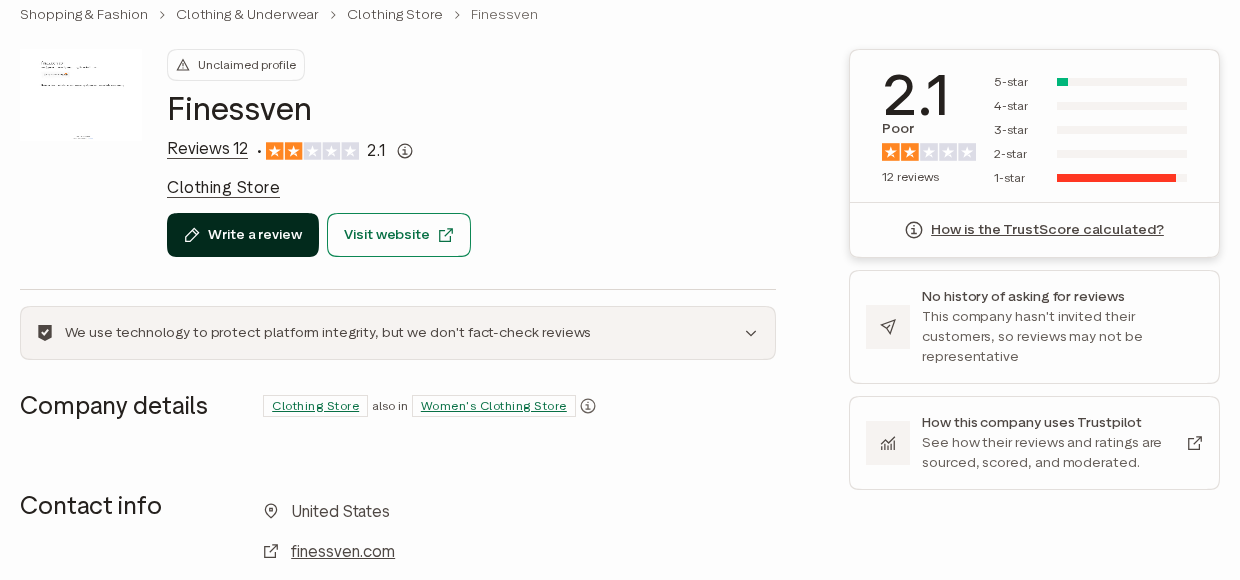
- Trustpilot: 2.1 out of 5 from 12 reviews, with 11 one-star ratings.
- Prices: e-bikes at $29.99 against a $499.98 list price, and club tracksuits around $10 to $12.
- Support: the e-bike page sent buyers to service@jamonlineca.com, an address tied to a fake store we reported in 2023.
- Company: a Hong Kong firm on Finessven, then a UK firm on Caresute, each beside a warning that it isn’t a return address.
Finessven Reviews: What Buyers Report
Finessven’s Trustpilot profile is unclaimed and has never invited customers to review. All 12 reviews were written by shoppers on their own, in October and November 2025.
Most reviewers are in the US, with others in Canada, the UK and Australia. Several of them bought e-bikes. None of the one-star reviewers says an order arrived.
The support channel failed as well. One buyer said the customer service email didn’t work, and two others said their messages about missing orders got no reply.
A US shopper lost $70 and recovered it only by calling the bank. A UK buyer said the order was confirmed but still hadn’t shipped, and wanted a refund.
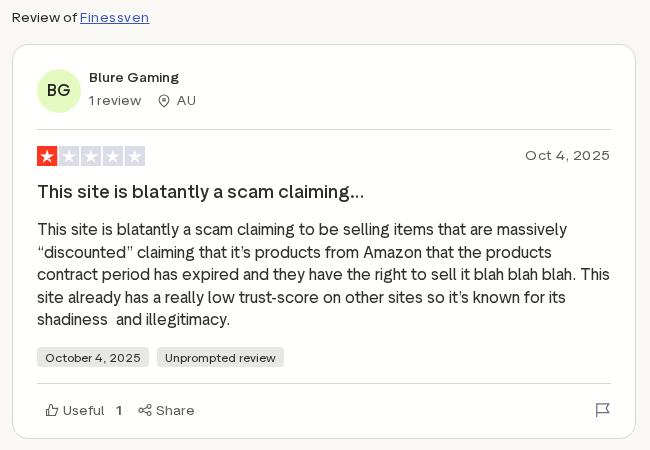
An Australian reviewer called out the store’s explanation for its prices as a scam. The reviewer also pointed to the low trust scores Finessven already had on other sites.
The only five-star review claims several bikes arrived within 48 hours. It is the sole account of a delivery anywhere on the profile.
How the Finessven Scam Worked
Step 1: A farewell sale to create urgency
A store that is closing has an excuse for deep cuts, and shoppers feel they must buy before it’s too late. That is why fake shops love a farewell story.
Our report on the Armand Nibosi watch sale shows the same trick dressed up as a watchmaker’s farewell. Finessven skipped the backstory and kept only the banner.
The catalog backed it up with cheap club gear. Tracksuits for FC Barcelona, Manchester United and France cost $10.59 to $12.00, beside a men’s two-piece set at $32.99.
The pages also loaded a Shopline sales pop-up app. Its purchase alerts come from the seller’s own settings, so they prove nothing about real orders.
Step 2: Motor vehicles at T-shirt prices
The bike listings were the real bait. One page offered a 55 mph off-road e-bike with a 60,000 mAh battery for $29.99, against a crossed-out $499.98.
That price belonged to the X160 version, which the page selected by default. The X260 option cost $36.99. Both came in four colors.
The specs contradicted the headline. The description quoted a 46.6 mph top speed and a 121.3-pound weight, matching Segway’s X260 Dirt eBike, a roughly $5,000 bike.
Another listing offered a custom purple 2023 Sur-Ron Light Bee X for $34.00, against $3,200.00. Its text credited the build to a different seller’s workshop.
At $34.00, the Sur-Ron cost about 1% of its own crossed-out price. No clearance sale explains a gap that wide.
On caresute.com, the same e-bike stayed at $29.99. A black Yamaha Raptor 700 ATV joined it at $39.90, marked down from $5,500.00.
Step 3: A cover story for the discount
The e-bike page answered the obvious question before buyers could ask it. The store said the bikes were Amazon backlog stock whose contract period had ended.
Its warehouse, the page said, therefore had the right to sell that stock cheaply to cut losses. The page never named the warehouse, the contract or the partner involved.
The same section promised shipping from the USA within 48 hours of payment, worldwide express delivery and round-the-clock support by email.
Step 4: A support inbox borrowed from another scam store
The 24/7 support address on the e-bike page was service@jamonlineca.com. That inbox belongs to Jamonlineca.com, a fake store we exposed in 2023.
Finessven’s own store settings named a different address, service@finessven.com. The e-bike listing was pasted in from another shop without even changing the contact line.
Step 5: A new domain and a new name
After the complaints of autumn 2025, the shop changed its address rather than its methods. Caresute.com was registered on December 16, 2025.
By January 2026 it showed the same closing-down banner and buy-3-get-1-free deal, now as Minecraft x Cool Shirtz. Hoodies and knits sold for $6.00, against $59 to $65.
The move also wiped the slate clean. Every warning, review and risk score attached to finessven.com stayed behind, while caresute.com started out with no record at all.
The store’s Shopline address now uses a third name, Clearance Co, with the support email service@caresute.com. It shows only a notice that the shop is closed.
Who Runs Finessven: Company Names, Addresses and Emails
Finessven named a Hong Kong company
The Finessven contact page listed Yicheng Network Technology Limited, company number 76828028, at the Yee Fat Industrial Building in San Po Kong, Hong Kong.
Next to the address, the page warned that it was not a return address. It listed no phone number, and the email line was left blank.
Even if that company exists, an office that refuses returns can’t help you send back a faulty bike or a wrong tracksuit.
Caresute switched to a UK company
On caresute.com, the contact page named Ardor Noah Trading Co. Ltd instead, with registration number 16199951 and an address in Kenilworth, Warwickshire, again marked as not a return address.
Companies House lists a company with that name and number, incorporated in January 2025 for IT services. It moved its registered office away from Kenilworth on January 30, 2026.
A genuine retailer doesn’t swap its legal owner each time it changes domains. With two different company names on one store, neither gives you anyone to hold to a refund.
The terms never name an operator
The Terms and Conditions open by saying who operates the website, then leave that spot to a script that prints the domain name.
Further down, the liability clause names a different shop, carflysun. The terms were copied from another store and never edited.
The contact template is older than Finessven
The not-a-return-address warning works like a fingerprint. The same wording appears on the contact pages of at least 15 fake stores we reported in 2023.
Otdaa.com paired it with a London address for Supic Company Limited. Folonas.com used it with an Irish address for FADEL-BEATTY LIMITED.
The company names change from store to store, while the template stays the same. That makes the company details decoration rather than a way to reach the seller.
Finsevit and FirstECN Are Different Sites
Both names look similar to Finessven, but neither shares its store ID, emails, theme or company details. Here’s what each one actually was.
Finsevit.com
Finsevit.com was a general online store with discounts of around 50% on everything from car parts and video games to clothing. Its domain is now on registrar hold.
It billed itself as an official licensed retailer without naming any brand that licensed it. Treat that claim with caution, even though Finsevit has no tie to Finessven.
FirstECN
FirstECN isn’t a shop. It was a forex and CFD trading site offering leverage of up to 1:200, run by Nakito SA, a company registered in the Comoros.
Its pages cited a brokerage license from the Mwali International Services Authority. In March 2025, Japan’s financial regulator warned that Nakito SA was soliciting derivatives trades online without registration.
The same company also appears on the investor-warning list of IOSCO, the global body of securities regulators. Nothing on either list connects FirstECN to Finessven.
The firstecn.com domain is now on registrar hold. If you funded an account there, ask for a withdrawal in writing and ignore anyone selling recovery services.
How to Check an E-Bike or ATV Deal Before You Pay
Vehicle bargains are a favorite of fake shops because the savings look enormous. A few checks take minutes and would have exposed every bike on Finessven.
Start with the brand. Makers such as Sur-Ron and Yamaha list authorized dealers on their official websites, and a clothing shop won’t be among them.
Then price the delivery. Heavy items travel by freight, and a real seller quotes that cost before checkout.
A store that ignores freight on a 121-pound bike isn’t planning to ship it. Finessven’s homepage offered free shipping on any order over $39.
Ask about paperwork. A new ATV or motorbike usually comes with a manufacturer’s certificate of origin, which many US states require for title or registration.
Be wary of any story that explains a price instead of proving it. Overstock, expired contracts and closing sales are all claims you can’t check before paying.
Finally, search the support email and the company name. If they lead to a different shop, or to nothing at all, close the tab.
What to Do If You Ordered From Finessven or Caresute
- Collect your proof first.
Save the order email, payment record and any replies. Note which domain you paid on, since the same store ran on finessven.com and caresute.com.
- Dispute the card charge as goods not received.
The FTC’s dispute guidance says written billing disputes must reach your issuer within 60 days of the first statement showing the charge.
- Open a PayPal claim if you paid that way.
Choose Item Not Received. PayPal gives buyers 180 days from the payment date to open a dispute, so don’t wait for the store to answer.
- Don’t write to the jamonlineca address.
It reaches another store’s inbox, not anyone accountable for your order. Sending your card details or home address there only spreads your data further.
- Ignore refund offers and recovery services.
Fake refund links and paid recovery offers often follow a scam like this. Deal only with your bank or PayPal, using contact details you look up yourself.
- Report the store where you live.
In the US, use ReportFraud.ftc.gov. In England, Wales and Northern Ireland, use Report Fraud. In Scotland, call Police Scotland on 101.
Canadian buyers can report to the Canadian Anti-Fraud Centre, and Australians to Scamwatch.
How to Spot Fake Clearance Stores
Fraudulent shopping websites often share common patterns that make them easier to detect once you know what to look for. Before entering personal information or making a payment, take a few minutes to check for these warning signs:
- Unrealistic prices and discounts
If a website offers products at prices far below trusted retailers, it’s often a red flag. Many of these sites advertise luxury or high-demand products at massive discounts to create a sense of urgency. A $300 product listed for $49.99 should immediately raise suspicion. - Recently registered or suspicious domain names
Many fraudulent websites operate on newly created domains that disappear after a few weeks. Look for signs like random characters in the URL, misspellings of well-known brands, or hyphenated domains.
You can check a site’s age with a WHOIS lookup, or run it through our free Scam URL Scanner. - Missing or vague company details
Legitimate businesses clearly display their company name, tax information, phone numbers, physical address, and return policies. Fraudulent sites often provide incomplete, fake, or no company details at all. A lack of verifiable contact information is a major warning sign. - No reliable customer service
Real businesses provide clear ways to contact support—email, phone, live chat, or physical return addresses. Fake stores often list nonfunctional contact forms, invalid phone numbers, or reply with generic automated messages. - Poor website quality and structure
Many fake stores are set up quickly with low-effort templates. Look for poor grammar, spelling errors, low-resolution product images, broken links, or missing legal pages (Terms of Service, Privacy Policy, Return Policy). A sloppy website often signals something isn’t right. - Copied product descriptions and images
Fraudulent sites often lift product listings directly from real retailers or marketplaces. If you reverse image search a product photo and find it on multiple unrelated websites, the listing is likely not original. - Lack of credible reviews or suspicious review patterns
A real store will usually have a mix of customer reviews across different platforms. Warning signs include no reviews at all, obviously fake five-star reviews, or multiple identical reviews posted on the same day. Searching “[website name] reviews” or “[website name] scam” on Google often reveals warnings from other consumers. - Unclear or unfair return and refund policies
Fake stores often use vague language around returns and refunds—or avoid the topic entirely. If you can’t easily find clear instructions for how to return an item or get a refund, proceed with caution. - Aggressive urgency and pressure tactics
Fraudulent websites commonly use fake scarcity (e.g., “Only 2 left in stock!”) or countdown timers (“Sale ends in 10 minutes!”) to push you to buy before you think it through. Legitimate stores don’t rely on fabricated urgency to make sales.
Quick Steps to Verify a Website’s Legitimacy
Before entering payment or personal details on a new shopping website, take a few simple precautions:
- Search for the store’s name along with words like “reviews” or “complaints” on Google and Trustpilot.
- Check the website’s domain registration using Whois.com.
- Use trusted tools to scan for malicious or fraudulent links:
- Malwarebytes ScamGuard – detect scams and unsafe links before they reach you on Android and iOS phone.
- Malwarebytes Browser Guard – block dangerous or fake websites on Windows and macOS browsers.
- Verify the business address on Google Maps to ensure it’s a legitimate location.
- Review the store’s accepted payment methods – credit cards and PayPal are traceable and safer than cryptocurrency or bank transfers.
- Trust your instincts; if something feels off, it’s better not to proceed.
How to Spot Similar Scams on Social Media
Many fraudulent shopping websites rely heavily on sponsored social media ads to draw in large numbers of potential buyers. These ads often promise extraordinary discounts—sometimes up to 90% off—and use emotionally charged language to push users into buying immediately.
They frequently appear on Facebook, Instagram, and TikTok, blending in with legitimate content. However, these ads follow predictable patterns that make them easier to identify once you know what to look for.
Spotting Fraudulent Facebook Ads
Facebook’s advertising platform is a favorite tool for fake online stores because of its massive reach. These ads often feature “unbelievable” offers designed to create urgency and bypass critical thinking. Warning signs include:
- Extreme, unrealistic discounts such as “90% OFF,” “Store Closing Sale,” or “Final Liquidation.” Real retailers rarely discount new products this aggressively.
- Poor grammar, awkward phrasing, or inconsistent language throughout the ad or website, indicating low-effort, mass-produced content.
- Generic stock photos or images with watermarks, suggesting the images were taken from legitimate brands or stolen from other sources.
- Recently created Facebook Pages, which is common for temporary fraudulent campaigns. Check the “Page Transparency” section to see when the page was created.
- Limited or no engagement from real customers. Authentic brands usually have reviews, comments, and visible user interaction.
If an ad raises doubts, search for reviews of the website or reverse image search the product photos to see if they’re copied from elsewhere. Never provide payment information until the site is verified.
Spotting Fraudulent Instagram Ads
Instagram is another major platform used to promote fake shopping sites through eye-catching visuals and short-lived “flash sale” captions. Warning signs to look for:
- New or disposable accounts with few posts and followers, often created just weeks or days before launching ads.
- Lack of tagged users in product posts. Legitimate stores often feature real customers, influencers, or product usage.
- Unsecured checkout pages. If the website linked in the bio does not use HTTPS, do not enter payment information.
- Fake or missing customer reviews. Fraudulent stores rarely have authentic purchase feedback.
- Unclear or restrictive return policies, often hidden or written vaguely to make refunds difficult.
When in doubt, search for independent reviews before buying, and only enter payment details on verified, secure websites.
Catching Fake TikTok Ads
TikTok is increasingly used to promote questionable shopping deals through short, persuasive videos. While many ads look polished, the same red flags apply:
- Links to unknown stores that don’t appear in search results or have no external reputation. Many of these sites are temporary and disappear after a short time.
- No verification badge on the TikTok account. While not every legitimate store is verified, the lack of a badge is one more indicator to check further.
- Aggressive countdown timers or “one-day only” promotions designed to rush decision-making.
- Lack of genuine customer reviews or real user content demonstrating the product in actual use.
- Comment sections filled with complaints or warnings from other users. This is often the first place victims speak up.
TikTok scams often rely on impulse buying. Take a moment to verify the website, read independent reviews, and use trusted browser protection before visiting external links.
More Steps If You Paid a Fake Shopping Site
If you made a purchase or entered personal information this website, acting quickly can help you minimize financial loss, secure your accounts, and prevent further misuse of your data. Follow these steps carefully:
- Contact your bank or payment provider immediately
If you paid with a credit or debit card, call your bank’s customer service line and explain that you placed an order on a website that may be fraudulent. Request to dispute the transaction or initiate a chargeback.
If you used PayPal or another payment processor, file a dispute through their resolution center and provide order confirmations, emails, or screenshots as supporting evidence.
Fast action gives you the best chance of recovering your money and preventing additional unauthorized charges. - Freeze or replace your payment method
If your card or account details were entered on this website, it’s safest to have your bank or provider issue a replacement card. This prevents future unauthorized transactions and protects your financial accounts.
Some banks may also offer temporary holds or fraud alerts, ensuring no additional transactions can be made without your consent. - Run a personal data removal scan
Fraudulent websites often collect personal information such as names, phone numbers, addresses, and emails. This data may be shared with third parties or added to marketing and phishing lists.
A trusted service such as Malwarebytes Personal Data Remover can identify where your information is listed across data broker networks and help you request its removal. - Check your digital footprint
Even if you didn’t lose money, your personal data could already be circulating online. Running a digital footprint scan can help reveal whether your email address, phone number, or other personal information is present in leaks or broker databases.
This allows you to take proactive measures such as changing credentials, monitoring accounts, or setting up alerts before your data is misused. - Change your passwords and enable 2FA
If the same email or password used during checkout is also used on other websites or services, update those credentials immediately.
Choose strong, unique passwords and enable two-factor authentication (2FA) on all important accounts, especially your primary email, banking apps, and social media. This extra security layer makes unauthorized access significantly harder. - Scan your device for potential threats
Many fraudulent sites contain hidden tracking scripts, phishing pop-ups, or files designed to compromise your security.
Run a full system scan using a trusted security solution such as Malwarebytes Free or ESET Online Scanner to make sure your device hasn’t been exposed to malware or spyware during the visit.
If any suspicious files are found, remove them and restart your device. - Check your accounts and statements regularly
Monitor your bank and credit card statements closely for any unauthorized activity. Look for unfamiliar charges, subscription renewals, or repeated small test transactions.
Also review your email inbox and online accounts for password reset notices or sign-in alerts you didn’t initiate. Report anything unusual to your bank or account provider immediately. - Report the incident to the appropriate authorities
Reporting helps law enforcement track fraudulent websites and can support your claim if needed.- In the U.S., file a report with FTC ReportFraud.ftc.gov.
- In the EU, contact Europol or your national cybercrime unit.
- Globally, you can also report the site to its domain registrar and hosting provider, and to us through the MalwareTips scam report form, to help warn other consumers.
Providing the website URL, order details, and communications increases the impact of your report.
- Save all evidence and communication
Keep copies of order confirmations, emails, payment records, chat logs, and screenshots of the website. This documentation can be crucial for supporting your chargeback request, reporting the case, or pursuing legal remedies if needed.
Store everything in one secure folder so you can easily provide it to your bank or relevant agencies. - Be cautious of follow-up contact
After incidents like this, affected individuals may receive fake refund messages, phishing emails, or phone calls pretending to offer “assistance.”
Do not click on unsolicited links, download attachments, or provide additional personal information. If you receive any message related to this website, verify its authenticity directly through your bank or official payment provider channels.
Frequently Asked Questions
Is Finessven legit?
No. Treat any Finessven order as lost unless your bank or PayPal reverses the charge. A store that used three names in one year can’t be held to a promise.
Is Caresute.com the same store as Finessven?
Yes. Both domains ran the same Shopline store, with the same store ID, theme files and e-bike listing. Caresute’s page code still listed service@finessven.com as the customer email.
Why were Finessven e-bikes so cheap?
Because the price was bait. The listing copied Segway’s specs and another store’s support email, so it only had to look tempting, not cover a real bike’s cost.
Can I still track a Finessven order?
Not through the store, which no longer runs on either domain. If you received a tracking number, check it on the carrier’s own website instead.
A number that shows no movement, or a delivery to the wrong city, supports your dispute. Screenshot the result before the record expires.
Are Finsevit and FirstECN linked to Finessven?
No. Finsevit was a separate discount store and FirstECN an offshore trading site. If you lost money with either one, report it under that site’s own name.
How do I get my money back from Finessven?
Go through your card issuer or PayPal, not the store. Tell them the seller changed domains, since the charge may appear under a name you don’t recognize.
The Bottom Line
Finessven was a fake clearance store. Its farewell banner, impossible bike prices and borrowed support inbox were built to take payments, not to deliver goods.
The same store has already reopened once as caresute.com and renamed itself again since then. Expect the banner and the $29.99 bikes to return under yet another name.
If you paid, skip the store’s email and go straight to your bank or PayPal. Keep your evidence, and report the site in your country.
This article is for informational purposes only and should not be relied upon for financial or business decisions. We identify potential scams using research, user experiences, and expert analysis. However, all claims should be independently verified. Mistakes may occur, and legitimate products could be flagged. We strive for accuracy but make no warranties regarding the completeness or reliability of the information.

If you are the owner of the website or product in question and wish to offer clarifications regarding your business or website, please reach out to us via our Contact form.

Join the discussion
0 commentsShare your experience or ask a question about this article.
Discussion
Start the conversation
Have a question or something useful to share? Add the first comment.