

The “Glucose Reset Ritual” is spreading through social-media advertisements, long-form videos, health advertorials, and supplement websites promising a surprisingly simple answer to high blood sugar and type 2 diabetes.
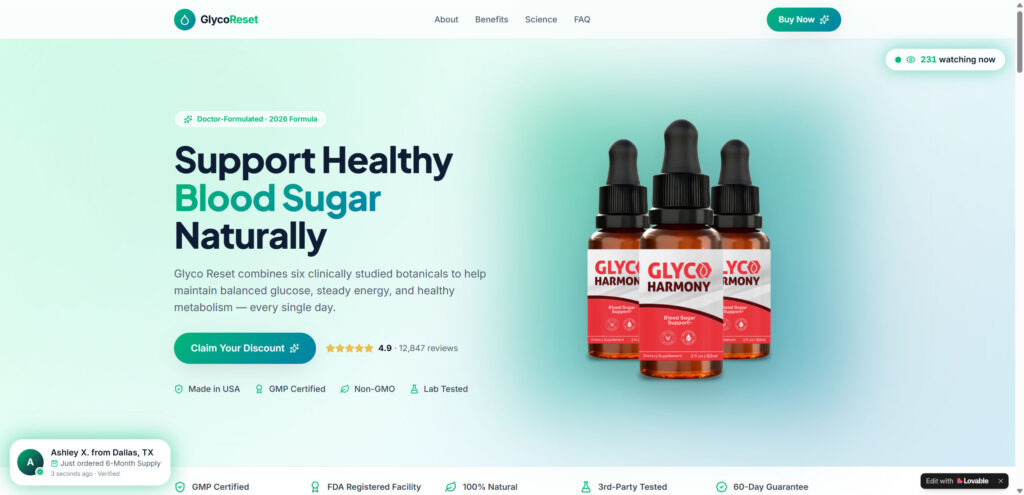
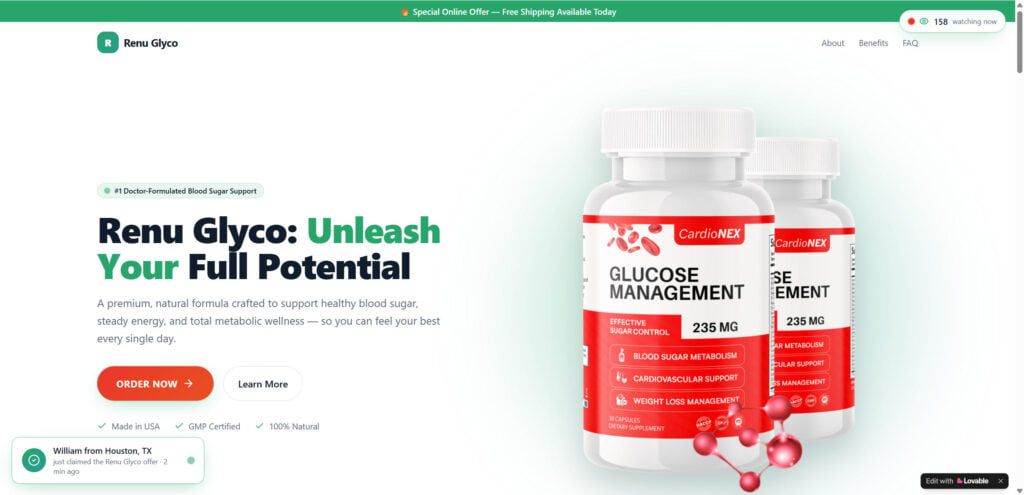
The names attached to the ritual keep changing. One campaign promotes Sugar Harmony, another Gluco Zen, another Free Sugar Pro, while similar funnels use Glyco Reset, Renu Glyco, and other rapidly changing brands. What deserves attention is not any single bottle, but the sales system surrounding all of them.
The Glucose Reset Ritual Is Not One Product
The first mistake consumers can make is assuming that the Glucose Reset Ritual refers to one specific formula discovered by one particular doctor.
It does not.
The phrase is being used across multiple supplement campaigns, sometimes with completely different products attached to it. Sugar Harmony has been promoted as part of a “5-Drop Morning Hack” and Glucose Reset Ritual, while a separate Gluco Zen video-sales presentation uses the same phrase to describe a supposedly homemade method capable of dramatically affecting diabetes. Another campaign promoting Free Sugar Pro describes a “10-second glucose reset ritual” that allegedly restores glucose levels and kills a hidden parasite. Even generic marketplace supplements now incorporate “Glucose Reset Ritual” directly into their product titles
That tells us something important about the phrase itself.
This does not behave like the name of a defined medical treatment. It behaves like an advertising keyword.
A marketer can keep the phrase “Glucose Reset Ritual,” change the supposed expert, rewrite the secret ingredient, attach another supplement bottle to the story, and send the campaign back into social-media advertising.
The product is replaceable because the hook is what generates the attention.
Sugar Harmony Shows Exactly How the Funnel Works
Sugar Harmony is one of the clearest examples because the “Glucose Reset Ritual” terminology is explicitly connected with its marketing.
A March 2026 article appearing on Yahoo Finance promotes Sugar Harmony through a “5-Drop Morning Hack” and refers to the product’s routine as the Glucose Reset Ritual. The article includes a direct call to action telling readers to begin the ritual through the “official Sugar Harmony website.”
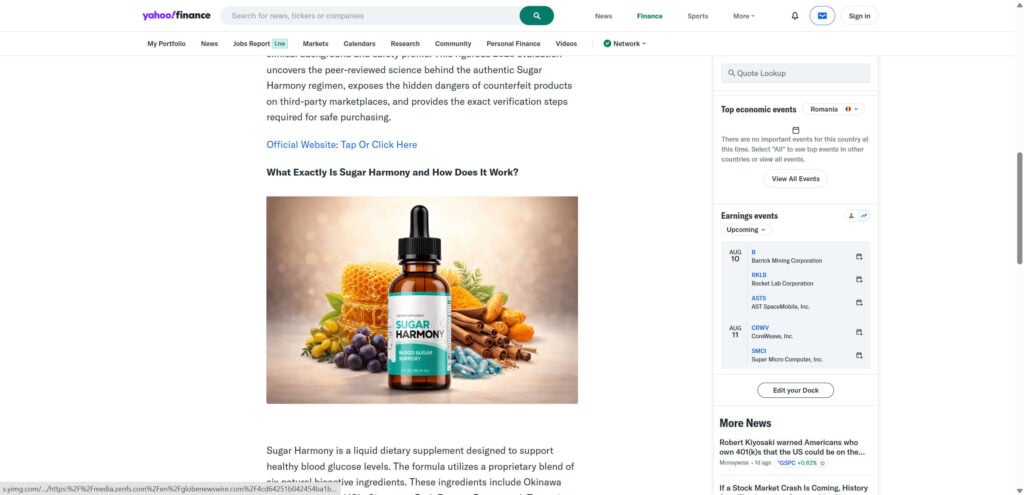
At first glance, appearing on Yahoo Finance gives the material an enormous credibility boost.
A consumer searching Google may reasonably assume that Yahoo’s editorial staff investigated Sugar Harmony and decided the product deserved coverage.
That is not what happened.
The article was distributed through GlobeNewswire. GlobeNewswire describes itself as a press-release distribution service that customers use to distribute promotional and corporate material across websites and media platforms, including Yahoo Finance. GlobeNewswire also states that press-release distribution is a paid service.
That distinction is critical.
The page may live on Yahoo Finance, but it should not be confused with a Yahoo Finance journalist independently investigating Sugar Harmony.
It is syndicated press-release material.
For supplement marketers, that placement is extremely valuable because a promotional article suddenly inherits some of the visual authority of a major financial-news website.
The Yahoo Article Is Part of the Marketing, Not Independent Proof
The Sugar Harmony release does not merely discuss the Glucose Reset Ritual as an interesting health trend.
It promotes the ritual and directs readers toward the product.
That means someone searching “Sugar Harmony scam,” “Sugar Harmony reviews,” or “Glucose Reset Ritual real or fake” can encounter what appears to be a reassuring article hosted on Yahoo Finance, even though the underlying content originated as a GlobeNewswire release.
This is a particularly effective form of reputation laundering.
The supplement is advertised through a dramatic social-media presentation. The skeptical viewer then leaves the advertisement and searches Google for more information. Instead of reaching an independent investigation, they may find syndicated promotional material on a recognizable financial-news domain.
To the average reader, the presence of the Yahoo logo can do more persuasive work than another dozen testimonials on the seller’s own website.
Consumers therefore need to distinguish between where an article appears and who actually produced or distributed it.
A press release replicated on a major portal remains a press release.
It does not become independent medical evidence simply because Google ranks it highly.
Gluco Zen Uses the Same Ritual With an Even More Extreme Story
Sugar Harmony is only one version of the campaign.
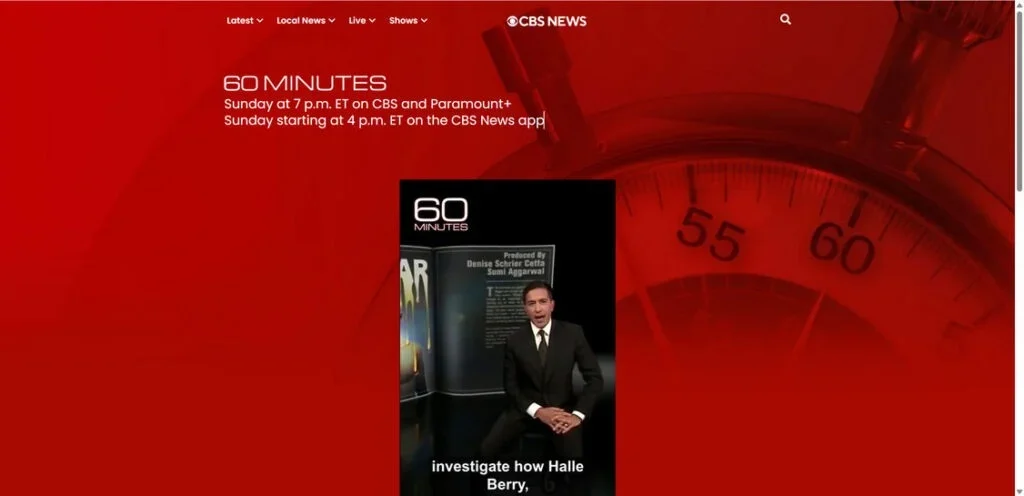
A detailed analysis of a Gluco Zen video-sales letter published in May 2026 found the product being promoted through the same Glucose Reset Ritual language. The presentation reportedly tells viewers that a 15-second homemade method can cause the body to expel a hidden parasite and suggests that A1C may begin dropping within hours. The same script invokes Dr. Mehmet Oz, Dr. Phil McGraw, Randy Jackson, Dr. Robert Lustig, and the Today Show as part of its authority-building narrative.
The Gluco Zen presentation is especially revealing because it demonstrates how little the underlying campaign depends on Sugar Harmony itself.
The same basic ritual survives after the brand changes.
Instead of beginning with an ordinary explanation of capsules or drops, the presentation begins like a medical exposé. Viewers are given a frightening new explanation for diabetes, introduced to famous medical or celebrity names, shown dramatic testimonials, and encouraged to believe that a simple natural discovery has been hiding in plain sight.
The actual supplement arrives later.
That structure matters because by the time the viewer sees the bottle, they are no longer evaluating an ordinary dietary supplement. They are evaluating what has already been framed as the solution to an alarming medical discovery.
Free Sugar Pro Recycles the Same Story Again
Another campaign promoting Free Sugar Pro uses almost exactly the same mechanism.
The video presentation has been documented describing a “10 second glucose reset ritual,” a three-ingredient recipe, and an “anti-diabetes elixir.” Viewers are allegedly told that the method can stabilize glucose, kill parasites, and dissolve “diabetic fat,” while the video also uses celebrity-style authority and a speaker identifying himself as Tom Hanks.
Again, the brand is different.
The ritual is not.
This is why consumers should stop searching for one definitive “Glucose Reset Ritual supplement.”
There is no reason to believe the next advertisement will use Sugar Harmony, Gluco Zen, or Free Sugar Pro. A marketer can simply invent another reassuring brand name and attach the same story to it.
Names containing words such as Glyco, Gluco, Sugar, Reset, Harmony, Balance, Blood, or Pro are particularly easy to generate because they sound vaguely medical without being specific enough to mean much.
The bottle is branding.
The ritual is the sales script.
The “Hidden Parasite” Story Is Designed to Rewrite What You Know About Diabetes
One of the most aggressive variations of the Glucose Reset Ritual claims that type 2 diabetes is caused by a parasite hiding inside or around the pancreas.
This is a powerful sales technique because the advertiser is not merely offering another supplement for blood-sugar support. The presentation attempts to replace the viewer’s understanding of the disease with a completely new explanation.
According to the Gluco Zen video analysis, viewers are told that a hidden pancreatic parasite feeds on insulin or damages beta cells and that the Glucose Reset Ritual helps the body eliminate it. The Free Sugar Pro presentation uses a similar parasite-centered narrative.
That is not how major public-health authorities describe ordinary type 2 diabetes.
The CDC explains that type 2 diabetes involves insulin resistance, in which cells stop responding normally to insulin. The pancreas initially produces additional insulin to compensate, but over time it may no longer keep up, causing blood glucose to rise.
The hidden-parasite story therefore does much more than simplify legitimate science.
It substitutes a different disease mechanism.
And once viewers believe that mechanism, an unfamiliar supplement suddenly makes much more sense. Conventional treatment can be portrayed as attacking the wrong problem, while the Glucose Reset Ritual supposedly targets the hidden “real cause.”
That is an extremely valuable belief shift for anyone trying to sell supplements.
Fake Authority Makes the Story Much Easier to Believe
These funnels frequently surround the ritual with recognizable doctors, television personalities, celebrities, or media brands because borrowed authority reduces skepticism.
The Federal Trade Commission has specifically warned that falsely claiming a famous person uses or recommends a product is deceptive. The FTC also warns against advertisements designed to look like independent news or editorial content when they are actually marketing.
The Gluco Zen presentation reportedly invokes Dr. Oz and Dr. Phil, while Sugar Harmony reviewers repeatedly describe advertisements they believed featured those same personalities. Trustpilot reviews of Sugar Harmony include consumers who say they purchased after watching what appeared to be a Dr. Phil presentation, including a story about Okinawan honey and a supposed parasite causing type 2 diabetes.
Those reviews are individual consumer reports rather than independently adjudicated findings, so they should not be treated as proof that every advertisement uses exactly the same video.
They do show how the marketing is being perceived.
And perception is what produces the transaction.
If a consumer believes Dr. Phil or another recognizable doctor has personally discovered a natural way to reverse diabetes, the seller begins the relationship with trust that it never earned.
The “Glucose Reset” Story Changes, but the Emotional Formula Does Not
The details vary because they are designed to keep the advertisement feeling new.
One campaign may talk about parasites.
Another describes a mysterious glucose switch.
Another promises a five-drop morning ritual.
Another introduces honey, cinnamon, purple fruit, a biblical recipe, a pancreatic cleanse, a mitochondrial switch, or some forgotten ingredient supposedly used overseas.
Marketplace listings now contain extraordinary titles combining phrases such as “Glucose Reset Ritual Cleanse,” “Mitochondria Switch,” “Purple Switch Sugar Cleanse,” and “Purple Fruit Hack Sugar Ritual” in a single supplement listing.
That is a useful clue.
When supposedly revolutionary medical discoveries begin appearing as interchangeable ecommerce keywords, consumers should question whether they are looking at medicine at all.
The terminology is designed for clicks, not clinical precision.
The Product Page Usually Retreats From the Biggest Claims
Another characteristic of these operations is the difference between the advertisement and the language used once the consumer reaches the actual supplement page.
The advertisement can imply diabetes reversal, dramatic A1C changes, elimination of a parasite, restored pancreatic function, or freedom from medication.
The legal language surrounding dietary supplements is usually much more cautious.
That is not accidental.
The FDA and FTC have previously taken action against companies marketing dietary supplements with claims that they treat, cure, mitigate, or prevent diabetes. The FDA warns that illegally marketed diabetes products have not necessarily been evaluated as safe and effective and may cause consumers to delay appropriate treatment.
Dietary supplements are also not FDA-approved for safety and effectiveness in the way prescription drugs are. The FDA reiterated this point in updated guidance in 2026
That is why consumers should always compare the most spectacular claim in the social-media advertisement with the disclaimer attached to the actual bottle.
The difference can be enormous.
Sugar Harmony’s Consumer Reviews Reveal What Can Happen at Checkout
The marketing claims are only part of the risk.
The checkout itself deserves just as much attention.
As of August 2026, the Trustpilot profile associated with Sugar Harmony shows 64 reviews and a TrustScore around 1.6, with 90% of displayed reviews rated one star. Trustpilot notes that reviews are individual user opinions and may not represent every customer’s experience.
What matters for this investigation is the pattern contained in several of those reviews.
One consumer reported ordering six bottles after watching a presentation they believed involved Dr. Phil and Dr. Oz. According to the review, every attempt to complete checkout produced additional product offers. The customer later claimed to discover two separate six-bottle Sugar Harmony orders at $309.58 each plus an additional Nerve Freedom product for $135.84, despite saying they had not intended to purchase the second package or the additional supplement.
Another reviewer reported that their six-bottle order was doubled and that an additional nerve supplement appeared on the transaction, resulting in more than $600 in charges. Other reviewers similarly describe unexpected additional products, duplicate orders, refund difficulties, and disputes over what they believed they had authorized
These are consumer allegations, not court findings.
But they illustrate exactly why aggressive supplement checkouts deserve scrutiny.
The Multiple-Bottle Trap Is Built Into the Economics
Most direct-response supplement funnels do not want the consumer to purchase one inexpensive bottle.
Customer acquisition through social-media advertising, affiliates, video sales letters, and advertorials can be expensive. The economics work much better when a visitor spends $200, $300, $600, or more during the first transaction.
That is why the offer frequently begins with three or six bottles.
Once the customer has accepted a large package, the funnel can introduce another discount, another supplement, another “recommended” protocol, or an even larger supply.
The psychological trick is that the second offer often looks cheaper than the first because the per-bottle price drops.
Consumers should stop thinking about the unit price and focus on the amount leaving the card.
If six bottles cost approximately $300, another six-bottle “upgrade” is not saving money.
It is another $300 purchase.
Upsells Can Look Like Part of the Original Checkout
The design of these funnels can make the problem worse.
A customer enters payment information and expects the order to be complete. Instead, another full-screen offer appears with language such as “Wait,” “Special Upgrade,” “Do Not Close This Page,” “One-Time Offer,” or “Complete Your Protocol.”
The consumer may believe they are modifying the first package or confirming the order.
The system may treat the button as authorization for another transaction.
The Sugar Harmony complaint involving two six-bottle orders is a concrete example of why buyers need to treat every post-payment screen as a potential new purchase.
The safest rule is straightforward: after entering card information, assume any button displaying another quantity or another price can create an additional charge.
Read it accordingly.
Refill and Subscription Billing Is Another Risk Across These Funnels
Not every Glucose Reset Ritual checkout necessarily includes recurring billing, so it would be inaccurate to claim that every buyer is automatically enrolled in a subscription.
However, continuity and refill complaints do appear elsewhere in the same ecosystem of rapidly changing “Glyco” supplements.
For example, reviews of Glyco Reset include a consumer alleging that additional bottles were added to an order and that, while trying to cancel, they were told they needed to provide a new credit-card number to cancel a subscription.
Renu Glyco reviews contain multiple separate allegations involving unwanted recurring shipments. One reviewer said another supply arrived without being requested and that a subscription they never knowingly agreed to had to be canceled. Another said they canceled a subscription but still received six more bottles the following month. Other reviewers describe receiving new shipments and charges after believing their original purchase was a one-time deal
Again, these are individual customer reports and do not establish that every Glucose Reset Ritual product uses the same recurring-billing model.
They establish why consumers should actively look for it.
Before paying, search the checkout for words such as subscription, autoship, continuity, automatic refill, monthly shipment, recurring delivery, membership, replenishment, or Subscribe & Save.
If you want one purchase, the order should clearly say one purchase.
Refund Guarantees Can Become Part of the Funnel Too
A large money-back guarantee is one of the easiest ways to remove hesitation from a $300 supplement purchase.
Consumers naturally think that if the product does not work, they can simply send it back.
Sugar Harmony reviews show why buyers should read the actual terms rather than relying on the promise made in the video.
Several reviewers say they struggled to obtain refunds even when they believed they were inside the guarantee period. One reviewer said the presentation mentioned a 180-day return period while the actual warranty stated 60 days. Another reported beginning the refund process before the 60-day deadline but spending weeks dealing with automated responses and reduced-refund offers.
One reviewer even reported pursuing the matter through small claims court after waiting months for a refund. That is an individual account rather than an independently verified legal record, but it demonstrates how far some consumers say they had to go to resolve the transaction.
A guarantee is only useful if its deadline, return procedure, and merchant contact information are clear.
The “Official Review” Search Results Can Be Part of the Same Machine
This is where the Glucose Reset Ritual funnel becomes particularly effective.
A cautious consumer sees a questionable Facebook advertisement and decides to research the product rather than buying immediately.
They search Google.
The results may include:
a Yahoo Finance page syndicated from a paid press-release service,
affiliate reviews,
supposed “consumer reports,”
“official website” pages,
advertorials explaining why the product is legitimate,
and another dozen domains optimized for the product’s name.
The consumer believes they escaped the advertisement.
In reality, they may still be inside the marketing ecosystem.
The Sugar Harmony Yahoo Finance example demonstrates this perfectly. The material was distributed through GlobeNewswire, whose business is press-release distribution, and the article itself directs readers toward the Sugar Harmony offer.
Search-engine placement does not transform promotional material into independent journalism.
The Brand Can Change When the Reputation Becomes Toxic
There is another reason the Glucose Reset Ritual should be evaluated separately from individual products.
Brands are disposable.
One Sugar Harmony Trustpilot reviewer wrote in July 2026 that they believed the product was now being promoted under the name GlucoZen using similar claims. Separately, affiliate publishers have also described links between GlucoZen and previous Sugar Harmony infrastructure, although the company has not publicly confirmed a formal rebrand.
That distinction matters.
It would be irresponsible to state as proven fact that every GlucoZen bottle is simply Sugar Harmony with a new label unless the business itself confirms that relationship.
What is verifiable is that the Glucose Reset Ritual marketing narrative has already moved across both names.
That alone demonstrates why the consumer should focus on the advertising method rather than memorizing individual product brands.
If Sugar Harmony disappears tomorrow, the Glucose Reset Ritual does not need to disappear with it.
How the Glucose Reset Ritual Supplement Scam Works
Step 1: A Social-Media Ad Creates Fear and Curiosity
The viewer encounters a video about diabetes, A1C, blood-sugar spikes, nerve damage, amputations, insulin, or another emotionally powerful consequence of the disease.
The advertisement is often presented like medical information rather than an obvious supplement commercial.
Step 2: A Famous Authority Makes the Story Feel Legitimate
A doctor, celebrity, television personality, or recognizable media brand appears somewhere in the presentation.
The goal is to transfer existing trust from that person or organization to the product.
The FTC has repeatedly warned that fake celebrity testimonials and ads disguised as independent content are deceptive marketing practices.
Step 3: The Viewer Learns That Diabetes Has a “Hidden Cause”
Instead of describing insulin resistance and established diabetes biology, the presentation introduces a more dramatic explanation.
It may be a parasite in the pancreas, toxins, a blocked pathway, mitochondrial dysfunction, or another supposedly ignored mechanism.
The seller now possesses information conventional medicine allegedly missed.
Step 4: A Simple Ritual Is Introduced
The answer sounds almost suspiciously easy.
Five drops in the morning.
A ten-second ritual.
A homemade recipe.
A glucose switch.
A purple fruit.
An Okinawan ingredient.
Because the method initially sounds inexpensive and natural, the viewer continues watching rather than feeling that they are being sold something.
Step 5: The Video Explains Why Nobody Told You About It
The pharmaceutical industry supposedly does not want the discovery known.
Doctors allegedly treat symptoms instead of the cause.
The media supposedly will not report it.
The video may disappear.
This conspiracy framing creates urgency while simultaneously explaining why the viewer cannot easily verify the claims elsewhere.
Step 6: The Free Ritual Becomes a Supplement
Eventually, the secret is productized.
The viewer is introduced to Sugar Harmony, Gluco Zen, Free Sugar Pro, Glyco Reset, Renu Glyco, or another supplement.
At this point, the funnel shifts from medical storytelling to ecommerce.
Step 7: The Buyer Is Pushed Toward Several Bottles
A single bottle usually looks expensive.
Three bottles look better.
Six bottles are presented as the smartest deal.
The low per-unit price becomes the headline while the much larger package total receives less psychological attention.
Step 8: Additional Offers Appear After the First Purchase
The buyer may then be offered more of the same supplement or an entirely different product.
Because the customer has already entered payment information and psychologically committed to the purchase, acceptance rates for these upsells can be significantly higher.
This is also where confusion about duplicate bottle orders can arise.
Step 9: Some Funnels Introduce Refill Billing
Depending on the product, recurring shipments or subscriptions may appear during checkout or after the initial purchase.
The precise terms vary, which is why buyers need to read the transaction they are actually authorizing.
Step 10: The Customer Eventually Has to Find the Real Seller
When a billing or refund problem begins, the beautifully produced social-media video is no longer useful.
The consumer needs the merchant.
Who actually charged the card?
Which company shipped the bottles?
Which support department controls refunds?
Which terms govern the transaction?
Those answers can be surprisingly difficult to find after a purchase that took only minutes to complete.
Why This Scam Is Particularly Dangerous
The financial losses matter, but diabetes supplement scams can create another risk that is much more serious.
Someone convinced that a Glucose Reset Ritual addresses the “real cause” of diabetes may begin questioning legitimate treatment.
The FDA warns that illegally marketed diabetes products can cause people to delay or abandon appropriate medical care, increasing the risk of serious complications.
Type 2 diabetes is a chronic metabolic disease, not an ecommerce problem waiting for the right secret ingredient.
The CDC explains that insulin resistance and the pancreas’s declining ability to compensate are central to type 2 diabetes
A viral supplement video does not overturn that evidence.
What to Do If You Already Bought a Glucose Reset Ritual Supplement
1. Identify the Actual Brand
“Glucose Reset Ritual” is not enough.
Find the exact product name, merchant, website, transaction descriptor, order number, and support contact.
2. Check Your Card for More Than One Charge
Do not assume the order confirmation shows everything.
Review your banking account directly and check for duplicate transactions or charges from related merchants.
3. Confirm How Many Bottles You Bought
If you intended to purchase six bottles, make sure there are not twelve or eighteen bottles across several confirmations.
Save every receipt.
4. Look for Recurring Billing
Search your emails and checkout documents for language involving subscription, autoship, continuity, recurring shipments, refills, monthly deliveries, or memberships.
If anything is recurring and you did not want it, cancel in writing immediately.
5. Save the Advertisement
Keep screenshots or recordings of any claim that influenced the purchase, particularly if it involved a doctor, celebrity, diabetes reversal, hidden parasite, A1C promise, or supposed media endorsement.
6. Request Cancellation Clearly
State exactly what you are canceling.
Ask for cancellation of the order, any subscription, any automatic shipments, and any future billing.
Request written confirmation.
7. Monitor the Card After Cancellation
Do not assume a cancellation email necessarily prevents another charge.
Review subsequent statements carefully.
8. Contact the Card Issuer if Necessary
If unauthorized charges appear or the merchant refuses to resolve a billing problem, contact your bank or card provider and explain the transaction.
Keep all documentation.
9. Do Not Change Diabetes Medication Because of the Ad
If you take insulin, metformin, a GLP-1 drug, or another prescription medication, do not stop or modify treatment because of a Glucose Reset Ritual video.
Discuss treatment decisions with a qualified healthcare professional.
The Bottom Line
The most important thing about the Glucose Reset Ritual is that it is not tied to one bottle.
Sugar Harmony is one example.
Gluco Zen is another.
Free Sugar Pro is another.
Other “Glyco,” “Gluco,” “Sugar,” and “Reset” products can be attached to the same narrative whenever marketers need another brand.
The underlying structure remains remarkably durable: a dramatic social-media video presents a hidden diabetes discovery, recognizable doctors or celebrities provide borrowed authority, conventional medicine is portrayed as missing the true cause, and a simple ritual is introduced as the solution. Only after the viewer has accepted that story does the campaign reveal the commercial supplement.
Then the transaction begins.
Multi-bottle packages can turn a curiosity click into a $300 purchase. Post-checkout offers can create additional orders. Consumer reports surrounding Sugar Harmony describe duplicate six-bottle packages and unwanted additional products, while complaints around other rapidly changing glycemic-support brands include allegations of refill subscriptions and recurring shipments
Even researching the product can keep consumers inside the marketing funnel. The Sugar Harmony article appearing on Yahoo Finance is a good example: it originated through GlobeNewswire, a paid press-release distribution service, and directly promotes the Sugar Harmony offer.
That is why the safest rule is not to memorize a blacklist of supplement names.
Recognize the script.
If a social-media advertisement talks about a “Glucose Reset Ritual,” “5-Drop Morning Hack,” “10-Second Sugar Ritual,” hidden pancreatic parasite, secret diabetes cure, suppressed discovery, or similar miracle mechanism and the story eventually asks you to purchase supplements, treat the entire funnel as a major scam warning and do not buy based on the advertisement.
The product name can change faster than consumer warnings can keep up.
The marketing psychology does not have to.
FAQ
What is the Glucose Reset Ritual?
The phrase is being used as a marketing concept across multiple blood-sugar supplement campaigns. It does not refer to one established medical treatment or one consistent formula. Sugar Harmony, Gluco Zen, Free Sugar Pro, and generic supplement listings have all used variations of the term.
Is the Glucose Reset Ritual a scam?
When the phrase appears in social-media advertising promising dramatic diabetes results and ultimately leads to a supplement checkout, it should be treated as a serious scam-style warning sign. The same narrative has been reused across multiple unrelated supplement brands, often alongside unsupported disease claims, celebrity authority, and aggressive direct-response sales tactics.
Is Sugar Harmony the official Glucose Reset Ritual supplement?
There is no evidence that one permanent “official” Glucose Reset Ritual supplement exists. Sugar Harmony is one product marketed using the phrase, but Gluco Zen, Free Sugar Pro, and other products have also been attached to it.
Is the Sugar Harmony article on Yahoo Finance an independent investigation?
No. The March 2026 Yahoo Finance result was syndicated from GlobeNewswire and contains a direct call to action promoting the Sugar Harmony website. GlobeNewswire describes itself as a press-release distribution service, and its distribution service is paid
Does being on Yahoo Finance mean Sugar Harmony is endorsed by Yahoo?
No. Press releases distributed through newswire services can appear on large portals such as Yahoo Finance. GlobeNewswire specifically lists Yahoo Finance among outlets reached through its distribution network.
What is Gluco Zen?
Gluco Zen is another supplement attached to a Glucose Reset Ritual video-sales presentation. The documented script includes dramatic claims involving a hidden pancreatic parasite, rapid changes in glucose markers, and recognizable public figures.
What is Free Sugar Pro?
Free Sugar Pro has also been promoted through a Glucose Reset Ritual narrative, including a supposed three-ingredient anti-diabetes recipe and claims involving parasites and glucose stabilization.
Is type 2 diabetes caused by a parasite?
Major medical authorities do not describe ordinary type 2 diabetes as being caused by a hidden pancreatic parasite. The CDC identifies insulin resistance and the body’s declining ability to regulate blood glucose as central mechanisms.
Do Dr. Phil or Dr. Oz endorse Glucose Reset Ritual supplements?
Their names have appeared in documented Glucose Reset Ritual marketing and consumers report seeing advertisements they believed featured them. A social-media video is not sufficient evidence of a genuine endorsement, particularly given the widespread use of fake celebrity testimonials and AI manipulation.
What do Sugar Harmony customers report?
The current Trustpilot profile contains 64 reviews with a TrustScore around 1.6, and 90% of displayed reviews are one-star. Common themes in the platform’s summary include unexpected items or charges, refund difficulties, communication problems, and dissatisfaction with product performance. Reviews represent individual consumers’ opinions and are not independent legal findings.
Can Sugar Harmony send more bottles than I ordered?
Some Trustpilot reviewers allege that they received or were charged for more bottles than they intended to purchase. One reviewer described two separate six-bottle Sugar Harmony charges plus another supplement after saying they had intended to purchase only one six-bottle package.
Can Glucose Reset Ritual supplements enroll buyers in subscriptions?
Terms differ between products, so it would be inaccurate to say every offer does. However, consumer reviews for products in the wider ecosystem, including Glyco Reset and Renu Glyco, contain allegations of unwanted subscriptions, repeat shipments, and difficulty canceling recurring orders.
Why are six-bottle packages so common?
Large bundles increase the value of each sale and allow marketers to advertise a lower per-bottle price. Consumers should evaluate the complete transaction amount rather than focusing on the unit price.
Are dietary supplements FDA approved for diabetes?
No. The FDA says dietary supplements are not approved for safety and effectiveness in the same way as prescription drugs, and it has specifically warned companies against marketing unapproved supplements as treatments for diabetes
Can a supplement cure type 2 diabetes?
Consumers should be extremely skeptical of supplements claiming to cure or reverse diabetes. The FDA warns about illegally marketed diabetes products and notes that relying on them can delay appropriate care.
Why do these campaigns keep changing product names?
The marketing concept can be reused independently of the bottle. Once a brand develops negative reviews or stops converting effectively, another supplement can be attached to the same Glucose Reset Ritual story without rebuilding the entire advertising concept.
What should I do if I already ordered?
Check every transaction on your card, confirm the bottle quantity, identify the actual merchant, look for recurring-payment terms, save the advertisement and checkout pages, cancel unwanted orders or subscriptions in writing, and contact your card issuer if you discover charges you did not authorize.
What is the biggest Glucose Reset Ritual red flag?
The strongest warning is the combination of a secret diabetes discovery, fake or unverifiable authority, parasite or “hidden cause” claims, conspiracy framing, a long video that eventually reveals a supplement, large bottle bundles, aggressive upsells, and possible recurring billing.
If you see that pattern, the safest move is not to find out which bottle the video is selling this time.
It is to close the funnel.








