

The Harley Advent Calendar 2025 has exploded across social media, promoted as the ultimate collectible for motorcycle enthusiasts. With promises of 24 miniature Harley-Davidson motorcycles packaged in a festive advent calendar, it seems like the perfect holiday gift for any biker. However, behind the enticing visuals and dramatic discounts lies a growing concern that this offer is not what it appears to be. Shoppers around the world are reporting missing deliveries, fake merchandise, and unresponsive sellers. This article investigates the Harley Advent Calendar 2025 scam in detail, breaking down how it works, what red flags to look for, and what you can do if you’ve already placed an order.
Scam Overview
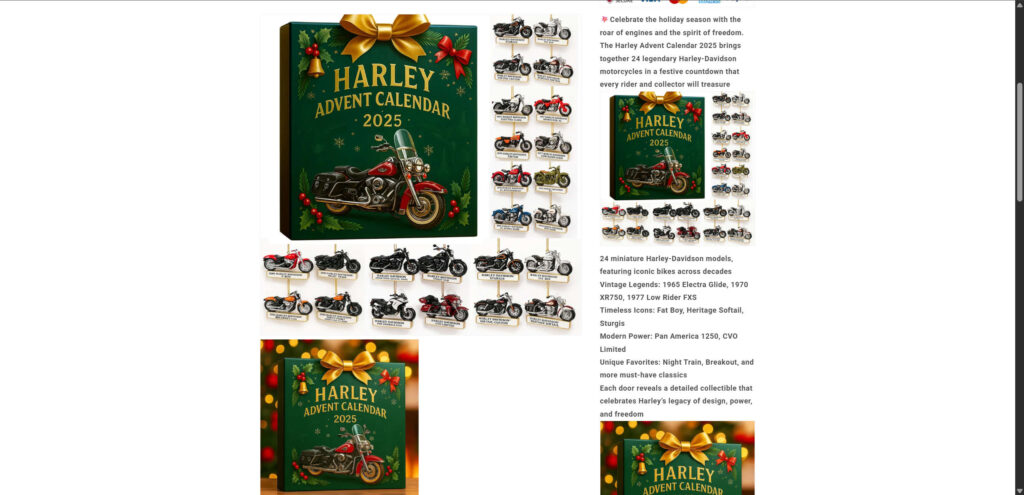
The Harley Advent Calendar 2025 is marketed as a luxury advent calendar designed for Harley-Davidson fans. Advertisements typically feature a glossy green box decorated with gold bows and a detailed motorcycle illustration. The listings claim that inside are 24 miniature Harley-Davidson bikes, including classics like the 1965 Electra Glide, 1977 Low Rider FXS, and modern models like the Pan America 1250. The concept appeals strongly to collectors, making it easy for unsuspecting buyers to overlook warning signs.
Upon deeper investigation, this product shows many characteristics of a scam operation designed to exploit consumer trust in the Harley-Davidson brand. Although the calendar looks professional and uses high-quality imagery, these images appear to be taken from unrelated sources and reused across multiple websites. The product descriptions are identical on various e-commerce stores with different names, a major red flag indicating a copy-and-paste scam network.
Key Red Flags in the Harley Advent Calendar 2025 Scam
- Recently Created Domains – Most of the sites selling this product have been registered only a few months ago. They lack any track record or real customer reviews. This is a common hallmark of short-term scam operations that disappear quickly once complaints start accumulating.
- Lack of Contact Information – The only point of contact is usually a single email address, with no physical address, phone number, or legitimate company details. Real businesses, especially those selling branded collectibles, provide full contact information, including registered addresses and verifiable customer service numbers.
- Unbelievable Discounts – These websites often advertise the Harley Advent Calendar 2025 at prices around 50% to 70% off, sometimes under the pretense of a “limited-time clearance sale” or “store closing promotion.” Considering that genuine licensed Harley-Davidson merchandise typically carries premium pricing, such deep discounts are unrealistic.
- Generic Templates and Copied Content – The product pages feature identical text, formatting, and images across multiple websites. This pattern strongly suggests the use of a cloned e-commerce template by fraudulent sellers.
- No Social Media Presence – Apart from paid ads on Facebook or Instagram, these stores have no genuine social media accounts, no user engagement, and no official Harley-Davidson connection.
- Suspicious Checkout Pages – Payment pages often use unsecured links or redirect buyers to unfamiliar third-party processors. Some buyers report being charged more than the listed price or having their credit card details compromised.
The Illusion of Authenticity
Scammers behind the Harley Advent Calendar 2025 scam rely on visual credibility. The website design looks clean and professional. The product photos are polished, showing miniature Harley bikes arranged beautifully against festive backgrounds. However, these same images appear in multiple unrelated listings, revealing that they have likely been stolen from design mockups or AI-generated catalogues.
They also include fake trust badges, such as “Guaranteed SAFE Checkout” or “SSL Secure Payment,” without actually implementing encryption or secure connections. The checkout experience mimics legitimate stores, which makes it even harder for buyers to detect fraud before purchasing.
Fake Reviews and Misleading Marketing
In some cases, these websites embed fabricated customer reviews claiming fast delivery and excellent quality. However, reverse image searches often show that the reviewers’ profile photos are taken from unrelated sources. These fake testimonials are designed to build false credibility, pushing hesitant buyers to act fast before the “sale ends.”
Scammers also leverage social media advertising algorithms to target niche audiences, especially older Harley-Davidson fans and collectors. The ads use phrases like “limited edition,” “perfect biker gift,” and “holiday exclusive” to trigger emotional responses and encourage impulse purchases.
The result is a convincing but deceptive ecosystem that turns excitement into regret once buyers realize the calendar never arrives or the items inside are cheap knockoffs.
How the Scam Works
Understanding how the Harley Advent Calendar 2025 scam operates can help prevent more shoppers from falling victim. The fraud follows a structured process that exploits both emotional appeal and trust in well-known brands.
Step 1: Creating a Fake Online Store
The scammers begin by creating a new online store using platforms like Shopify, WooCommerce, or other e-commerce builders. These platforms allow anyone to launch a store quickly without verification. The scammers use a generic store name that sounds family-friendly or luxury-oriented. They copy an existing product template, upload stolen images, and add exaggerated descriptions of the Harley Advent Calendar 2025.
The store usually includes:
- Fake logos and certificates claiming authenticity
- Unrealistic sales slogans such as “Up to 70% Off for Today Only!”
- Fabricated policies like “Money-Back Guarantee” and “Worldwide Shipping” that are never honored
Step 2: Running Aggressive Social Media Ads
Once the fake store is live, the scammers invest heavily in targeted ads, particularly on Facebook and Instagram. These ads use eye-catching visuals of Harley motorcycles and Christmas themes to attract attention. They often feature limited-time countdowns or phrases like “Selling Out Fast” to create urgency.
The goal is to reach impulse buyers who see the ad, click the link, and make a purchase without researching the seller. Many of these ads lead directly to cloned websites with identical designs but different URLs, allowing scammers to rotate domains once one gets reported or flagged.
Step 3: Collecting Payments
When customers add the Harley Advent Calendar 2025 to their cart, the checkout page often looks legitimate, but payment processing is not secure. Instead of using trusted gateways like PayPal or Stripe, scammers frequently use lesser-known processors or direct credit card inputs to harvest personal and financial data.
In some cases, customers receive confirmation emails that appear authentic, but tracking numbers are fake or never update. Others notice that they are charged a higher amount than advertised, suggesting manipulation of payment fields.
Step 4: Delayed or Missing Deliveries
After payment, customers are led to believe their order is being processed. Days or weeks later, they may receive generic tracking numbers linked to nonexistent shipping carriers. When the tracking fails, customers attempt to contact the seller, only to find the email address inactive or unresponsive.
In other scenarios, a low-quality product arrives instead of the advertised Harley Advent Calendar. These cheap items, often unrelated to motorcycles, are sent merely to provide a fake proof of delivery that prevents payment disputes.
Step 5: Disappearing Websites
As complaints mount, the scam stores suddenly vanish. The domain becomes inactive, or redirects to a new fake site under a different name. Because these websites are typically registered anonymously, it becomes impossible to trace the operators or claim refunds.
Step 6: Reappearing Under New Names
The cycle continues as scammers replicate the entire operation under new domains. They reuse the same images, product descriptions, and reviews, making it appear as though the Harley Advent Calendar 2025 is still available. This tactic helps them reach fresh audiences who are unaware of the previous complaints.
The network of cloned stores makes this scam particularly resilient. Even after public warnings appear, new buyers continue to fall victim because the ads reappear under new branding every few weeks.
What to Do If You Have Fallen Victim to the Harley Advent Calendar 2025 Scam
If you have already placed an order and suspect you have been scammed, immediate action can help minimize losses and prevent further damage.
1. Contact Your Payment Provider
If you paid by credit or debit card, contact your bank immediately to report the fraudulent transaction. Request a chargeback, explaining that you made a purchase from a website that turned out to be a scam. Most banks can reverse the charge if reported within a specific timeframe.
2. Report to PayPal or Payment Gateways
If you used PayPal or another payment service, file a dispute under “item not received” or “significantly not as described.” Provide screenshots of the order confirmation, payment receipt, and any communication attempts with the seller.
3. Change Your Passwords
If you created an account on the scam website, change the password immediately. Scammers sometimes reuse login data to access other accounts if the same credentials are used elsewhere.
4. Monitor Your Financial Accounts
Keep an eye on your bank and credit statements for unauthorized transactions. Scammers often attempt multiple small charges after the initial payment.
5. Report the Website
Report the fraudulent site to your local consumer protection agency or cybercrime unit. You can also report it to:
- The Federal Trade Commission (FTC) if in the U.S.
- Action Fraud if in the U.K.
- The European Consumer Centre (ECC) if in the EU.
6. Warn Others
Post reviews on trusted consumer forums or social media to help others avoid the same mistake. Many people search for product reviews before purchasing, so your experience could prevent further victims.
7. Install Security Software
Ensure that your device has updated antivirus and anti-phishing protection. Some scam websites attempt to install tracking cookies or malicious scripts that collect personal information.
8. Stay Alert for Follow-Up Scams
Once scammers obtain your email or payment data, they may attempt secondary scams by posing as refund agents or support staff. Never share additional personal details or payment information with unsolicited contacts.
Harley Advent Calendar 2025 Scam: Frequently Asked Questions
Is the Harley Advent Calendar 2025 a real Harley-Davidson product?
No, the Harley Advent Calendar 2025 is not an officially licensed Harley-Davidson product. The real Harley-Davidson company has not released any advent calendar for 2025. The products being promoted online are unauthorized and often part of fraudulent operations designed to deceive collectors.
How can I tell if a website selling this calendar is fake?
Check for the following signs of a scam:
- Recently created website domain
- Lack of physical address or phone number
- Only one email for contact
- Unrealistic discounts (over 50% off)
- Copied product descriptions and images from other sites
- No real customer reviews or social media presence If a site displays these red flags, avoid making any purchases.
What happens if I already bought the Harley Advent Calendar 2025?
If you made a purchase, contact your bank or payment provider immediately and file a chargeback. Provide as much documentation as possible, including screenshots of the website, receipts, and any email correspondence. The quicker you act, the better your chances of recovering your funds.
Why are these scam websites hard to track down?
Scammers typically register domains anonymously and host their websites on international servers. Once complaints pile up, they shut down the site and relaunch under a new name. This makes it difficult for authorities to trace or shut down the operation completely.
How can I avoid scams like the Harley Advent Calendar 2025 in the future?
To avoid falling for similar scams:
- Always buy from official brand stores or authorized retailers.
- Look for HTTPS-secured checkout pages.
- Research the seller’s background and check reviews outside the website.
- Avoid deals that sound too good to be true.
- Use credit cards rather than debit cards for online purchases, as they offer better fraud protection.
Are there real advent calendars for motorcycle enthusiasts?
Yes, there are legitimate motorcycle-themed advent calendars made by verified companies. Always verify authenticity through official motorcycle retailers or large, trusted platforms like Amazon, RevZilla, or Harley-Davidson’s official site.
Can scammers access my personal information if I ordered from a fake site?
Yes. If you entered payment details or created an account, scammers may have collected sensitive information such as your name, address, and card data. Monitor your financial statements closely and consider canceling or replacing your card to prevent further misuse.
Why do fake stores use Harley-Davidson branding?
Harley-Davidson is a globally recognized brand associated with quality and prestige. Scammers exploit this trust to make their offers look more believable. Using the Harley name and imagery gives their fake listings an air of legitimacy, increasing the likelihood that buyers will make impulse purchases.
What should I do if I see these ads on Facebook or Instagram?
Report the ad immediately using the platform’s reporting tools. Select “scam or fraud” as the reason. The faster these ads are flagged, the sooner platforms can remove them and prevent others from being deceived.
Is there any legal action being taken against these scams?
Many consumer protection agencies are aware of this trend and are working to track and shut down fake stores. However, because most of these operations originate overseas and use anonymized hosting, legal action can be slow. Reporting the scam to your local authorities still helps build a case and protects other consumers.
The Bottom Line
The Harley Advent Calendar 2025 scam is a sophisticated operation that preys on the excitement of holiday shopping and the loyalty of Harley-Davidson fans. While the ads appear legitimate, the absence of verifiable company information, unrealistic prices, and repeated use of cloned content reveal the truth: these calendars are not genuine Harley products. Buyers should remain skeptical of offers that seem too good to be true and always research unfamiliar online stores before making purchases.
If you or someone you know has been affected by this scam, take immediate steps to report it and secure your finances. The more awareness that spreads about the Harley Advent Calendar 2025 scam, the fewer people will fall into its trap. Remember, legitimate Harley-Davidson merchandise is sold only through official channels or authorized dealers. This holiday season, let caution ride alongside your enthusiasm.

Join the discussion
0 commentsShare your experience or ask a question about this article.
Discussion
Start the conversation
Have a question or something useful to share? Add the first comment.