

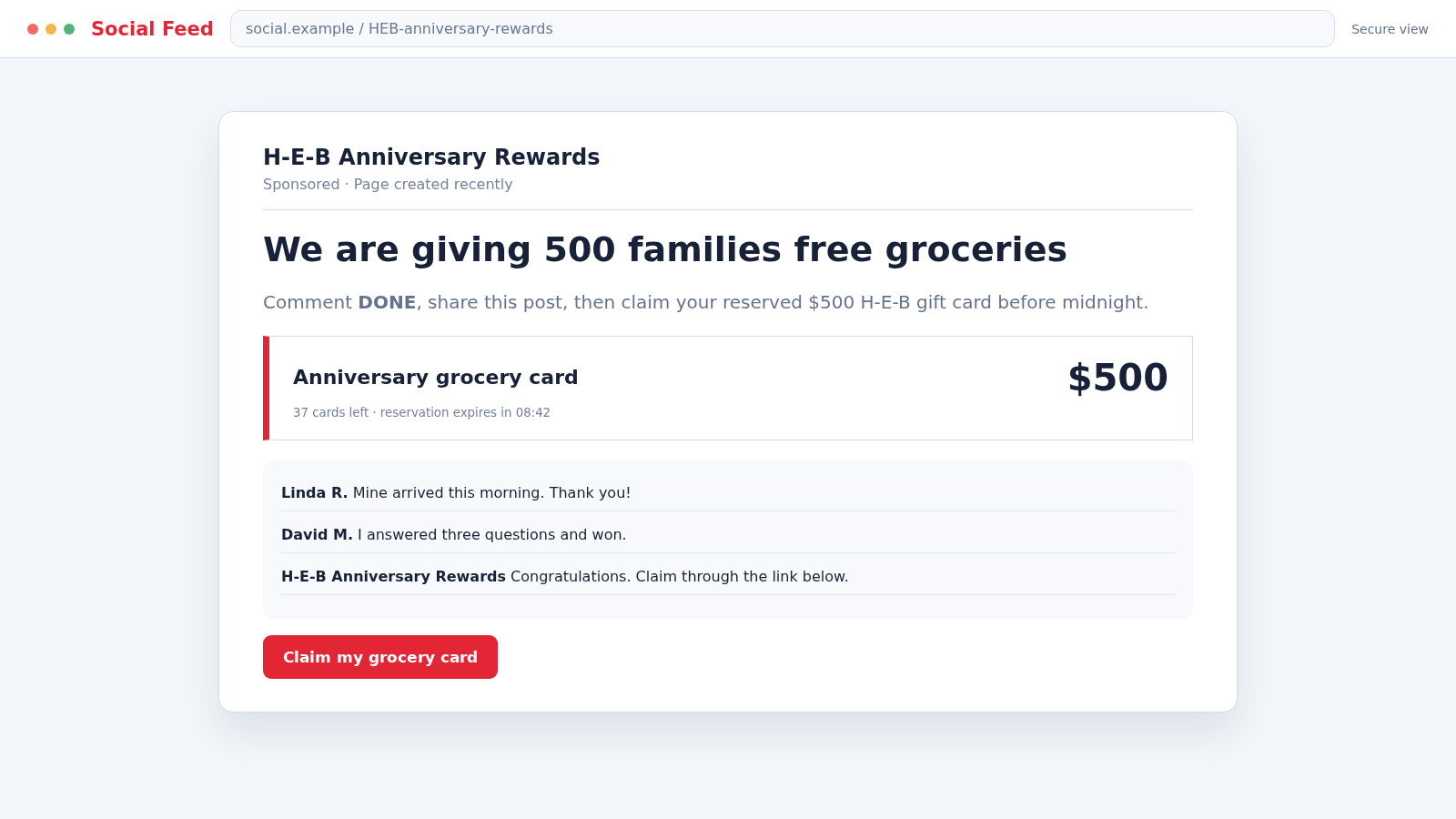
A Facebook post says H-E-B is celebrating with free groceries or a large gift card. The comments are full of people claiming theirs already arrived.
The offer feels local, timely, and easy to share. The H-E-B gift card scam uses that familiarity to pull shoppers into a much less generous arrangement.
Overview
The giveaway borrows trust from a familiar grocery brand
The H-E-B gift card scam spreads through Facebook posts, Messenger links, texts, emails, and copied promotional pages.
It may promise a grocery voucher, anniversary reward, shopping spree, customer survey prize, or emergency food assistance.
H-E-B is a real Texas grocery company and runs legitimate promotions.
Scammers copy its logo, colors, store photos, and community-focused tone so the fake offer feels like something neighbors would naturally share.
A simple claim turns into data collection and paid offers
The first page usually asks a few easy questions and announces that the visitor has won.
The apparent prize is then placed behind identity forms, account logins, friend-sharing requirements, or a long chain of partner offers.
Some versions steal a Facebook password. Others collect contact details for marketing, enroll visitors in subscriptions, or request a small shipping fee that exposes the card.
The campaign can change its final destination without changing the bait
One H-E-B-themed post may send different visitors to different pages. Common outcomes include:
- A copied Facebook sign-in that captures the victim’s password
- A survey funnel collecting a name, address, phone number, and birth date
- A “prize shipping” checkout requesting card details
- Paid subscription offers hidden behind the reward claim
- An EBT-themed page asking for a benefit card number and PIN
- A forced-sharing step that sends the scam to friends and relatives
The shopper may never receive a gift card. The campaign earns value from the information, payment details, subscriptions, and new victims generated along the way.
How to Separate a Real H-E-B Promotion From a Copy
A promotion should be traceable through HEB.com, the official My H-E-B app, a verified H-E-B social account, or clearly published rules.
A forwarded post is not proof simply because it uses the right logo.
Real sweepstakes rules identify the sponsor, entry period, eligibility, prize, odds, selection process, and a way to obtain winner information.
A countdown page with no rules gives the visitor no accountable operator.
A legitimate prize does not require the winner to reveal a Facebook password, EBT PIN, online banking login, or one-time security code.
It also does not become more real because strangers in a comment section say they won.
H-E-B does have legitimate feedback and research programs, including official customer surveys and an Insiders community.
That makes independent verification important: a real program should still be reachable through an official H-E-B property you open yourself.
Do not use search popularity as confirmation either. A copied offer can spread rapidly enough to appear in search suggestions and social feeds before the brand or platform removes it.
Warning Signs in the Post and Prize Page
- The page name adds words such as fans, rewards, giveaway, or anniversary.
- The account was created recently or has little unrelated posting history.
- The post promises a prize to nearly everyone who comments or shares.
- A strange domain opens instead of HEB.com.
- The page shows a fake stock counter or countdown that resets on refresh.
- Every visitor “wins” after answering the same simple questions.
- Comments repeat the same wording or come from suspicious profiles.
- The claim button opens a Facebook login outside Facebook.com.
- A free reward requires a card for shipping, verification, or activation.
- The terms mention subscriptions or marketing partners unrelated to H-E-B.
Scammers often mix genuine-looking details with one dangerous request. Judge the entire path, not the quality of the logo or the spelling in the first screen.
How the H-E-B Gift Card Scam Works
Step 1: A giveaway post is placed where local shoppers will see it
The campaign may begin in a community group, promoted advertisement, compromised account, or direct message.
The post claims that excess gift cards, damaged packaging, an anniversary, or a store opening created a limited giveaway.
A local brand works well because recipients already shop there. The promise is easier to believe when the name is connected to routine family spending.
Step 2: Social proof makes the offer feel confirmed
Fake or copied comments say the voucher arrived, the balance worked, or customer service was helpful. Reaction counts and shared posts create the appearance of a popular promotion.
Some comments may come from real people who only shared the offer and have not received anything. Their participation spreads the campaign without proving the prize exists.
Step 3: The visitor is sent away from the social platform
A “Claim now” link opens a survey or landing page on an unrelated domain. The address may contain H-E-B words, but the registered domain belongs to someone else.
Redirect services can hide the final destination and route visitors by country, device, or advertising profile. Two people clicking the same post may see different offers.
Step 4: Easy questions create momentum
The page asks whether the visitor shops at H-E-B, how often they buy groceries, or which department they prefer. There are no meaningful wrong answers.
After several clicks, a prize animation says the gift card is reserved. The questions are not selecting a winner; they are building commitment before the sensitive request appears.
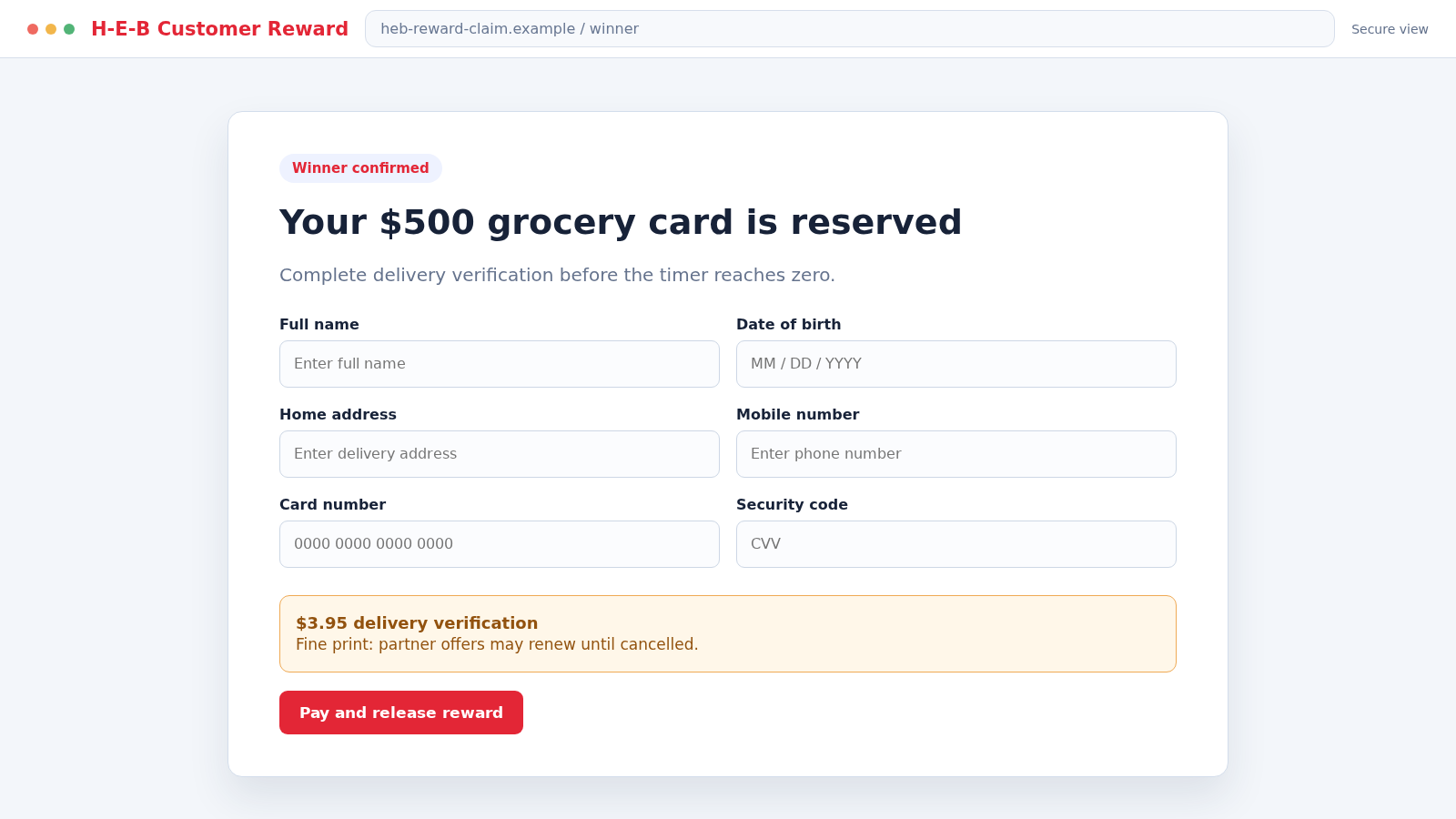
Step 5: Personal information is framed as delivery verification
The victim enters a name, email, phone number, home address, and birth date so the supposed prize can be issued. These fields can be valuable even without a payment.
The information may be sold as a marketing lead or used for targeted scams.
A future caller can mention the H-E-B promotion and the victim’s address to sound familiar.
Step 6: The page adds a login, sharing demand, or small charge
One version asks the visitor to sign in to Facebook again before sharing. Another says five friends must receive the link. A third requests a small shipping or activation payment.
Each route benefits the operator. The login can enable account takeover, the sharing step finds new targets, and the checkout exposes card data or starts recurring billing.
Step 7: The promised reward is delayed behind more offers
After completing one form, the victim is told to claim several sponsor deals, download apps, or answer additional surveys.
Fine print may say the gift card depends on completing paid requirements.
The finish line keeps moving. The operator can earn referral fees while the visitor spends time and money chasing a reward that was presented as immediate.
Step 8: Stolen access and data support follow-up fraud
A captured Facebook account can be used to message friends, buy advertisements, or spread the same giveaway. Payment information may be tested for unauthorized charges.
Contact details can feed fake delivery, loyalty, EBT, and refund messages. Because the victim recently entered a grocery promotion, the follow-up story can feel connected and believable.
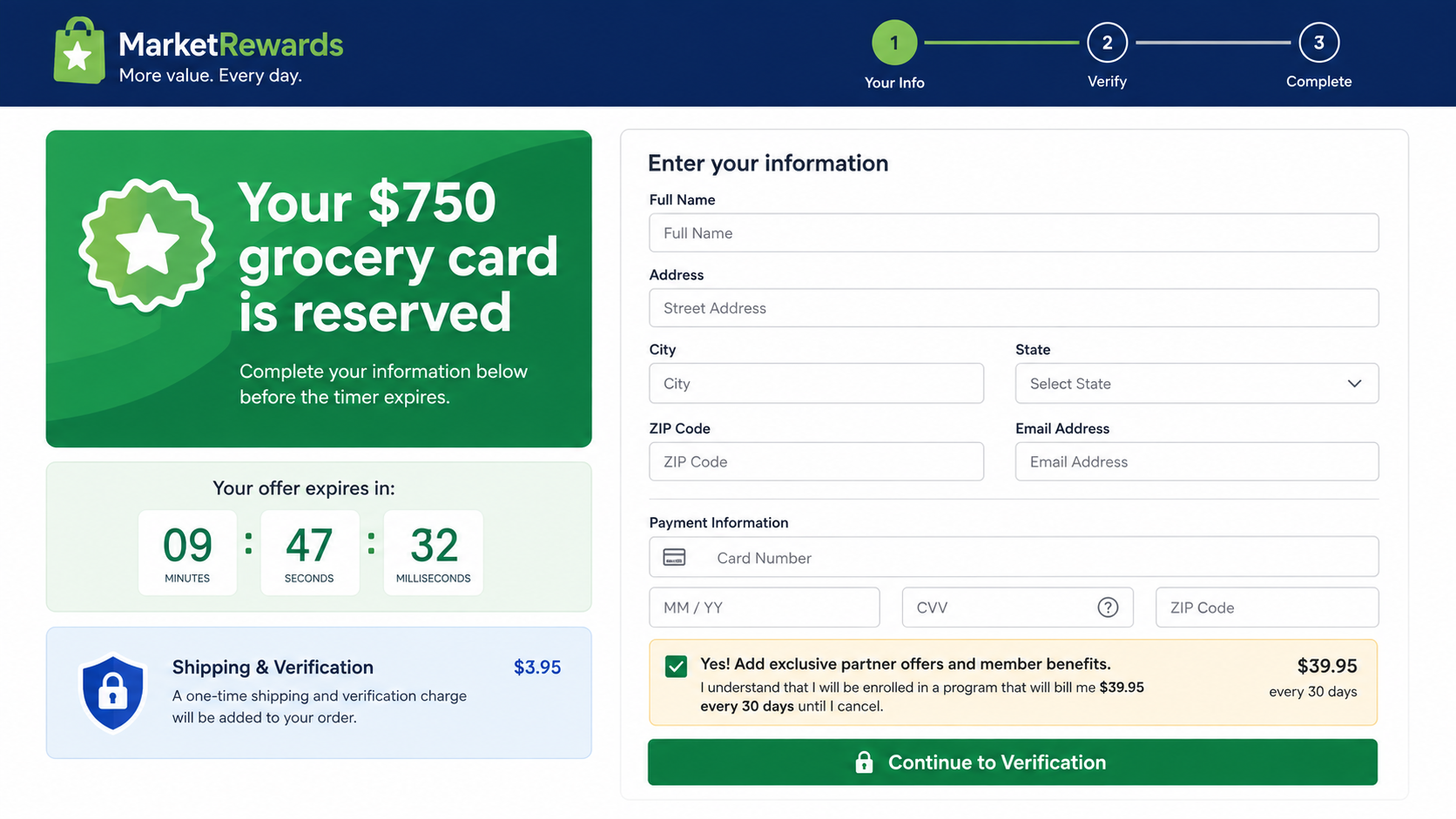
The final page can reveal the real bargain. A tiny shipping charge may expose a card while preselected partner offers create recurring billing.
Company, Address, and Fulfillment Checks
Trace the promotion back to an official H-E-B channel
Do not begin with the link in the post. Open HEB.com, the My H-E-B app, or a verified corporate profile independently and look for the same promotion.
If customer service cannot locate the offer from its name or published rules, do not treat the forwarded page as authorized. A real promotion should survive independent verification.
Read the registered domain rather than the page headline
The important part of a web address is the registered domain immediately before the top-level ending.
A long address can display “heb” in a subdomain or path while belonging to an unrelated operator.
A padlock only shows that the connection is encrypted. It does not prove that H-E-B operates the site or that the prize claim is true.
Find the sponsor, rules, and mailing address
Legitimate sweepstakes identify the sponsor and provide official rules. The rules should explain eligibility, dates, prize value, odds, winner selection, and contact details.
A page that names no legal sponsor, physical address, or fulfillment company leaves no one accountable for the promised reward or collected information.
Check what must happen before the gift is delivered
A prize described as free should not quietly depend on multiple purchases, trial subscriptions, or an unrelated credit offer.
Read the page immediately above the final button and every linked term.
If fulfillment cannot be explained in one clear sentence, leave. Do not keep submitting data in the hope that the next screen will finally produce the gift card.
Why Fake Comments and Share Requirements Are So Effective
People trust people they know more than advertisements. When a friend sends a giveaway, the recipient often assumes the friend checked it first.
In reality, that friend may be completing a forced-sharing instruction.
Comment sections exploit a similar shortcut. A dozen enthusiastic replies can look like independent evidence, even when the profiles are fake, compromised, or repeating text supplied by the page.
Sharing before receiving the reward reverses normal proof. The campaign gets distribution first, while the user only discovers later that the prize never arrives.
Do not feel embarrassed if social proof influenced you. These campaigns are designed around ordinary trust.
The useful response is to warn anyone who received the link and secure any account used in the process.
Other H-E-B Impersonation Variants to Recognize
A prize is only one possible lure. Fake pages may advertise grocery coupons, product-tester positions, receipt surveys, holiday assistance, or exclusive loyalty benefits.
EBT phishing calls and messages claim that a benefit card will be suspended unless its number and PIN are verified.
H-E-B branding can make the message seem connected to a recent grocery purchase, but benefit credentials should never be supplied to an unsolicited caller.
Fake job offers may advertise remote customer-service or mystery-shopping work.
A check is sent for supplies or gift cards, then the victim is told to return part of the money before the check is rejected.
Delivery messages can claim that a grocery order needs a small redelivery fee. Verify every order inside the official app or account, not through the message.
What to Do if You Have Fallen Victim to This Scam
- Close the page and stop sharing the link. Do not complete more offers or pay another fee. Remove your own post or comment so friends do not mistake it for an endorsement.
- Warn the people who received it from you. Send a direct message explaining that the giveaway was not verified and that they should not click or enter information.
- Change a submitted Facebook password immediately. Use the real app or type Facebook.com yourself. Choose a unique password and sign out unfamiliar sessions.
- Protect the connected email account. Change a reused email password, enable multifactor authentication, and check recovery addresses, forwarding rules, and recent logins.
- Contact the card issuer. If you paid shipping or activation, report the card as exposed. Ask about replacing it, stopping recurring charges, and disputing unauthorized transactions.
- Review any subscription terms you accepted. Cancel through a verifiable merchant route and keep confirmation. Ask the card issuer about blocking future charges if the operator is unreachable.
- Protect exposed EBT information. Contact the agency or number on the back of the card, change the PIN, review the balance and transactions, and report unauthorized benefit use.
- Watch for personalized follow-up messages. A caller who knows your name, address, or the promotion may be using data from the form. Verify every new claim independently.
- Run a security scan if anything was installed. If the page downloaded a file, app, or extension, remove unknown software and run a full Malwarebytes scan.
-
Block the malicious site and related ads.
AdGuard can help block many phishing pages, deceptive advertisements, and tracking requests used in reward funnels. - Report the fake account and page. Use Facebook’s reporting controls, notify H-E-B through an official channel, and report financial or identity theft at ReportFraud.ftc.gov.
- Preserve useful evidence. Save screenshots, URLs, messages, transaction records, and the names shown on charges. Evidence helps platforms, banks, and investigators connect related campaigns.
Frequently Asked Questions
Is H-E-B really giving away gift cards on Facebook?
H-E-B may run legitimate promotions, but any specific offer must be verified through HEB.com, the official app, or a verified H-E-B account.
A shared post and copied logo are not confirmation.
Why did all the comments say people received a prize?
Comments can be fabricated, copied, posted by compromised accounts, or written by people who shared before receiving anything. Treat published rules and official confirmation as evidence instead.
Can a free gift card require a small shipping payment?
A surprise shipping or activation charge is a major warning. It exposes card details and may hide recurring billing. Verify the promotion independently before paying any amount.
What if the page was using HTTPS and looked perfect?
HTTPS encrypts the connection but does not verify the operator’s honesty. Scam sites can use certificates and copied designs. The registered domain and official promotion record matter more.
Is an H-E-B customer survey automatically fake?
No. Real surveys and research programs exist. Access them through official H-E-B channels, check the rules, and reject any page requesting passwords, benefit PINs, or unexplained payment.
Will reporting the post get my Facebook account back?
Reporting helps remove the campaign, but account recovery is separate. Change credentials, secure the connected email, sign out unknown sessions, and use Facebook’s official recovery process.
The Bottom Line
The H-E-B gift card scam turns a trusted local name and friendly social sharing into a pipeline for passwords, personal data, card details, and paid offers.
Do not judge the giveaway by its comments or design.
Trace it to an official H-E-B channel, read the rules, and leave the moment a free prize asks for sensitive access or an unexplained payment.

Join the discussion
0 commentsShare your experience or ask a question about this article.
Discussion
Start the conversation
Have a question or something useful to share? Add the first comment.