

Herbiva Cayenne Pepper Drops are marketed as a fast-acting liquid supplement for blood flow, stamina, energy, circulation, heart health, and even intimate performance.
The page looks polished. The claims sound scientific. The price appears discounted through bundle offers.
But once you look closer, Herbiva shows the same pattern seen in many high-risk dropshipping supplement operations: generic product sourcing, aggressive health claims, subscription risk, bundle pressure, and refund terms that are far less friendly than the sales page suggests.
Overview
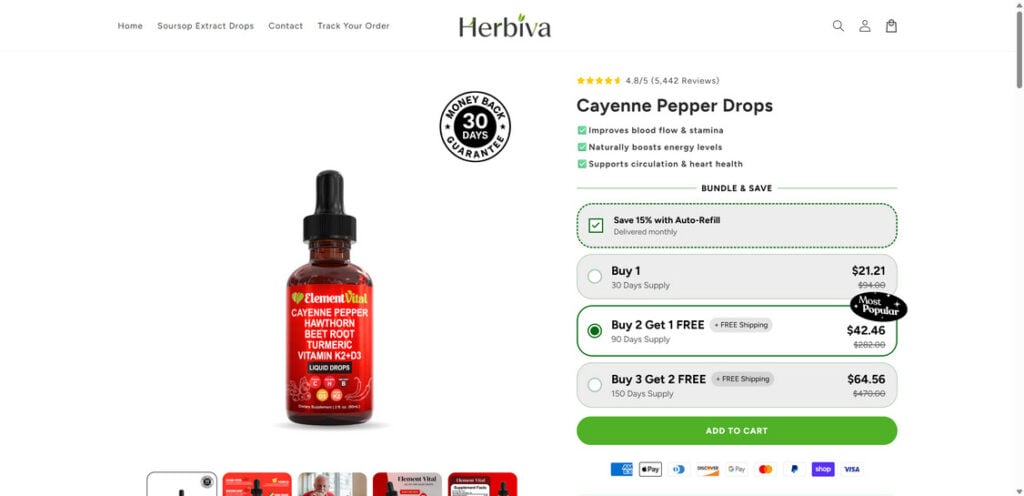
Herbiva sells a product called Cayenne Pepper Drops, but the bottle shown on the page is labeled Element Vital. That already creates confusion. The store branding says Herbiva, while the product branding appears to be Element Vital.
What the site claims
Herbiva claims the drops may:
- Improve blood flow and stamina
- Naturally boost energy levels
- Support circulation and heart health
- Deliver “oxygen-rich blood” where needed
- Improve cold hands and feet
- Support blood pressure readings
- Support performance and confidence in intimate situations
The product page also claims “4.8/5 (5,442 Reviews)” and publishes survey-style claims from “2,000+ verified users after 30 days,” including reported improvements in energy, performance, circulation, and blood pressure readings.
What it appears to be
This appears to be a generic liquid supplement formula containing common wellness ingredients such as:
- Cayenne pepper
- Hawthorn berry
- Beetroot
- Turmeric
- Berberine
- Panax ginseng
- Cinnamon
- Vitamin K2
- Vitamin D3
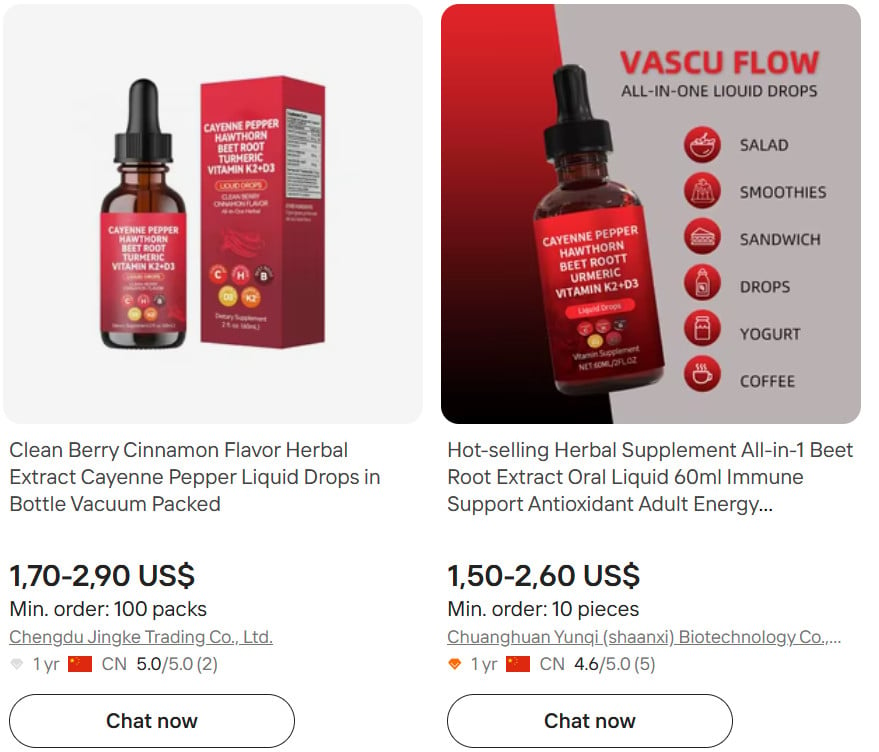
The same type of product appears in wholesale listings for roughly $1.50–$2.90 per bottle, while Herbiva sells bundles at much higher retail prices.
That strongly suggests a private-label or dropshipping model rather than a unique supplement brand.
Major Red Flags
1. The claims go far beyond normal supplement support
The product is not marketed as a basic cayenne tincture. It is framed as a fast-acting circulation and performance enhancer.
The page says users may notice changes in circulation and energy within 3–5 days, and claims benefits can build over 1–2 weeks. It also says many male customers report improved performance, stamina, and confidence as circulation improves.
That type of language is risky because it pushes the product close to medical and sexual-performance territory.
A dietary supplement can make general structure/function claims, but it cannot legally be marketed as a product that diagnoses, treats, cures, or prevents disease. FDA guidance states that supplements using these kinds of claims must carry a disclaimer that the FDA has not evaluated the statement and that the product is not intended to diagnose, treat, cure, or prevent disease.
2. Blood pressure and cardiovascular claims are especially concerning
Herbiva’s product page says 87% saw improvements in blood pressure readings after 30 days, according to its survey-style claims.
That is a major red flag.
Blood pressure is not a casual wellness metric. If a product implies measurable improvement in blood pressure, consumers may interpret it as a substitute for medical care, lifestyle changes, or prescribed treatment.
The FTC’s health-products guidance says health-related advertising claims must be truthful, not misleading, and supported by science. It also explains that the same legal principles apply to supplements and other health-related products.
3. “Third-party lab tested” is claimed, but proof is not shown
The page states that the product is third-party lab tested and says every batch is tested for purity, potency, and safety.
But the page does not clearly show:
- A certificate of analysis
- The testing lab name
- Batch numbers
- Heavy metal testing
- Microbial testing
- Ingredient identity verification
- Active compound levels
Without accessible documentation, “lab tested” is just a trust phrase.
For an ingestible supplement making circulation and blood pressure claims, the evidence should be visible, not implied.
4. The auto-refill option is a subscription trap risk
The site shows “Save 15% with Auto-Refill” and “Delivered monthly” selected near the top of the buying options.
That creates a high risk that some customers may accidentally enroll in recurring billing.
The site’s own cancellation policy confirms that subscriptions exist. It says customers must cancel at least 48 hours before the next scheduled billing date, and charges processed before cancellation are non-refundable.
That means a buyer who misses the deadline may be charged again even if they did not intend to keep receiving bottles.
5. Bundle pricing can lead to more bottles than expected
The sales page presents several buying options, such as:
- Buy 1
- Buy 2 Get 1 Free
- Buy 3 Get 2 Free
These bundle layouts are common in dropshipping supplement funnels because they increase average order value.
The risk is that users may not fully understand:
- How many bottles they selected
- Whether auto-refill is active
- Whether the shipment is one-time or recurring
- Whether the “free” bottles change return eligibility
For buyers already worried about unwanted subscriptions or multiple bottles being sent, this checkout structure deserves caution.
6. The refund policy is much stricter than the marketing suggests
The product page shows a “30 Days Money Back Guarantee,” while other sections mention “90 days money back.”
But the refund policy is far less buyer-friendly.
It says:
- dietary supplements are final sale once shipped
- opened, used, consumed, or tampered products are not refundable
- refunds are not provided for personal dissatisfaction
- refunds are not provided for lack of perceived results
- refunds are not provided for taste preferences
- refunds are not provided for allergic reactions or individual sensitivities
- damaged or incorrect orders must be reported within 48 hours
- once an order is processed or shipped, it cannot be cancelled or refunded
That is a serious contradiction.
The sales page creates the impression of a low-risk purchase. The policy makes the actual refund process highly limited.
7. Generic supplier evidence points to private-label dropshipping
Nearly identical cayenne pepper liquid drop products with similar ingredients and packaging style sold wholesale for around $1.50–$2.90.
The bottle and box style are not unique. Similar formulas are also sold across marketplaces under different brand names, using combinations of cayenne pepper, hawthorn berry, beetroot, turmeric, vitamins, and other common ingredients.
This suggests Herbiva is likely not selling a unique breakthrough formula. It appears to be selling a low-cost private-label product at a retail markup.
8. Testimonials read like sales copy
The page includes testimonial-style claims such as:
- “Blood flow improved”
- “energy like I’m 30 again”
- “husband’s energy and confidence are back”
- “she noticed right away”
The problem is not that testimonials exist. The problem is that they are used to support claims that overlap with circulation, stamina, performance, and blood pressure improvement.
The FTC treats testimonials as advertising claims. If customer stories imply typical results, those results need proper substantiation.
9. The “fast-absorbing liquid” claim is used to justify superiority
Herbiva claims its liquid formula provides “up to 98% absorption,” better taste, and easier dosing than capsules.
That sounds impressive, but the page does not show product-specific evidence proving 98% absorption for this exact formula.
This is another example of a technical-sounding claim that increases perceived value without showing enough proof.
How This Operation Appears to Work
Step 1: Use a trending health angle
The product focuses on circulation, stamina, energy, heart health, blood flow, and male performance.
These are emotionally powerful topics, especially for older buyers.
Step 2: Present a generic supplement as advanced
The formula uses common ingredients, but the page frames it as a “revolutionary liquid delivery system” and a premium blend.
Step 3: Add survey results and testimonials
The store uses large review counts, survey percentages, and “verified customer” style testimonials to create authority.
Step 4: Push bundles and auto-refill
The checkout area encourages bigger purchases and recurring deliveries.
Step 5: Limit refunds after shipping
The refund policy sharply restricts refunds once the order has shipped, even if the buyer is dissatisfied or sees no results.
Is Herbiva Cayenne Pepper Drops a Scam?
Not necessarily a fake-product scam
The product likely exists, and customers may receive a bottle of liquid supplement.
But it is high-risk
The risks are clear:
- aggressive circulation and blood-pressure claims
- sexual-performance implications
- generic private-label sourcing
- auto-refill subscription risk
- bundle confusion
- strict refund policy
- limited proof for lab testing and absorption claims
The most accurate verdict is:
Herbiva Cayenne Pepper Drops appear to be a high-risk dropshipping supplement sold with exaggerated health claims and potentially unfavorable billing and refund terms.
Should You Buy It?
For most people, caution is warranted.
Reasons to avoid it
- The claims are stronger than the evidence shown
- The same type of product appears available from suppliers for a few dollars
- Auto-refill may lead to unwanted monthly charges
- Refunds appear limited once the product ships
- Health claims around blood pressure and circulation should not be taken lightly
If you are considering it anyway
Do not buy it as a treatment for:
- high blood pressure
- erectile dysfunction
- poor circulation
- heart disease
- fatigue
- cold extremities
- any diagnosed medical condition
Speak with a medical professional first, especially if you take blood thinners, blood pressure medication, diabetes medication, or heart medication.
What To Do If You Already Ordered
1. Check whether auto-refill is active
Look at your order confirmation and account page.
Check for words like:
- Auto-Refill
- Delivered monthly
- Subscription
- Recurring order
- Next billing date
If auto-refill is active, cancel immediately and save proof of cancellation.
2. Watch for extra bottles
If you selected a bundle, check how many bottles were included.
Compare:
- what you thought you ordered
- what the checkout charged
- what the order confirmation says
If the number is wrong, contact support within the shortest possible window.
3. Act within 12 hours if you want to cancel
Herbiva’s cancellation policy says orders may be cancelled within 12 hours, but cancellation is not guaranteed once the order enters processing or shipment.
Do not wait.
Send a direct message immediately.
4. Save all evidence
Keep screenshots of:
- the product claims
- the 30-day or 90-day guarantee language
- the subscription option
- the refund policy
- your order confirmation
- the checkout total
- emails with support
This matters if you need to dispute a charge.
5. Do not rely on it as medical treatment
Do not stop or reduce prescribed treatment because of these drops.
This is especially important for:
- blood pressure medication
- heart medication
- blood thinners
- diabetes medication
- ED medication
A supplement marketed online should not replace medical care.
6. Monitor for side effects
Cayenne, ginseng, berberine, cinnamon, turmeric, hawthorn, and vitamin K2 may interact with certain medications or affect sensitive users.
Stop use and seek medical advice if you experience:
- stomach burning
- nausea
- dizziness
- rapid heartbeat
- allergic reaction
- unusual bleeding or bruising
- blood pressure changes
- worsening symptoms
7. Dispute the charge if necessary
If you were enrolled in auto-refill unintentionally, charged for extra bottles, or denied a refund despite misleading claims, contact your card issuer or payment provider.
Use evidence showing:
- what the site promised
- what you ordered
- what you were charged
- what the refund policy says
- how support responded
The Bottom Line
Herbiva Cayenne Pepper Drops are not a proven breakthrough for circulation, stamina, heart health, blood pressure, or male performance.
They appear to be a generic liquid supplement sold through a high-conversion dropshipping funnel with:
- bold health claims
- large review numbers
- survey-style results
- auto-refill billing
- bundle upsells
- strict refund limits
The product may arrive.
That does not mean the claims are reliable, the value is fair, or the buying process is low-risk.
The safest conclusion is simple:
Herbiva Cayenne Pepper Drops look like a high-risk private-label supplement sold with exaggerated claims and a real possibility of unwanted subscriptions or extra bottles.








