

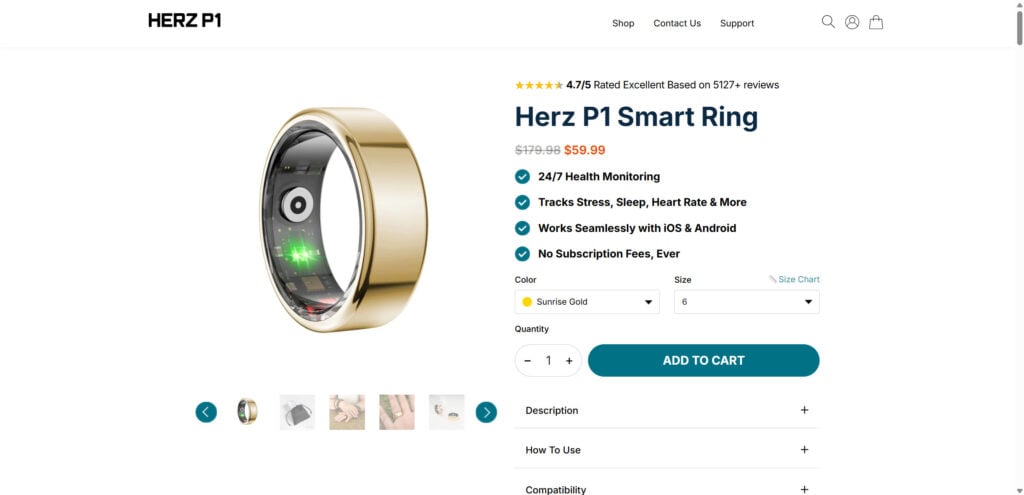
Herz P1 Smart Ring is marketed as a low-cost wearable ring that tracks heart rate, sleep, stress, activity, and other wellness data without a subscription.
The product page looks professional and promises many of the same benefits buyers expect from more expensive smart rings. But several details raise concerns, including generic app references, unclear manufacturer transparency, broad accuracy claims, confusing charging information, and a return policy that is much less risk-free than the sales page suggests.
This review breaks down what Herz P1 claims, what buyers may actually be getting, and why caution is warranted before ordering.
Scam Overview
Herz P1 is sold as a $59.99 smart ring, discounted from a claimed $179.98 price. The site says the ring provides 24/7 health monitoring, tracks stress, sleep, heart rate and more, works with iOS and Android, requires no subscription fees, offers up to 6 days of battery life, and is IP68 waterproof up to around 164–165 feet.
The product page also claims a 4.7/5 rating based on 5,127+ reviews, displays several “verified buyer” testimonials, and promotes a 90-day money-back guarantee with a “hassle-free, no-questions-asked return process.”
At first glance, that sounds like a strong deal.
But when you look closer, Herz P1 has several red flags commonly seen in rebranded wearable-device funnels:
- A low-cost smart ring sold with premium-style claims
- Generic health-tracking promises without visible independent validation
- Support pages that refer to the QRing app, not a clearly branded Herz app
- Similar QRing/OEM smart rings available from China-based suppliers
- A “90-day guarantee” that appears limited by sealed/unopened return conditions
- Charging information that may confuse buyers
- Minimal legal company transparency
The product may exist. Buyers may receive a smart ring. The concern is whether the marketing makes the device look more premium, accurate, and risk-free than it really is.
What Herz P1 Claims
The site claims Herz P1 can track:
- Heart rate
- Heart rate variability
- Sleep patterns
- Stress index
- Activity
- Blood oxygen levels
- Women’s health or cycle-related insights
- Recovery, energy, and general wellbeing
The product page also claims “pinpoint precision,” “exceptional accuracy,” and “highly accurate heart rate tracking.”
Those claims matter because health-tracking accuracy is one of the main reasons people buy a smart ring. If the data is inaccurate, delayed, poorly calibrated, or dependent on a generic app, the ring may not deliver the experience implied by the sales page.
Major Red Flags
1. The app branding does not look fully consistent
The product page says data syncs with the Herz App, but the support documentation repeatedly tells users how to update and use the QRing app. One support article says heart rate, sleep, and activity data are sent to the QRing app for reports.
That is a major clue.
QRing is commonly associated with generic smart rings sold by multiple manufacturers and resellers. If Herz P1 relies on the QRing app rather than a proprietary Herz app ecosystem, buyers should treat it as a likely rebranded generic smart ring rather than a unique health-tech product.
2. Similar QRing/OEM smart rings are sold by China-based suppliers
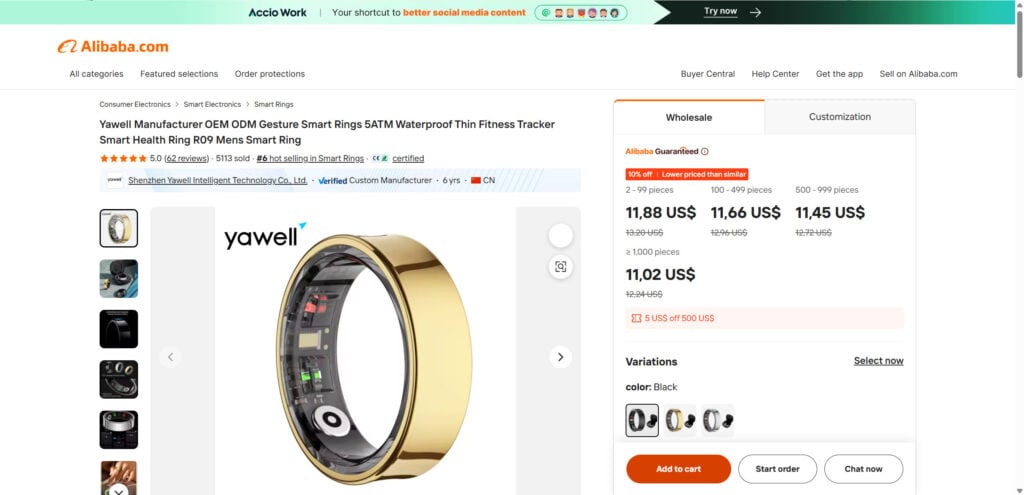
Alibaba listings show China-based suppliers selling QRing app smart rings, OEM wearable smart rings, and health tracker rings with similar functions such as heart rate, sleep, blood oxygen, waterproofing, and iOS/Android app compatibility. One supplier listing mentions a QRing app smart ring for about $18.87–$19.22 at wholesale order quantities, while other smart ring listings show even lower pricing depending on model and supplier)
This does not prove Herz P1 uses one specific supplier.
But it does show the product category is highly commoditized and easy to rebrand. A seller can source a generic smart ring, add a new brand name, create a polished landing page, and sell it as a premium wearable.
3. “Pinpoint precision” is not backed by visible independent testing
Herz P1 says the ring tracks sleep, heart, activity, stress, and cycles with accuracy, and the FAQ claims “exceptional accuracy.
But the product page does not clearly provide:
- Independent lab testing
- FDA clearance
- Clinical validation
- Accuracy studies for Herz P1 specifically
- Sensor model details
- Algorithm validation
- Comparison against ECG, pulse oximeter, or sleep lab data
- Error margins for heart rate, SpO2, HRV, or sleep stages
Smart rings can be useful for trend tracking, but accuracy varies by device, fit, sensors, firmware, and algorithm. Research on smart rings shows promise, especially for heart rate and some sleep metrics, but also notes variation across devices and validation metho
Herz P1 does not show enough product-specific evidence to support strong “pinpoint precision” claims.
4. This is a wellness tracker, not a medical device
The ring tracks health-related signals, but buyers should not treat it as a medical device.
The FDA’s general wellness guidance explains that low-risk wellness products are generally for maintaining or encouraging healthy lifestyle habits and are not intended to diagnose, cure, mitigate, prevent, or treat disease.
That matters because some consumers may use heart rate, oxygen, stress, or sleep readings to make decisions about real health concerns.
A smart ring can help spot trends. It should not be used to diagnose heart problems, sleep disorders, oxygen issues, stress disorders, or medical conditions.
5. The return policy is much stricter than the sales page suggests
The product page says there is a 90-day money-back guarantee and describes the return process as “hassle-free” and “no-questions-asked.”
But the actual returns policy says returns should arrive sealed, unopened, and in original condition. It also says opened, partially used, or perishable items cannot be accepted, and return shipping costs are non-refundable.
That is a serious issue.
How can a buyer properly test a smart ring for comfort, app connection, sleep tracking, battery life, and accuracy while keeping it sealed and unopened?
This makes the “90-day satisfaction guarantee” much less useful than it appears on the sales page.
6. Return shipping is at the customer’s expense
The contact page says return shipping is the customer’s responsibility and that items must be returned within 90 days of delivery in original condition.
That means the purchase is not truly risk-free.
If the ring does not fit, does not sync, gives inaccurate readings, or feels cheap, the customer may still need to pay return shipping and may be denied if the item is considered opened or used.
7. The charging information is potentially confusing
The product page says the ring has “lightning-fast charging” and fully recharges in under an hour with magnetic charging. But the “What’s included” section lists:
- Smart Ring
- Charging Station — sold separately
- USB Power Cord
The site also sells a separate Herz P1 Rapid Charging Case for $19.98.
That creates confusion.
A buyer may reasonably expect everything needed to charge the ring to be included. If the charging station or case is sold separately, the product page should make that extremely clear before checkout.
8. The review system looks seller-controlled
The page claims 4.7/5 based on 5,127+ reviews, and several testimonials appear on the product page. Some reviews are generic, and one visible product-page testimonial appears duplicated under different names.
Seller-hosted reviews are not the same as independent verified reviews.
The site does not clearly show a third-party review platform where buyers can inspect negative reviews, sort by rating, verify purchase status independently, or confirm that the 5,127+ review count is real.
9. The site lacks clear company transparency
The site provides an email, SMS number, and phone number, but the visible pages do not clearly show a full legal business entity, physical business address, manufacturer name, regulatory registration, or warranty company.
The Terms page says the website is operated by “Herz P1,” but that is not the same as identifying a registered company responsible for manufacturing, returns, warranty, data handling, and product safety.
For a product collecting health-related data, transparency matters.
10. The privacy policy raises data-sharing considerations
The privacy policy says the store is hosted on 29 Next, collects personal information during purchases, receives IP address information when users browse, and may send marketing emails with permission. It also says phone numbers provided at checkout may be used for order-related SMS and, with consent, promotional SMS.
It also includes a rewards program section requiring users to link a debit or credit card post-checkout to activate cashback rewards through LIQUID Rewards.
That does not prove wrongdoing, but buyers should understand they are not just buying hardware. They are also entering an ecommerce ecosystem that may involve third-party services, apps, rewards, SMS, and data handling.
What Herz P1 Probably Is
Herz P1 appears to be a low-cost, app-connected smart ring using common wearable sensors and likely relying on the QRing app ecosystem.
It may track:
- heart rate
- sleep estimates
- activity
- HRV-style metrics
- stress estimates
- blood oxygen estimates
- basic wellness trends
But buyers should not assume it will perform like premium smart rings from established brands that have clearer hardware documentation, stronger app ecosystems, published validation, deeper customer support, and more transparent policies.
What It Can Realistically Do
A device like Herz P1 may be useful for:
- Basic wellness tracking
- Step and activity estimates
- Sleep trend awareness
- Heart rate trend monitoring
- General recovery insights
- People who want a cheaper alternative to premium smart rings
For $59.99, expectations should be realistic.
What It Cannot Reliably Do
Buyers should not expect Herz P1 to:
- Diagnose health conditions
- Detect heart disease
- Replace a pulse oximeter
- Replace an ECG device
- Replace a sleep study
- Provide medical-grade HRV data
- Accurately measure stress in a clinical sense
- Guarantee precise sleep-stage tracking
- Match premium smart rings in software quality and long-term reliability
How This Type of Funnel Works
Step 1: Sell a familiar premium concept at a low price
Premium smart rings are expensive. Herz P1 positions itself as a cheaper, no-subscription alternative.
Step 2: Use broad health-tracking claims
The site promises stress, sleep, heart rate, activity, women’s health, and overall wellbeing insights.
Step 3: Use large review numbers
The page claims 5,127+ reviews and a 4.7 rating to reduce skepticism
Step 4: Rely on a generic app ecosystem
Support pages reference QRing, which suggests the ring may not be built around a fully proprietary Herz health platform.
Step 5: Make the purchase feel risk-free
The site promotes a 90-day guarantee, but the policy says returns should be sealed, unopened, and in original condition
That gap is where many buyers may get stuck.
Is Herz P1 Smart Ring a Scam?
Not necessarily a fake-product scam
Herz P1 may ship a real smart ring. The device may connect to an app and provide basic health metrics.
But it is high-risk from a marketing and buyer-protection standpoint
The main concerns are:
- Likely generic/rebranded smart ring model
- Support documentation tied to QRing app
- Strong accuracy claims without visible validation
- Seller-controlled review numbers
- Confusing charging accessory details
- 90-day guarantee limited by sealed/unopened return wording
- Customer-paid return shipping
- Limited visible legal company transparency
- Health-tracking data should not be treated as medical data
The most accurate verdict is:
Herz P1 Smart Ring appears to be a high-risk low-cost smart ring funnel. The product may work as a basic wellness tracker, but the marketing makes it look more premium, accurate, and risk-free than the available information supports.
Should You Buy Herz P1?
For most buyers, caution is warranted.
Reasons to be careful:
- Similar QRing/OEM smart rings are sold by overseas suppliers.
- The support pages refer to QRing rather than a fully branded Herz app.
- The return policy may not allow realistic testing.
- The charging setup may require an extra accessory.
- Accuracy claims are not backed by visible independent testing.
- The device should not be used for medical decisions.
If you still want to try it:
Buy it only as a budget wellness gadget.
Do not buy it expecting:
- medical-grade tracking
- premium smart-ring accuracy
- guaranteed fit
- a truly risk-free return
- a full proprietary app ecosystem
- long-term support comparable to major wearable brands
What To Do If You Already Ordered
1. Save the product page
Take screenshots of:
- 90-day money-back guarantee
- “no-questions-asked” wording
- 4.7/5 and 5,127+ review claim
- “pinpoint precision”
- no subscription claim
- charging information
- return policy
- checkout total
This can help if you need to dispute the charge.
2. Confirm what charging accessories are included
Check whether your package includes:
- ring
- USB cord
- magnetic charger
- charging dock
- rapid charging case
- sizing materials
If the ring cannot be charged without a separately purchased accessory, document it.
3. Check the app before relying on the data
The support documentation references the QRing app. Confirm:
- app developer name
- App Store or Google Play reviews
- app permissions
- privacy policy
- data export options
- whether the app works in your country
- whether the app requires account creation
4. Test accuracy realistically
Compare heart rate readings against a reliable device while resting.
Do not use the ring as your only source for:
- blood oxygen concerns
- abnormal heart rate concerns
- sleep apnea concerns
- stress or anxiety concerns
- health diagnosis
5. Act fast if you want a return
Contact support quickly and ask in writing whether opened/tested smart rings qualify for the 90-day guarantee.
Use this message:
I am requesting a return for order #[number]. Please confirm whether the 90-day satisfaction guarantee applies to an opened and tested Herz P1 Smart Ring, and provide the return address and refund timeline in writing.
6. Keep all packaging
The return policy says items should be returned sealed, unopened, and in original condition. Keep everything until you are certain you will keep the product.
7. Dispute if necessary
If the product does not arrive, cannot charge, cannot connect, arrives different from the page, or the seller refuses to honor the guarantee as advertised, contact your payment provider.
Use evidence showing:
- what was advertised
- what arrived
- what the return page says
- what support told you
- photos or videos of the issue
FAQ About Herz P1 Smart Ring
Is Herz P1 Smart Ring a scam?
Herz P1 may not be a fake-product scam. Buyers may receive a working smart ring. The concern is that it appears to be a low-cost, likely generic smart ring sold with premium-style claims, seller-controlled reviews, and return terms that may limit real-world refunds.
Does Herz P1 use the QRing app?
The product page refers to the Herz app, but Herz P1 support articles repeatedly reference the QRing app and say health data is sent to QRing for reports.
Is Herz P1 medically accurate?
The site claims high accuracy, but it does not show independent validation for Herz P1 specifically. Treat it as a wellness tracker, not a medical device.
Is the 90-day guarantee really risk-free?
Not fully. The sales page says “no questions asked,” but the returns policy says returns should be sealed, unopened, and in original condition, and return shipping costs are non-refundable.
Does Herz P1 require a subscription?
The product page says there are no subscription fees. (herzp1.com) Buyers should still review app terms and permissions before using the ring.
Are similar smart rings available elsewhere?
Yes. Alibaba and other supplier listings show QRing/OEM smart rings with similar health-tracking features, often at wholesale prices.
The Bottom Line
Herz P1 Smart Ring is not clearly a “nothing ships” scam. The product may arrive and may provide basic wellness tracking.
The concern is the gap between the marketing and the likely reality.
The site promotes Herz P1 as a precise, premium-looking smart ring with thousands of reviews, a no-subscription app, waterproofing, long battery life, and a 90-day money-back guarantee. But support pages refer to the QRing app, similar OEM smart rings are available from overseas suppliers, the review claims are seller-controlled, and the return policy appears to require sealed/unopened condition despite the product needing real-world testing.
The safest conclusion is simple:
Herz P1 Smart Ring looks like a budget rebranded smart ring sold through premium-style marketing. It may work for basic tracking, but buyers should not treat it as a medical device, should not expect premium accuracy, and should read the return policy carefully before ordering.








