

HoneyPezil arrives wrapped in the familiar language of sharper thinking, dependable memory, and everyday confidence. Its polished bottle and reassuring promises invite an easy first impression.
Look across the pages calling themselves official, however, and the product becomes much harder to identify. Important details shift precisely where buyers need consistency.

Overview
What HoneyPezil is advertised to do
HoneyPezil is marketed as a capsule supplement for memory, focus, mental clarity, and long-term brain health. Several pages also connect it with energy and circulation.
The presentation targets ordinary lapses that become worrying with age. Forgetting a name, losing concentration, or feeling mentally tired is framed as a problem requiring daily capsules.
That positioning can feel personal. It reaches people who fear cognitive decline, caregivers searching for answers, and adults frustrated by stress-related forgetfulness.
No finished-product clinical trial was provided on the pages we reviewed. Ingredient descriptions and confident testimonials are used instead of evidence for the complete formula.
Why the competing official websites matter
Several domains present HoneyPezil as their own official offer. They do not agree on bottle count, dosage, ingredient disclosure, pricing, or the company behind the sale.
One page promotes 30 capsules but tells buyers to take two daily. Another displays 60 capsules with the same direction. A third recommends only one capsule.
Those differences change how long a bottle lasts and how much each day costs. They also make it unclear which label a customer will actually receive.
The seller identity changes too. One site names Gex Corporation LLP, while another calls Goldhive Wellness Inc. the company operating an authorized HoneyPezil portal.
What our investigation found
A purchasable capsule appears to exist, but the online sales ecosystem is not consistent enough to treat every HoneyPezil page as trustworthy.
- An unrelated IQHoney promotion redirects shoppers to HoneyPezil.
- Competing official sites describe different serving sizes.
- The advertised bottle contains either 30 or 60 capsules.
- Prices and bundle totals vary substantially between domains.
- Different companies claim responsibility for the brand.
- Dramatic memory claims appear without product-specific trials.
These are material contradictions, not cosmetic website differences. Buyers cannot make an informed decision when the product, seller, and daily cost change across supposed official sources.
How the HoneyPezil Sales Funnel Works
Step 1: A different product name attracts the first click
The journey does not always begin with HoneyPezil. We found an affiliate page advertising IQHoney, another brain supplement with its own bottle, formula, and identity.
The IQHoney page uses familiar memory language and a glossy product render. Nothing near the first sales pitch clearly prepares the visitor to buy HoneyPezil instead.
When its order button was tested, the browser moved through tracking links before arriving at the HoneyPezil package page.
This is a meaningful switch. A person persuaded by claims about one formula can reach a transaction for another without receiving a plain comparison.
Step 2: The landing page turns ordinary forgetfulness into urgency
The HoneyPezil page presents memory worries as a problem that should be addressed quickly. Images of the brain, aging adults, and healthcare figures reinforce the message.
Readers are invited to imagine losing independence or missing important moments. The page then positions a daily capsule as the simple response.
Emotion can narrow attention. A worried visitor may focus on hope while overlooking the absence of a named study evaluating the finished bottle.
Statements about supporting memory are not the same as proving that HoneyPezil prevents, treats, or reverses dementia. Those distinctions matter greatly.
Step 3: Authority cues make the offer feel medically settled
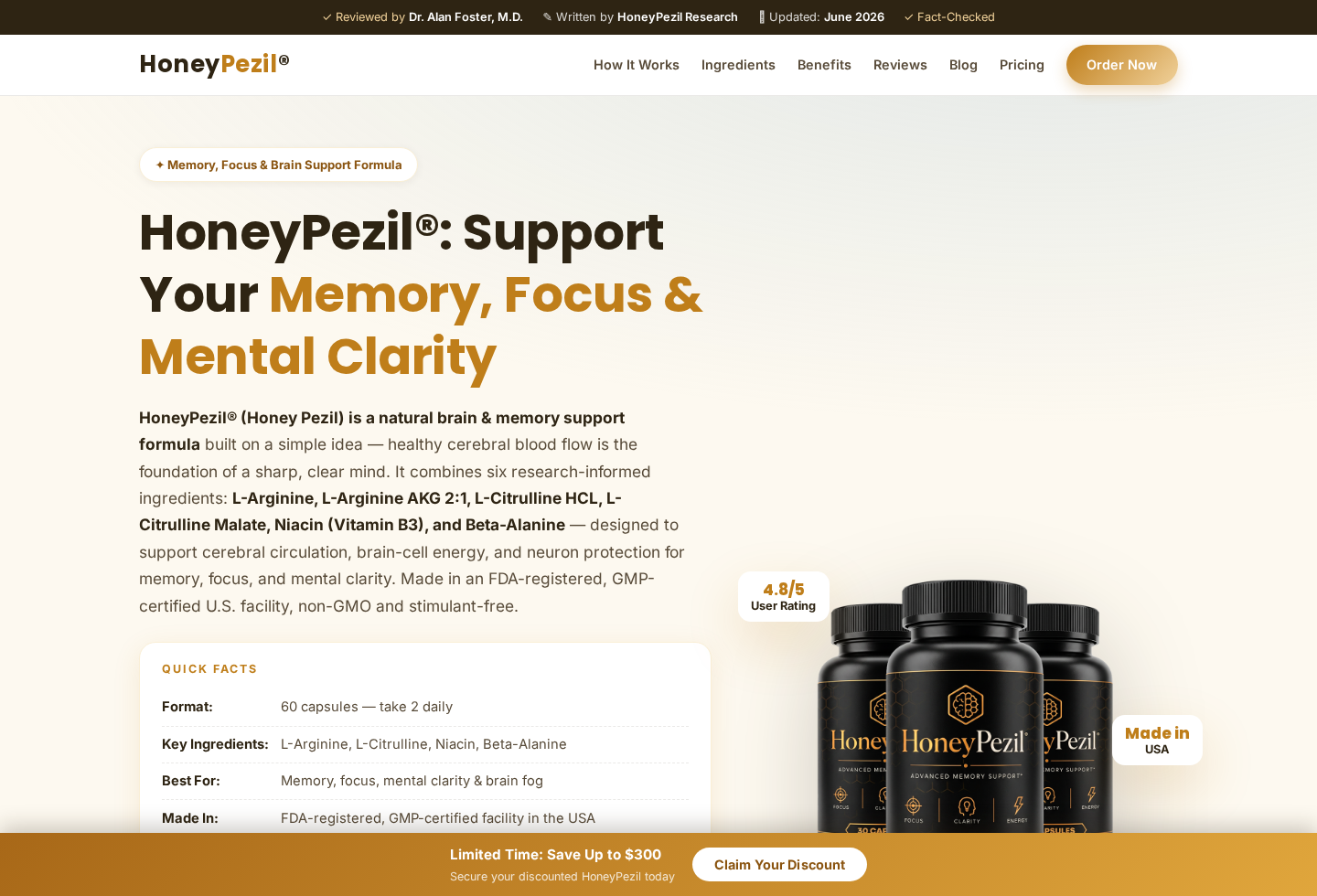
One competing site says the product was reviewed by “Dr. Alan Foster, M.D.” Beside that claim are clean medical graphics and explanations of individual nutrients.
Another page displays quality symbols, laboratory imagery, and references to American manufacturing. These elements create confidence before the seller supplies verifiable testing.
A doctor-style endorsement should be independently checkable. Buyers should be able to confirm the person, credentials, relationship, and exact conclusions attributed to that reviewer.
Facility standards also do not establish effectiveness. A manufacturing badge cannot substitute for a controlled trial of the completed HoneyPezil formula.
Step 4: Bulk pricing makes the largest order look safest
The main offer emphasizes packages of two, three, or six bottles. The displayed per-bottle price falls as the upfront commitment grows.
One page lists two bottles for $158, three for $207, and six for $294. The largest option appears to deliver the greatest savings.
A competing site shows two bottles for $138, three for $147, and six for $234. That is not a small promotional adjustment.
Someone comparing only the headline amount may miss the full charge. The lowest price applies to each bottle inside a larger prepaid bundle.
Bulk ordering is especially risky before a buyer knows whether the label matches the advertisement or whether the ingredients are tolerated.
Step 5: The product specifications change with the domain
Honeeypezil.com describes a 60-capsule bottle and says adults take two capsules daily. It highlights six amino-acid and circulation-related ingredients.
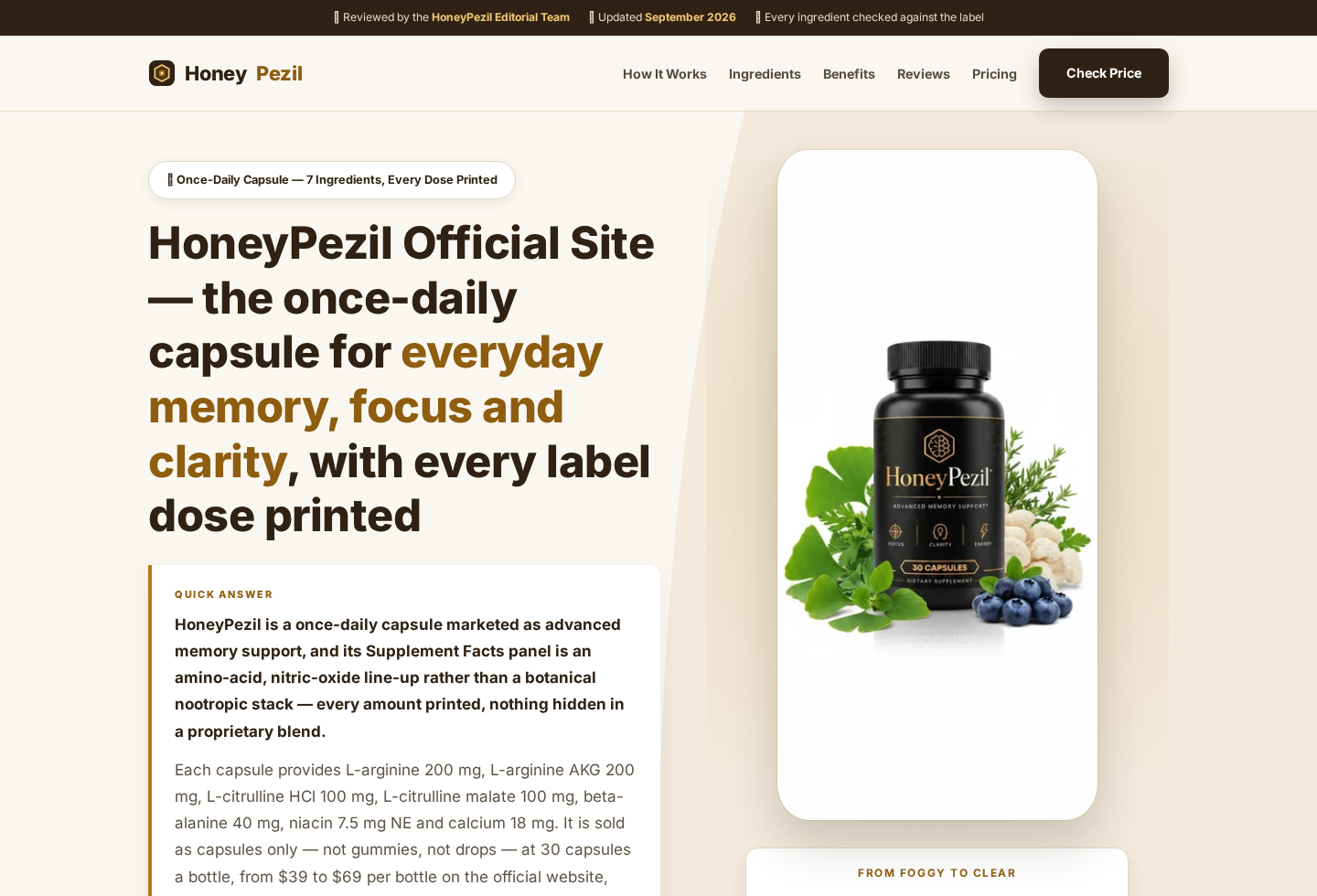
Honeyypezil.com displays 30 capsules, recommends one daily, and publishes seven ingredients with amounts. The bottle lasts a month under that instruction.
The principal honeypezil.com offer also shows 30 capsules while directing users toward two per day. That would make one bottle last only 15 days.
These discrepancies affect dosage, value, and safety. A shopper cannot calculate a regimen when the same brand is assigned multiple incompatible specifications.
Step 6: A guarantee calms concerns after the commitment grows
The package pages promote a 60-day money-back guarantee. That message appears near expensive bundles and helps make a large first order feel reversible.
A guarantee is only useful when its administrator is clear. The buyer must know who charged the card, where returns go, and what condition bottles must meet.
Shipping costs, return authorization, opened containers, and the date used to calculate eligibility can determine whether a refund is actually available.
Before paying, save the version of the policy shown at checkout. A promise on a referring page may not bind a different merchant.
The Product Claims Need More Than Testimonials
Memory support is not an Alzheimer’s treatment
HoneyPezil advertising uses broad phrases such as memory support, focus, and cognitive clarity. Those descriptions can sound modest while surrounding imagery implies much more.
No supplement should replace evaluation for new or worsening memory problems. Medication effects, sleep disorders, depression, thyroid disease, vitamin deficiencies, and neurological conditions can overlap.
A timely medical assessment matters because some causes are treatable. Delaying care while testing an online supplement can lose valuable time.
Consumers should be especially cautious when an advertisement implies that doctors hide a simple cure. That story discourages evidence-based care and rewards the seller’s urgency.
Ingredient research cannot prove the finished bottle works
The sites discuss L-arginine, citrulline, niacin, beta-alanine, and related compounds. Most are better known in circulation or exercise contexts than as established memory treatments.
Even when a published paper examines one ingredient, the result does not automatically transfer to HoneyPezil. Dose, purity, population, duration, and outcome may differ.
A reliable finished-product claim requires evidence on that exact formulation. The sales pages did not provide a trial allowing readers to verify dramatic cognitive benefits.
The disclosed amounts also matter. Ingredient names printed beside illustrations reveal little when the quantity and standardized form remain unknown.
Testimonials cannot resolve the contradictions
Customer stories describe clearer thinking and renewed confidence. They are presented as social proof, but the pages do not show a transparent verification process.
Testimonials cannot establish typical results. They may reflect selection, editing, placebo effects, unrelated lifestyle changes, or experiences that cannot be independently confirmed.
A “verified buyer” label is meaningful only when the verification method is disclosed. A graphic badge created by the seller does not prove an independent review.
Before trusting a dramatic story, look for balanced reporting of limitations, adverse effects, and people who saw no benefit. Sales pages rarely emphasize those outcomes.
Company, Address, and Fulfillment Red Flags
The company identity changes between official pages
Honeyypezil.com names Gex Corporation LLP as the distributor. A separate HoneyPezil site identifies Goldhive Wellness Inc. as the operator of an authorized portal.
Those may be distinct marketing or distribution businesses, but the pages do not clearly explain their relationship. Buyers are left to guess who is accountable.
A trustworthy checkout should name the legal seller before payment. That same entity should appear consistently in the terms, receipt, card descriptor, and refund instructions.
The listed address may not identify the manufacturer
One page lists a post-office box in Ogden, Utah. A mailing address can receive notices, but it does not establish where capsules are made or tested.
Another site provides a suite address in Saratoga Springs, New York. An office listing is not evidence of a supplement factory or laboratory.
Buyers should distinguish headquarters, registered agent, mailbox, returns center, and manufacturing facility. Marketing pages often blur those roles to create an appearance of substance.
Support details do not create one coherent operation
The Gex-branded page lists contact@customercs.com and +1 (507) 448-8190. Other HoneyPezil pages use different support pathways.
A functioning telephone number alone does not confirm product quality. Call before ordering and ask the agent to state the exact bottle count, dosage, formula, and return address.
If the representative cannot identify the product shown on the site, do not assume customer service will become clearer after a disputed charge.
Fulfillment can hide the real supply chain
The parcel sender may be a warehouse handling many direct-response brands. That location can process shipments without manufacturing, owning, or testing the capsules.
Generic supplements can be mass-produced and relabeled for fast-moving campaigns. Without batch-specific testing, buyers cannot independently verify identity, potency, or contamination controls.
Imported production is not automatically unsafe, and Chinese manufacturing alone proves nothing. The concern is missing traceability, inconsistent labels, and no accessible quality evidence.
Do not use capsules arriving without a sealed bottle, lot number, expiration date, full facts panel, warnings, and an identifiable distributor matching the receipt.
What to Check Before Ordering HoneyPezil
Start by recording the exact domain. Similar spellings can lead to different pages, companies, labels, and policies while all claim official status.
Compare the advertised bottle with the Supplement Facts panel. Confirm whether it contains 30 or 60 capsules and whether the direction is one or two daily.
Calculate the full regimen cost. A 30-count bottle taken twice daily lasts 15 days, making a seemingly affordable package much more expensive.
Follow the order button without entering payment information. Stop if the product name changes, the cart adds bottles, or a recurring option appears.
Read the refund policy from start to finish. Note the deadline, required authorization, return destination, opened-bottle rules, and responsibility for postage.
Search the legal seller separately. Compare its name across the terms, privacy policy, contact page, checkout, confirmation email, and anticipated card descriptor.
Ask for a current certificate of analysis matching the lot offered. A generic certificate or quality logo may not represent the bottle delivered.
Discuss the complete label with a clinician or pharmacist, particularly when using blood-pressure medicines, nitrates, anticoagulants, diabetes treatments, or other supplements.
What to Do if You Have Fallen Victim to This Scam
- Document the complete journey. Save the referring advertisement, IQHoney page, HoneyPezil destination, cart, final total, policies, receipt, bottle, parcel label, and support messages.
- Confirm the actual merchant. Use the receipt and card statement to identify who accepted payment. Do not rely solely on the first advertisement’s contact page.
- Stop using a mismatched product. Keep it sealed when the ingredient panel, serving size, or distributor differs. Seek medical advice after any concerning reaction.
- Request cancellation in writing. State the exact charge, order number, contradiction, and remedy requested. Ask for return authorization and a usable return address.
- Check for recurring authorization. The reviewed principal page says one-time purchase, but confirm directly with both merchant and card issuer that no renewal exists.
- Dispute deceptive billing promptly. Explain the product switch or material mismatch to the card issuer. Supply screenshots and observe every evidence deadline.
- Secure your device and accounts. Change reused passwords. Run Malwarebytes if the funnel triggered downloads, notification prompts, or suspicious browser behavior.
- Limit future advertising exposure. AdGuard can reduce aggressive ads and redirect chains. It cannot cancel an order, so complete the merchant and banking steps separately.
Frequently Asked Questions
Is HoneyPezil a real supplement?
HoneyPezil capsules are offered for purchase, but competing official pages describe conflicting counts, directions, prices, and companies. Confirm the exact item before paying.
Is HoneyPezil proven to restore memory?
We found no finished-product clinical trial proving that HoneyPezil restores memory or treats cognitive disease. Ingredient summaries do not establish those results.
Why does an IQHoney page send buyers to HoneyPezil?
The tested order link moved through affiliate tracking to HoneyPezil. That product switch should be disclosed clearly because the names and advertised formulas differ.
Does every HoneyPezil bottle contain 60 capsules?
No. One reviewed page promoted 60 capsules, while other pages displayed 30. Serving directions also changed, so buyers should inspect the physical label.
Is HoneyPezil sold as a subscription?
The principal pages reviewed described one-time purchases, not automatic refills. Buyers should still inspect the final checkout and confirmation for recurring-payment language.
Can HoneyPezil replace medical evaluation?
No. New, worsening, or disruptive memory symptoms deserve professional assessment. A supplement cannot diagnose the cause or replace evidence-based treatment.
The Bottom Line
HoneyPezil may be a purchasable capsule, but its online identity is fragmented. Different official pages disagree about the bottle, dose, price, company, and guarantee.
The IQHoney redirect makes that uncertainty more serious. Do not let a polished brain graphic or bulk discount replace a stable label and accountable seller.
Until the transaction details match one verifiable product from advertisement through delivery, the safest decision is to avoid the funnel and seek transparent alternatives.

Join the discussion
0 commentsShare your experience or ask a question about this article.
Discussion
Start the conversation
Have a question or something useful to share? Add the first comment.