

Military Honey appears in polished ads as a convenient gummy for energy, circulation, and confidence. The bottle looks consistent enough to inspire a quick purchase.
That surface impression changes when the competing “official” pages, ingredient claims, contact details, and checkout destinations are examined together.
Overview
What Military Honey is supposed to be
Military Honey is presented as a men’s wellness supplement, usually in gummy form. Its advertising connects the product with energy, stamina, circulation, and general vitality.
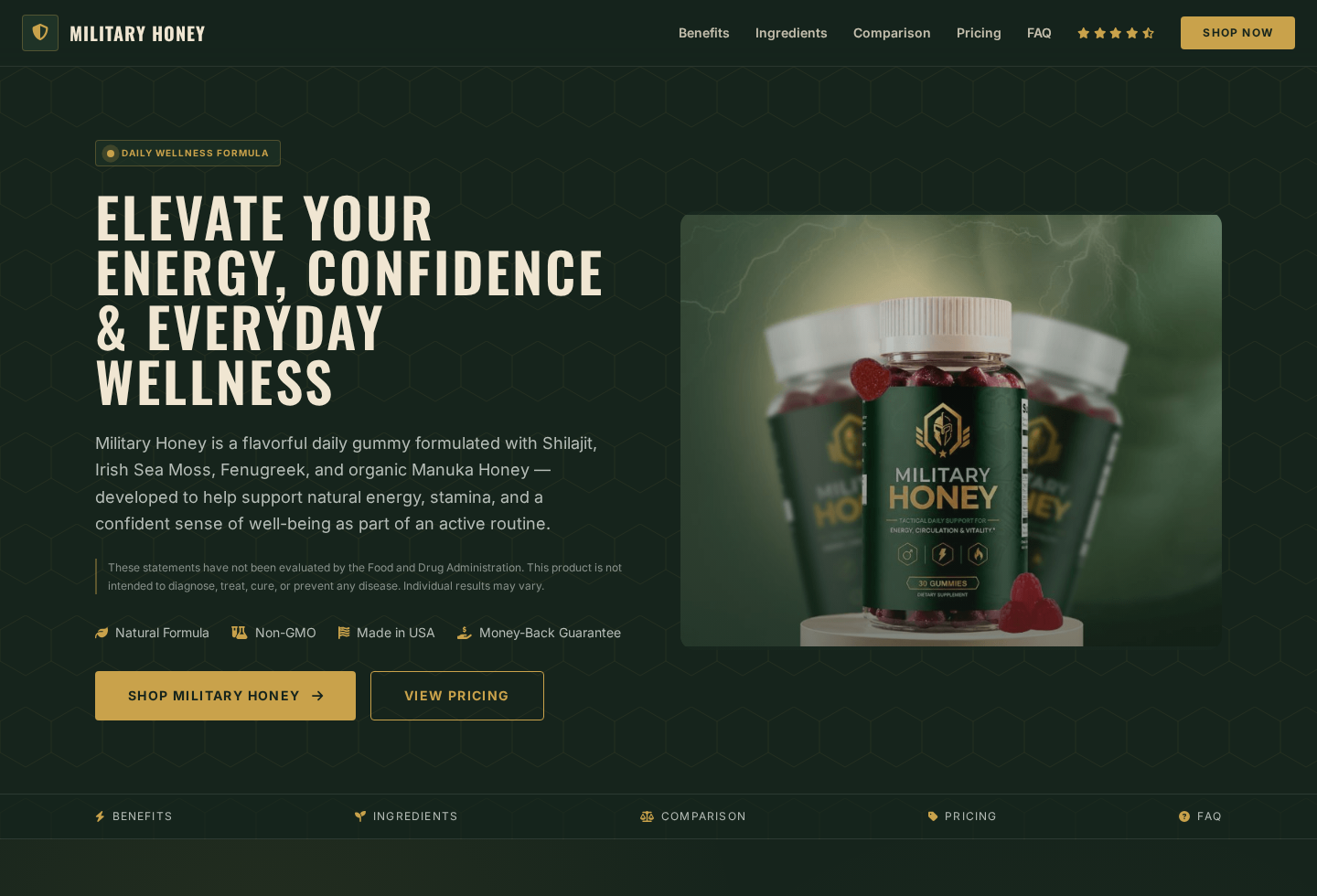
One prominent page describes 30 gummies containing shilajit, Irish sea moss, fenugreek, and Manuka honey. It recommends an ordinary daily wellness routine.
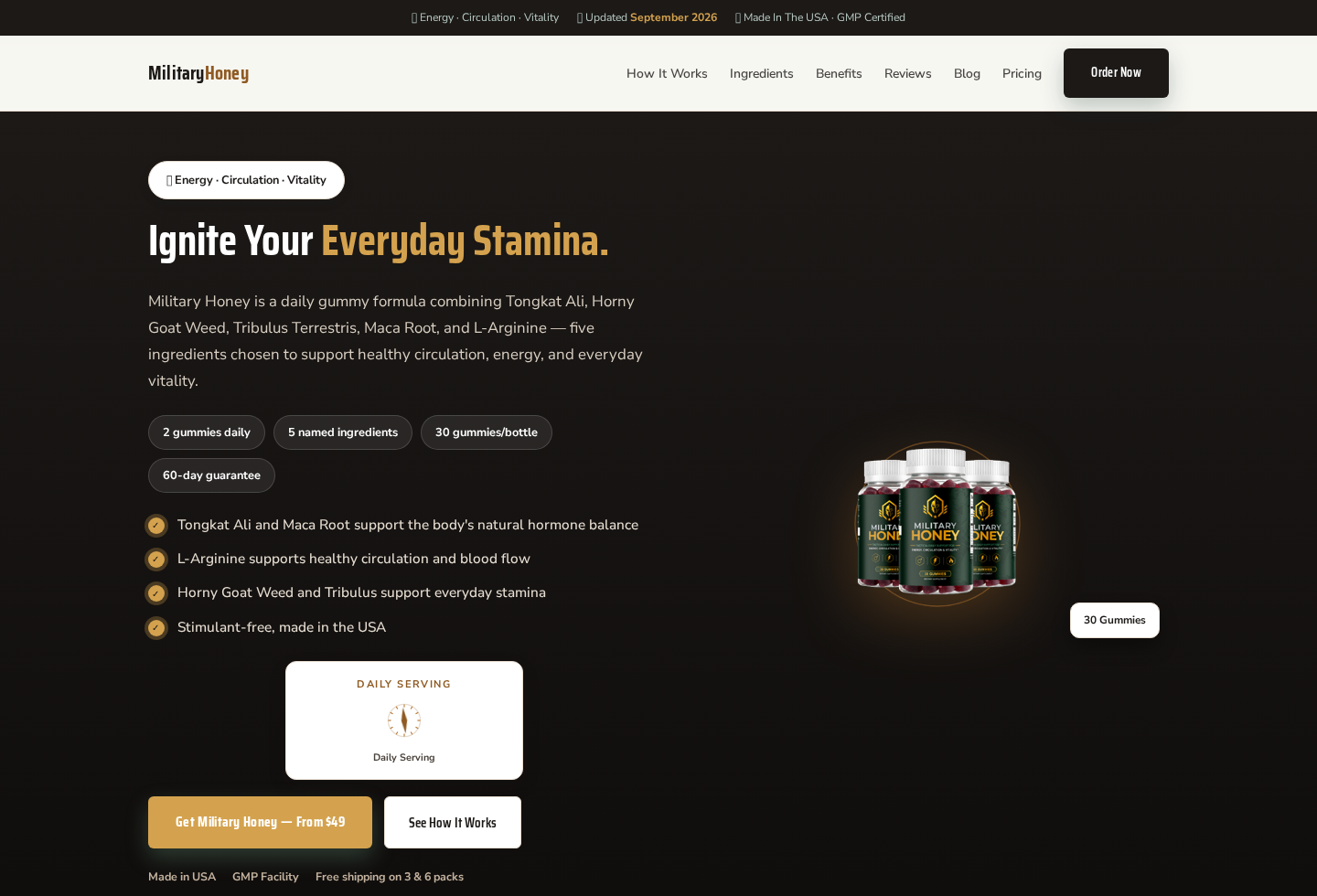
Another page bearing the same product name lists Tongkat ali, horny goat weed, tribulus, maca, and L-arginine instead. It recommends two gummies daily.
Other pages switch from gummies to capsules and make much stronger sexual-performance claims. A stable product should not change identity whenever the domain changes.
Why these “official” pages are a serious problem
Several recently registered domains present themselves as the authoritative Military Honey website. They do not agree about format, formula, serving size, or intended benefit.
These are not harmless variations in wording. Ingredient information determines allergy risks, medication interactions, dosing, and whether the item matches what a buyer expected.
The pages also lack a consistent legal seller. A product name and attractive bottle image cannot replace an identifiable business responsible for payment, manufacturing, and returns.
Most importantly, some order buttons do not lead to Military Honey at all. They redirect visitors into checkout funnels displaying entirely different supplements.
What our investigation found
The evidence supports a strong warning about the Military Honey advertising network. It does not support trusting any page merely because it calls itself official.
- Multiple “official” sites publish incompatible formulas.
- The advertised format changes between gummies and capsules.
- One site uses an obvious example-style 555 support number.
- Another provides no meaningful direct contact information.
- Military Honey buttons can open JellyFill or Horse Boost offers.
- New domains present large discounts and short refund promises.
We found enough direct contradictions to classify these pages as deceptive affiliate funnels. Buyers cannot know which representation governs an order without inspecting the final checkout.
How the Military Honey Scam Works
Step 1: A social advertisement sells confidence, not verifiable details
The first contact may be a Facebook post, video advertisement, sponsored review, or search result promising renewed energy and stronger performance.
Military imagery gives the name a tough, disciplined identity. Honey suggests something natural, familiar, and safer than a conventional performance product.
The creative usually keeps the message broad. Viewers hear about vitality and circulation before seeing a complete label, manufacturer, or accountable company.
That emotional framing matters. Someone worried about aging or intimacy may click before asking who actually formulated, tested, and distributes the supplement.
Step 2: A review page declares itself the official website
The visitor lands on a professional page with star ratings, seals, product renders, testimonials, and repeated buttons urging an immediate order.
Terms such as “made in USA,” “GMP certified,” and “FDA registered facility” appear beside the bottle. None proves that the finished supplement is FDA approved.
The page may say supplies are limited or that a large discount expires today. Those messages reduce the time available for comparison.
A shopper sees an official-looking presentation, yet often receives no clear legal entity, physical headquarters, manufacturer name, or independent test report.
Step 3: The product changes across nearly identical sales sites
On mymilitaryhoney.com, the highlighted formula uses shilajit, sea moss, fenugreek, and Manuka honey. The bottle is described as a 30-count gummy product.
On militaryhoneey.com, the formula instead uses five libido and circulation ingredients. The page says two gummies are taken daily.
Militaryhoney.co goes further, advertising capsules with extraordinary enlargement and sexual-performance claims. Its own guarantee language changes between sections.
En-militaryhoney.com publishes another six-ingredient capsule formula. Its buttons accidentally tell visitors to order “Quiet Nerves,” revealing recycled sales-page material.
A legitimate reformulation can happen, but it should be documented by the responsible brand. Here, separate domains claim authority while offering incompatible stories.
Step 4: The button silently changes the product
The strongest warning appears when the shopper clicks the purchase button. The displayed brand can disappear before the payment stage.
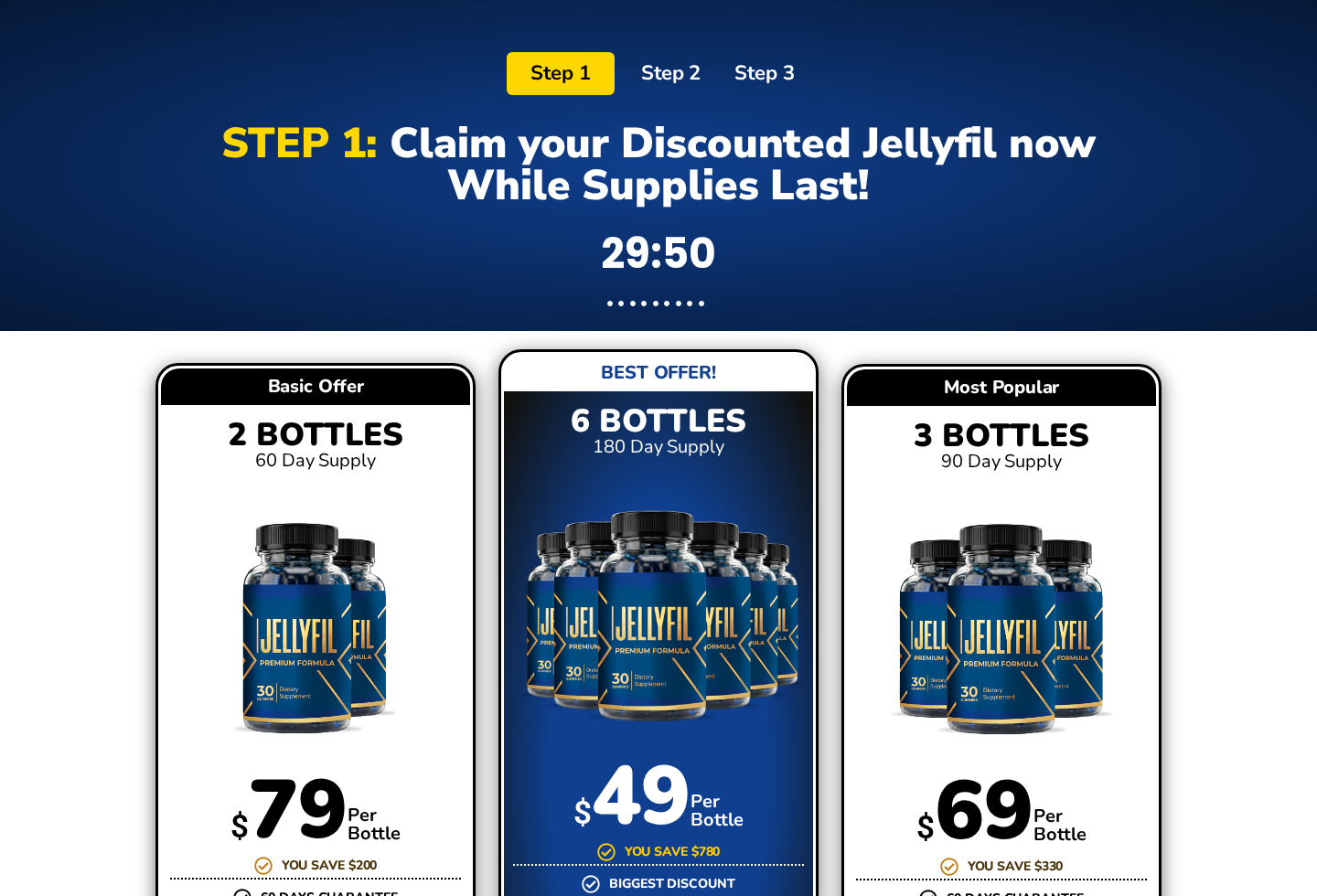
The “Shop Military Honey” button on mymilitaryhoney.com passed through an affiliate tracker and ended at a JellyFill order page during our test.
A button on militaryhoneey.com used another tracking network and ended at a Horse Boost checkout. Neither destination displayed Military Honey.
This creates a bait-and-switch risk. The advertisement captures interest with one identity, while the transaction records a different item, merchant, and policy.
A buyer who notices only after delivery may struggle to explain the dispute. The confirmation email and card statement may reference the checkout product instead.
Step 5: Bulk packages replace the imagined single bottle
The destination pages emphasize bundles of two, three, or six bottles. The lowest per-bottle amount belongs to the largest upfront order.
Large “savings” figures make six bottles feel prudent, even though the buyer has not tested one serving or confirmed the true ingredient panel.
Some funnels add a countdown, limited inventory, free shipping, or bonus products. These devices move attention away from the complete cart total.
Always calculate the actual charge. A $49 headline can describe each bottle inside a $294 package, not the amount leaving the card today.
Step 6: The refund promise becomes harder to use than it looked
A 60-day guarantee appears reassuring, but the buyer must identify which seller accepted the payment and which policy applies to that checkout.
The referring Military Honey page may not process orders. Contacting its generic address cannot necessarily authorize a return for JellyFill, Horse Boost, or another product.
Refund conditions may require every bottle, a return authorization, original packing materials, tracking, and a request made within a narrowly calculated period.
Shipping costs, opened containers, and international returns may affect the outcome. Verbal assurances inside an advertisement are weaker than the transaction’s written terms.
The Contradictions Buyers Should See Before Paying
There is no dependable ingredient identity
A supplement is defined by its label, not its brand mood. Military Honey pages name several unrelated formulas under nearly identical product imagery.
Shilajit and sea moss create different safety questions from L-arginine, horny goat weed, or Tongkat ali. Those substitutions are medically meaningful.
The capsule pages introduce still more ingredients and directions. A consumer cannot evaluate interactions when the advertisement never establishes which formula will arrive.
Do not use a product when its sealed bottle lacks a complete Supplement Facts panel, lot code, expiration date, distributor, and readable warnings.
The stated purpose keeps expanding
Some pages stay with vague energy and wellness language. Others imply improved blood flow, testosterone, erections, semen volume, or physical enlargement.
Those claims are not interchangeable. Stronger promises require stronger evidence, and no page we reviewed provided finished-product clinical trials supporting dramatic outcomes.
Research on an individual herb does not prove the advertised bottle works. Study doses, extraction methods, participants, and measured outcomes may differ completely.
Anyone experiencing persistent sexual dysfunction should seek medical advice. It can reflect cardiovascular, hormonal, medication-related, neurological, or psychological conditions requiring proper assessment.
The guarantee is not one consistent promise
Different Military Honey pages mention different windows and procedures. Some make the guarantee prominent while withholding a practical returns address until after purchase.
A promise cannot be evaluated without knowing the merchant. The page displaying the badge may only be an affiliate earning commission from another seller.
Save the final checkout, not only the first landing page. The checkout identifies the product, total, processor, seller, and terms tied to payment.
If those details change after clicking, stop. A legitimate purchase should not require guessing which company will appear on the statement.
Company, Address, and Fulfillment Red Flags
The sites do not identify one accountable company
The pages use the Military Honey name, yet we did not find one consistently disclosed legal entity across the network.
A brand label is not a company record. Buyers need the entity accepting the order, administering refunds, and answering product-safety questions.
Affiliate disclaimers reveal that some pages may earn a fee for referrals. That explains promotion, but it does not establish authority over the product.
The phone and address details do not inspire confidence
Mymilitaryhoney.com displayed 1-800-555-0199, a number using the familiar fictional 555 range. It also listed a post-office box in Austin.
A mailbox can receive correspondence, but it does not prove manufacturing, management, or laboratory operations occur at that location.
Another Military Honey page offered no direct telephone number or ordinary support address. It directed visitors back toward checkout-related support.
The domains are extremely young
Militaryhoneey.com was registered on September 11, 2026. Mymilitaryhoney.com was registered on August 30, 2026.
En-militaryhoney.com appeared on August 15, 2026. A young domain is not proof of fraud, but it cannot support claims of a long reputation.
Mymilitaryhoney.com also displayed a 2024 copyright notice despite appearing in 2026. That mismatch weakens the impression of an established brand history.
Fulfillment may involve a completely different seller
The checkout redirects show that the Military Honey page can function only as a lead generator. The actual transaction may belong to another product operation.
That separation complicates returns. The address on a parcel may be a fulfillment warehouse handling many brands, not the seller’s headquarters.
Cheap mass-produced supplements can be relabeled rapidly. Without traceable manufacturing and testing, buyers cannot verify purity, dosage accuracy, or contamination controls.
What to Check Before Ordering Any Similar Supplement
Begin with the sealed label. Compare every ingredient, amount, warning, serving size, and distributor detail with the page currently asking for payment.
Next, test the order button without entering personal information. Confirm that the product name remains unchanged through the cart and checkout.
Read the complete total aloud. Distinguish a per-bottle price from the amount due today, and check whether an optional subscription was preselected.
Search the contact information independently. A support number appearing only on an affiliate page may not belong to the company processing the card.
Call before ordering. Ask the representative to name the exact product, legal seller, return address, renewal status, and procedure for unopened containers.
Request a certificate of analysis tied to the current lot. A generic quality badge is not a batch-specific laboratory result.
Discuss the ingredients with a clinician or pharmacist when taking medication. Natural compounds can still affect blood pressure, glucose, hormones, or anticoagulants.
Use a payment method with dispute rights. Avoid bank transfers, cryptocurrency, gift cards, or any seller that discourages ordinary card protections.
What to Do if You Have Fallen Victim to This Scam
- Identify what was actually purchased. Compare the advertisement, checkout, confirmation, packing slip, bottle label, and card descriptor. Record every product name involved.
- Stop using an uncertain supplement. If the formula differs from the advertised ingredients, keep the container sealed and ask a healthcare professional about any consumed doses.
- Contact the transaction seller. Use details from the receipt or processor, not the referring Military Honey page. Request cancellation, return authorization, and refund separately.
- Preserve the funnel. Save screenshots of the original page, redirect, cart, guarantee, policies, emails, tracking, package label, and all support messages.
- Challenge unauthorized billing quickly. Tell the card issuer exactly how the delivered or charged product differed from the representation. Observe the issuer’s deadline.
- Block future renewals. Ask the merchant and card issuer whether recurring authorization exists. Obtain written confirmation that no additional shipment will be billed.
- Secure exposed accounts. Change reused passwords and enable multifactor authentication. Run Malwarebytes if the funnel prompted downloads, notifications, or unusual browser permissions.
- Reduce repeated exposure. AdGuard can block many aggressive ads and redirect chains. It cannot recover a payment, so complete the financial steps separately.
Frequently Asked Questions
Is Military Honey a real supplement?
Bottles using that name are advertised online, but competing “official” sites describe incompatible products. Verify the exact label and checkout rather than trusting the name.
Is Military Honey FDA approved?
No reviewed page established FDA approval of the finished product. Facility registration or compliance language does not mean the supplement itself received FDA approval.
Why does the Military Honey button open JellyFill or Horse Boost?
The tested pages used affiliate redirects leading to those products. That mismatch indicates the Military Honey page was referring traffic rather than completing a matching sale.
Does Military Honey contain shilajit or Tongkat ali?
Different pages claim different formulas. One lists shilajit, while another lists Tongkat ali. Only the sealed, traceable label can define the item received.
Will Military Honey create a subscription?
The reviewed pages sometimes claim one-time payment, but the final destination controls the transaction. Check the cart, receipt, and statement for recurring terms.
Can Military Honey improve erectile dysfunction?
No reliable finished-product evidence reviewed here proves that claim. Persistent symptoms deserve medical assessment, not replacement with an anonymously marketed supplement.
The Bottom Line
Military Honey is not presented as one stable, traceable supplement. Its “official” websites disagree about formula, format, dosing, company details, and intended results.
The most decisive finding is the checkout switch. Pages advertising Military Honey directed our tests toward JellyFill and Horse Boost rather than the named product.
That is sufficient reason to avoid these funnels. Do not pay until the label, seller, checkout item, total, refund route, and laboratory evidence all agree.

Join the discussion
0 commentsShare your experience or ask a question about this article.
Discussion
Start the conversation
Have a question or something useful to share? Add the first comment.