

MemoryVitali promises a clearer mind at the exact moment forgetfulness begins to feel frightening. Its calm design makes the offer seem careful and science-led.
The deeper pages tell a less disciplined story, filled with incompatible claims, copied health language, shifting directions, and a large family of “official” websites.
Overview
What MemoryVitali is advertised to do
MemoryVitali is marketed as a daily brain supplement for memory, focus, mental clarity, recall, and steady cognitive energy.
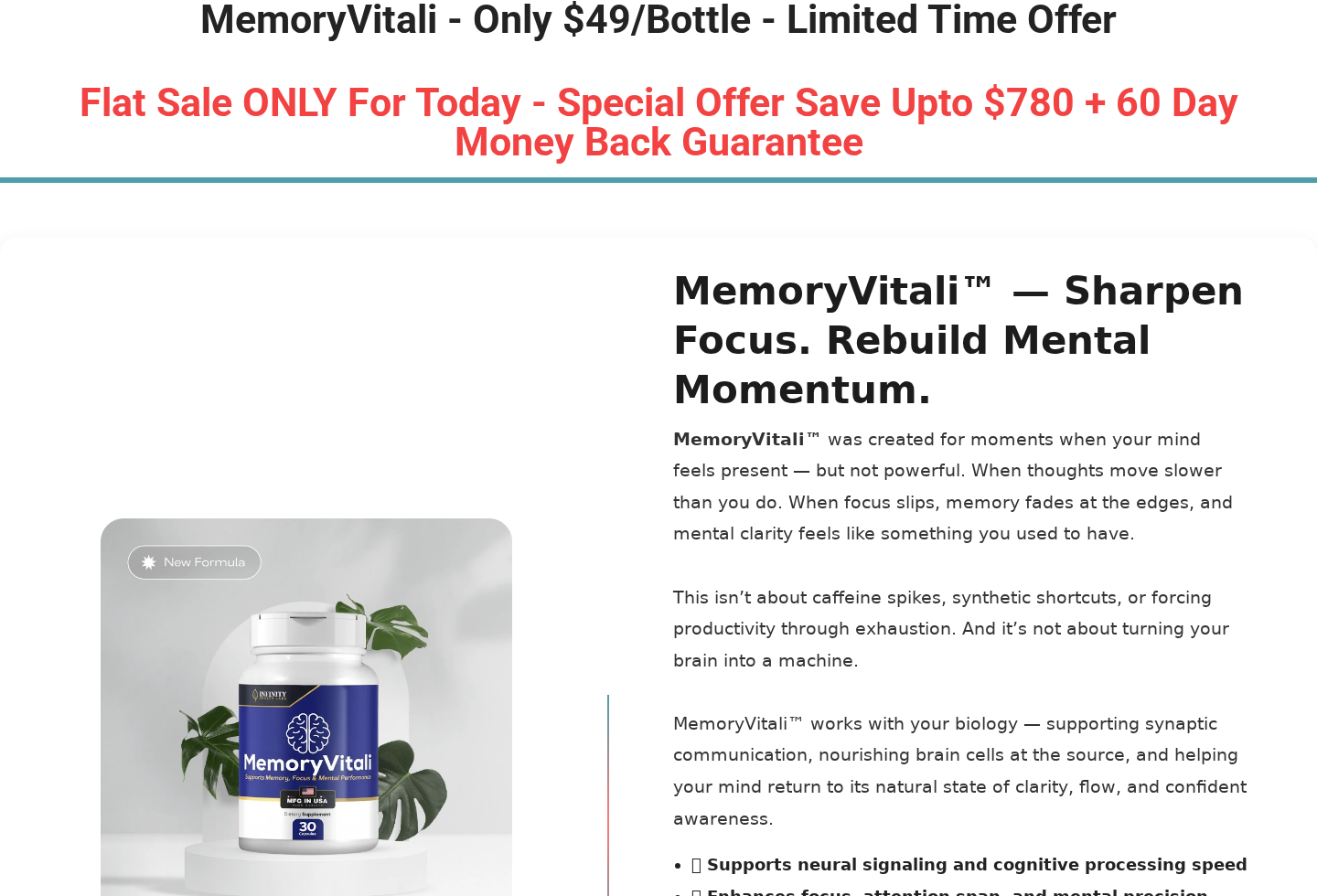
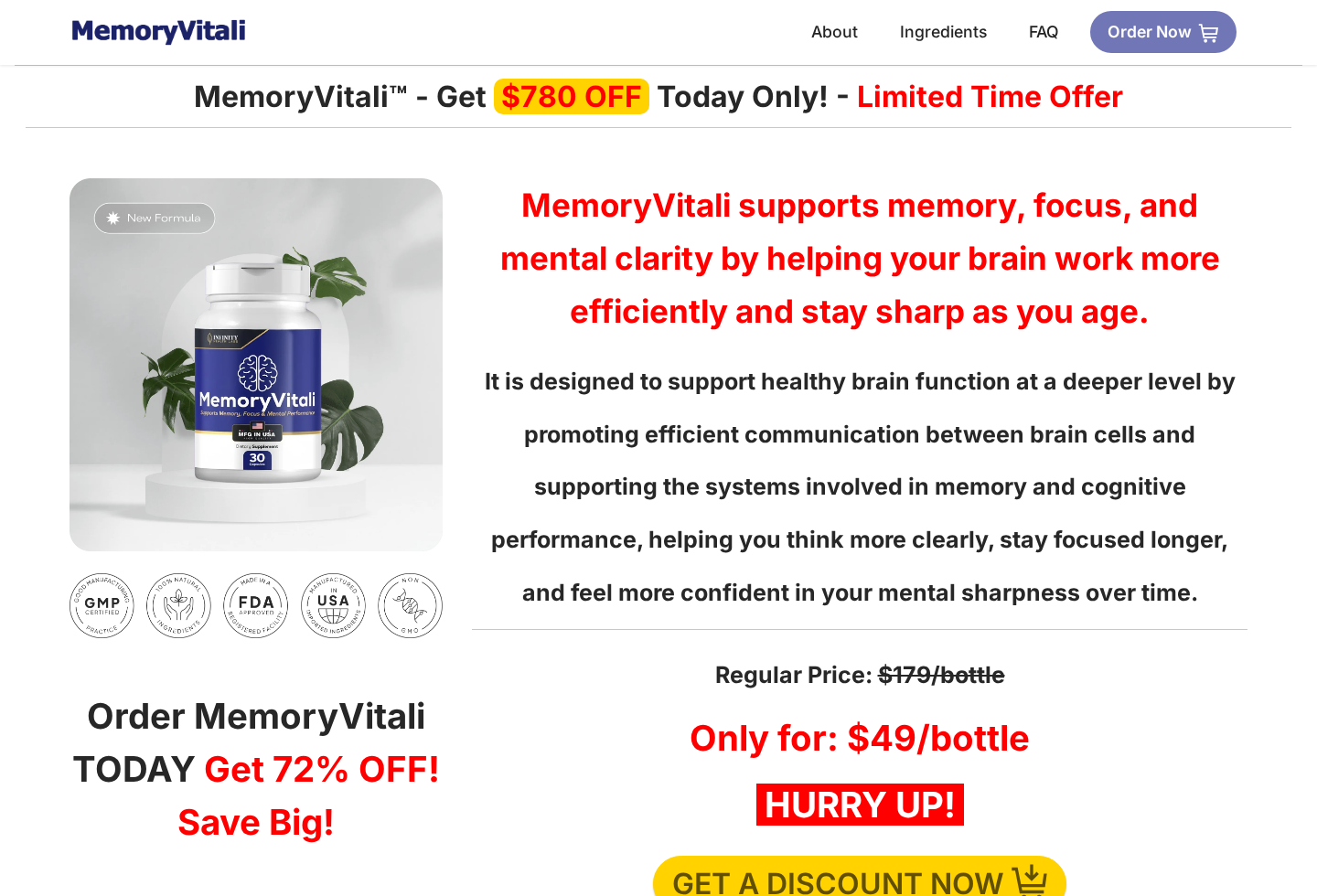
The principal sales page shows a 30-capsule bottle from Infinity Health Labs. It recommends one capsule daily and sells two, three, or six-bottle packages.
The label described on related pages includes B vitamins, caffeine from green coffee, L-tyrosine, theacrine, theobromine, bacopa, rhodiola, and huperzia.
Those ordinary product details sit beside much stronger phrases, including “brain cleanse,” regenerative protein claims, and suggestions of rapid cognitive improvement.
Why the sales network deserves scrutiny
MemoryVitali appears across numerous domains claiming to be the official or safest purchase source. Many repeat identical imagery and promotional blocks.
The pages are not consistent. Some call the product capsules, while others describe a melt-in-your-mouth tablet that can be chewed or dissolved.
Ingredient descriptions change across the network. One page discusses choline, biotin, selenium, and antioxidants, while another supplies the caffeine-heavy label above.
Several affiliate pages contain obvious copy errors about blood sugar, diabetes, and weight management inside a product supposedly written for memory.
What our investigation found
MemoryVitali appears to be a physical BuyGoods product rather than a completely imaginary bottle. The advertising ecosystem remains highly unreliable.
- The principal domain was registered on September 27, 2025.
- Numerous newer domains claim official status.
- Pages disagree about capsule or dissolvable-tablet format.
- Ingredient summaries are not consistent across promoters.
- Affiliate copy mistakenly discusses diabetes and fat loss.
- Large testimonial counts lack transparent verification.
- The six-bottle offer totals $294.
This is best understood as a real supplement surrounded by a deceptive, copy-heavy affiliate funnel. The bottle’s existence does not validate every promise used to sell it.
How the MemoryVitali Sales Funnel Works
Step 1: The advertisement turns normal forgetfulness into urgency
Memory ads speak to people who misplace words, lose focus, or worry that ordinary lapses signal something more serious.
The story often frames modern toxins, aging, or weak brain-cell communication as a hidden cause. One simple formula is then presented as the missing answer.
This approach is powerful because cognitive fears feel personal. Consumers may suspend ordinary shopping skepticism when an advertisement appears to offer reassurance.
No supplement page can diagnose the cause of memory changes. Sleep, stress, medication, depression, thyroid problems, deficiency, and neurological illness require proper assessment.
Step 2: An “official” page imitates medical authority
The landing page uses brain graphics, facility seals, percentage claims, testimonials, and language about synapses, neurotransmitters, and cellular nutrition.
Scientific vocabulary can sound precise while remaining unconnected to clinical evidence for the finished MemoryVitali formula.
Some pages display “FDA Approved” near production claims. Dietary supplements are not reviewed and approved like prescription medicines before sale.
An FDA-registered facility, if accurately described, concerns manufacturing oversight. It does not prove that MemoryVitali improves memory or treats cognitive decline.
Step 3: Repetition across clone sites creates artificial consensus
Searchers encounter domains such as memoryvitali.com, eng-en-memoryvitali.com, en-us-memory-vitali.com, memoryvitali.org, memoryviteli.com, and other slight spelling variations.
Each may use the same bottle render and call itself official. The collection can look like widespread independent coverage when it is largely promotional.
Some pages explicitly disclose affiliate compensation. Others present sales copy in a review-like format without making the commercial relationship equally prominent.
Repeated claims remain one marketing source when the pages recycle assets and link into the same checkout. Frequency does not convert advertising into evidence.

Step 4: The story changes faster than the bottle
The affiliate page en-en-en-memoryvitali.com begins with memory, focus, and neural signaling. Later paragraphs abruptly discuss glucose, sugar cravings, and diabetes management.
That language plainly belongs to another supplement template. It was not properly removed when the page was repurposed for MemoryVitali.
Another promoter says the tablet can dissolve or be chewed, despite the principal bottle being labeled as capsules.
Different sites also publish different ingredient summaries. A buyer cannot safely rely on a blog-style page when the sealed label may say something else.
Step 5: A large discount turns uncertainty into a bulk order
The sales funnel places the $49 per-bottle figure beside a six-bottle package. The actual total displayed for that bundle is $294.
Three bottles can cost $207, while two may total $138 or $158 depending on the page. Promotional arithmetic itself is inconsistent.
Claims such as “save up to $780” depend on a crossed-out reference price that buyers may never encounter in an ordinary transaction.
Buying six bottles before testing one capsule magnifies every uncertainty, including tolerability, effectiveness, shipping damage, and refund complexity.
Step 6: The guarantee requires more work than the badge suggests
The principal page promotes a 60-day money-back guarantee. Its instructions say buyers may need to return all bottles, including empty containers, with the packing slip.
The countdown begins from the original purchase, not from whenever a customer decides the product was ineffective.
Return postage, authorization, and processing time can matter. An affiliate page saying “no hassles” cannot override the transaction seller’s detailed conditions.
Consumers should keep every bottle and the packing slip until the refund period ends. Discarding packaging may weaken an otherwise eligible request.
Memory Claims Versus the Available Evidence
A complete formula needs complete-product testing
Several MemoryVitali ingredients have been studied individually. Those studies do not establish that the marketed combination produces every promised result.
Formulation, dosage, extract standardization, participant age, medical history, trial length, and outcome measures affect whether research applies.
We did not find a peer-reviewed clinical trial testing the finished MemoryVitali product against a placebo for its advertised cognitive outcomes.
Without that evidence, claims of restored memory, regenerative proteins, or broad neurological improvement should be treated as marketing hypotheses.
Stimulant language is internally inconsistent
Some pages say MemoryVitali supports focus without stimulants or caffeine-like pressure. Related product descriptions list caffeine from green coffee and stimulant-like compounds.
Theacrine and theobromine can also affect alertness. Their presence matters to users with insomnia, anxiety, heart conditions, or stimulant sensitivity.
A complete label should state amounts. General assurances such as “gentle” or “natural” do not predict how an individual will respond.
Consumers who already use coffee, energy products, or attention medication should count the total exposure and consult a qualified professional.
Testimonials cannot diagnose improvement
Sales pages feature named customers reporting clearer thought, improved recall, and reduced fatigue. The collection process and purchase verification are not explained.
Cognitive performance naturally varies with sleep, stress, routine, expectation, and health. A personal story cannot isolate which factor caused a change.
Some websites claim thousands or even 160,000 users without showing an auditable source. Large numbers are easy to display and difficult to verify.
Look for independent, methodologically transparent evidence before treating testimonials as proof of a neurological effect.
Memory symptoms deserve more than a sales-page explanation
Occasional distraction can follow poor sleep, anxiety, grief, dehydration, infection, alcohol use, or an overloaded schedule.
Persistent change can also involve medication effects, vitamin deficiency, thyroid disease, sleep apnea, depression, or neurological illness.
A supplement funnel collapses those possibilities into one marketable cause. That simplification is convenient for sales, not medical reasoning.
Keep a short symptom diary noting onset, frequency, sleep, medication changes, headaches, mood, and daily functioning.
Bring the record to a clinician, especially when memory problems are new, worsening, or noticed by other people.
Urgent confusion, weakness, speech trouble, severe headache, or sudden personality change requires immediate medical attention.
No refund guarantee can compensate for delayed diagnosis. The safest first step may have nothing to do with ordering capsules.
If a clinician approves a supplement trial, define a review date and measurable goal instead of relying on vague impressions.
Company, Address, and Fulfillment Red Flags
The bottle names a distributor, but affiliates blur responsibility
MemoryVitali imagery identifies Infinity Health Labs. Some pages publish support@infinityhealthlabs.com and the telephone number (302) 200-3480.
Other pages use support@MemoryVitali.com or provide only generic language. Buyers should use the contact details in their actual confirmation and label.
An affiliate can explain the product without controlling fulfillment. That page may be unable to cancel, refund, or investigate an adverse event.
The principal website has limited history
Public registration data shows memoryvitali.com was created on September 27, 2025. A short history does not prove misconduct.
It does mean claims of a long, established customer record require evidence beyond the domain itself. Affiliate sites created later add no independent longevity.
Copyright years and “trusted by thousands” statements should never be mistaken for verified operating history.
Support details change across supposedly official pages
One page tells buyers to contact Infinity Health Labs. Another uses a product-branded address. Others offer vague support wording without a complete telephone number.
Changing support channels can leave customers contacting a promoter instead of the seller. That wastes time inside a limited refund window.
Before purchasing, ask the final checkout who will appear on the card statement and who accepts returns.
Fulfillment proves delivery, not effectiveness
BuyGoods processing and a delivered parcel show that a transaction occurred. They do not validate medical claims or ingredient purity.
Inspect the safety seal, lot, expiration date, Supplement Facts, and distributor. Do not consume capsules from damaged, unlabeled, or inconsistent packaging.
Request lot-specific testing when safety matters. A generic GMP badge cannot reveal contaminants, microbial quality, heavy metals, or actual ingredient quantities.
Questions to Ask Before Buying MemoryVitali
Ask which exact label you will receive. Request a clear image showing every active ingredient, amount, warning, serving direction, and other ingredient.
Ask whether it is a capsule or dissolvable tablet. If support cannot answer a basic format question, do not trust broader efficacy claims.
Ask whether caffeine, theacrine, or theobromine is present and at what dose. “No harsh stimulants” is not an adequate ingredient disclosure.
Ask for the legal seller and distributor names. Compare them with the checkout, receipt, bottle, card descriptor, privacy policy, and returns correspondence.
Ask whether every bottle must be returned, including opened or empty containers. Record the address, deadline, authorization requirement, and postage responsibility.
Ask for a current certificate of analysis for the lot being shipped. Confirm that it comes from a real laboratory and matches the bottle code.
Ask a pharmacist about medication interactions. Huperzia, caffeine, adaptogens, and other cognitive ingredients may be unsuitable for particular conditions.
Never stop prescribed treatment because a sales page promises natural brain support. Discuss new or worsening memory symptoms with a medical professional.
What to Do if You Have Fallen Victim to This Scam
- Locate the real transaction record. Find the BuyGoods receipt, order number, charge descriptor, package sender, and exact domain used during checkout.
- Preserve every bottle. The published guarantee may require empty and unopened containers plus the packing slip. Photograph everything before requesting a return.
- Stop if the label conflicts. Do not take capsules when ingredients or directions differ from the advertisement. Ask a clinician about any symptoms.
- Request a return authorization promptly. State the order date, package quantity, reason, requested amount, and need for a written shipping destination.
- Escalate unresolved billing. Give the card issuer the advertisement, receipt, guarantee, support messages, tracking, and evidence of any material mismatch.
- Monitor for additional charges. Confirm whether the purchase was one-time. Challenge any renewal that was not clearly authorized.
- Check account security. Change reused passwords and run Malwarebytes if the funnel asked for a download, browser notification, or suspicious extension.
- Limit future ad exposure. AdGuard can reduce deceptive sponsored pages and redirects, but it cannot cancel an order already placed.
Frequently Asked Questions
Is MemoryVitali a real product?
A physical supplement with that name is sold through BuyGoods. Its existence does not make the numerous affiliate claims and clone sites reliable.
Is MemoryVitali FDA approved?
No evidence reviewed establishes FDA approval of the finished supplement. Facility registration language should not be presented as product approval.
Does MemoryVitali treat Alzheimer’s disease or dementia?
No. It is sold as a dietary supplement and should not replace diagnosis or treatment. New cognitive symptoms require professional evaluation.
Does MemoryVitali contain caffeine?
Several detailed descriptions list caffeine from green coffee, although some promotional pages imply stimulant-free support. Check the current sealed label before use.
How much does MemoryVitali cost?
The principal offer displays six bottles for $294 and three for $207. Smaller packages and shipping can vary, so confirm the final total.
How does the MemoryVitali refund work?
The advertised window is 60 days. Published instructions may require all bottles and the packing slip, so keep the package and obtain authorization quickly.
The Bottom Line
MemoryVitali is a purchasable supplement promoted through an unusually messy network of official-looking pages, not a well-controlled body of consistent product information.
Copied diabetes text, conflicting formats, changing ingredient summaries, vague evidence, and bulk-price pressure make the affiliate funnel unreliable.
Anyone considering the product should ignore the clone pages, verify the sealed label, consult a professional, and document the exact BuyGoods terms before paying.
Clarity should begin with the transaction itself, not with promises the seller cannot consistently explain.

Join the discussion
0 commentsShare your experience or ask a question about this article.
Discussion
Start the conversation
Have a question or something useful to share? Add the first comment.