

A Facebook page can borrow a product name, add “Official Website,” and look established before it has earned a single genuine customer.
The surrounding trail often looks even larger. Reviews, buying guides, groups, and podcast pages appear everywhere, yet they may lead toward one sales commission.

Overview
The page name can be more persuasive than the page history
Promotional Facebook pages frequently combine a product name with words such as “Official,” “Reviews,” “Website,” “USA,” or the current year.
Those additions feel authoritative, but Facebook does not certify a page merely because its title contains an official-sounding phrase.
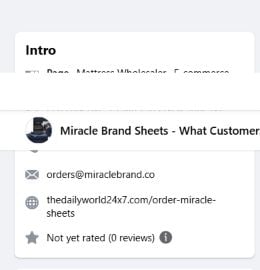
Several pages reviewed for this investigation had zero followers, zero ratings, or almost no visible history while presenting confident buying recommendations.
A real product can still be promoted through an unofficial funnel
Miracle Made is an established bedding seller. Its existence does not automatically validate every Facebook page, review site, group, or advertisement using Miracle Sheets.
Other campaigns promote generic gadgets, wellness items, pet devices, detox products, and television boxes through pages that resemble brand-owned destinations.
The deception may concern identity, independence, evidence, pricing, or checkout design, even when a physical item eventually arrives.
The surrounding review network is often the real warning
Search results can fill rapidly with favorable articles on unrelated publishing platforms. Many repeat the same phrases, discount prompts, and “official site” links.
Volume creates an illusion of consensus. In reality, dozens of pages may come from a coordinated affiliate campaign rather than independent customers.
The safest approach is to trace every claim back to the brand, legal seller, policy page, and final checkout.
- An official-sounding page name is not proof of brand ownership.
- Follower counts, page age, transparency, and posting history matter.
- A genuine product does not make every promotion genuine.
- Affiliate reviews may earn money from each completed order.
- Bridge pages can hide the final seller until late in the journey.
- Search-result saturation can be manufactured across free publishing sites.
- The checkout and written policies matter more than promotional labels.
What Is the Fake Official Facebook Page Scam?
The scheme begins by borrowing familiarity. Operators create a page around a trending product, then choose a title that sounds like the brand’s authorized account.
The page may copy product photographs, slogans, contact details, logos, and descriptions. It can therefore look convincing during a quick mobile scroll.
Some pages are ordinary affiliates using careless branding. Others are impersonators, disposable ad assets, counterfeit sellers, or gateways to deceptive checkouts.
That distinction matters. A page can be misleading without stealing every payment, and a delivered product can still be overpriced or materially misrepresented.
The strongest concern appears when multiple signals overlap: a new page, no audience, copied identity, aggressive claims, external redirects, and unclear merchant details.
Mass-published “reviews” amplify the effect. They repeat buying language on sites that have no natural relationship with the product category.
A shopper searching the name then sees apparent agreement everywhere. Repetition feels like verification, although each result may serve the same campaign.
This is why the story is broader than one brand. The same funnel can be reused tomorrow with a different sheet, hose, supplement, pet gadget, or streaming box.
Why These Pages Look Convincing
Most people do not inspect a Facebook page like an investigator. They notice the familiar product image, recognizable name, and a button leading toward more information.
Mobile screens hide context. Page history, transparency details, altered links, and subtle affiliate disclosures may sit several taps away from the advertisement.
Scammers and aggressive marketers exploit that compressed view. They place the strongest trust signals above the fold and leave important qualifications below it.
The current year is another shortcut. A title containing “Reviews 2026” sounds current, even when the underlying text was generated quickly or copied.
Location labels can add false familiarity. A page may display New York or another recognizable city without showing that the product team actually operates there.
Contact details can also be copied from the real seller. Their presence may prove only that the page owner found the company’s public support information.
Finally, Facebook groups provide additional surfaces. Repeated product links across newly created groups can resemble community discussion without meaningful independent participation.
How the Fake Official Facebook Page Funnel Works
Step 1: Operators choose a product already attracting attention
The target may be a legitimate brand, a newly launched direct-response gadget, or a generic product renamed for a short advertising cycle.
Existing interest reduces the work required. People are already searching the name after seeing an advertisement or hearing a recommendation.
The operator only needs to intercept that curiosity before the shopper reaches a trustworthy source.
Step 2: A page adopts an authoritative identity
The title adds “Official Website,” “Official Page,” “Reviews,” or a geographic label. The profile image uses the product packaging or campaign logo.
Descriptions emphasize savings, limited availability, and direct ordering. They may avoid explicitly claiming brand ownership while strongly implying it.
A shopper must inspect the page transparency record, creation date, handle, follower history, and linked domain to see the mismatch.
Step 3: Multiple pages and groups manufacture visibility
Separate pages target different search phrases. Groups, events, short posts, and copied discussions expand the campaign’s footprint across Facebook.
The network may use several identities while directing visitors toward the same external destination. Repetition makes the product appear popular and widely discussed.
Real conversation is usually thin. Many pages have few followers, no meaningful comments, and almost no history beyond promotional links.

Step 4: Search spam creates a wall of favorable reviews
Promoters publish articles on free blogs, profile pages, form builders, podcast hosts, travel platforms, education tools, community forums, and unrelated websites.
Headlines often include “truth revealed,” “consumer report,” “official,” “before you buy,” or “is it worth the hype.”
These phrases imitate investigation. The body usually repeats sales points, includes purchase prompts, and offers little original testing or documentary evidence.
Some posts disclose affiliate relationships. Others obscure compensation behind neutral-sounding review language.
Step 5: A bridge page separates the ad from the checkout
The Facebook link may open an advertorial rather than the seller’s main website. That page warms the visitor with testimonials, comparisons, or a dramatic story.
From there, buttons redirect to another domain for package selection and payment. The merchant’s legal identity may appear only inside dense policy text.
Bridge pages can disappear quickly. A vanished article leaves the Facebook post active while removing evidence about the original promises.
Step 6: The checkout converts urgency into a larger order
Package selectors may emphasize the largest bundle, calculate savings per item, and reveal shipping or tax only after contact details are entered.
Optional protection, priority handling, warranties, or additional products can appear along the path. A hurried shopper may focus only on the headline price.
Some funnels use recurring billing, but not all do. Subscription claims should be verified in the exact checkout rather than assumed from the advertising style.
Step 7: The campaign is recycled when attention declines
Disposable pages and bridge domains can be abandoned. The same images, policies, support details, and checkout structure then reappear under another product name.
This constant renaming weakens product-specific warnings. Understanding the funnel protects shoppers even after the original page disappears.
The story, not merely the brand name, is the durable warning.
Real Brand, Affiliate Page, or Impersonation?
Not every unofficial page has the same intent. A careful investigation separates several possibilities instead of treating them as identical.
A real brand page should be linked from the company’s own website, use consistent domains, provide stable contact details, and maintain a meaningful posting history.
An affiliate page can lawfully promote another company’s product when it identifies its relationship and avoids pretending to be the brand.
An impersonation page presents itself as the company or an authorized destination without permission. It may direct payments to an unrelated merchant.
A counterfeit page sells an imitation while borrowing the original brand’s presentation. Product delivery does not erase the identity deception.
A lead-generation page collects contact information before revealing the seller. The immediate risk may be unwanted calls, messages, or resale of personal data.
Look for a direct link from the verified company website to its Facebook profile. A one-way link from Facebook to a store is not equivalent.
Compare the exact domain, email suffix, legal entity, refund address, and card descriptor. Small inconsistencies often reveal a separate operation.
Examples of the Pattern
Miracle Sheets illustrates why nuance matters. Miracle Made sells a real bedding product, yet separate pages use official-sounding names to promote reviews and savings.
The existence of Miracle Made does not authenticate every page using its photos. Buyers should begin from the company’s own domain and follow its verified links.
JetStrike shows a less stable variation. Its new Facebook page linked to an external article URL that displayed a page-not-found error during our review.
WoofAway demonstrates the checkout issue. The product funnel offered several packages while highlighting four devices, even though a single unit was available.
PLAYVERO-style television-box promotions use a different promise. Ads may imply access to premium entertainment while selling inexpensive generic receiving hardware.
Detox teas and supplements add health claims to the same structure. A celebrity image, invented doctor, or fabricated news page can provide false authority.
The common denominator is not the product category. It is the engineered journey from borrowed trust to a commission-producing checkout.
How to Check a Facebook Product Page
- Open Page transparency. Note creation date, former names, management locations, and any recent identity changes.
- Inspect the audience. Zero followers, empty comments, and no customer history contradict claims of widespread popularity.
- Visit the brand independently. Type the company’s known domain or use a trusted search result instead of the advertisement’s button.
- Look for a reciprocal link. Confirm whether the genuine website identifies that exact Facebook page as its social account.
- Expand every URL. Check whether the link goes to the brand, a bridge article, an affiliate redirect, or an unrelated checkout.
- Search exact phrases. Repeated sentences across unrelated websites indicate coordinated promotional content, not independent testing.
- Read the checkout policies. Identify the seller, final price, quantity, renewals, returns, shipping, and statement descriptor.
- Save evidence before paying. Capture the advertisement, page identity, offer, package selection, and terms.
Company, Address, and Fulfillment Checks
Copied company details can create borrowed legitimacy
An unofficial page may list the genuine brand’s public phone number or email. That information can be copied in seconds and does not establish ownership.
Contact the company through a route reached independently. Ask whether it controls the exact Facebook handle and linked domain.
An impressive address may be only a mailbox or shared office
Search the complete address with the suite number. Determine whether it represents headquarters, a registered agent, coworking space, mailbox, warehouse, or unrelated tenant.
Do not assume the contact address accepts returns. Sending merchandise without authorization can eliminate tracking, deadlines, or refund eligibility.
The checkout entity matters more than the page identity
Read the terms and payment screen for the legal company accepting the order. Compare that entity with the receipt and eventual card descriptor.
If the seller remains unclear, leave. A reliable merchant should not require detective work before receiving your money.
Fulfillment does not prove the advertising was honest
A warehouse can ship a real parcel while knowing nothing about the Facebook claim. Delivery alone does not validate endorsements, discounts, performance, or brand authorization.
Keep packaging labels because they may identify a fulfillment partner or return trail. Treat that information as a lead, not automatic proof of ownership.
What to Do if You Have Fallen Victim to This Scam
- Capture the page immediately. Save the handle, transparency record, advertisement, comments, linked URLs, checkout, receipt, and every promise.
- Contact the real brand separately. Ask whether it owns or authorizes the page and whether your order exists in its system.
- Write to the actual merchant. Use the legal entity and support details from the receipt or policies, not only the Facebook profile.
- Cancel quickly when possible. State the order number, quantity, charge, and requested resolution. Preserve proof of delivery for your message.
- Notify the payment provider. Dispute unauthorized, duplicated, undelivered, counterfeit, or materially misrepresented transactions before the deadline.
- Replace exposed credentials. Create a unique password for every affected account, then activate multifactor authentication wherever it is available.
- Monitor the card. Watch for small test charges, unfamiliar merchant names, add-ons, and recurring transactions.
- Report the infrastructure. Report the Facebook page, advertisement, bridge domain, and misleading search pages with supporting screenshots.
- Check the device. Run Malwarebytes after suspicious downloads, and use AdGuard to reduce malicious advertisements and redirect chains.
Frequently Asked Questions
Does “Official Website” in a Facebook name prove authenticity?
No. A page owner can place those words in a title. Confirm ownership through the company’s independently located website and Page transparency information.
Can a fake page promote a real product?
Yes. Unofficial affiliates and impersonators may use a real product’s identity. The product’s existence does not authenticate the page or its claims.
Why are there so many positive reviews in search results?
Affiliate campaigns can publish similar articles across numerous platforms. Search visibility measures discoverability, not independence, customer satisfaction, or factual accuracy.
Are all affiliate pages scams?
No. Ethical affiliates disclose compensation and avoid pretending to be the brand. Hidden relationships and false identities create the serious concern.
Should I trust a page that lists a real address?
Not automatically. Addresses can be copied or may belong to agents, mailboxes, offices, warehouses, and unrelated companies. Verify the exact connection.
What is the safest way to buy the product?
Start from the verified brand website, inspect the final seller and policies, choose the quantity deliberately, and pay with strong dispute protections.
The Bottom Line
Fake official Facebook pages succeed by borrowing trust before a shopper checks who controls the page, link, checkout, and policies.
The surrounding flood of reviews can be part of the same campaign. Repetition across unrelated platforms is not independent confirmation.
Some funnels deliver real products. Others lead to counterfeits, inflated bundles, unsupported claims, recurring charges, or stores that vanish after the advertising cycle.
Ignore the authority claimed in the page name. Follow the ownership trail, verify every charge, and let the evidence decide whether the offer deserves trust.








