


Huobit.io looked like a polished crypto exchange, with live prices, staking plans and a big European backstory. Its name sounds almost exactly like Huobi, the exchange now called HTX.
The site is now offline. If you signed up, deposited crypto or got a message offering to recover your money, here’s what Huobit was and what to do next.
Overview
What Huobit.io claimed to be
Huobit.io called itself “the leading cryptocurrency exchange.” It offered spot, margin and futures trading, a swap tool, staking, a trading tournament and even a payment card.
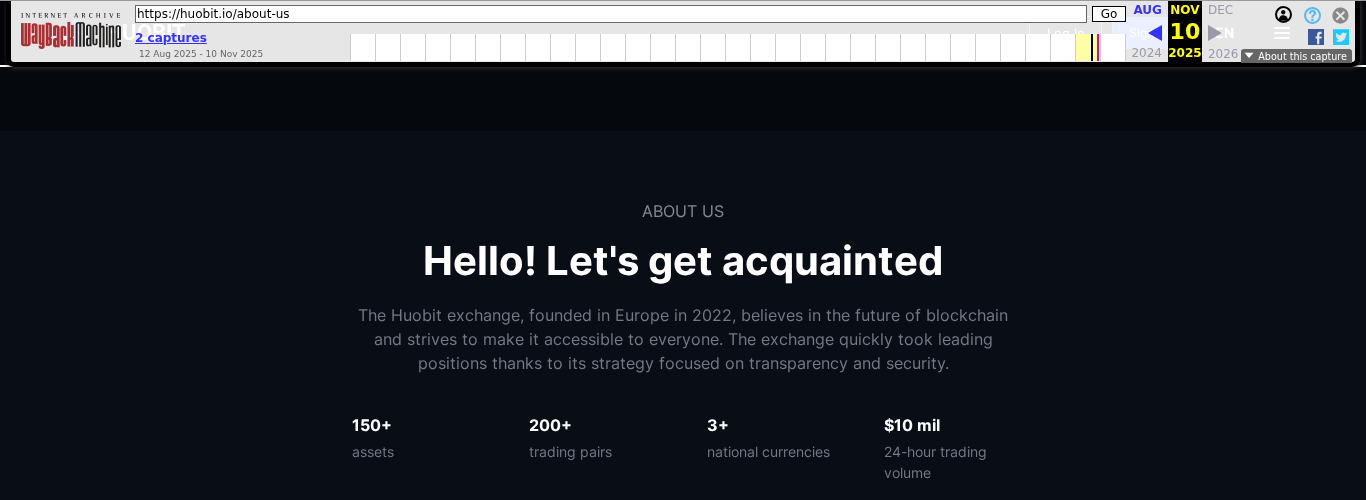
Its About Us page said the exchange was “founded in Europe in 2022” and grew into a leading platform with over 150 assets and $10 million in daily trading volume.
What the record shows
The Wayback Machine has no copy of this exchange before August 2025. Between 2018 and 2020 the same domain hosted a Chinese-language crypto news site, not a trading platform.
Archived copies from August to December 2025 show the exchange pages. By March 2026 the site returned an error, and by October 29, 2026, the domain no longer resolved.
That gap matters. A company can’t run a leading European exchange for three years without leaving any trace on its own domain.
Is Huobit.io legit?
No. Huobit.io presented a company history it couldn’t have had, and it never said who ran it. Here’s the short version:
- Name: a near copy of Huobi, the real exchange now known as HTX, with one extra letter.
- History: a claimed 2022 launch, while archives show the exchange only from August 2025.
- Owner: no company name, address or license number on any archived page.
- Sign-up: a form with a promo code field, the hook used by fake exchange giveaways.
- Status: offline since early 2026, so balances shown on the site can’t be withdrawn.
Huobit Is Not Huobi or HTX
Huobi was a large crypto exchange that rebranded as HTX. Huobit.io borrowed that recognition by adding a single letter to the name, a common trick with lookalike exchange sites.
We found nothing linking huobit.io to HTX. HTX runs its own site at htx.com, and none of the archived Huobit pages mention HTX, Huobi Global or any of their companies.
If you meant to use HTX, type htx.com yourself. In the UK, though, the FCA says consumers should avoid dealing with HTX, as covered below.
Why Lookalike Exchanges Copy Famous Names
A famous name does the selling for free. People who have heard of Huobi or HTX are more likely to trust a site that looks and sounds like it.
Lookalike names also catch typing mistakes and autocomplete errors. Someone who means to visit a real exchange can end up on the copy without noticing the extra letter.
Huobit added its own touches, like a payment card, a trading tournament and a celebrity show, to make the brand feel bigger than a single website.
None of those extras could be checked from outside, which is the point. They fill the page with activity while the operators stay anonymous.
Who Is Behind Huobit.io?
Nobody is named. The archived pages speak only of “Huobit” and “our exchange,” without a legal entity, address, registration number or regulator.
No company or license
The footer linked to a page called Regulatory License. It held general text about compliance teams and eKYC, but no license number and no named regulator.
The compliance text wasn’t even Huobit’s own. Two sentences still name Bitget, a different exchange, where Huobit’s name should have been.
The law enforcement page asked police to address requests “to the specific legal entities,” yet it never said which entities those were. Only a single contact email address was given.
A recycled domain
Between 2018 and 2020, www.huobit.io was a Chinese crypto news site. The archive then goes quiet until August 2025, when the exchange pages suddenly appear.
Reusing an older domain can make a new scam look established. It can also confuse reputation tools that judge a site partly by how long its domain has existed.
A history that doesn’t add up
The About Us timeline starts with the launch of the Huobit exchange on 16 January 2022, followed by Huobit Earn, margin trading and a decentralized swap service.
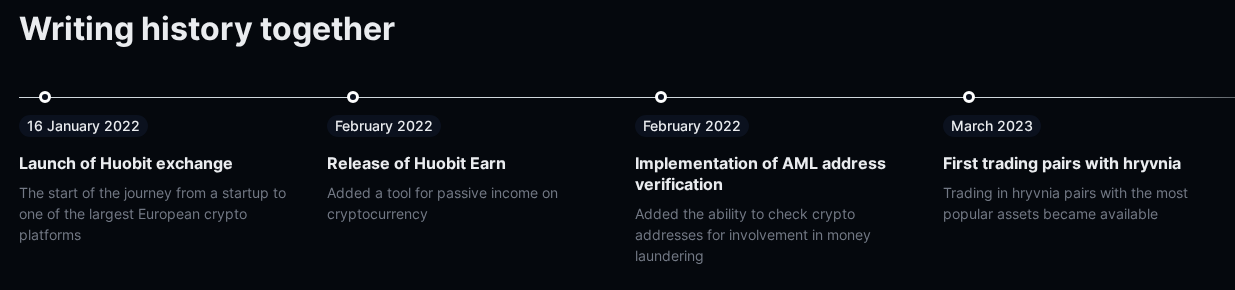
It also lists a crypto show with celebrities and a payments service with POS terminals. None of this left any trace before the exchange pages appeared in August 2025.
A real exchange with $10 million in daily volume would show up in market data, news coverage and regulator records. Huobit doesn’t.
Contradictions in its own rules
The timeline boasts about the first trading pairs with the hryvnia, Ukraine’s currency. Yet the sign-up form barred Ukraine’s citizens and residents, along with 11 other countries.
An exchange can’t build a market around a currency while banning the people who use it. The contradiction suggests the history was copied from somewhere else.
How the Huobit.io Scam Works
Step 1: A tip or promo code points to the site
Fake exchanges usually reach people through social media posts, video comments or private messages. The message shares a link and a promo code that supposedly unlocks free crypto.
Step 2: Sign-up asks for the code
Huobit’s sign-up form asked for an email, a password and an optional promo code. On giveaway scams, that code is what makes a fake balance appear in the new account.
Step 3: The dashboard shows a balance
Live prices, charts and staking plans make the numbers look real. The balance exists only in the site’s database, so there’s nothing behind it to withdraw.
Step 4: Withdrawals need a deposit or fee
The FTC warns that on fake crypto platforms you may withdraw “only if you pay high fees,” or not at all. Each payment just leads to another request.
Step 5: The site disappears
Once deposits slow down, the operators move on. Huobit.io went offline in early 2026, taking every balance and every support chat with it.
How Promo Code Exchange Scams Spread
Promo code scams rely on borrowed trust. We’ve seen them pushed with deepfake celebrity videos, fake giveaway posts and comments telling viewers to enter a code.
The code seems to add free bitcoin or USDT to the account. That fake balance is the bait, because the visitor now believes real money is waiting.
The FTC puts the core rule simply: “Only scammers will guarantee profits or big returns.” Free crypto from a stranger’s code falls into the same category.
The posts and codes that promoted Huobit haven’t surfaced, but its sign-up form was built for exactly this kind of campaign.
Regulator Warnings: What They Name
We found no regulator warning that names huobit.io. Warnings about the real exchange, HTX, do exist, and they shouldn’t be confused with this copycat.
On 10 February 2026, the UK’s Financial Conduct Authority said it had begun legal proceedings against HTX, formerly Huobi, for illegally promoting crypto services to UK consumers.
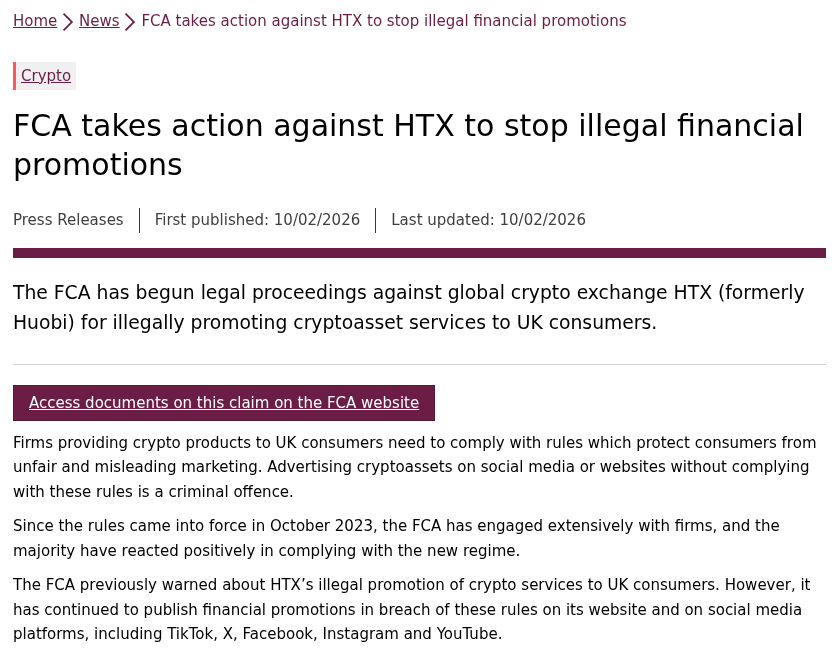
The FCA says HTX is on its Warning List and that consumers “should avoid dealing with this, or similar unauthorised firms.” Its notice is about HTX’s marketing, not about huobit.io.
The lesson for any exchange is the same. Before you deposit, check that the platform is registered with your financial regulator under the exact web address you’re using.
In the UK, that means the FCA register and Warning List. In the US, look the platform up in FinCEN’s money services business registry and your state’s license list.
YoBit Review: Is YoBit the Same as Huobit?
No. YoBit is a separate crypto exchange that runs at yobit.net. The names sound alike, so the two are easy to mix up in search results.
We found no link between YoBit and huobit.io. They use different domains, different branding and different trading pages, and neither mentions the other.
If you’re weighing YoBit or any other exchange, use the same checks. Find the legal company behind it, confirm its registration with your regulator and read independent user complaints.
Watch Out for Recovery Scams
People who lose money to a fake exchange often get a second wave of contact. Strangers offer to recover the funds, for a fee.
The FBI warned in August 2025 that fictitious law firms are targeting crypto scam victims. Some cite fake regulators, and some say a bank fee is needed to release funds.
The FBI adds that “the US Government does not request payment for law enforcement services provided.” A real agency won’t charge you to get your money back.
We’ve documented the same pattern in a fake IC3 recovery scam that used FBI deepfake videos. Treat any unsolicited recovery offer as part of the original fraud.
Red Flags of a Fake Crypto Exchange
- A name one letter away from a famous exchange, like Huobit and Huobi.
- No company name, address or license number anywhere on the site.
- A promo code that adds free crypto to a brand-new account.
- A deposit, tax or verification fee before you can withdraw.
- A long company history that doesn’t match the domain’s record.
- Support only through a chat widget on the site itself.
You’ll find the same warning signs in our reports on Htx-wallet.com, Kiyobit.com and the Cristiano Ronaldo bitcoin promo code scam.
How to Check a Crypto Exchange Before You Deposit
A few minutes of checking would have exposed Huobit before anyone sent money. These steps work for any exchange, whether it’s new to you or a famous name.
- Type the exchange’s address yourself instead of following a link from a post or message.
- Compare the spelling letter by letter with the official domain, such as htx.com for HTX.
- Find the legal company name, address and license number, then look them up on the regulator’s own register.
- Check the domain’s history in the Wayback Machine and compare it with the company’s claimed founding date.
- Search the exchange’s name with words like scam, withdrawal and complaint before you sign up.
- Never deposit to unlock a bonus, a promo balance or a withdrawal.
If a site fails any of these checks, walk away. A real exchange gains nothing by hiding who runs it.
What Your Huobit Account Exposed
Signing up gave the operators your email address and the password you chose. If you reused that password anywhere else, those accounts are now at risk.
Huobit’s compliance page also talked about eKYC checks with facial recognition and ID matching. If you uploaded a passport, driver’s license or selfie, assume the operators kept them.
Stolen ID scans can be used to open accounts in your name or to make later scam messages look official. Watch for new accounts or loans you didn’t request.
In the US, IdentityTheft.gov explains how to set up a fraud alert or credit freeze if you shared ID documents.
What to Do if You Deposited Money on Huobit.io
- Stop sending money.
Don’t pay any withdrawal fee, tax or verification deposit. The balance on Huobit wasn’t real, and the site is now offline.
- Save your records.
Keep the wallet addresses you sent crypto to, the transaction IDs, the dates and any messages or promo codes that led you to the site.
- Tell the platform you sent from.
If you bought or sent crypto through a real exchange or payment app, contact it right away and report the receiving address as fraud.
- Report the scam.
File reports with IC3 and ReportFraud.ftc.gov in the US, or with your national police and financial regulator elsewhere.
- Secure your accounts.
If you reused the Huobit password anywhere, change it there and turn on two-factor authentication, starting with your email and real exchange accounts.
- Protect your identity if you uploaded ID.
If you sent a passport, license or selfie for verification, consider a fraud alert or credit freeze and watch for accounts opened in your name.
- Ignore recovery offers.
Anyone who contacts you promising to get the money back for a fee is running a second scam. Don’t share wallet details or seed phrases with them.
Frequently Asked Questions
Is Huobit.io legit?
No. Huobit.io claimed a 2022 European launch that its archive record doesn’t support, named no company or license and went offline in early 2026.
Is Huobit the same as Huobi or HTX?
No. Huobi is the former name of HTX, which runs at htx.com. Huobit.io copied the name with one extra letter, and we found nothing linking the two.
Why can’t I withdraw from Huobit.io?
The site is offline, and balances on fake exchanges exist only in their own database. Paying a fee won’t release them, so stop sending money.
Is YoBit connected to Huobit?
YoBit is a separate exchange at yobit.net with no link we could find to huobit.io. Check any exchange’s company and registration with your regulator before depositing.
Can I get my crypto back from Huobit.io?
Crypto transfers are hard to reverse. Report the transactions to the platform you sent from and to the authorities, and don’t pay anyone who promises recovery.
Did any regulator warn about Huobit.io?
We found no regulator warning that names huobit.io. The UK FCA’s warnings and court action concern HTX, the real exchange formerly called Huobi.
The Bottom Line
Huobit.io was a lookalike exchange with a borrowed name, a history it couldn’t back up and no company behind it. It’s offline now, and its balances went with it.
If you deposited money, stop paying fees, save your transaction records and report them to IC3, the FTC or your regulator. Tell the exchange you sent from right away.
Then expect recovery offers and ignore every one. No real lawyer or agency will ask for a fee to return crypto lost to a fake exchange.

Reviews & discussion
0 commentsShare a firsthand experience, or ask a question.
Community reviews
huobit.io
Moderated reader experiences, not an editorial verdict.
Start the conversation
Have a question or something useful to share? Add the first comment.