

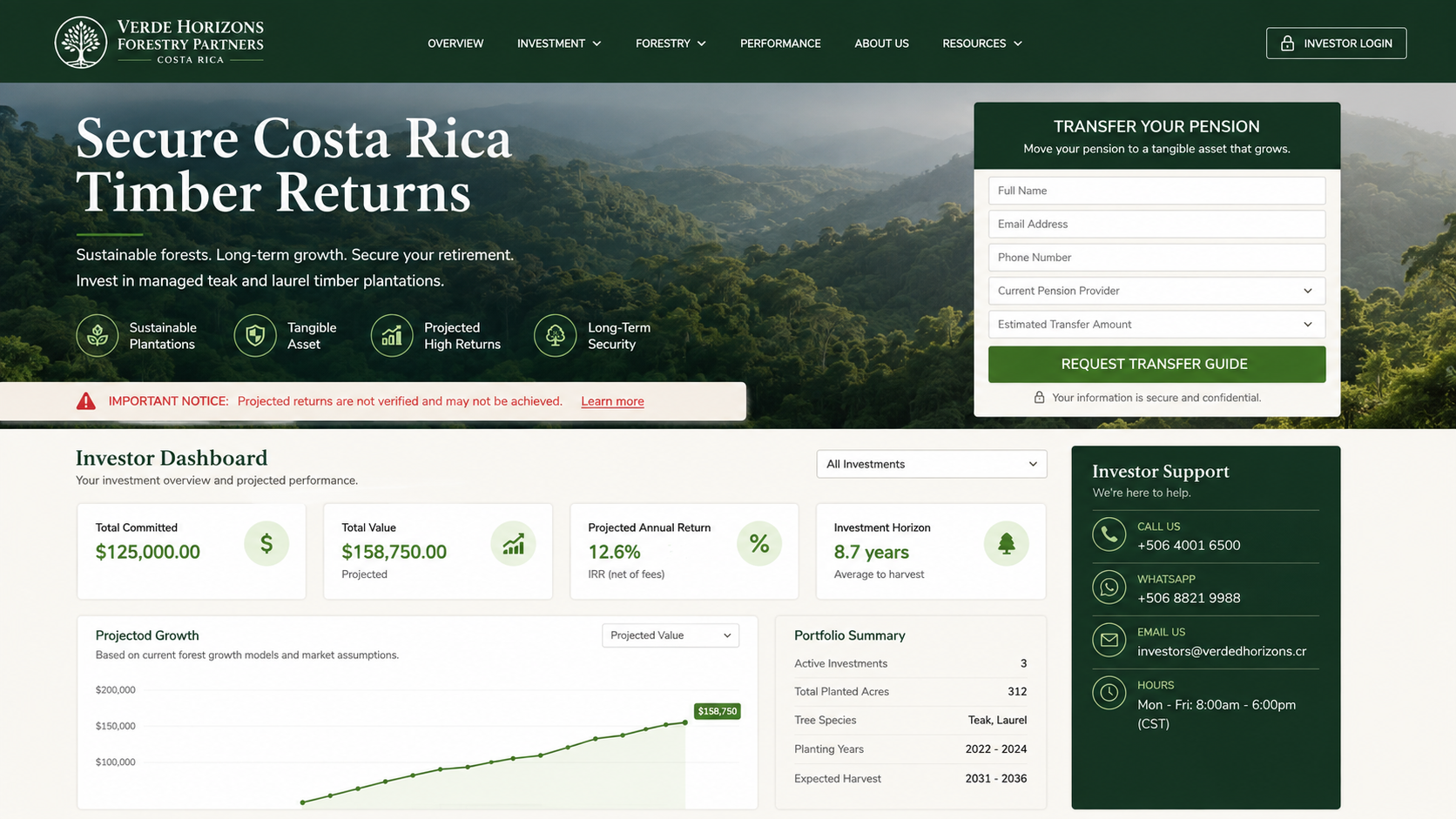
The pitch offered something many savers wanted to believe in: move part of a pension into real trees, support a greener future, and collect strong returns when the timber was harvested.
Trees were planted in Costa Rica. Investors received contracts and saw a company with offices, sales staff, and a polished environmental story.
What they did not see was the missing money needed to maintain and harvest those trees. That gap turned a tangible-looking investment into the £70 million Ethical Forestry investment scam.
Overview
More than 3,000 people were sold a pension-backed tree scheme
Ethical Forestry Limited promoted plots in Costa Rica as an investment. Callers persuaded members of the public, including pensioners, to move savings from legitimate pension arrangements into the company’s tree-planting operation.
According to the UK Serious Fraud Office, the fraud ran for seven years, took about £70 million, and affected more than 3,000 people. Employees operated from a Bournemouth call centre and used false company names to gain trust before recommending the investment.
This is not a review dispute or an unproven allegation. Three former directors pleaded guilty to fraudulent trading and were sentenced in September 2026 to a combined 15 years and nine months in prison. Each was also disqualified from acting as a director for ten years.
Real trees concealed an investment that could not deliver
The operation was persuasive because it was not entirely imaginary. Trees were planted. Investors could picture a physical asset growing in value, and the environmental theme made the project feel useful as well as profitable.
The SFO found that nothing was set aside to maintain or harvest the saplings. Without funding for those essential stages, investors’ money could not generate the promised returns.
A real plantation therefore did not make the financial claim real. The scheme used a visible activity to distract from whether the business model, cash reserves, ownership rights, costs, and exit plan could support the promised payout.
Cold callers used false identities and pension pressure
Employees did not always disclose that they were calling for Ethical Forestry Limited. The SFO says false names included Richmond Solutions and the Pension Report Service. Those labels made the first contact sound like an independent review rather than a sales funnel for one investment.
Victims were encouraged to withdraw or transfer pension savings. Pension money is especially attractive to fraudsters because one successful conversation can release years of accumulated funds.
Red flags in forestry and alternative-investment pitches include:
- An unsolicited pension review leads to one recommended scheme.
- The caller uses a different business name from the company receiving money.
- Returns are described as secure, predictable, or low risk.
- A physical asset is offered as proof without audited cash-flow evidence.
- The investment is overseas and difficult to inspect independently.
- Maintenance, insurance, harvesting, and sale costs are vague.
- The investor is urged to leave a regulated pension.
- Introducers and advisers cannot be verified on official registers.
- Luxury marketing replaces clear risk disclosure.
How the Ethical Forestry Investment Scam Worked
Step 1: Cold calls offered a pension review
The contact did not begin with an obvious request to send money to Costa Rica. Callers offered a review of the victim’s pension, creating the impression of a useful financial service.
The use of names such as the Pension Report Service helped separate the salesperson from the product. A consumer might believe an independent reviewer had examined many options and selected the forestry plan on merit.
Step 2: False company names created borrowed independence
The caller did not fully disclose the relationship with Ethical Forestry Limited. This matters because a recommendation from the seller is very different from advice by an independent, regulated professional.
Once the supposed reviewer won trust, the introduction to the investment felt like expert guidance rather than a commission-driven sale.
Step 3: The green story made risk feel responsible
Investors were shown a tangible narrative: land, saplings, timber growth, harvesting, and environmental benefit. Unlike an abstract trading strategy, a tree can be photographed and visited.
The ethical theme also changed the emotional frame. The investor was supposedly supporting sustainable development while earning a profit and protecting retirement savings.
Step 4: Savers were moved out of legitimate pensions
Call handlers encouraged people to withdraw or transfer funds from established pension schemes. Once the money entered the alternative investment, ordinary pension safeguards and recovery options could be reduced.
Early paperwork and professional language made the move look administrative. The economic decision was much larger: exchanging regulated retirement assets for a difficult-to-value overseas scheme.
Step 5: Trees were planted without a funded route to harvest
Planting produced photographs, reports, and a visible asset. The missing question was who would pay for years of maintenance, protection, harvesting, transport, processing, and sale.
The SFO said no money was reserved to maintain or harvest the saplings. The central promise depended on a future sale that the operation had not financially prepared to complete.
Step 6: Investor money funded luxury spending and tax arrangements
While savers waited for returns, millions were spent on luxury lifestyles. The SFO described high-end sports cars, expensive homes, a yacht, and holidays across Europe and Asia.
Investigators also found £2.77 million of investor funds was diverted to administer a tax-avoidance scheme for the directors’ benefit. The use of money did not match the retirement story sold to the public.
Step 7: The long timeline delayed recognition
Forestry is naturally a long-term activity. Trees do not mature overnight, so missed returns can be explained as market timing, growth cycles, weather, or delayed harvests.
That patience benefits a fraudulent operator. Investors may wait years before the gap between projected value and a realizable return becomes undeniable.
Why Tangible Assets Can Still Support a Fraud
A common sales line says land, trees, wine, storage units, precious materials, or other physical assets are safer because they can be seen. Visibility is not the same as liquidity, legal ownership, or commercial viability.
An investor needs evidence of who owns the asset, whether the seller can transfer that right, how the asset will be maintained, who will buy it later, what fees apply, and which regulator or compensation scheme covers the transaction.
A photograph of planted trees cannot answer those questions. Neither can a projected dashboard. Returns depend on the complete operation, not the existence of its most photogenic part.
The FTC’s investment scam guidance warns that promises of large or guaranteed returns and pressure to act are classic signs of fraud. Research must be independent of the person selling the opportunity.
Why the Scheme Looked Convincing for So Long
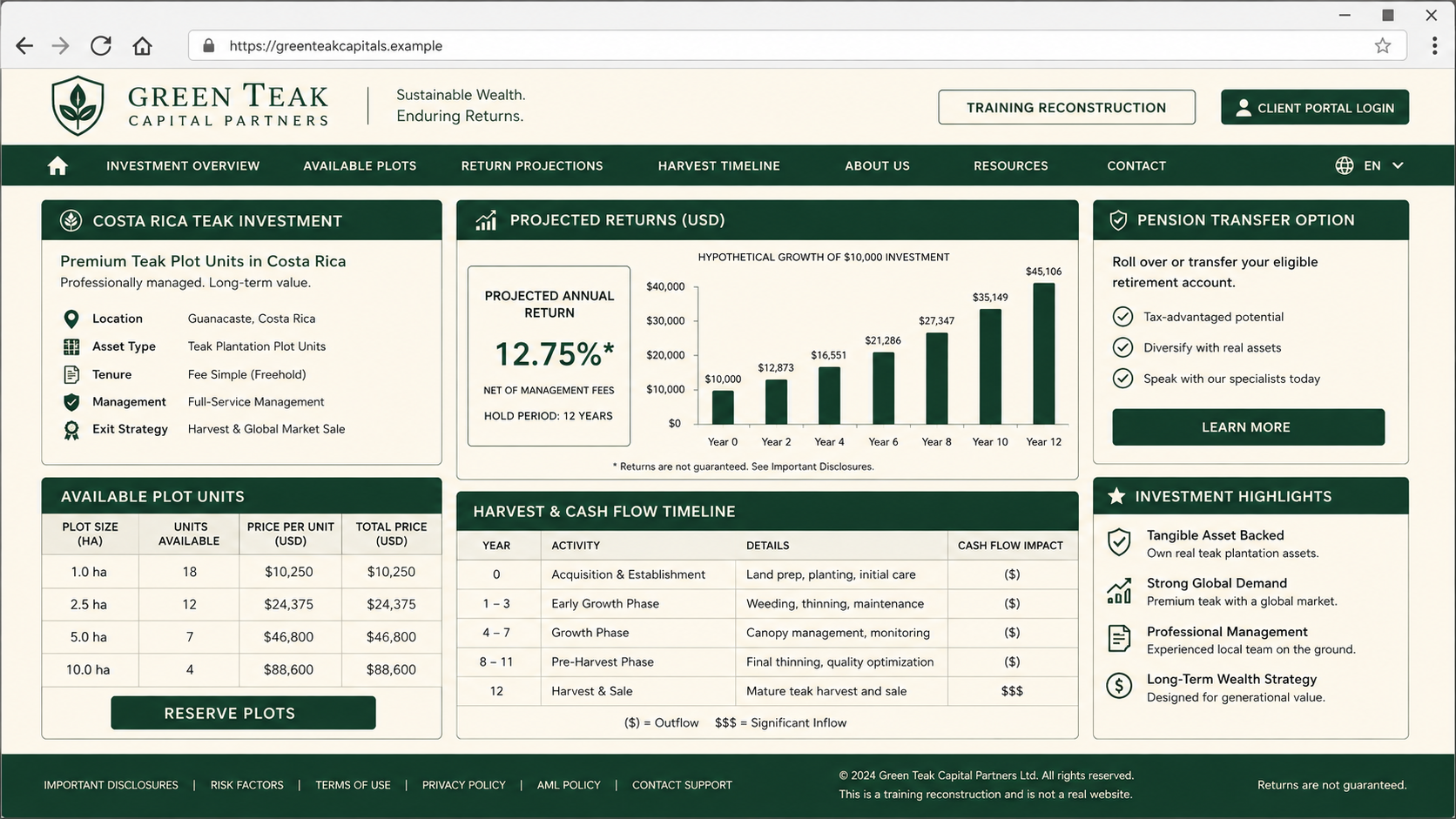
Investment fraud does not always arrive as a crude cold call. Ethical Forestry Limited sold a physical story: named plots, tropical trees, brochures, projected harvests, and an environmental theme.
For investors who distrusted shares or wanted something tangible inside a pension, owning trees in Costa Rica could feel easier to understand than a complex financial product.
The paperwork created another layer of comfort. Contracts, plot numbers, payment schedules, and corporate names can make a transaction look formal while saying very little about whether the underlying economics work.
The important questions were not whether trees existed, but whether the plots could generate the advertised returns, whether costs and risks were disclosed, and whether investor money was being used as promised.
Long investment periods also help operators delay discovery. A timber project can claim that meaningful returns will arrive only after years of growth and harvesting.
Early doubts can be blamed on weather, land management, export conditions, or a revised schedule. By the time missed returns become undeniable, records may be scattered and the money difficult to trace.
Pension-funded purchases add a particularly damaging twist. Victims may be moving savings intended to support decades of retirement, not simply risking spare cash.
A promoter can focus attention on projected returns and tax language while playing down illiquidity, resale difficulty, management dependence, currency risk, and the possibility that the asset cannot support the promised payout.
The lesson is not that every overseas forestry project is fraudulent. It is that a real asset does not verify the claims wrapped around it.
Independent regulation checks, audited accounts, ownership records, realistic cash-flow evidence, and advice from a professional who is not paid by the promoter are essential before pension money leaves a protected account.
Investors should also test the exit, not just the promised growth. Ask who is contractually required to buy the timber, how its value is measured, what happens if the manager fails, and whether the plot can be sold without the promoter.
If those answers depend entirely on the same sales company, the asset offers far less protection than the brochure suggests.
Company, Address, and Fulfillment Checks
Verify every business name in the chain
Search the introducer, adviser, investment company, payment recipient, plantation operator, trustee, and administrator separately. A polished trading name may hide the fact that several roles lead back to the same seller.
Check regulatory status before discussing a transfer
Use the Financial Conduct Authority register and the regulator’s warning list. Verify the exact legal name, reference number, permissions, address, and phone number. Clone firms often copy details from a real authorized business.
Trace the money and the asset ownership
Ask who receives the funds, where they are held, what legal interest the investor obtains, and how that interest can be sold. An overseas plot reference is not useful if it cannot be matched to enforceable ownership records.
Demand audited costs, reserves, and an exit path
For forestry, examine maintenance, insurance, disease, fire, harvesting, transport, currency, tax, and buyer risk. If no independent budget exists for years of work, a projected harvest value is only a number on paper.
What to Do if You Have Fallen Victim to This Scam
- Stop new payments and do not pay a release fee. A demand for tax, legal costs, insurance, or recovery money may be a follow-up scam.
- Gather the complete investment file. Preserve contracts, pension-transfer documents, bank records, brochures, emails, call notes, company names, adviser details, plot references, and projected statements.
- Contact the SFO case channel. The official Ethical Forestry Limited case page contains current victim and confiscation information. Use the contact route listed there rather than details supplied by a third party.
- Speak to the pension provider. Ask for a complete transfer history, receiving account details, correspondence, and any warnings recorded at the time.
- Check compensation eligibility. The SFO notes that some investors may meet criteria for the Financial Services Compensation Scheme. Eligibility depends on the circumstances and should be assessed through the official FSCS process.
- Report connected advisers or introducers. Provide evidence to the FCA, Action Fraud, pension authorities, and professional regulators as appropriate.
- Protect identity documents. If passports, driving licences, tax records, or pension statements were supplied, monitor for identity fraud and consider protective registration or credit-file alerts.
- Secure online accounts. Change passwords if an investment portal reused credentials, review email forwarding and recovery methods, and enable multifactor authentication.
- Scan devices if software was installed. If a salesperson directed you to a remote-access tool, document portal, or unknown app, remove it and run a full Malwarebytes scan.
- Reduce exposure to malicious follow-ups. After the device is clean, AdGuard can help block known phishing and advertising destinations. It cannot verify an investment or recover pension money.
- Get independent legal or financial advice. Use a regulated professional who has no connection to the original scheme or recovery offer.
- Reject recovery agents who contact you first. Fraud victim lists are valuable. Anyone promising guaranteed recovery for an upfront payment should be treated as another scammer.
Frequently Asked Questions
Was Ethical Forestry Limited officially proven to be fraudulent?
Yes. Three former directors pleaded guilty to fraudulent trading and received prison sentences in September 2026. The SFO’s criminal investigation concluded, while proceeds-of-crime work continues.
Were any trees actually planted?
Yes. The SFO said trees were planted in Costa Rica, but no money was reserved to maintain or harvest them, so the operation could not generate the promised returns.
How many people lost money?
The SFO says the scheme defrauded more than 3,000 people and took approximately £70 million over seven years.
Why did the pension review sound independent?
Employees used other company names, including Richmond Solutions and the Pension Report Service, without disclosing their true employer. That separation helped the recommendation appear independent.
Can victims still contact the investigation?
The SFO maintains an official case page with current victim information and a contact address. Check that page directly because deadlines and procedures can change.
Does a physical asset make an investment safer?
Not by itself. Legal ownership, regulation, maintenance funding, market demand, costs, and a workable exit determine whether the asset can return money to the investor.
The Bottom Line
The Ethical Forestry investment scam wrapped pension fraud in a story about real land, real saplings, and ethical growth. The visible trees made the scheme feel tangible while the financial structure needed to maintain, harvest, and sell them was missing.
The convictions remove the ambiguity. Before moving retirement money into any alternative asset, verify every company, adviser, permission, cost, ownership record, and exit route independently. A green promise can still leave a pension permanently in the red.

Reviews & discussion
0 commentsShare a firsthand experience, or ask a question.
Community reviews
Ethical Forestry
Moderated reader experiences, not an editorial verdict.
Start the conversation
Have a question or something useful to share? Add the first comment.