

If you’ve seen ads claiming a simple wall charger can make your phone faster, cooler, and last days on a single charge, you’re not alone.
The Hyper Charge Pro is heavily promoted across TikTok, Facebook, and Instagram with bold promises that sound impressive at first glance. But once you look closer, the entire operation raises serious concerns.
This article breaks down what’s really going on.
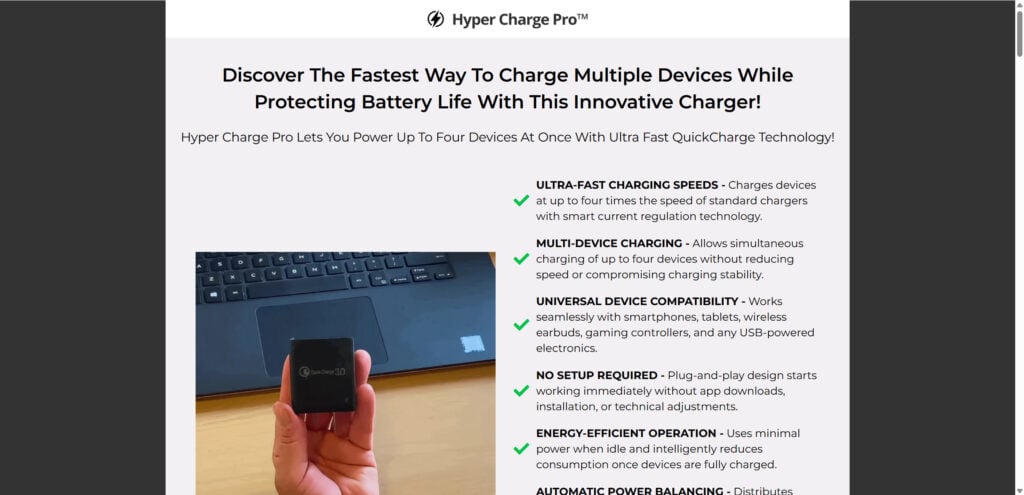
Scam Overview
What Hyper Charge Pro claims
The product is marketed as an “innovative smart charger” that can:
- Charge devices up to 4x faster
- Extend battery lifespan
- Prevent overheating
- Improve device performance
- Make older phones feel “like new”
Some ads go even further, suggesting:
- apps will run faster
- phones will stay cooler
- battery life will dramatically increase
These claims are designed to make it feel like a tech upgrade, not just a charger.
What it actually is
In reality, Hyper Charge Pro is:
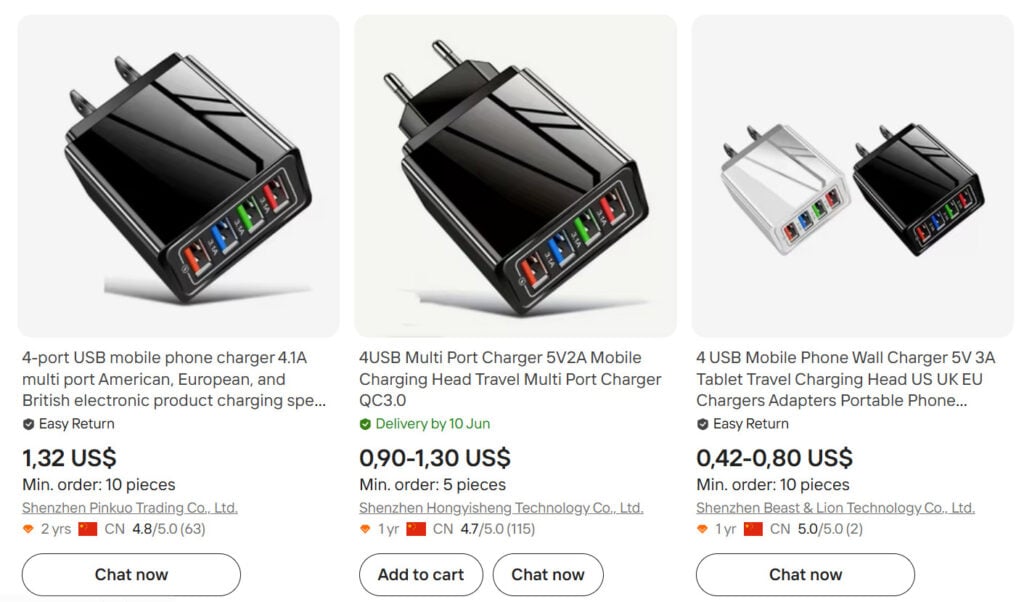
- a generic multi-port USB wall charger
- mass-produced and sold wholesale for $0.50–$2
- widely available under dozens of different names
There is no proprietary technology. No breakthrough. No “smart optimization” beyond basic charging circuitry.
This is a rebranded commodity product.
Major Red Flags
1. Impossible performance claims
A charger cannot:
- speed up your phone’s processor
- improve app performance
- extend battery capacity beyond hardware limits
- “cool” your phone in any meaningful way
These claims are not just exaggerated. They are technically false.
At best, a charger can:
- deliver stable power
- support fast charging protocols (if legit)
That’s it.
2. Identical product sold for under $2
The same charger design appears on wholesale platforms:
- 4 USB ports
- generic plastic casing
- labeled “QC3.0” or “3.1A”
Typical bulk price:
- $0.80 – $1.50 per unit
Hyper Charge Pro is often sold for:
- $20–$40+
This is a massive markup driven entirely by marketing.
3. Dropshipping funnel across multiple domains
The product is sold on sites like:
- hyperchargepro.store
- and similar single-product stores
These sites usually:
- have no real brand history
- appear recently created
- reuse the same product images and copy
This is a classic dropshipping network, not a real tech brand.
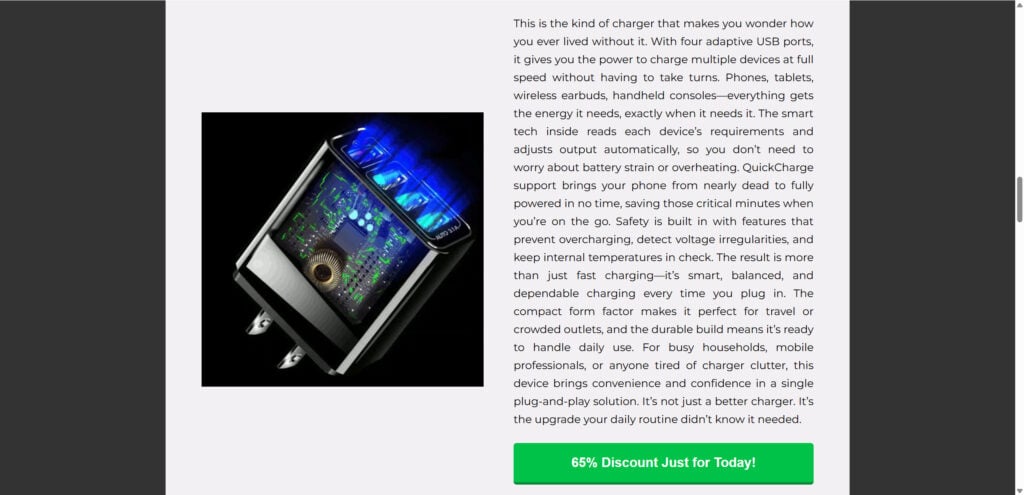
4. Misleading visuals and AI-enhanced marketing
The ads frequently show:
- glowing energy effects
- “internal chip animations”
- phones charging unrealistically fast
- battery indicators jumping instantly
These are:
- edited visuals
- stock animations
- sometimes AI-generated content
They are not real demonstrations.
5. Fake urgency and pressure tactics
Common elements:
- “65% discount today only”
- countdown timers
- “limited stock” warnings
These are almost always:
- fake
- reset per visitor
They exist to push quick decisions.
6. Customer complaints about orders
Buyers report issues such as:
- receiving multiple units they didn’t intend to buy
- confusing bundle pricing
- unexpected charges
This often happens due to:
- pre-selected upsells
- misleading checkout flows
Customer Complaints & Risks
Receiving more items than expected
A common pattern:
- user selects 1 unit
- checkout defaults to bundles
- multiple chargers arrive
Result:
- higher charges than expected
- difficulty disputing the order
Product not matching expectations
Customers report:
- basic build quality
- no noticeable charging improvement
- no difference from standard chargers
Because that’s exactly what it is: a standard charger.
Long shipping times
Since it’s dropshipped:
- shipping often takes weeks
- tracking may be unreliable
- items ship from overseas
Returns are extremely difficult
This is one of the biggest risks.
Typical issues:
- return address in China
- high shipping cost
- delayed or ignored support
In many cases:
- returning the product costs more than the refund
Poor customer support
Buyers frequently experience:
- slow replies
- generic responses
- no clear resolution
How the Operation Works
This follows a familiar pattern:
Step 1: Find a cheap product
A generic multi-port charger from a supplier.
Step 2: Rebrand it
Add:
- “Hyper Charge Pro” name
- claims of advanced technology
Step 3: Build a high-conversion page
Include:
- exaggerated benefits
- technical-sounding language
- fake performance visuals
Step 4: Run aggressive ads
Push through:
- TikTok
Step 5: Fulfill orders cheaply
- product ships from overseas
- minimal quality control
Step 6: Limit refunds
- difficult return process
- slow or unresponsive support
Is Hyper Charge Pro a Scam or Legit?
The reality
- The product exists
- It will charge devices
But:
- claims are exaggerated or false
- pricing is heavily inflated
- marketing is misleading
- refunds are difficult
Verdict
High-risk dropshipping product with misleading claims.
Not a total fake, but clearly not what it promises.
Should You Buy It?
Reasons to avoid
- false performance claims
- extremely low actual value
- inflated pricing
- confusing checkout tactics
- difficult returns
Better alternative
If you need a charger:
- buy from known brands
- check verified reviews
- avoid viral “miracle tech” ads
What To Do If You Already Ordered
1. Review your order carefully
Check:
- how many units you were charged for
- total cost
- any hidden bundles
2. Save all evidence
Keep:
- product page screenshots
- ad claims
- order confirmation
3. Contact support immediately
Request:
- clarification
- cancellation (if possible)
- refund instructions
4. Monitor your payment
Watch for:
- additional charges
- subscription-style billing (if applicable)
5. File a chargeback if needed
If the seller refuses:
- contact your bank or PayPal
- report “item not as described”
Bottom Line
Hyper Charge Pro is not a breakthrough charger.
It is:
- a cheap generic product
- sold through aggressive marketing
- backed by unrealistic promises
The biggest issue is not that it won’t charge your phone.
The problem is that it’s being sold as something far more advanced than it actually is.
Frequently Asked Questions
Is Hyper Charge Pro a scam?
Not in the sense that nothing is delivered. You will usually receive a charger.
However, it is misleadingly marketed, heavily overpriced, and sold with claims that are not technically accurate. That places it in the high-risk / deceptive product category.
Can Hyper Charge Pro really make my phone faster?
No.
A charger cannot:
- improve processor speed
- make apps run faster
- boost overall device performance
Those claims are false and used purely for marketing.
Does it actually charge faster than normal chargers?
Only if:
- your phone supports fast charging
- the charger truly supports a compatible standard
Even then, performance is similar to any standard fast charger, not something unique.
Can it improve battery life or make it last days longer?
No.
Battery life depends on:
- your phone’s battery condition
- software optimization
- usage habits
A charger cannot increase battery capacity or dramatically extend usage time.
Why is it so cheap on wholesale sites but expensive online?
Because this is a classic dropshipping model:
- bulk price: around $0.50–$2
- retail price: $20–$40+
The difference is pure markup driven by marketing, not quality.
Why do some people receive multiple units?
This usually happens due to:
- pre-selected bundle offers
- confusing checkout design
- “Buy 2 Get 1” type traps
Many users don’t realize they’ve selected more than one unit.
Is Hyper Charge Pro safe to use?
In most cases, it functions like a basic charger.
However, risks include:
- inconsistent quality control
- unknown internal components
- lack of certifications
It may not be as reliable as chargers from trusted brands.
Are the reviews on the website real?
Often not.
Many of these stores use:
- generic testimonials
- stock photos
- copied or fabricated reviews
They are designed to build trust quickly, not reflect real customer experiences.
Why are returns so difficult?
Because:
- products are shipped from overseas
- return addresses are often in China
- shipping costs are high
In many cases, returning the item is impractical or ignored.
Can I cancel my order after buying?
Sometimes, but only if you act quickly.
You should:
- contact support immediately
- request cancellation before shipping
Once shipped, cancellation becomes much harder.
What should I do if I feel misled?
Take these steps:
- save screenshots of the product claims
- contact the seller and request a refund
- dispute the charge with your bank or PayPal if needed
Use “item not as described” as your reason.
Is there any reason to buy it?
Not really.
You can get:
- the same or better charger
- from a known brand
- at a similar or lower price
without the risks and misleading claims.









Thank you.
You are very welcome, William. I am glad the investigation was useful, and thank you for taking the time to leave a note.