


A number on a screen can feel like money long before it reaches your bank account. It is hard to forget that number once you have seen it grow.
Years after IcomTech stopped paying, some investors still have a screenshot, a receipt or a token name. Each one tells a different part of the story.
Overview
IcomTech was sold as a mining and trading company
IcomTech launched in 2018 with a promise that cryptocurrency mining and trading could produce guaranteed daily returns. Buyers were offered investment products and an account to watch the results.
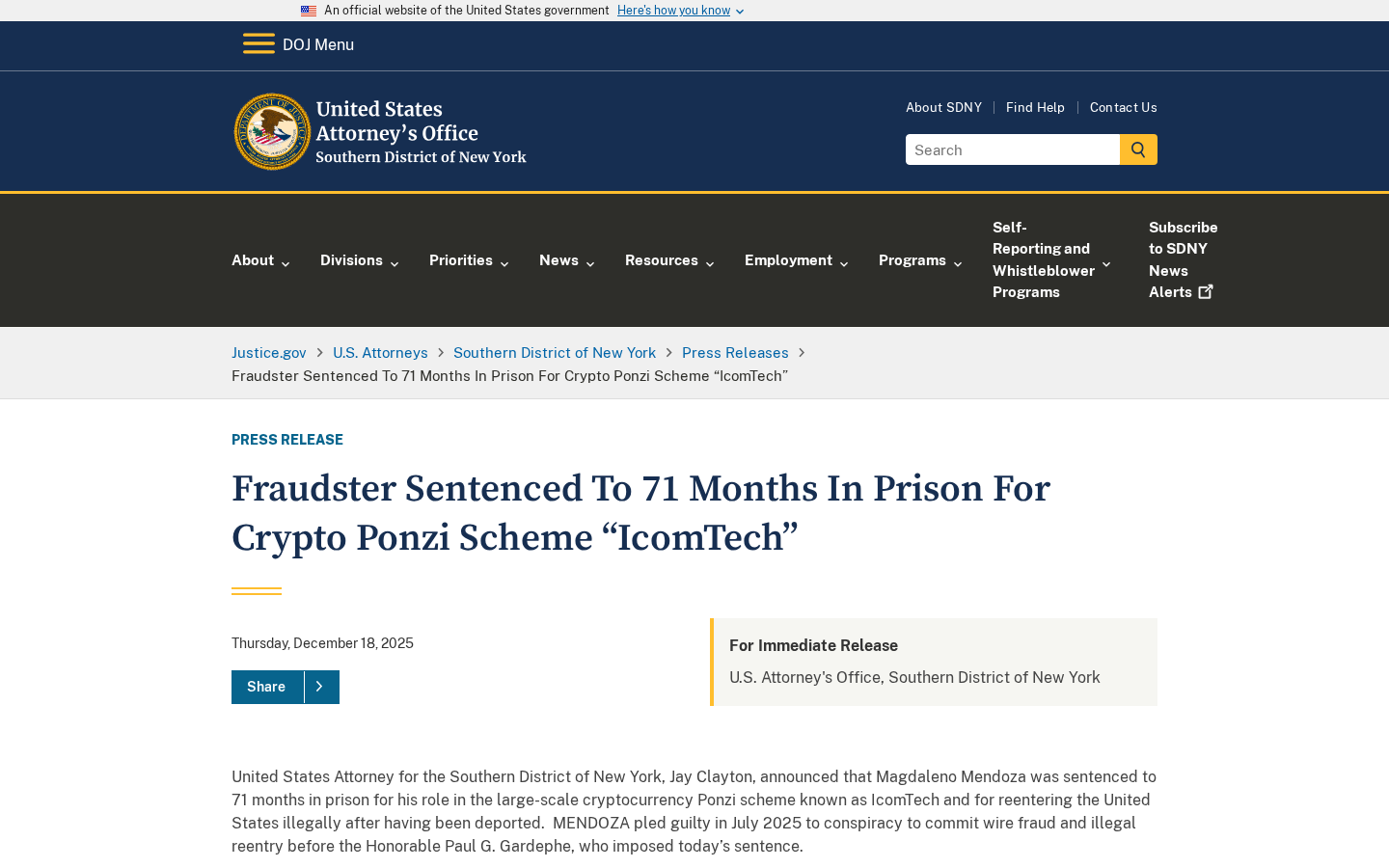
The Justice Department’s IcomTech sentencing announcement says the company did not mine or trade cryptocurrency for those investors. The money came from people buying into the operation.
Promoters used some of that money to pay other participants and encourage more promotion. They also used money for expenses and personal enrichment, according to the federal account.
IcomTech is a useful case because the numbers on its website looked like a running explanation for the money. In fact, the portal and the underlying payments told different stories.
Three records answer three different questions
An investment receipt shows what you gave someone and perhaps what you were promised. A bank statement or independent transaction record shows what really moved.
The online portal shows what IcomTech represented to you. You can keep all three without assuming a number displayed by IcomTech had any independent backing.
- Your original payment can help establish the cost of the investment product you bought.
- A withdrawal shown in an independent account can document value you actually received.
- A portal balance or an Icoms quote helps explain the pitch, but does not prove a payout.
That distinction is especially important for Icoms. This was the operation’s own token, promoted when ordinary withdrawals were already difficult, not a reserve of cash held for participants.
Who was sentenced, and what that means for readers
Magdaleno Mendoza pleaded guilty in 2025 to conspiracy to commit wire fraud and illegal reentry. The 71-month sentence announced that December was for his role and the reentry offense.
Mendoza was ordered to pay $789,218.94 in restitution and $1.5 million in forfeiture. Neither figure reports money already paid to victims.
Founder David Carmona and other IcomTech defendants were convicted and sentenced separately, according to the Justice Department. The cases should not be rolled into a single sentence or payout estimate.
If you are trying to work out what happened to your own money, the next step is to rebuild what you paid and contact the published victim assistance office.
How the IcomTech Scam Worked
Step 1: The promotion began away from the dashboard
People did not need to find IcomTech through a crypto exchange. Promoters held community presentations and larger events, and Mendoza collected cash at events at his California restaurant.
The Justice Department describes an operation that targeted working-class Spanish speakers, many with little prior experience with cryptocurrency. Real people could vouch for the product without knowing how it worked.
At larger expos, displays of expensive cars and clothing were presented as evidence of success. That showed that promoters had access to expensive things, not where the money came from.
A photo of a presentation is still useful if that is how you first heard of IcomTech. Note the location and what the speaker promised rather than interpreting everyone’s finances.
If a relative introduced you to the opportunity, you do not have to accuse them to document what happened. An introduction and a decision to run the scheme are different.
Step 2: Real money bought access to purported returns
Investors paid for the products through promoters using cash, checks, wires or cryptocurrency. The payment could go through a person before the buyer saw a position in the portal.
That is why a statement without the word IcomTech can still be relevant. The payee could be the promoter or the name they put on the payment instructions.
Once the buyer had access, the portal showed purported profits accumulating. What it did not show was proof of independent mining income that matched those figures.
An investor might count the growth in that portal as something earned each morning. With no independent evidence of the underlying trading, there was nothing to substantiate that reading.
If you received a small early payment, preserve it as a separate receipt. The Justice Department says money from investors was used to pay some other participants.
Step 3: The withdrawal exposed the difference
People had trouble pulling money out, and promoters responded with delays, explanations or fees. Meanwhile, IcomTech continued taking more investments, according to the federal account.
This is the point at which the meaning of the portal changed. It could still show profits even when the account it was supposed to represent could not pay out.
A withdrawal request, a confirmation on the website and a deposit in your own account are three different events. Only the last establishes that the money reached you.
An extra charge can also be real money even when it was paid to free an invented balance. Keep the proof of paying it separate from the balance itself.
Look for the reply you received when you first asked to withdraw. That message may explain whether you were told to wait, pay or accept something else.
Step 4: Icoms offered another story about when money would arrive
As complaints mounted, IcomTech offered a proprietary token for sale. Promoters said it would become valuable when businesses started accepting it for goods and services.
The offer shifted the conversation from what the company could pay then to what other people might pay later. It still did not fund the original promised withdrawal.
Federal prosecutors describe Icoms as essentially worthless and say the token brought additional financial losses. IcomTech stopped making payments around the end of 2019 and collapsed.
A token with its own name and a displayed price can sound like a more concrete asset than a balance inside a website. Neither label creates a willing buyer.
If you bought Icoms with additional funds, record that payment distinctly. Do not treat an automatic change in the displayed balance as a separate outlay without a corresponding transfer.
What to Do If You Invested in IcomTech
- Write down the name of the promoter you paid, the dates you remember, and where you attended a presentation or received the offer.
- Pull the actual transfers, checks, exchange records or receipts before using any totals from the old IcomTech portal.
- Separate what you paid for the original investment, cash you put toward Icoms, and money or assets you can prove reached you.
- Check the federal case page for the published IcomTech victim contact and ask how the office wants you to provide your records.
- Treat any request for a payment to convert old Icoms or release a court refund as a separate warning sign.
- If you made a recent recovery payment, contact its payment provider promptly and preserve that transaction separately from your original investment records.
When you paid a person rather than a website
For cash, look for a receipt, a calendar entry for the event or a text acknowledging the handoff. No bank label will turn that payment into an online purchase.
If the receipt is gone, note the approximate date and the reason you believe the payment happened then. Keep any amount you recall marked as an estimate.
For a check, ask your bank whether a canceled check image is available. A clearing date or endorsement can help show who actually handled the payment.
For an exchange withdrawal, look up the historical record inside the service you used, rather than opening a link from an old IcomTech chat.
Record the transaction identifier, receiving address, amount and currency as displayed. An identifier can help trace the transfer without giving anyone the keys to your wallet.
If you paid with crypto, preserve the original unit quantity and any recorded cash equivalent at the time. Today’s price is not the amount recorded in an old transaction.
The IcomTech victim contact is on the Justice Department site
Open the IcomTech federal case page and find its victim assistance details near the bottom. The page identifies the case as 22 Cr. 551 (JLR).
The Victim/Witness Coordinator’s number listed there is (866) 874-8900. Call that published number and say you have records for the IcomTech matter, naming the promoter if known.
Ask whether your prior report is on file or how to supply one, as applicable. Confirm where to send records and what information the office should receive first.
The case page includes historical updates and court dates. Use it to find the office, not to infer that the next listed event or deadline is still ahead.
Keep any case reference and the date of your contact. If you hear nothing, follow up through the same public office instead of responding to someone else offering quicker access.
If asked for sensitive records, confirm the channel first. The office can tell you how to share proof without relying on a link from a chat.
Keep a new recovery approach out of the old ledger
A claim to be able to turn Icoms into usable funds does not become credible because your balance is real to you. Do not send a deposit to investigate.
If a stranger asks for control of your device or wallet to process a payout, end the conversation. An official victim inquiry does not require handing over wallet control.
If you already sent money, ask the financial service whether the specific transaction can be stopped or flagged. Have the new receipt to hand when you call.
The FBI recovery scam warning describes services that take advance fees without recovering funds. A promising recovery message is not a second chance worth paying to test.
How to describe a balance that changed units
Write down the unit shown beside each number in the portal. An entry displayed as cash, bitcoin or Icoms does not necessarily represent the same asset.
If two screenshots show a change, retain both with dates. Note that the displayed denomination changed rather than assuming that your bank or wallet received anything.
Compare each claimed withdrawal with the receiving record. A missing transaction reference is something to flag, not a reason to guess which wallet received the money.
If you did receive a transfer that you cannot identify, write that down separately. Do not assign it to IcomTech merely because it occurred around the same time.
Someone else involved may have recovered a different amount. Use your own cleared checks, bank credits or confirmed crypto deposits to document your experience.
Even if none of the old screenshots are available, a payment record and the name of a promoter can give the federal office somewhere to start.
That office can explain what it needs for the case. Your job is to preserve the distinction between a representation, a payment and an amount you cannot verify.
Frequently Asked Questions
Was IcomTech a real crypto mining company?
Federal prosecutors say it did not mine or trade cryptocurrency for its investors. It used money from investors to pay some other participants, support promotion and enrich operators.
The existence of a portal or a payment made by a promoter is entirely compatible with that explanation. Neither establishes that the promised business earned the money.
What exactly was the Icoms token?
Icoms was a proprietary token IcomTech offered while investors were struggling to withdraw. Promoters said it could become valuable as businesses began accepting it.
Prosecutors describe it as essentially worthless. A person promising redemption today should not receive a fee or access to your wallet on the strength of that old claim.
Should I include gains from the IcomTech portal in my losses?
Show the portal records if they help document what you were told. Keep those figures separate from your deposits, token purchases and proceeds you received.
If you are asked for the amount you actually paid, use your financial records. Label any missing or estimated information so it is not mistaken for a confirmed transfer.
Can I report a cash investment without a bank receipt?
Yes, you can ask the published victim assistance office how it handles a cash payment. Bring whatever you have, including messages that acknowledge the amount or place.
Say clearly when the amount is approximate. Do not create a replacement receipt or fill in a payee you cannot verify.
Does the Mendoza sentence mean restitution is available to me now?
The sentence announcement states what Mendoza was ordered to pay. It does not confirm your eligibility or provide a payment date.
Contact the victim office if you have questions about the federal case. A private message quoting the court amount is not evidence of a distribution.
What if someone says they can convert my Icoms for a fee?
Do not send the fee or give anyone wallet access. Keep the message and independently check any claim tied to the criminal case with the published victim contact.
If you paid already, give the new payment record to the provider you used. Do not let the person sell you another transaction to undo it.
The Bottom Line
Do not pay to unlock an old IcomTech balance or convert Icoms. Rebuild your records using actual money sent and received, then contact the federal victim office through justice.gov.
Contacting the office does not guarantee repayment. It will give you a reliable answer about where to take your records, without risking more money on the same promise.

Join the discussion
0 commentsShare your experience or ask a question about this article.
Community experiences
Did this happen to you?
Your experience could help someone recognize the same scam. Submit a private report for our team to review.
I experienced this tooReports are reviewed before publication. Sharing publicly is always your choice.
Discussion
Start the conversation
Have a question or something useful to share? Add the first comment.