

The promise sounds almost cinematic: buy a stack of Iraqi dinar today, wait for a secret currency reset, then exchange it for life-changing wealth. Online promoters make the finish line feel close enough to touch, even when the same prediction has failed for years.
That is what gives the Iraqi dinar scam its staying power. It sells anticipation first, currency second, and keeps people emotionally invested by suggesting that anyone who questions the story simply does not understand what is about to happen.
Overview
What the Iraqi dinar scam promises
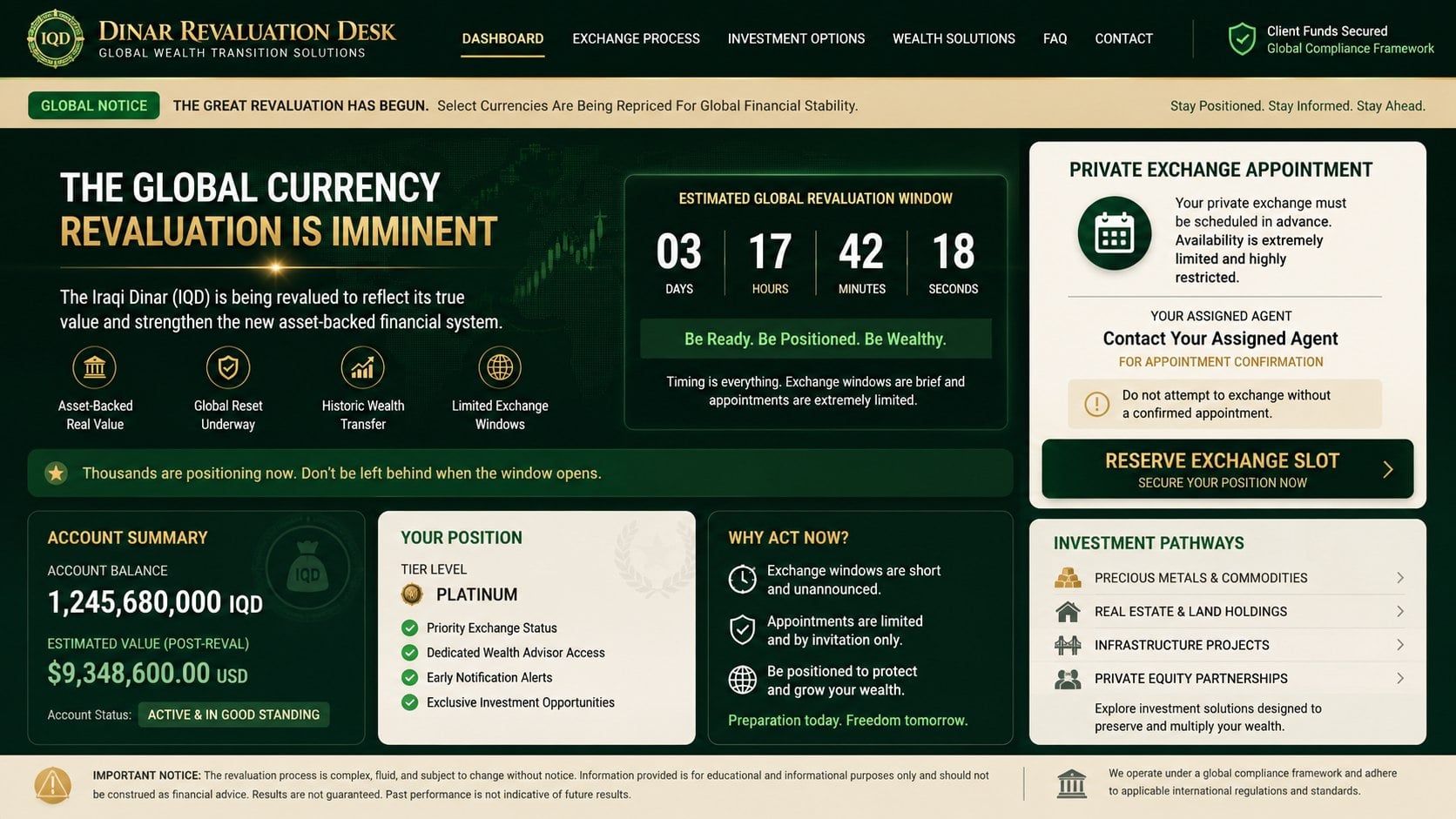
Promoters claim that Iraq will suddenly “revalue” its currency at a dramatically higher rate. They say ordinary dinar holders will soon be invited to private exchange appointments where modest purchases can allegedly turn into six- or seven-figure payouts.
The story is often wrapped in references to global banking changes, oil reserves, asset-backed currencies, government contracts, or a hidden international agreement. None of those impressive-sounding claims proves that a retail holder will receive the promised return.
- An imminent revaluation, reset, or reinstatement
- Secret exchange rates unavailable to the public
- Invitation-only redemption centers
- Guaranteed or nearly risk-free returns
- Urgent instructions to buy more currency or pay a fee
Why owning real banknotes does not validate the pitch
Some buyers receive genuine Iraqi banknotes. That physical delivery can make the transaction feel legitimate, but it does not make the investment claims true. A person can receive exactly what was ordered and still be misled about liquidity, resale value, spreads, or the chance of a windfall.
The Washington State Department of Financial Institutions has warned that established exchange houses and banks generally do not convert the dinar for consumers. When there is no accessible market, a dealer can set a wide difference between its selling price and its buyback price.
Where the real financial danger begins
The loss may start with an inflated currency purchase, but it can grow. Holders are later approached about private redemptions, account activation, taxes, insurance, legal certificates, or special appointment fees. Personal and banking information may also be collected for identity theft.
The scheme can become a community. Private groups, conference calls, video channels, and self-styled insiders repeat one another’s rumors. Constant updates keep members waiting through missed deadlines and make it harder to accept that the promised event may never arrive.
How the Iraqi Dinar Scam Works
Step 1: A promoter introduces the revaluation story
The first contact may be a social media post, livestream, podcast, email, private message, or recommendation from someone the victim trusts. The promoter says the dinar is severely undervalued and will rise once a political or financial milestone is reached.
Specific language varies, but the emotional message is consistent: wealthy institutions already know what is coming, ordinary people have a rare chance to participate, and anyone who acts before the announcement could escape debt or retire early.
The pitch sometimes borrows real news about Iraq’s economy, central bank policies, or oil production. Legitimate events are then stretched into unsupported predictions about a massive retail exchange rate that governments and major banks are supposedly keeping quiet.
Step 2: The seller turns uncertainty into urgency
Next comes a deadline. The promoter may claim that bank screens are being updated, exchange centers are staffed, rates are “locked,” or a final announcement is hours away. Buyers are encouraged to secure more notes before dealers run out.
When the deadline passes, the explanation changes. A holiday, court ruling, security issue, banking test, political vote, or unnamed official allegedly delayed the process. The failure is presented as proof that complicated work is happening, not as evidence that the prediction was unreliable.
This moving-target structure protects the story. There is always another date, another source, and another technical phrase. Followers are kept busy interpreting updates instead of measuring the promoter’s record of failed claims.
Step 3: The victim buys currency at a costly spread
The buyer is directed to a dealer, reseller, private contact, or website. The listed price may include a large markup, shipping, handling, authentication, or installment fees. Comparisons are difficult because ordinary US financial institutions may not offer a convenient dinar exchange.
Some sellers emphasize that they are registered as a Money Services Business. Registration alone is not an endorsement of the investment pitch, a guarantee of fair pricing, or proof that a predicted revaluation will occur.
The buyer may receive banknotes and a certificate that looks official. Those items create a sense of ownership and progress, but the practical question remains unanswered: who will buy the notes back, today, at a transparent and competitive rate?
Step 4: Online communities reinforce the belief
After the purchase, victims are invited into groups where members share rumors, countdowns, supposed bank contacts, and stories about secret exchanges. Skeptical questions may be deleted, while optimistic claims are repeated until they feel familiar and credible.
Promoters often imply that mainstream reporting cannot be trusted or that critics want small investors to miss out. This isolates holders from independent advice and turns reasonable doubt into a test of loyalty.
The longer a person waits, the harder it can feel to step away. Admitting the pitch was misleading may also mean accepting a financial loss, so one more update or one more purchase can seem emotionally easier than selling.
Step 5: A private exchange or fee request appears
Once the victim is committed, a second-stage scam may arrive. A caller or email claims that exchanges have begun privately and that the holder qualifies for a preferential rate. The message may include an appointment number, account dashboard, or confidentiality warning.
Before the payout can be released, the victim is asked for a processing charge, tax deposit, compliance bond, insurance premium, background-check fee, or charitable contribution. Cryptocurrency, wire transfers, gift cards, and payment apps may be requested because they are difficult to reverse.
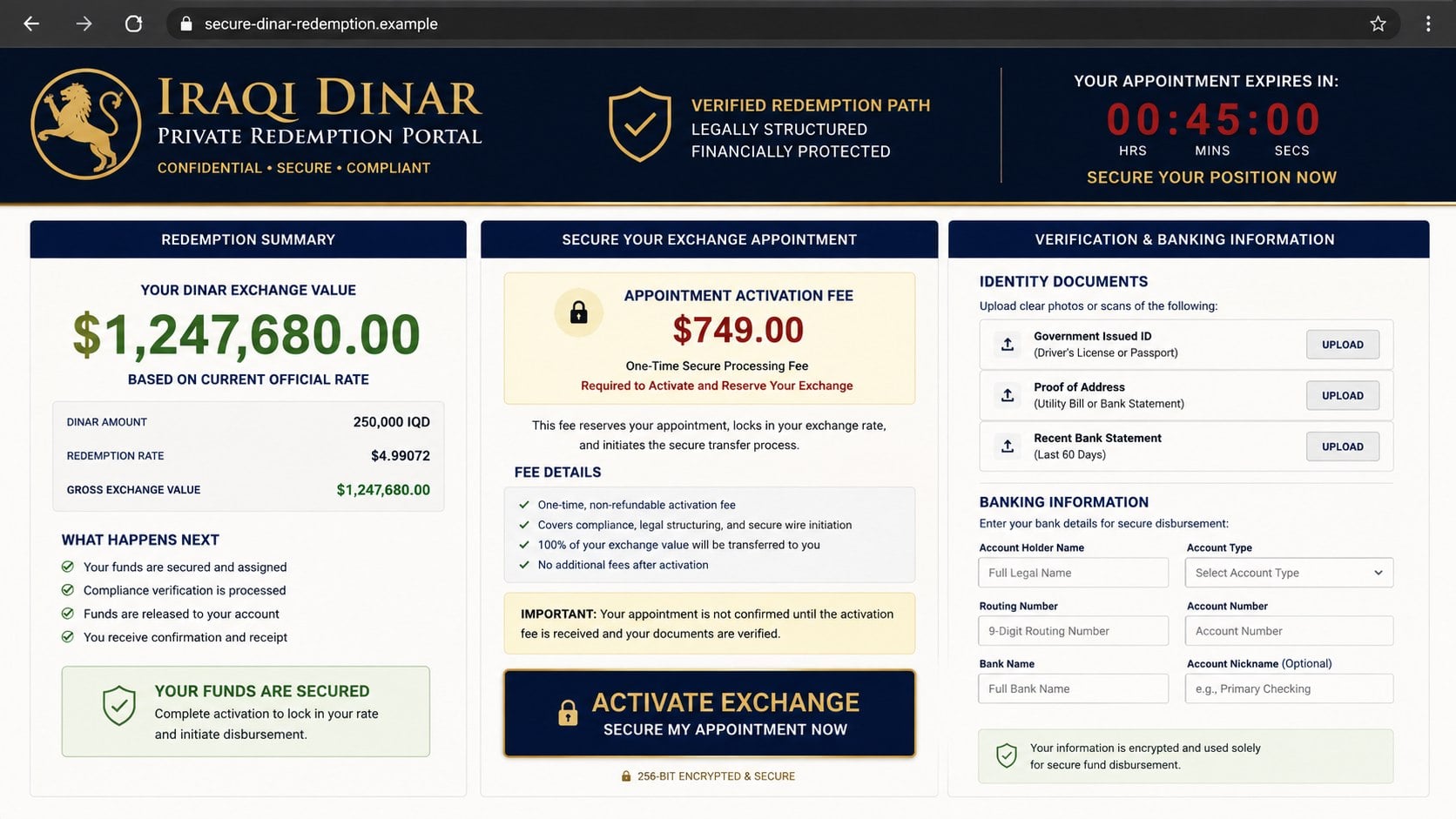
The portal may also request passport images, a driver’s license, Social Security number, bank routing details, and proof of address. Those details have value even if the promised exchange never happens.
Step 6: Losses continue through recovery offers
When the payout fails, another person may offer to recover the money or redeem the currency. The new contact could claim to represent a law firm, regulator, international bank, government task force, or victim compensation program.
Recovery scammers often know the original purchase amount and dealer name because victim lists are sold or reused. That inside knowledge makes the follow-up believable, but the request ends in another upfront fee.
No genuine authority needs gift cards, cryptocurrency, or a secrecy agreement to return recovered funds. A real investigation can be verified through a publicly listed agency number and an official case reference obtained independently.
The Red Flags That Matter Most
The return requires an extraordinary exchange-rate leap
Promoters frequently invite people to multiply a huge number of dinar by an imagined future rate. The arithmetic is exciting, but it skips the economic, monetary, and market consequences of creating vast wealth for every note holder.
A credible investment explanation should address liquidity, spreads, custody, regulation, risks, and a realistic exit route. A story built mainly around a secret rate and a coming announcement is not financial analysis.
The evidence always comes from unnamed insiders
Claims may be attributed to military contacts, bank employees, diplomats, contractors, or “people in the room.” The source cannot be contacted, the document cannot be authenticated, and the prediction cannot be tested before money changes hands.
Real public currency information is released through identifiable institutions. Screenshots, cropped memos, voice notes, and statements from anonymous contacts are easy to fabricate and should not replace independently verifiable records.
Every failed date produces a new explanation
A missed prediction is meaningful. Write down each promised date, rate, and condition instead of relying on memory. A simple timeline often reveals that the same certainty has been recycled for months or years.
Be especially cautious when a promoter blames skeptics, secrecy rules, or a last-minute intervention while immediately announcing another date. That pattern keeps attention on the future and prevents accountability for the past.
The transaction depends on secrecy or special access
Legitimate retail exchanges do not require customers to hide appointments from family, lawyers, banks, or financial advisers. Secrecy protects the scammer by stopping the victim from getting a second opinion.
A claim that only selected “humanitarians” or private groups will receive a superior rate is another warning. Preferential treatment is often used to make the victim feel chosen and to justify additional paperwork or fees.
Company, Address, and Fulfillment Checks
Check the dealer’s actual license status
Search the relevant state financial regulator for the exact legal business name, not just the brand displayed on a website. Confirm what activity the license covers and whether the address and owners match the seller.
A filing, registration number, or company incorporation does not prove that an investment claim is accurate. Scammers frequently display ordinary administrative records as though a government agency approved the promised returns.
Verify the physical address independently
Look up the address through an independent map service and public business records. A virtual office, mailbox, residence, unrelated shop, or address shared by many short-lived companies deserves closer examination.
Call a number found through an official register rather than the number shown in an advertisement. Ask who operates the business, where currency is stored, how buybacks work, and which regulator handles complaints.
Ask for a written buyback quote before purchasing
A sales price alone hides the most important part of the trade. Request a same-day written quote showing exactly what the dealer would pay to buy back the same quantity, including every fee.
Compare that figure with the purchase cost. A large immediate loss exposes the spread the buyer must overcome before earning anything, even if the currency later moves favorably.
Inspect delivery, refund, and complaint terms
Read the refund window, return conditions, authentication process, shipping insurance, and dispute procedure before paying. Save copies because a website can change after the transaction.
Do not rely on verbal promises that a dealer will arrange a future redemption. If the exit route is not clear, enforceable, and available through an independently verified institution, assume the notes may be difficult to convert.
What to Do if You Have Fallen Victim to This Scam
- End the payment chain now. Do not send an activation fee, tax, bond, courier charge, or recovery payment. A new deadline is pressure, not proof that a payout exists.
- Contact the payment provider immediately. Ask your bank, card issuer, wire service, or payment app about a recall, chargeback, or fraud claim. Be precise about what the seller promised and what was delivered.
- Preserve the full evidence trail. Save advertisements, invoices, emails, chat logs, group posts, phone numbers, wallet addresses, receipts, shipping records, banknote photos, and every revaluation prediction.
- Protect exposed identity information. If you supplied identification or a Social Security number, place a fraud alert or credit freeze with the major credit bureaus and monitor new-account activity.
- Secure your email and financial accounts. Change reused passwords, enable strong multi-factor authentication, review recovery details, and sign out unfamiliar sessions. Never approve a code requested by a caller.
- Scan devices used for the transaction. If you opened attachments or installed an “exchange” application, disconnect if suspicious activity is occurring and run a full scan with Malwarebytes.
- Block malicious follow-up pages. Remove unwanted browser notification permissions and use AdGuard to reduce exposure to known malicious ads, redirects, and phishing pages while you investigate.
- Report the scheme. File a report with the FTC at ReportFraud.ftc.gov, the FBI’s IC3 if the loss involved online communications, and your state financial or securities regulator.
- Reject recovery scammers. Anyone promising guaranteed recovery for an upfront payment is likely targeting the same loss again. Verify agencies and attorneys through independently sourced contact details.
How to Evaluate a Dinar Claim Without Getting Pulled In
Start by separating the currency from the sales story. The Iraqi dinar is real. The question is whether the claimed investment return, timeline, exchange channel, and rate are supported by evidence that can be checked outside the promoter’s community.
Ask a licensed financial professional who does not sell dinar and does not earn a referral fee. Show that person the written pitch, dealer spread, buyback terms, and predicted rate rather than describing the opportunity from memory.
Search for enforcement records using the promoter’s legal name, company, phone numbers, and addresses. The US Department of Justice prosecuted a $24 million Iraqi currency fraud case, demonstrating why real banknotes do not excuse deceptive marketing.
Finally, decide in advance what evidence would prove the prediction wrong. If every missed deadline can be explained away, the claim has become impossible to test, which is exactly the environment a long-running scheme needs.
Frequently Asked Questions
Is the Iraqi dinar itself fake?
No. It is Iraq’s national currency, and genuine banknotes exist. The scam is usually the unsupported promise of an imminent, enormous revaluation or a deceptive sale that hides pricing, liquidity, and resale limitations.
Can a government suddenly revalue a currency?
Governments and central banks can change monetary arrangements, but that broad possibility does not validate a specific promoter’s rate, date, or private redemption story. Extraordinary claims require public, independently verifiable evidence.
Does Money Services Business registration make a dealer safe?
No. Registration should not be confused with government approval of an investment, a dealer’s pricing, or a predicted return. Verify applicable licenses, disciplinary history, and buyback terms separately.
Why do people keep predicting private exchange appointments?
Exclusivity makes the story feel urgent and special. It also creates a reason to collect identity documents, banking details, fees, and confidentiality promises without providing a normal public market.
Should I pay tax before receiving a dinar payout?
Do not pay a supposed tax, release charge, or compliance fee to an unknown intermediary. Verify any tax obligation with a qualified tax professional and the relevant government authority using contact details you locate yourself.
What if a friend or relative introduced me to the opportunity?
They may sincerely believe the story and may also be a victim. Focus on verifiable claims, written pricing, independent licensing checks, and current liquidity rather than arguing about motives.
The Bottom Line
The Iraqi dinar scam turns a real foreign currency into a story about secret rates, imminent wealth, and privileged access. The warning is not the existence of the banknotes; it is the gap between what can be verified today and what the promoter promises tomorrow.
Do not buy, pay another fee, or disclose identity documents because a countdown says the window is closing. Verify the seller, measure the buyback spread, seek independent advice, and treat every guaranteed revaluation claim as a serious fraud warning.

Join the discussion
0 commentsShare your experience or ask a question about this article.
Discussion
Start the conversation
Have a question or something useful to share? Add the first comment.