

Jelly Boost can look like two completely different products depending on which advertisement reaches you. One page promises weight management and metabolic support. Another calls it a men’s gummy for testosterone, circulation, stamina, and confidence.
This Jelly Boost review compares those offers instead of accepting whichever page calls itself official. The incompatible purposes, different formulas, shifting guarantees, multiple domains, and unexpected LeanBliss order links create a brand identity problem that buyers should resolve before sharing payment or health information.
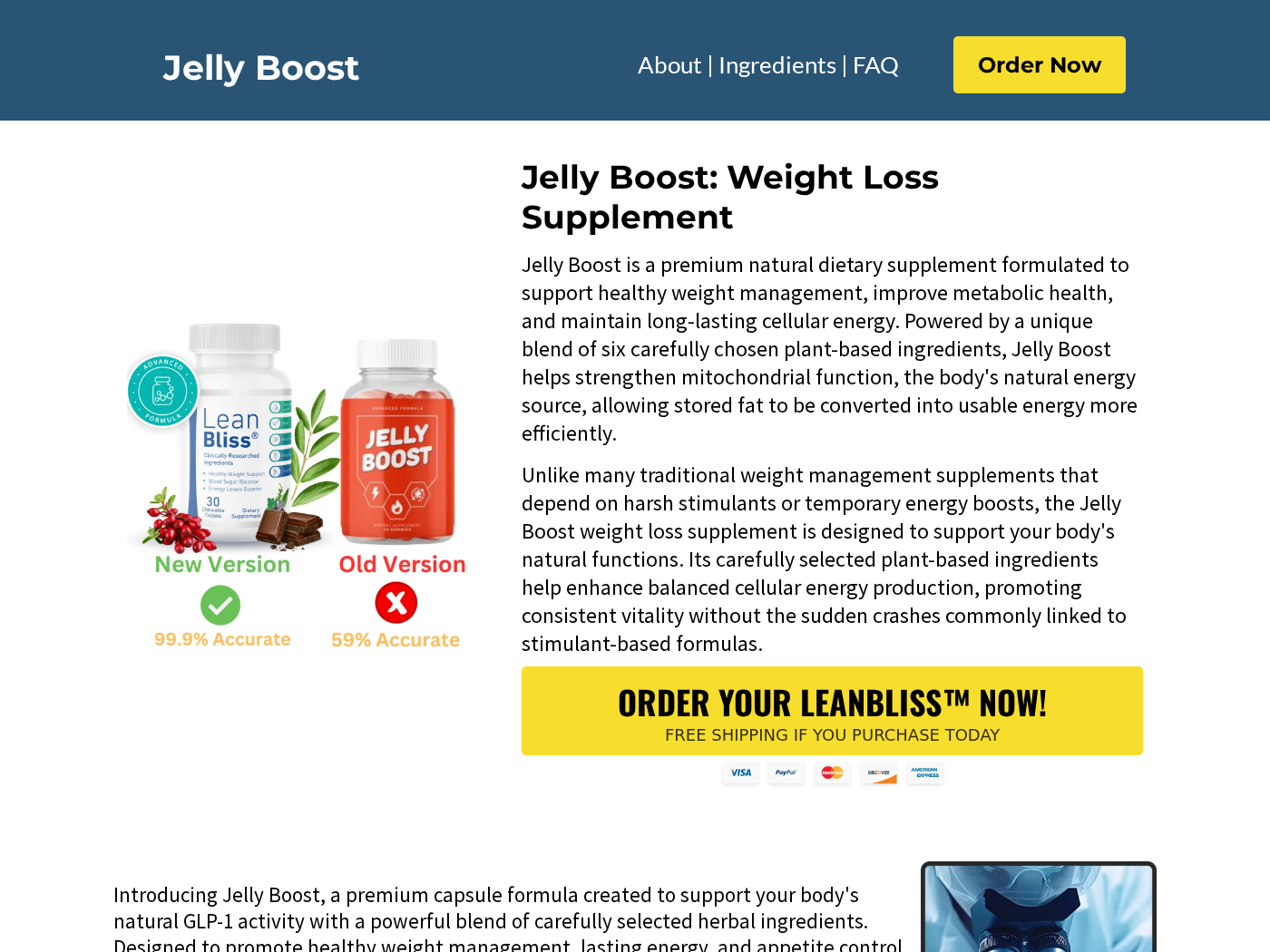
The weight loss page shows a red Jelly Boost bottle next to a white LeanBliss bottle. LeanBliss is labeled the new version, and the most prominent purchase button says to order LeanBliss now.
That same page cannot settle whether Jelly Boost is a capsule or gummy. It moves between both words while discussing GLP-1 activity, mitochondria, chromium, vitamins, blood sugar, appetite, and a list of plant extracts.
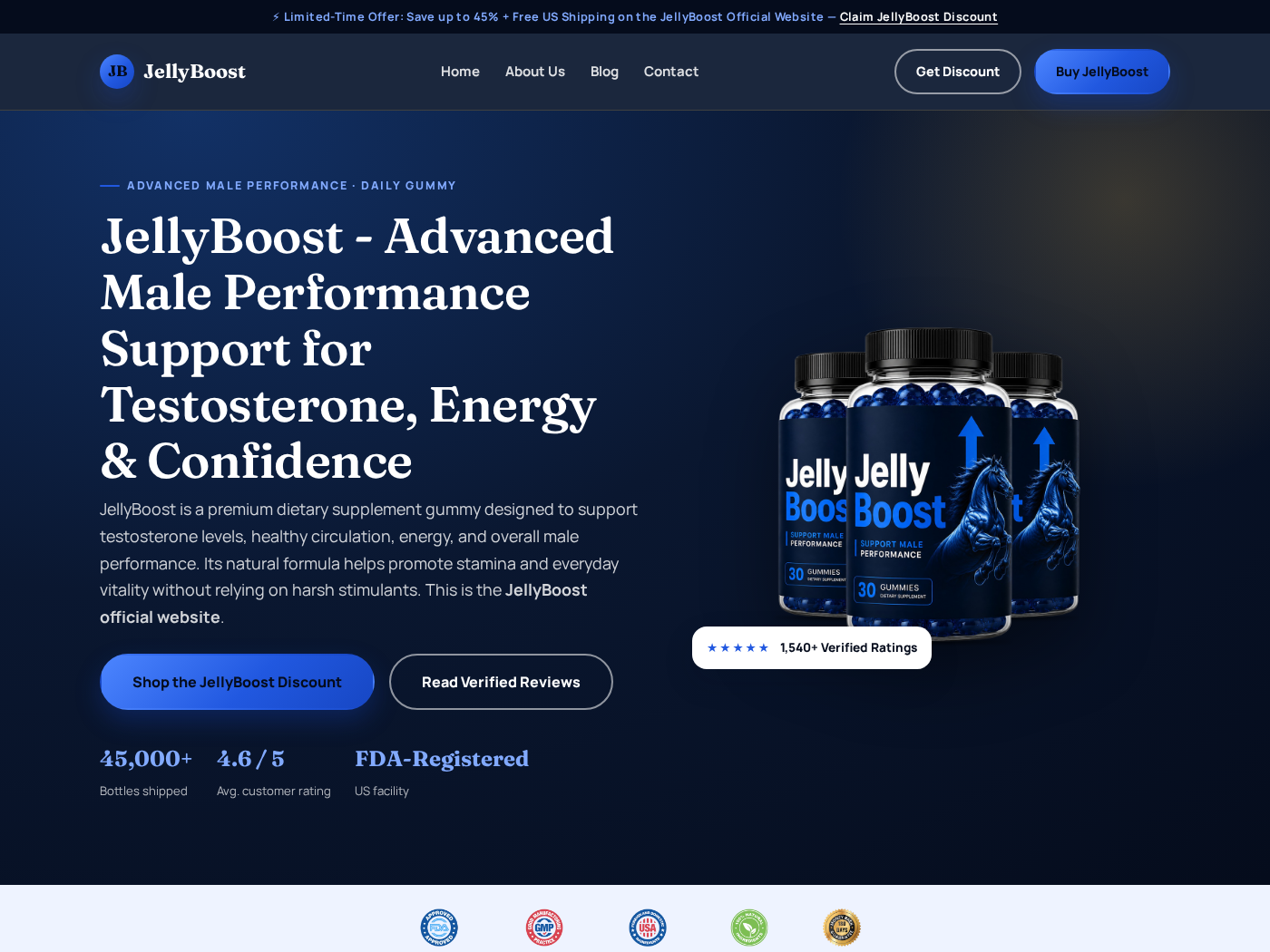
A separate website presents dark blue JellyBoost gummies for male performance. It claims 45,000 bottles shipped, a 4.6 out of 5 rating, a US facility, and bundles from two to six bottles. The product purpose and ingredient story are entirely different.
Overview
Jelly Boost does not have one stable product identity
The name is being used for at least two incompatible supplement pitches. The weight loss version discusses metabolism, fat use, natural GLP-1 activity, and appetite. The male performance version promotes testosterone support, circulation, energy, and sexual confidence.
A single brand could sell more than one product, but these pages do not present a transparent product family with separate labels and a clearly named owner. Each tries to position itself as the authoritative Jelly Boost offer.
The weight loss order buttons sell LeanBliss instead
On the weight management page, the call to action does not lead to a Jelly Boost cart. It routes through ClickBank toward LeanBliss. The page even labels LeanBliss the new version and Jelly Boost the old version.
This means the consumer may research Jelly Boost, click an advertisement for Jelly Boost, and ultimately authorize a different supplement. The initial claims, displayed guarantee, ingredient text, and brand name cannot be assumed to describe the item at checkout.
There is no single billing claim that covers every Jelly Boost site
The pages reviewed emphasize multi-bottle purchases and money-back periods, but no clear evidence established that every Jelly Boost checkout automatically creates a refill subscription. The domains and payment routes are too fragmented for one broad billing conclusion.
Treat the final checkout as a separate contract. Confirm the product name, number of bottles, total, shipping, merchant, renewal language, and refund policy before pressing the order button. A claim made on one Jelly Boost page may not govern another site.
- One Jelly Boost page markets a weight loss capsule or gummy.
- Another sells a male performance gummy under almost the same name.
- The formulas, benefits, colors, bottle designs, and audiences do not match.
- The weight loss offer sends order clicks to LeanBliss through ClickBank.
- The weight loss page promises 90 days, while the performance page advertises 60 days.
- Several sites use official wording, making the true seller difficult to identify.
- Seller-controlled ratings and shipment counts are not independent verification.
- Recurring billing must be checked at the exact checkout rather than assumed.
How Jelly Boost Is Promoted Through Conflicting Health Stories
The weight loss campaign can begin with an AI celebrity, doctor, or dramatic personal transformation. A long video discusses a biological switch, a hidden cause of weight gain, or a gummy that supposedly works without strict dieting. Jelly Boost appears only after the story has created hope.
Male performance advertisements use a different vulnerability. They focus on confidence, stamina, testosterone, blood flow, relationships, and embarrassment. The product is framed as a private daily gummy that avoids the discomfort of speaking with a clinician.
Both stories benefit from delayed disclosure. The consumer first responds to a problem and an apparent solution. Price, formula, company identity, contraindications, and refund friction appear later, when the viewer is emotionally prepared to buy.
The same name can therefore be attached to whatever health topic is currently performing well in advertisements. When the campaign changes, the promoter can redirect traffic to another supplement without rebuilding the entire story from the beginning.
This is why the name on the ad is not enough. Buyers need a domain, finished-product label, legal seller, exact checkout, and receipt that all point to the same item. Jelly Boost fails that basic consistency test across the pages reviewed.
What the Two Jelly Boost Websites Actually Show
The weight loss page describes Jelly Boost as a plant-based formula for mitochondrial health, metabolism, appetite, glucose balance, and energy. It alternately calls the product a capsule and gummy, while listing several different groups of vitamins, minerals, and botanical ingredients.
Its pricing text says one bottle costs $69, three cost $59 each, and six cost $49 each. It claims a 90-day guarantee and says even empty bottles can be returned, yet the purchase buttons are labeled LeanBliss and point away from the Jelly Boost brand.
The male performance site presents blue gummies containing ingredients such as L-arginine, tribulus, tongkat ali, horny goat weed, maca, zinc, and other botanicals. It prices two bottles at $59 each, three at $49 each, and six at $39 each with a 60-day refund window.
That site claims more than 45,000 bottles shipped, a 4.6 out of 5 average, and over 1,540 verified ratings. These numbers appear on the seller-controlled page. They are promotional statements, not an independently audited sales or review record.
The weight loss page calls LeanBliss the new version and displays both bottles together. This is more than an affiliate link placed in an unrelated article. The page uses Jelly Boost search interest to introduce a different brand as the supposed replacement.
Multiple domains containing variations of Jelly Boost also appear in search results, with different page designs, retailer details, prices, and claims. The abundance of pages calling themselves official makes it harder for a customer to know which operator owns the brand or which refund terms apply.
How the Jelly Boost Scam Funnel Works
Step 1: The ad selects a private or emotional problem
Weight loss versions talk about stubborn fat, low energy, cravings, or failed diets. Male performance versions focus on confidence, circulation, stamina, or hormone concerns. The opening is designed to feel personal before any product facts are shown.
A synthetic presenter, altered celebrity clip, or doctor-style voice can add instant authority. The advertiser relies on the viewer recognizing the emotion and the face, not on checking who paid for the ad.
Step 2: A hidden biological cause simplifies the issue
The script blames one mechanism, such as weak mitochondria, low testosterone, poor circulation, unbalanced glucose, or missing gut bacteria. Complicated health questions are reduced to a single switch that the advertised formula supposedly resets.
Real symptoms can have many causes and may require testing. A marketing video cannot determine whether a viewer has a hormone disorder, medication effect, vascular problem, nutritional deficiency, sleep issue, or another condition.
Step 3: An advertorial pretends to educate
The social click often leads to a long article or video sales letter that resembles independent health reporting. Scientific graphics, white coats, customer stories, and urgent headlines keep the viewer inside the seller’s narrative.
The page does not meaningfully test alternative explanations or discuss what evidence would disprove the claim. Its apparent education is structured around one outcome, making the visitor comfortable with the eventual purchase button.
Step 4: Jelly Boost appears as the simple daily answer
The product is introduced after the campaign has made the viewer dissatisfied with ordinary solutions. A gummy seems pleasant, discreet, and easier than a medical appointment, sustained lifestyle change, or a transparent conversation about sensitive symptoms.
The wording remains broad enough to cover many expectations. Support for metabolism, energy, blood flow, confidence, or hormones can sound powerful without promising a specific measurable outcome for the finished product.
Step 5: Bundle pricing rewards the biggest commitment
Both versions make the six-bottle package look like the smartest choice. The unit price falls, shipping becomes free, and bonuses or longer use windows are added to discourage a cautious trial.
The buyer assumes more months mean a fair test. That logic benefits the seller before the customer knows whether the label is accurate, the product is tolerated, the support team responds, or the guarantee works outside the promotional page.
Step 6: The destination can switch products or merchants
The weight loss path moves from Jelly Boost to LeanBliss. Other Jelly Boost domains may use their own carts or third-party retailers. The consumer can cross several operators while believing the journey belongs to one brand.
At each transition, terms can change. A 90-day statement on an affiliate page does not necessarily bind a 60-day seller, and an ingredient list for one bottle does not describe the product named on another checkout.
Step 7: The fragmented trail complicates complaints
When the buyer seeks a refund, the advertisement may be gone and the first domain may deny being the merchant. Support may ask for an order number issued by a retailer whose name the customer never noticed.
The customer must then prove what was promised and who charged the card. Screenshots, confirmation messages, package labels, and the exact statement descriptor become more useful than the broad Jelly Boost name.
Company, Address, and Fulfillment Checks
Too many official sites means no clear accountable owner
Several domains present themselves as the official Jelly Boost destination. Their products and purposes do not agree, yet the pages do not provide a central corporate site that explains authorized sellers, trademarks, formula versions, and legal ownership.
If a company cannot state which domains it controls, counterfeit warnings become impossible to evaluate. The buyer needs one legal entity that accepts responsibility for the advertisement, formula, data collection, payment, and refund.
The payment path can belong to another product
The weight loss page routes purchases to LeanBliss through ClickBank. A third-party retailer can process a legitimate transaction, but the customer must know that the merchant and product changed before authorizing the charge.
Compare the seller named in the cart, receipt, return policy, and card descriptor. If the advertisement says Jelly Boost while the payment page says LeanBliss, do not assume the difference is harmless or that earlier promises carry over.
Addresses and phone numbers must match the exact order
A returns warehouse may handle packages for dozens of supplement campaigns. A shared phone number may reach a call center that supports only certain order prefixes. Neither proves the warehouse or agent owns Jelly Boost.
Search the address, call before buying, and ask the agent to identify the exact product and retailer. If support cannot locate the advertised brand until after payment, the buyer has no reliable escalation path.
Unknown manufacturing is not a small paperwork problem
The two Jelly Boost versions claim different ingredients and benefits. Without a stable label, a buyer cannot check allergies, drug interactions, hormone-sensitive conditions, blood pressure concerns, or the total amount of overlapping nutrients.
Some internet supplements are mass-produced overseas and some are made domestically. Hidden origin is the problem. Require the finished-product manufacturer, lot, expiration date, complete Supplement Facts panel, warnings, and credible batch testing before consuming any bottle sent through this funnel.
Jelly Boost Formulas, Pricing, and Refund Conflicts
The weight loss and male performance products are not minor packaging variants. They target different bodies, different symptoms, and different biological systems. Their ingredient lists cannot be blended into one general answer about safety or effectiveness.
Pricing also changes. The weight loss page describes a $69 single bottle and a six-bottle $49 unit price. The performance page starts with two bottles at $59 each and lowers the six-bottle unit price to $39. A search result may therefore quote a price from the wrong offer.
The guarantees conflict at 90 days and 60 days. A customer should not pick the longest promise from any Jelly Boost page. The valid policy is the one incorporated into the exact checkout and confirmed by the merchant that accepted payment.
No finished-product clinical trial was found that supports the dramatic range of claims made across these pages. Research on individual ingredients does not establish that an undisclosed amount in a particular gummy or capsule produces the advertised result.
Automatic refills were not proven as a universal Jelly Boost term. Read the final cart for continuity language and save it. The more immediate verified problem is that the product itself can change before the buyer reaches that cart.
Warning Signs to Watch For
- The same name is used for weight loss and male performance products.
- The bottle design, ingredients, audience, benefits, and dosage story change by domain.
- The weight loss page mixes the words capsule and gummy.
- Its main buttons order LeanBliss instead of Jelly Boost.
- More than one site calls itself the official Jelly Boost website.
- The advertised refund window changes from 90 days to 60 days.
- Seller-controlled shipment and rating figures are presented as proof of trust.
- Multi-bottle discounts create pressure before product identity is resolved.
- No single legal owner is clearly tied to every offer.
- The final checkout can use a different product, retailer, and policy.
Jelly Boost is not merely a supplement with mixed reviews. It is a name attached to incompatible offers. When the purpose, formula, seller, destination, and guarantee all change, the customer cannot make an informed purchase from the brand name alone.
What to Do if You Have Fallen Victim to This Scam
- Determine which Jelly Boost you purchased. Record the domain, bottle color, product purpose, ingredient label, retailer, order number, quantity, and card descriptor. Separate a Jelly Boost order from any LeanBliss transaction before contacting support.
- Stop taking an uncertain formula. If the delivered label differs from the checkout, lacks ingredients, or causes symptoms, stop using it and speak with a clinician or pharmacist. Seek urgent medical help for severe reactions, breathing trouble, chest pain, or fainting.
- Collect every promise tied to your checkout. Save the ad, landing page, bundle price, guarantee, renewal terms, receipt, tracking, and package. Do not rely on another Jelly Boost website with a longer refund period or different formula.
- Contact the merchant named on the receipt. Send a written refund request with the order number, exact product received, amount, and applicable policy. Ask whether a return is required, where it must go, and whether opened bottles or shipping charges are covered.
- Cancel only through a verifiable channel. If the checkout created recurring deliveries, request cancellation in writing and keep confirmation. Do not give full card details to a phone number copied from an ad. Use the receipt, card issuer, or official retailer account.
- Dispute unresolved unauthorized charges. Contact the card issuer if the seller billed a different product, wrong quantity, unapproved renewal, or refused a documented refund. Provide a timeline showing the brand switch and the specific resolution already requested.
- Check the browser for unwanted changes. Remove suspicious notification permissions, extensions, and downloaded files connected with the ad. Scan the device with Malwarebytes, and use AdGuard to block deceptive ads, trackers, and redirect chains going forward.
- Report the impersonation and health claims. Report the social advertisement, advertiser account, and destination domain to the platform. US consumers can also notify the FTC and state attorney general. Include both Jelly Boost and LeanBliss names when relevant.
Frequently Asked Questions
Is Jelly Boost fake or real?
Multiple functioning pages use the Jelly Boost name, but they do not describe one consistent product. The existence of bottle images and checkout buttons does not resolve the conflicting formulas, purposes, sellers, and guarantees.
Is Jelly Boost for weight loss or male performance?
Both claims appear on separate websites. One promotes metabolic weight support and redirects to LeanBliss. Another sells blue male performance gummies. Treat them as different offers despite the shared name.
Why does the Jelly Boost page sell LeanBliss?
The weight loss page positions LeanBliss as a new version and routes its purchase buttons to that product. This makes the page an affiliate bridge rather than a straightforward Jelly Boost checkout.
What ingredients are in Jelly Boost?
There is no single answer across the sites reviewed. The weight loss page lists metabolic herbs, vitamins, minerals, and other compounds, while the male version lists performance-focused botanicals and nutrients. Read the exact delivered label.
Does Jelly Boost cause automatic monthly charges?
A universal subscription term was not established. Billing may depend on the exact domain and checkout. Read and save the final authorization, then monitor the statement for future transactions.
Which Jelly Boost guarantee applies?
Use only the policy incorporated into your exact purchase. One page advertises 90 days and another 60 days. Confirm the deadline, return conditions, address, and merchant before mailing anything.
The Bottom Line
Jelly Boost fails the most basic test of a transparent supplement brand. The same name is attached to a weight loss offer, a male performance gummy, multiple official-looking domains, different formulas, different guarantees, and a LeanBliss redirect at the point of purchase.
That does not prove every parcel is fake or every checkout creates a subscription. It does mean buyers cannot safely rely on the name, testimonials, or seller-controlled badges. Until the exact product, legal seller, formula, billing terms, and refund policy align, the sensible choice is not to order.








