

Jevawell KGG Probiotic Kombucha Gummies are being promoted as a gut-health supplement that claims to restore the microbiome, reduce bloating, support inflammation balance, improve digestion, and help people feel better within days.
But before ordering, buyers should look carefully at the claims, the social media ads, the refund terms, and the fact that similar kombucha probiotic gummies are sold across multiple marketplaces and private-label supplier sites. This appears to fit the same pattern seen with many dropshipping-style supplement offers: dramatic health claims, AI-style ad creatives, generic product sourcing, bundle pressure, refund friction, and possible checkout risks such as unwanted extra units or refill offers.
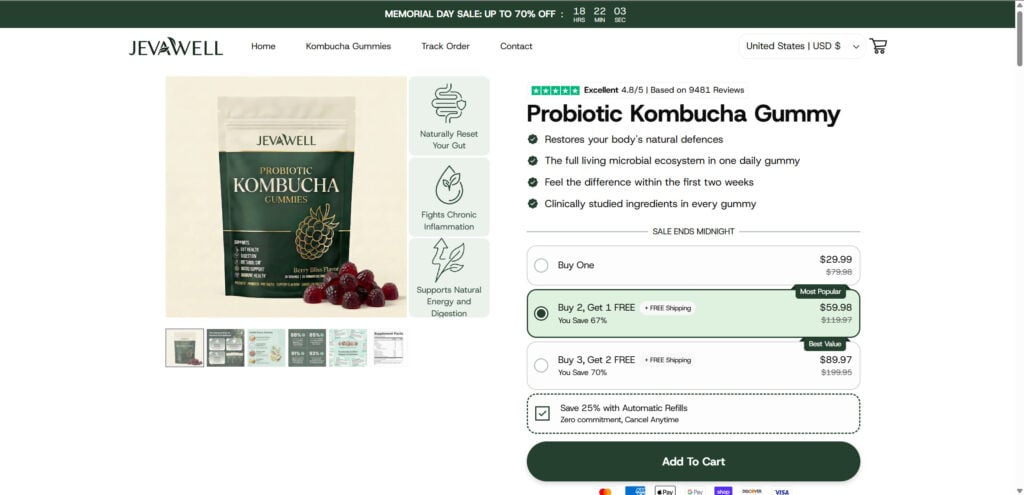
Jevawell KGG Overview
Jevawell KGG is sold as a “Probiotic Kombucha Gummy.” The product page claims it can naturally reset the gut, restore the body’s natural defenses, deliver a “full living microbial ecosystem,” and help users feel a difference within the first two weeks.
The sales page presents Jevawell as different from standard probiotic capsules. It claims regular probiotics are mostly dead by the time they reach the gut and argues that Jevawell works because it delivers kombucha fermentation compounds, organic acids, probiotics, postbiotics, slippery elm, bacillus coagulans, and dandelion root.
The product is marketed toward people dealing with:
- bloating
- chronic inflammation
- gut discomfort
- post-antibiotic digestive issues
- perimenopause-related bloating
- fatigue
- swollen legs
- fluid balance issues
- autoimmune-related symptoms
- brain fog
- digestive instability
That is already a broad range of claims for one gummy supplement.
The concern is not that probiotics, kombucha, fiber, or herbal ingredients are automatically fake. The concern is that Jevawell’s marketing goes much further than basic digestive support. It uses strong body-wide claims and suggests the product works at the “root cause” of multiple symptoms.
That is a red flag in the supplement world. When one gummy is positioned as the answer for gut health, inflammation, energy, circulation, fluid balance, autoimmune flares, bloating, and post-antibiotic problems, buyers should slow down.
Why Jevawell Raises Red Flags
1. The claims are extremely broad
Jevawell is not just marketed as a simple probiotic gummy. The product page suggests it can support gut wall integrity, reduce inflammation, improve fluid balance, calm digestion, and help the body run properly again.
The page also includes customer-story style sections involving perimenopause bloating, post-antibiotic gut issues, Hashimoto’s-related claims, chronic bloating, lighter legs, calmer skin, better digestion, and more energy.
This kind of “everything starts in the gut” marketing is common in supplement funnels. It works because many symptoms are vague and frustrating. Bloating, fatigue, puffiness, brain fog, and digestive discomfort can have many causes, so it is easy for a seller to connect them all to one root-cause story.
But a supplement ad cannot diagnose the cause of someone’s symptoms. A gummy cannot replace medical evaluation for chronic digestive problems, autoimmune disease, swelling, inflammation, or unexplained fatigue.
2. The product appears to be promoted with AI-style ads and exaggerated visuals
The user-provided concern is that Jevawell is being sold through social media ads using AI videos or AI-style images.
That matters because AI-generated supplement ads are now a major problem. They can create fake doctors, fake customers, fake before-and-after visuals, fake news-style clips, and fake “medical explanation” videos that look convincing but are not real evidence.
If an ad uses AI visuals to suggest dramatic bloating reduction, body transformation, gut repair, or medical-style results, buyers should treat it as marketing, not proof.
The safest assumption is simple: if the ad looks too polished, emotional, or medically dramatic, verify the product outside the ad before buying.
3. Similar kombucha probiotic gummies are sold under multiple names
Jevawell’s product category is not unique. Similar probiotic kombucha gummies are sold on Amazon and other marketplaces under several brand names. Some listings use very similar ingredient language, including prebiotics, probiotics, postbiotics, slippery elm, dandelion root, fiber, and MCT oil.
This suggests Jevawell may not be a unique breakthrough formula. It may be part of a broader private-label supplement trend where generic or near-generic gummies are branded, repackaged, and sold through different storefronts.
That is a common dropshipping and private-label pattern:
- A supplier manufactures a generic supplement.
- Multiple sellers create different brand names.
- Each seller builds a polished landing page.
- Social media ads drive traffic.
- The product is sold at a higher price using emotional claims.
This does not prove every seller is fraudulent. But it does mean buyers should not assume Jevawell is special just because the landing page looks scientific.
4. Private-label kombucha gummies are available from Chinese suppliers
Private-label kombucha gummy supplements are available through wholesale supplier platforms, including suppliers that advertise OEM/ODM service, bottle packaging, digestive support positioning, and China origin.
That is important because Jevawell’s marketing makes the product sound highly specialized. But the broader product category is easy to source, relabel, and sell under different brand names.
This raises a real possibility that buyers are paying premium prices for a generic supplement that may cost far less at the supplier level.
Again, the issue is not that a product is made in China. The issue is when a generic product is sold as if it were a unique science-backed breakthrough while using exaggerated claims and high-pressure advertising.
5. The “official website only” claim conflicts with marketplace listings
Jevawell’s product page says the product is only available through the official website. However, public marketplace listings show “Jevawell Probiotic Kombucha Gummies” being sold through Amazon-style listings under other seller or brand names.
That mismatch is concerning.
If the official website says the product is not available elsewhere, but the same product name appears on marketplaces, buyers should ask:
- Are those marketplace listings unauthorized?
- Are they counterfeit?
- Are they the same generic product?
- Is the official website claim just a sales tactic?
- Is Jevawell a brand or just a label used by multiple sellers?
A trustworthy supplement brand should make this clear.
6. The refund terms are less generous than the sales page sounds
The product page promotes a 60-day money-back guarantee and elsewhere mentions return windows that sound reassuring. But the return policy says returns must be made within 30 days of receipt, in good condition, and in the original packaging.
It also says the customer is responsible for return shipping, shipping costs are non-refundable, a trackable shipping method is required, and a restocking fee may apply.
That is a major practical issue.
If a buyer opens the bottle, uses it for a few weeks, and decides it does not work, they may discover the refund process is not as easy as the sales page implied. For supplement products, return policies often become difficult because the item has been opened or partially used.
7. Cancellations may be difficult after checkout
The return policy says orders are processed quickly and cancellation or modification requests must be sent within one hour of placing the order. Even then, cancellation is not guaranteed.
This is important because buyers may accidentally order multiple bottles, accept an upsell, or select the wrong quantity. If they realize the mistake after the first hour, they may be stuck trying to return the product after it ships.
That is exactly how many dropshipping funnels create consumer complaints. The checkout may be fast and easy, but cancellation is difficult.
8. Buyers should watch for unwanted subscriptions or refill offers
The visible product page does not clearly show a subscription in the scraped content, but buyers should still be careful. Supplement funnels often introduce refill options, “subscribe and save” offers, discounted bundles, VIP clubs, or post-purchase one-click upsells during checkout.
The risk is that someone may think they are buying one bottle, but later discover:
- multiple bottles were added
- a discounted bundle was selected
- a refill plan was activated
- a recurring charge was created
- a post-purchase offer was accepted by accident
Before paying, buyers should screenshot the cart and checkout page showing the exact quantity, total price, and whether the order is one-time or recurring.
How the Jevawell Sales Funnel Appears to Work
Step 1: The ad targets digestive frustration
The marketing focuses on people who are tired of bloating, gut discomfort, inflammation, or food-related symptoms.
This is effective because digestive problems are common and difficult to solve. Many people have already tried probiotics, fiber, elimination diets, apple cider vinegar, kombucha drinks, or digestive enzymes. When an ad says “this is why nothing worked,” it immediately grabs attention.
Step 2: The product is framed as different from regular probiotics
Jevawell’s page says standard probiotic capsules often fail because the bacteria die before they reach the gut. It then positions Jevawell as a better option because it allegedly delivers a fermented kombucha matrix with organic acids, microbes, and postbiotics.
This sounds scientific, but buyers should be cautious. A scientific-sounding explanation is not the same as independent clinical proof that this exact product produces the advertised results.
Step 3: The page connects gut health to whole-body symptoms
The page goes beyond bloating and digestion. It connects the gut to energy, skin, circulation, inflammation, fluid balance, and autoimmune-related complaints.
This broadens the product’s appeal but also increases the risk of misleading buyers. The more conditions and symptoms a supplement claims to influence, the more evidence it should have.
Step 4: Social proof is used heavily
The product page displays high review counts and customer-story sections with emotional testimonials. It also claims thousands of customers have reported improvements.
Buyers should treat this carefully. On-page testimonials are not the same as independently verified reviews. They can be selectively chosen, edited, exaggerated, or generated. Even real testimonials do not prove typical results.
Step 5: The buyer is pushed toward quick checkout
The site uses sale messaging, free shipping over a threshold, guarantee language, and checkout convenience.
That creates urgency and reduces comparison shopping. Many buyers may not search Amazon, Alibaba, or other sites before buying. If they did, they might find similar kombucha probiotic gummies sold under different names for less.
Step 6: Returns become the buyer’s problem
If the buyer is disappointed, they may face a more restrictive return process than expected. They may need to return the product at their own cost, use trackable shipping, keep original packaging, and possibly pay a restocking fee.
For a low-cost supplement, return shipping and time spent dealing with support may make the refund not worth pursuing.
Main Red Flags
- Strong claims around gut repair, inflammation, bloating, energy, circulation, and autoimmune-related symptoms.
- AI-style or exaggerated social media ad creatives may be used to sell the product.
- The product page uses broad “root cause” language.
- Similar probiotic kombucha gummies are sold under multiple names.
- Private-label kombucha gummies are available from Chinese suppliers.
- Marketplace listings show Jevawell-style products outside the official website.
- The official page says Jevawell is only available from its website, which raises questions when marketplace listings exist.
- The sales page promotes a guarantee, but the return policy includes stricter conditions.
- Customers are responsible for return shipping.
- A restocking fee may apply.
- Cancellation requests must be made within one hour and are not guaranteed.
- Buyers should watch for multi-bottle upsells or unwanted refill offers at checkout.
Is Jevawell KGG a Scam?
Jevawell may ship a real gummy supplement. This may not be a simple “pay and receive nothing” scam in every case.
The bigger concern is whether the product is being oversold.
A fair conclusion is this: Jevawell KGG appears to be a high-risk supplement offer because it combines broad health claims, social media-style marketing, possible AI-generated ad content, generic/private-label product signals, marketplace duplication, and refund terms that may be harder to use than the sales page suggests.
Buyers should not assume this gummy can “reset” the gut, reverse inflammation, fix autoimmune symptoms, reduce swelling, or solve chronic bloating without proper medical evaluation.
Why the Health Claims Should Be Treated Carefully
Dietary supplements are not approved like prescription medicines. Companies are responsible for making sure their products are safe, properly labeled, and not marketed with misleading claims.
That matters here because Jevawell’s marketing suggests the product can influence multiple body systems. Claims involving inflammation, gut wall permeability, immune markers, fluid balance, and autoimmune-related symptoms should require strong evidence.
Ingredient studies are not enough. A seller should be able to show credible evidence for the finished product at the dose being sold.
For buyers, the safest rule is this: do not treat supplement ads as medical advice. If you have chronic bloating, swelling, autoimmune disease, persistent diarrhea, constipation, blood in stool, unexplained weight loss, severe fatigue, or symptoms after antibiotics, speak with a healthcare professional.
What To Do Before Buying
1. Compare the product with other kombucha gummies
Search for similar products using phrases like:
- probiotic kombucha gummies
- kombucha gummies slippery elm dandelion
- prebiotic probiotic postbiotic gummies
- Jevawell probiotic kombucha gummies
- private label kombucha gummies
If you find similar formulas for much less, that is a sign the product may be generic or private-label.
2. Avoid multi-bottle bundles at first
Do not buy a large bundle before testing one bottle. If the product does not work, causes side effects, or cannot be returned easily, the loss will be larger.
3. Check for subscriptions before payment
Look carefully for:
- subscribe and save
- auto-renew
- refill plan
- monthly delivery
- recurring billing
- VIP membership
- reorder program
- post-purchase upsell
Take screenshots before paying.
4. Read the return policy, not just the guarantee banner
The guarantee may sound simple, but the return policy controls what actually happens. Check who pays return shipping, whether opened bottles qualify, whether a restocking fee applies, and how long you have to cancel.
5. Use a payment method with buyer protection
Use a credit card or PayPal. Avoid debit cards if you are unsure about the seller.
What To Do If You Already Ordered
1. Check your confirmation email
Verify:
- how many bottles were ordered
- total amount charged
- shipping cost
- whether any bundle was added
- whether any refill or subscription was created
- merchant name on your statement
2. Cancel quickly if you made a mistake
The policy says cancellation requests must be made within one hour. Send the request immediately and keep proof.
3. Screenshot everything
Save:
- product page
- ad
- checkout page
- order confirmation
- return policy
- tracking page
- support emails
This evidence helps if you need a chargeback.
4. Monitor your card
Watch your card or PayPal account for repeat charges. If any subscription or refill appears, cancel it immediately and save confirmation.
5. Contact support in writing
Ask for written confirmation that:
- your subscription is canceled, if any exists
- no future charges will occur
- unwanted extra units will be refunded
- the return address and refund terms are clearly provided
6. Dispute the charge if necessary
Contact your card issuer or PayPal if:
- you were charged for more units than ordered
- the product never arrives
- a refill was created without clear consent
- the seller refuses a valid cancellation
- the product is not as advertised
- the return process is unreasonable
Use phrases such as “item not as described,” “unauthorized quantity charged,” “misleading health claims,” or “unauthorized recurring charge.”
FAQ
What is Jevawell KGG?
Jevawell KGG is a probiotic kombucha gummy marketed for gut health, bloating, inflammation support, digestion, and overall body balance.
Is Jevawell a scam?
It may ship a real supplement, but the offer has multiple red flags: broad health claims, social media-style marketing, generic product signals, possible AI ad creatives, and refund terms that may be more restrictive than the guarantee language suggests.
Is Jevawell made in China?
The product category appears available through Chinese private-label suppliers. That does not prove the exact Jevawell bottle is from China, but it raises the possibility that similar gummies are generic or private-label products.
Is Jevawell sold on Amazon?
Marketplace listings show Jevawell-style probiotic kombucha gummies under other seller or brand names. This conflicts with the official site’s claim that Jevawell is only available through the official website.
Can Jevawell really reset the gut?
Be cautious. “Gut reset” is marketing language. Probiotics and fibers may support digestion for some people, but they do not guarantee broad improvements in inflammation, swelling, autoimmune symptoms, or chronic gut issues.
Are the testimonials reliable?
On-page testimonials should not be treated as proof. They may be selected, edited, exaggerated, or difficult to verify.
Can buyers receive more units than they ordered?
That is a risk with supplement funnels that use bundles, upsells, or one-click post-purchase offers. Always screenshot the cart and checkout page before paying.
Can Jevawell create an unwanted subscription?
The visible product page may not clearly show a subscription, but buyers should still check carefully during checkout for refill plans, subscribe-and-save offers, VIP memberships, or recurring billing.
Are returns easy?
Not necessarily. The return policy says the customer is responsible for return shipping, shipping costs are non-refundable, a trackable shipping method is required, and a restocking fee may apply.
Should I buy Jevawell?
Be cautious. Compare similar products first, avoid bundles, check for subscriptions, and do not rely on supplement ads for medical concerns.
The Bottom Line
Jevawell KGG Probiotic Kombucha Gummies are marketed as a powerful gut-health solution that can restore balance, reduce bloating, support inflammation, improve digestion, and help the body feel better within days or weeks.
The problem is the offer carries several dropshipping-style red flags: broad health claims, AI-style social media advertising, generic/private-label product signals, multiple marketplace listings, possible checkout upsells, cancellation limits, and return terms that may make refunds difficult.
Jevawell may ship a real supplement, but buyers should not treat it as a proven medical solution or a unique breakthrough. Compare prices, avoid multi-bottle bundles, check for recurring charges, and use a payment method with strong buyer protection.

Reviews & discussion
6 commentsShare a firsthand experience, or ask a question.
Community reviews
Jevawell KGG Probiotic Kombucha Gummies
Moderated reader experiences, not an editorial verdict.
I KEEP GETTING THIS EVERY MONTH! THEIR PHONE NUMBER DOES NOT WORK SO I HAVE BEEN UNABLE TO CONTACT THEM TO CANCEL. I DO NOT HAVE AN email ADDRESS FOR THEM EITHER. ANY SUGGESTIONS?
In reply to LAURA THOMAS
Hi Laura – MalwareTips is an independent review site, not the seller, so unfortunately we can’t cancel anything on their end. Since their phone number and email don’t work, the fastest fix is through your bank or card issuer: ask them to stop the recurring payments to that merchant and to dispute the charges you’ve already been billed as unauthorized. If it was charged to a debit card, ask about getting a new card number so they can’t bill it again. It’s also worth reporting it at reportfraud.ftc.gov and to your state Attorney General’s office – that’s what builds the case against these subscription traps.
Please stop sending Jevawell Kombucha Gummies
Alberta Pulice
In reply to Alberta Pulice
I understand the frustration, but we cannot stop the shipments – MalwareTips is an independent review site and we have no connection to the company selling those gummies, no access to their orders, and no way to cancel anything on your behalf.
What does work is going around them. Ring the bank or card issuer on the back of your card, tell them you want the recurring charges from that merchant stopped and disputed, and ask for a new card number – that ends the billing even if the company never answers you. Any further parcels that turn up are legally yours to keep under the FTC’s unordered-merchandise rules, so do not pay to send them back. If you would like it on the record, reportfraud.ftc.gov takes complaints in a few minutes.
Thank you for posting this article! Alas, it came too late for my husband to check all the points listed in your thorough article. The Kombucha gummies he ordered (directly from the JevaWell site, not Amazon) look entirely different than what is posted on their website. But this is nothing compared to the absolute hogwash they print on the backside of the package as “Supplement Facts” (no doubt an AI generated label). In all my many years of researching supplements, I have never heard of such an ingredient as “Olpioary-Bim Berk Eaicfict” (all 25mg of it), or “Bektfius coeguisita PHCC 5996” (which come in 1 Gvlliksen Q/U). Needless to say, I immediately contacted the seller via email to request a full refund, and noting that I certainly wasn’t going to pay for any return shipping or restocking costs. Crickets! I followed up 5 days later and made clear that if I didn’t hear from them in a certain amount of days I would report them via the FDA Safety Reporting Portal and the FTC Report Fraud Site. More crickets! As a result, I am now going to report them, start a dispute with my bank for the charge, and toss those gummies in the trash bin where they belong (God knows what’s actually really in those gummies other than sugar and pectin). An “Excellent 4.8/5 based on 9481 reviews” – sure, you can’t even leave a review on their website 🙄
In reply to Sabine Vosters
I am sorry it arrived too late to help – and please pass on to your husband that there is nothing embarrassing about it, because the site is designed to survive careful reading.
The Supplement Facts panel is the part worth acting on. Fabricated or impossible label information on an ingestible product is not just marketing puffery; it is a labelling violation, and it is the one thing regulators can act on regardless of what the advertising claimed. Please report it to the FDA at fda.gov/medwatch, and photograph the package, the panel and any lot number before anything gets thrown away. If your husband has taken any of them and felt unwell, that goes in the same report, and it is worth mentioning to a pharmacist – the practical concern with a label like that is not the ingredients listed but the ones that are not.
For the money: ring the card issuer, dispute it as not as described – the product not matching their own website’s images is about as clear as that gets – and ask them to revoke any recurring authorisation and issue a new card number, because this seller enrols most buyers in a monthly charge. Then reportfraud.ftc.gov and your state Attorney General. And do not send the gummies back at your own cost; you may need the package as evidence.