

Jingle & Pine makes Christmas decorating sound pleasantly simple. A realistic garland, a cozy room, and one less thing to replace next December.
The offer deserves a closer look before you plan your holiday around it. Some details matter much more after the box arrives.
Overview
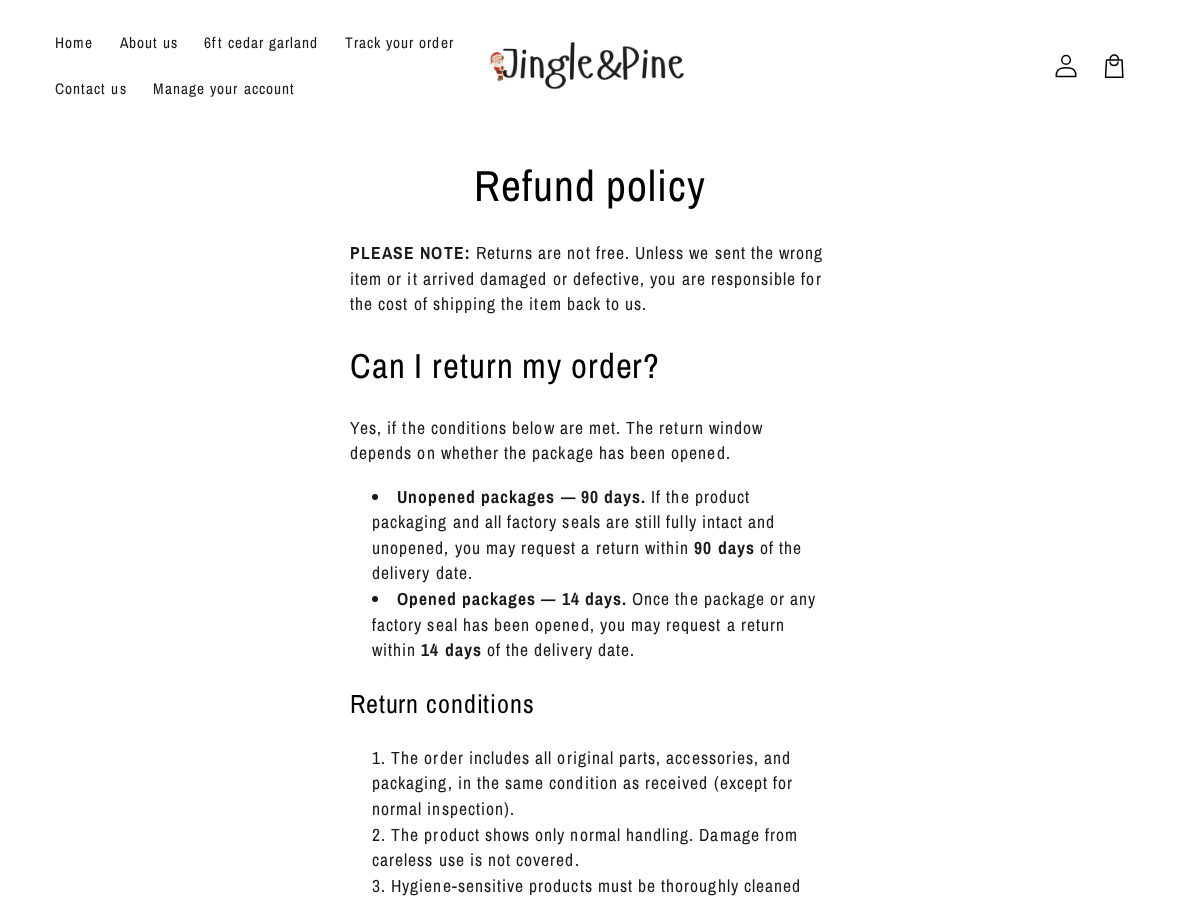
The 90-day promise changes when you open the package
The main finding in this Jingle & Pine review is a significant mismatch between the welcoming return pitch and the restrictions inside its refund policy.
The homepage invites customers to hang the greenery, live with it through the season, and decide within 90 days. That sounds like an extended home trial.
The detailed policy gives unopened, factory-sealed packages 90 days. Once packaging or a factory seal is opened, the stated window falls to 14 days.
Those are different buying propositions. Someone ordering in October could reasonably expect to assess the decoration during December, yet encounter a much earlier opened-item deadline.
Do not buy on the strength of the homepage promise alone. Ask whether the exact garland can be opened, displayed, and returned under the advertised 90-day arrangement.
Other refund details also need clarification
The website describes emailing a return label, but its policy makes buyers responsible for ordinary change-of-mind postage. A label does not necessarily mean prepaid shipping.
There is another internal inconsistency. A retained-item refund option describes a 25% deduction, while the later refund paragraph refers to 20% for that option.
Neither figure should be guessed away. A customer needs one written answer about the applicable amount before deciding whether to accept a partial refund.
- Unopened returns are described as eligible within 90 days of delivery.
- Opened packages have a stated 14-day request window.
- Damage, defects, and wrong items should be reported within seven days.
- Return authorization and a designated return address are required.
- Clearance goods, personalized goods, and gift cards are excluded from ordinary returns.
This is a buyer-risk finding, not proof of blanket fraud
Jingle & Pine is an operating storefront with product pages, contact details, tracking, and policies. Our review did not establish that every order fails or every refund is refused.
We also did not purchase a garland, contact support, or independently inspect its business premises. Product quality and real response times remain untested.
The contradictory return presentation is enough to justify caution without inventing missing parcels, Chinese manufacturing, or a hidden subscription. The practical concern is already visible.
Why the Seasonal Trial Language Matters
Christmas greenery is not something most shoppers evaluate through an unopened box. They want to see its shape, fullness, color, and appearance in their own room.
A photograph cannot settle whether the garland looks convincing beside your mantel or whether its wiring holds the arrangement you wanted.
Opening and positioning the product are natural parts of that assessment. A return promise that changes at the opening stage should make the distinction unmistakable.
The homepage also suggests keeping the decoration through the season. That framing matters because the season may begin weeks after a person receives an early order.
A 14-day opened-package window does not function like a 90-day seasonal trial. Both policies can exist, but advertising should not leave buyers to reconcile them afterward.
For illustration, imagine receiving a garland on October 15 and hanging it immediately. A 14-day window ends well before most December gatherings.
That is an example, not a documented customer case. It shows why the difference affects an ordinary holiday purchase rather than a technical corner case.
How the Jingle & Pine Ordering Journey Works
Step 1: The brand story encourages confidence in a specialist shop
The store presents itself as a family business focused on Christmas throughout the year. Its story emphasizes improving artificial greenery after disappointing experiences with other decorations.
This creates a familiar, personal tone. A shopper may feel they have found people who understand the same frustration instead of another generic seasonal catalog.
That story is the seller’s account, not independently verified company history. It should not substitute for information about the item, seller, and return process.
Judge the offer by concrete details: actual length, construction, included accessories, delivery estimate, and whether the checkout matches the product you selected.
Step 2: The long return promise lowers the perceived risk
A 90-day guarantee makes an early purchase feel safer. You might order ahead, avoid the seasonal rush, and believe you can return an unsuitable item later.
The homepage’s invitation to hang it and live with it strengthens that impression. It does not sound like a promise limited to untouched packaging.
Before paying, compare the sales page with the detailed refund rules. Save both versions if they say materially different things.
Ask support a specific question about opened, displayed greenery. A general reply that repeats the guarantee without addressing the 14-day restriction does not resolve the issue.
Step 3: The shipping schedule becomes part of your holiday plan
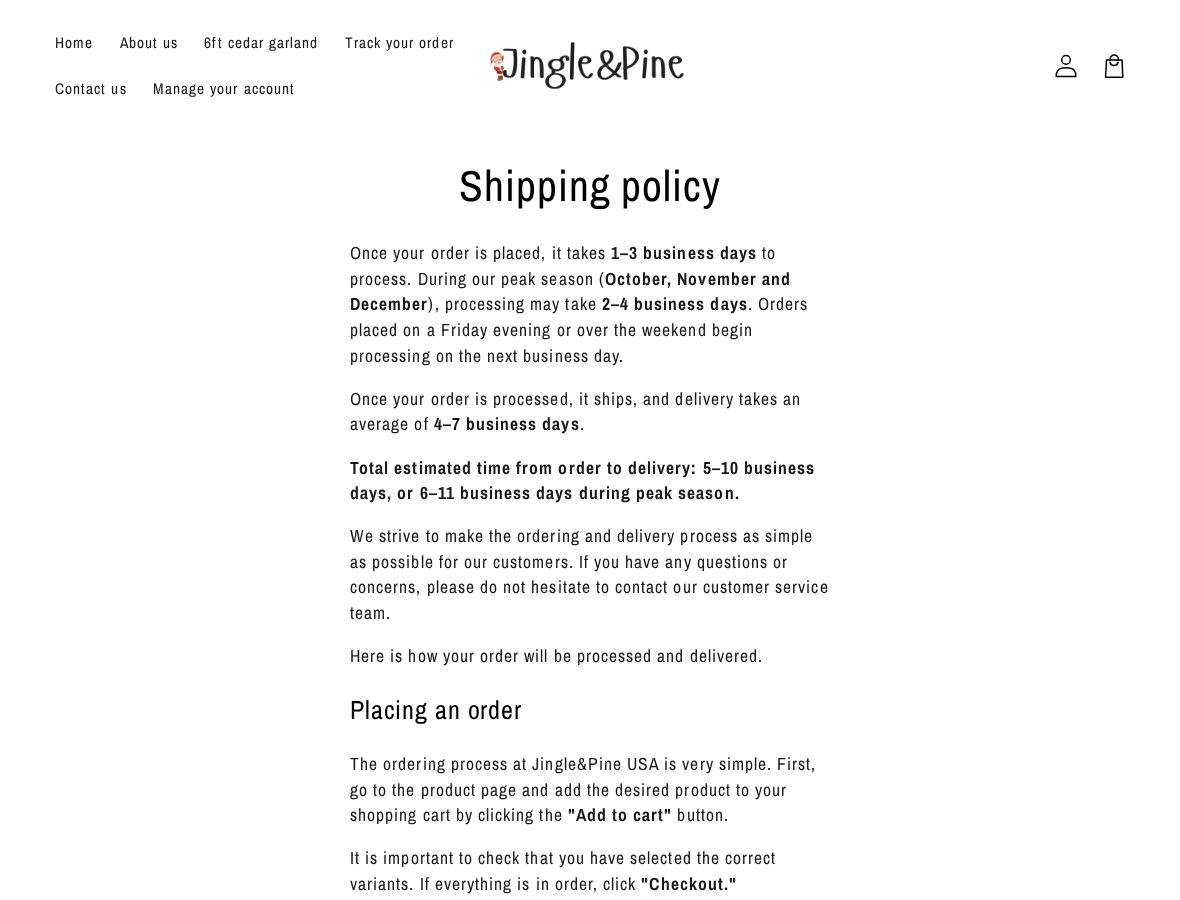
The published shipping information separates order processing from delivery. It describes a longer processing range during October, November, and December.
Its stated peak-season total is six to 11 business days. Those are estimates, not a promise that an order will arrive on a particular calendar date.
Fulfillment partners are mentioned, but that wording does not identify the factory, dispatch country, or exact warehouse handling your parcel.
Allow a margin if the decoration is needed for an event. A tracking number should be followed through to carrier acceptance, not treated as arrival proof.
Step 4: Opening the delivery changes the stated return category
According to the refund policy, the condition of the packaging determines whether the longer or shorter window applies. Note the delivery date before opening anything.
Photograph the box, its label, the product, and all included parts. Keep packaging while checking size, appearance, and any damage.
If the item is wrong or damaged, identify that issue promptly. The policy gives those complaints a separate seven-day reporting period.
Do not assume a disappointing appearance and a manufacturing defect will receive identical treatment. Describe what differs from the offer with clear photographs and measurements.
Step 5: Returning the item requires authorization and another cost decision
The policy says not to send a parcel before receiving a return authorization number and the correct address. It warns against using the original sender address.
For an ordinary return, postage can reduce the value of the refund. Ask where the parcel must go and what a tracked shipment will cost.
The seller describes inspection after receipt and approval before repayment. The homepage’s immediate-sounding refund language should be read alongside that more detailed procedure.
If offered a retained-item refund, ask whether the deduction is 25% or 20%. Do not accept an unexplained figure just to end the conversation.
Company, Address, Support, and Fulfillment Checks
The displayed business name does not settle the legal identity
The footer lists the company name as Jingleandpine. That is useful identifying information, but it does not independently establish the registered entity accepting an order.
Check the seller name on the payment receipt and card statement. If another business appears, request an explanation of its role.
The family-business description is not a registration record. You should be able to identify whom you paid without piecing together a brand story.
The Beverly Hills address is offered as a virtual office
The website lists 132 S Lasky Drive, Floor 2, Beverly Hills, CA 90212. We did not verify that Jingle & Pine operates a staffed shop there.
Davinci Virtual lists this exact address for virtual-office and mail-handling services. That verifies the location’s advertised function, not Jingle & Pine’s particular tenancy.
A prestigious mailing address is not proof of a stocked showroom or local factory. Request the actual return destination instead of shipping to this address unannounced.
The phone and mailbox are published, but responsiveness is untested
The store publishes (760) 284-4504 and info@jingleandpine.com. Its policy gives weekday service hours and says out-of-hours calls will be returned.
We did not call or email. There is no basis here to claim the number is disconnected or that the support team never replies.
For an actual order problem, keep a written record. An email confirming the return category and address is more useful than an undocumented verbal reassurance.
Fulfillment partners are not evidence of a specific manufacturing country
The shipping terms mention fulfillment partners. That can mean outsourced storage or dispatch, but the text does not establish where a particular garland was made.
Request the dispatch country, material information, and return destination if these influence your decision. A domestic contact address is not a country-of-origin statement.
There is no verified refill or automatic-shipment arrangement in this review. An email discount signup is not, by itself, a recurring product subscription.
Questions Worth Asking Before You Order
Do not ask only whether the store offers a guarantee. The website already answers yes. Ask how the guarantee applies to the way you intend to use the item.
The most useful questions turn the broad promise into a clear agreement about your exact order.
- Can I open and display this garland, then return it after 14 days but before 90 days?
- Is the emailed label prepaid, or will its cost be deducted from my refund?
- Does a sale price make this item a non-returnable clearance item?
- Which country receives the return, and is tracked shipping required?
- Which deduction applies if I keep the product and accept a partial refund?
- What delivery estimate applies to my destination during the current holiday period?
A helpful reply should answer each relevant point directly. Save it with a dated copy of the offer rather than relying on a later policy revision.
If the answer remains contradictory, you can simply choose another seller. There is no reason to accept uncertainty about returns for a discretionary decoration.
What to Do If You Ordered From Jingle & Pine
- Record the delivery date and inspect promptly.
Keep the tracking confirmation and note when the package actually reached you. Photograph any crushed packaging, missing parts, or visible product damage before discarding materials.
Check the length and construction against the listing. An early inspection gives you time to use the stated reporting windows rather than discovering a problem during December.
Do not delay a damage complaint while negotiating a general return. Explain that it is a damaged, defective, or wrong-item claim when that accurately describes the delivery.
- Preserve the promise that influenced your purchase.
Save the homepage, product description, detailed refund page, order confirmation, and any email that mentioned a 90-day trial or return label.
Record the date of each capture. If you bought because you expected to display the decoration for longer, explain that expectation with the original wording.
Keep copies locally as well as inside your email account. A link alone may show different terms after a page changes.
- Request the correct return category in writing.
Email your order number, delivery date, opened or unopened status, and reason for returning. Add photographs when the problem concerns damage or a mismatch.
Ask the merchant to reconcile the homepage promise with the opened-package rule. Request an explicit eligibility decision, not another link to the general guarantee.
Avoid sending full payment-card details. The order reference should allow support to locate the transaction without exposing your financial credentials.
- Get authorization, the address, and postage details before shipping.
Wait for the return authorization number and designated destination. Confirm who pays postage and whether original shipping charges will be retained.
Use tracking and keep the receipt, parcel weight, and delivery confirmation. Include the order and authorization references as instructed.
If postage seems unreasonable, ask about other remedies before accepting a retained-item deduction. Request the exact refund amount, not only a percentage.
- Follow the approval and repayment timeline.
The policy describes warehouse processing within seven business days and approved refunds within 10 business days of approval. Ask which milestone your return has reached.
Keep inspection approval separate from the date the card credit appears. Your bank may take additional time to display a payment already issued.
If support changes the deduction between 20% and 25%, ask for the contractual basis and the resulting amount before agreeing.
- Escalate a genuine unresolved dispute with accurate evidence.
Contact your payment provider if goods never arrive, the item materially differs from the offer, or a documented return agreement is not honored.
Ask about deadlines and the appropriate dispute category. Supply the order record, photographs, correspondence, and tracking rather than making unsupported accusations.
No payment dispute guarantees recovery. Acting promptly and explaining the actual problem gives the provider a clearer basis to assess your case.
Frequently Asked Questions
Is Jingle & Pine a confirmed scam?
The reviewed evidence does not establish blanket fraud. It does show materially inconsistent return messaging that should be resolved before purchase.
Can I display a garland and return it within 90 days?
Do not assume that. The detailed policy limits opened packaging to 14 days, despite the homepage’s broader seasonal-trial language. Obtain written clarification.
Are Jingle & Pine returns free?
Ordinary change-of-mind postage is assigned to the buyer. Approved damaged, defective, or wrong-item cases are treated differently. Confirm whether any supplied label is prepaid.
Why does the policy mention both 20% and 25%?
Those figures appear in different descriptions of the retained-item refund option. The inconsistency remains unresolved; ask for the exact deduction before accepting that arrangement.
Does the Beverly Hills address prove local manufacturing?
No. A published business address does not identify the manufacturing plant or parcel origin. The terms mention fulfillment partners without establishing the factory location.
Should I wait until Christmas to inspect my order?
No. Early inspection protects the stated damage-reporting and opened-package windows. Keep packaging and document issues while the delivery details are easy to establish.
The Bottom Line
Jingle & Pine’s friendly seasonal promise is not enough. Its opened-package limit, postage rules, and conflicting refund deductions materially change the buying decision.
Do not order expecting a 90-day displayed-product trial unless the seller confirms that exact entitlement in writing. If already delivered, inspect now and document your request.
The decisive issue is whether the merchant will honor one clear return agreement. Until that is settled, choose a seller whose promise and policy match.








