

After pregnancy, finding comfortable clothes can feel like another task on an already crowded list. Snoothe offers a reassuring promise wrapped around one everyday garment.
The website gives you plenty of reasons to imagine it helping. Before making that purchase, a few less prominent details deserve a careful look.
Overview
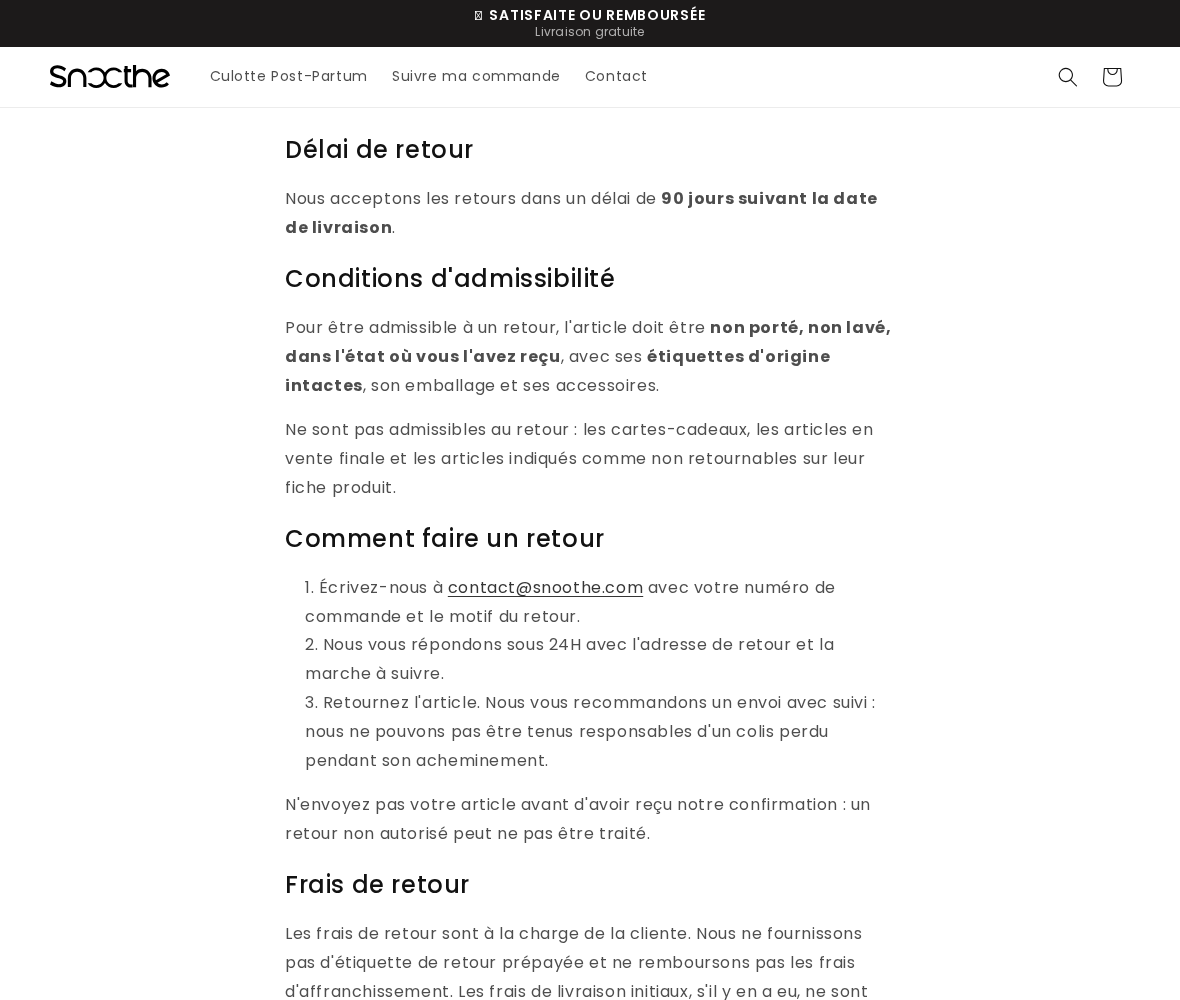
The advertised trial and written return conditions conflict
Snoothe promotes a 90-day opportunity to try its postpartum underwear, with a full refund if you see no change and no conditions attached.
Its separate return policy requires an unworn, unwashed garment. That is a substantial difference for someone expecting to wear the product while evaluating its promised effect.
We would not purchase on the assumption that a worn 90-day trial is available. Ask the seller to reconcile those promises before paying.
Our October 8, 2026 review also found recovery claims that deserve medical scrutiny. We did not test the garment or establish a fraudulent operation.
Compression clothing is being presented alongside recovery claims
The French-language storefront addresses mothers in Quebec and sells high-waisted postpartum support underwear. It emphasizes a smoother appearance, circular compression, and everyday comfort.
Those ordinary garment benefits are different from demonstrating lasting tissue recovery. The website moves between appearance, support, and claims about separated abdominal muscles.
It also suggests visible firmness changes after several weeks of regular wear. We did not find verified clinical results for the exact Snoothe garment.
- Clarify whether wearing the underwear invalidates the advertised satisfaction trial.
- Separate temporary shaping from medically assessed recovery.
- Ask where approved returns go and who pays postage.
- Discuss persistent postpartum discomfort with a healthcare professional rather than relying on a sales explanation.
The recommendation is clear without inventing a scam verdict
Do not buy Snoothe as a substitute for assessment or rehabilitation. If you want support underwear, evaluate it as clothing with a clearly defined return arrangement.
The store publishes contact details and a policy. However, their existence does not resolve the conflict between an unrestricted-sounding trial and an unworn-condition requirement.
We have no basis to declare every review fake, the company nonexistent, or all orders undelivered. The documented contradictions are enough to guide the purchase decision.
What the Recovery Claims Need to Explain
Abdominal separation does not follow one universal timeline
Pregnancy can separate the abdominal muscles, a condition called diastasis recti. The extent and recovery vary, so a garment website should not diagnose everyone from appearance.
Snoothe’s FAQ about changes persisting years after childbirth attributes them to muscles remaining separated. This cannot establish the cause for every person reading the offer.
The NHS explains postpartum abdominal separation and says it commonly returns toward normal during the early weeks after birth.
Its guidance recommends discussing a persistent gap or troublesome symptoms with a clinician. Some people need physiotherapy and individualized exercises, rather than a product recommendation.
Early recovery guidance is not a diagnosis for a problem lasting years. A clinician can assess that situation instead of a storefront’s generalized explanation.
Feeling supported is not proof of a lasting correction
A compression garment may change how clothing sits or how supported someone feels while wearing it. Those observations do not measure whether abdominal tissue has recovered.
To demonstrate a lasting treatment effect, evidence would need to describe the actual product, participants, measurements, follow-up, and comparison being made.
Customer enthusiasm and traditional inspiration cannot replace that evidence. Snoothe’s reference to a binding tradition describes its marketing story, not a validated outcome for every buyer.
If the product makes an outfit feel more comfortable, that can be useful. It should not become a reason to ignore pain or postpone professional advice.
Post-surgical timing should come from your own care team
The website gives general timing suggestions for wearing the garment after different types of birth. Those statements do not assess an individual’s healing or complications.
If you have had a cesarean delivery, ask your care team whether this type of compression is appropriate. Give them the actual garment information if available.
Stop wearing anything that worsens discomfort and seek advice. This review does not provide a personalized postoperative schedule or validate the seller’s timing recommendations.
How the Snoothe Offer Leads to a Purchase
Step 1: a familiar concern receives a simple explanation
The storefront speaks directly to changes in abdominal appearance after pregnancy. That can feel reassuring when a reader is tired of being told simply to wait.
The risk begins when a broad explanation sounds like a diagnosis. A protruding abdomen does not, by itself, establish the cause or the appropriate intervention.
Read the promised benefit carefully. Clothing support, a smoother silhouette, increased firmness, and recovery of separated muscles are different claims.
Decide which one motivates your purchase. If the medical outcome matters most, the missing product-specific evidence becomes more important than the garment’s styling.
Step 2: repeated comfort and recovery language builds confidence
Snoothe presents a continuous compression design and emphasizes comfortable use. It also displays customer-rating and popularity claims aimed at its Quebec audience.
We did not independently verify the displayed customer total or authenticate the testimonials. A number on the merchant’s own page remains the merchant’s representation.
Do not use apparent popularity as a shortcut around the evidence question. A satisfied clothing customer is not necessarily reporting a clinically measured recovery.
Likewise, a photograph cannot establish a lasting result. It may illustrate fit or presentation without documenting what caused a physical change.
Step 3: the 90-day promise reduces the perceived commitment
A long trial makes an unfamiliar garment feel easier to order. You may reasonably believe you can wear it for weeks before deciding whether it helps.
That expectation needs written confirmation here. The policy’s condition requirement appears incompatible with returning something after ordinary daily wear.
Ask whether the product-page guarantee creates an exception for this exact underwear. Request the answer before washing it or treating the trial as established.
Do not infer permission from a phrase about satisfaction. The useful answer specifies what use is permitted and which return conditions apply afterward.
Step 4: selecting a size becomes part of the return question
The store provides a sizing guide and encourages buyers to use body measurements. That can help selection, but cannot guarantee comfort for every individual.
Before ordering, ask how an indoor fit check is treated. The policy uses an unworn requirement, while the shopping page emphasizes a forgiving satisfaction offer.
Find out whether a size exchange involves postage and whether the complete packaging must remain intact. Those practical details affect the usefulness of the guarantee.
Keep the selected size and the chart used with your receipt. If the delivered garment differs measurably, that record is more useful than a remembered letter size.
Step 5: support decides how the published promises are applied
The returns process begins with an email request and authorization. The seller supplies the return address after receiving the request.
Its published policy places ordinary return postage on the customer. It separately offers assistance for a damaged or incorrectly supplied item.
A long return period does not eliminate those distinctions. You need to know whether your complaint concerns preference, sizing, a defect, or the advertised trial itself.
We did not run a return transaction. Whether support will make an exception is a question for an actual written response, not something this review can promise.
Company, Address, and Fulfillment Checks
The operator is disclosed, but the corporate match remains unverified
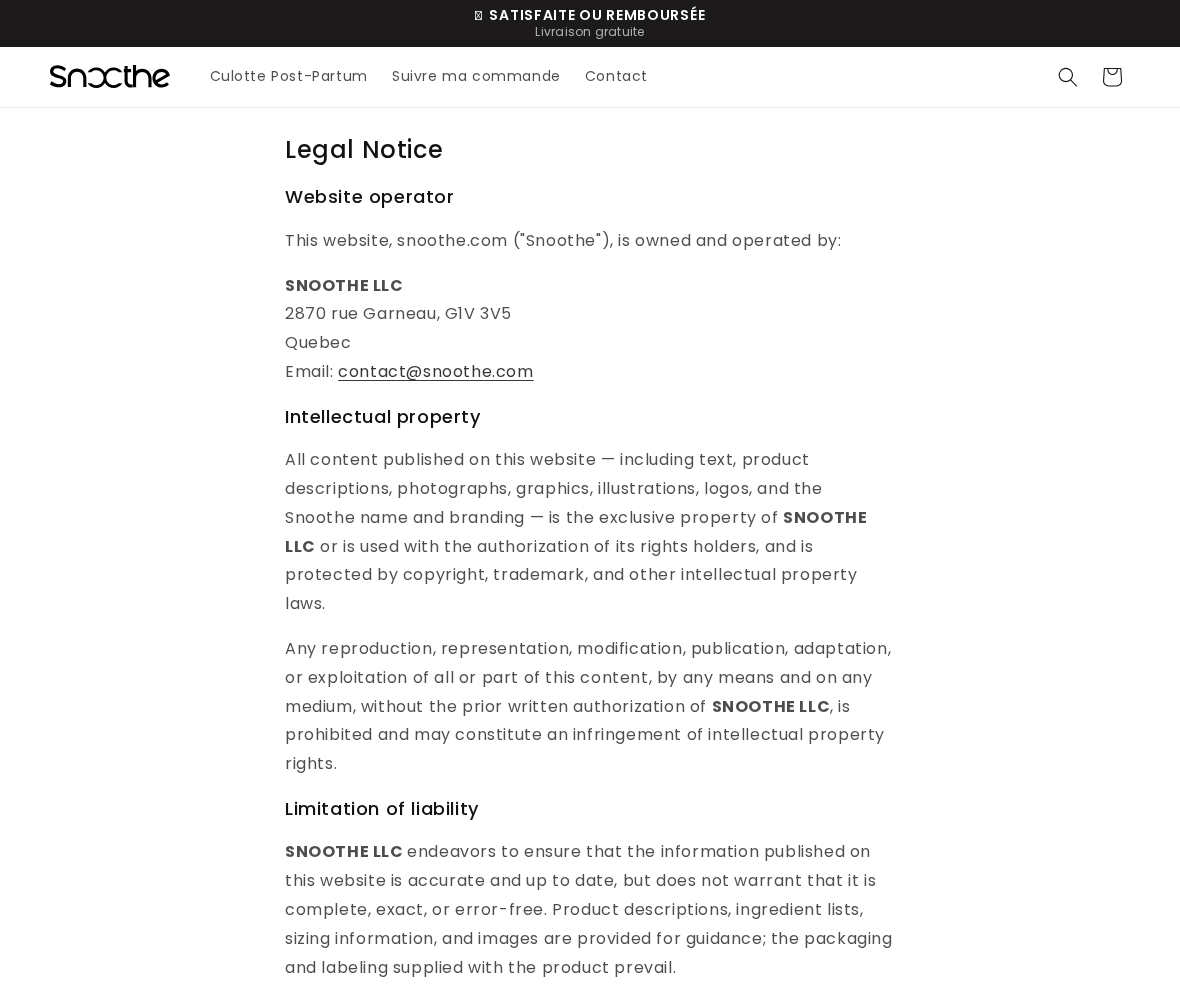
The legal notice names SNOOTHE LLC. That gives buyers a claimed operator, but we did not independently establish its complete registration record.
The notice combines a Quebec address with Delaware governing-law language. Those details call for clarification if you need to identify the business handling your payment.
They do not, alone, prove a fake company. Ask for the registration jurisdiction and invoice entity, then compare those details with the purchase confirmation.
The Quebec address is expressly not a returns destination
The site lists 2870 rue Garneau, G1V 3V5, Quebec as its business address. Its contact information explicitly warns against sending returns there.
That disclosure matters more than assumptions about the brand’s local presentation. A registered or mailing address does not establish a warehouse that accepts your parcel.
Obtain the recipient and destination through an approved return request. We did not independently inspect the listed premises or verify where the garments are stocked.
The support response should settle the trial conflict
The advertised support email is contact@snoothe.com. The site gives response-time assurances, but we did not send an inquiry and cannot assess responsiveness.
Ask a precise question: can this underwear be worn during the 90-day evaluation and still qualify for a full refund?
Also ask whether an approved exchange is genuinely free once postage is considered. Save an answer identifying the garment and the offer you plan to buy.
The legal disclaimer does not validate the recovery story
The legal notice includes a disclaimer about cosmetics and medicine, although the inspected main offer is support underwear. That language does not establish a clinical assessment.
We did not verify a manufacturer, manufacturing country, or independent performance study. Those gaps should remain gaps rather than becoming claims about contamination or Chinese production.
A care label and material composition can help assess a garment. Neither is sufficient to verify the broader recovery outcome advertised alongside it.
What the Return Conditions Mean in Practice
The conflict is easy to picture. A buyer expects to wear the underwear regularly, watch for an improvement, and use the guarantee if none appears.
That is an illustrative reading of the offer, not a verified customer complaint. The unworn-condition rule could prevent exactly that interpretation from working.
Resolve it before the garment arrives. If you wait until the end of the advertised period, support may point to a condition you could have clarified earlier.
For a preference return, calculate the actual postage after receiving the authorized address. A full item refund and a cost-free transaction are not equivalent.
Keep your expectations realistic as well. A garment may support your body during wear without producing the lasting change that persuaded you to order.
You are entitled to ask the seller to explain its offer clearly. You do not need to purchase first to make those questions reasonable.
What to Do If You Bought Snoothe Underwear
If you already ordered, preserve both the product promise and the policy. Then address the specific concern while the available return period is still open.
- Keep the advertised guarantee.
Capture the trial wording, product name, selected size, and order confirmation. Save the policy separately so the two versions can be compared.
Record when you received the parcel. Keep tags and packaging until you know whether the fit and terms work for you.
- Seek written clarification before extended wear.
Explain that you relied on the 90-day evaluation promise and ask whether wearing the garment is allowed. Request the applicable condition rather than a general reassurance.
If you no longer want the order and it has not shipped, ask about the cancellation route the policy provides.
- Put comfort and recovery ahead of the sales timetable.
If compression causes pain or aggravates a healing area, stop and contact a healthcare professional. Do not continue simply to complete an advertised trial.
For persistent abdominal symptoms, seek appropriate assessment. Explain the product’s claims if they influenced your decision to delay other help.
- Document a garment or sizing problem.
Photograph defects, labels, and relevant measurements. Describe whether the issue is an incorrect item, a measurable listing mismatch, or unsuitable fit.
A clear explanation lets the seller identify the appropriate remedy. Do not represent ordinary preference as a defect if that is not what happened.
- Arrange an authorized return.
Ask for the full address, recipient, postage agreement, and refund amount. Avoid sending clothing to the disclosed Quebec business address without instructions.
Use tracking for an approved shipment and retain the receipt. Keep the approval email until the refund is visible in the payment account.
- Escalate a genuine unresolved dispute.
Ask your card issuer or payment service which records it needs and when a complaint must be filed. Include both guarantee versions and your support exchange.
Describe what was promised and what remedy you requested. Available protections vary, and a refund should not be presented as guaranteed by this article.
Frequently Asked Questions
Is Snoothe a confirmed scam?
Our investigation found a trial-condition conflict and medical-marketing concerns. It did not establish confirmed fraud, nonexistent products, or a verified pattern of every buyer losing money.
Do not rely on the offer as an unrestricted worn trial or a proven recovery treatment until the relevant questions are answered.
Can you wear Snoothe for 90 days and then return it?
The shopping page suggests an evaluation opportunity, but the return policy requires an unworn, unwashed item. We did not verify a written exception for ordinary wear.
Ask specifically about this garment before assuming the broader promise controls. Preserve the response with your receipt.
Does postpartum compression prove abdominal muscles have healed?
No. Feeling supported or looking smoother while dressed does not, by itself, demonstrate tissue recovery or resolution of abdominal separation.
Seek clinical advice for ongoing symptoms. This review does not diagnose your condition or establish the garment’s treatment effectiveness.
Is the listed Quebec address where returns go?
The seller explicitly says its business address is not a return or walk-in location. It requires customers to request the correct instructions.
Do not independently mail a parcel there. An authorized recipient and tracking record will make a return easier to document.
Are Snoothe size exchanges free?
The shopping page promotes an easy size exchange, while the policy links exchanges to ordinary return conditions and places usual postage on the customer.
Clarify the complete cost, not merely whether an exchange is available. Keep the garment and packaging in the condition the seller requires.
Should you rely on the store’s cesarean-use guidance?
A general sales recommendation cannot assess your individual healing. Ask your own care team about appropriate compression, particularly if you have discomfort or complications.
Do not use a garment promise to override personalized instructions. The seller’s marketing is not a substitute for that advice.
The Bottom Line
Snoothe’s return promise needs clarification before purchase. A 90-day trial sounds very different from a policy limited to unworn underwear.
Evaluate the product as a garment, and seek qualified advice for medical recovery questions. If the seller cannot reconcile the guarantee, leave the offer alone.
Existing buyers should keep both versions of the promise, protect their comfort, and request a documented remedy promptly.








