

A friend sends a cheerful message: your name is on a government list, and an agent can help you collect money you didn’t know was waiting.
The AmeriCorps grant scam begins with that welcome surprise. Before contacting the agent, it helps to understand what the list is supposed to prove.
Overview
The CNCS list is a pretext for an advance-payment scam
The scam uses the names CNCS, the Corporation for National and Community Service, or AmeriCorps to make an unexpected cash offer look like a federal program.
A supposed claiming agent may promise approval, then demand a deposit or release fee. Personal information can also be requested under the cover of an application.
AmeriCorps’ fraud alert, issued December 4, 2020, specifically warns about this impersonation and a purported empowerment compensation program.
That is the relevant finding: the payment-demanding impersonation is fraudulent. AmeriCorps itself is not the scammer, and a copied name does not create a real benefit.
This is a documented historical pattern with practical relevance, not proof of a newly intercepted message or a current list containing your name.
A familiar profile can carry someone else’s story
The first approach can appear to come from a friend. A compromised account, copied profile, or forwarded message may supply the introduction.
Do not assume your real friend deliberately deceived you. The profile and the person controlling this conversation are not necessarily the same.
Likewise, a friend repeating an offer is not an independent verification of the agent. They may have misunderstood the message or become involved themselves.
Check with your friend through an established channel that the message did not supply. Ask about the actual offer, not merely whether the account looks familiar.
The agent’s payment request is the decisive warning
Pause when a stranger claims that approved government money depends on sending money first. Calling the payment refundable or official does not verify it.
- You supposedly qualified without a genuine application.
- A friend or agent says your name appears on a special list.
- A deposit, tax, delivery fee, or clearance payment appears before the award.
- The contact wants gift-card codes or another hard-to-reverse payment.
- The claimed program cannot be verified through the agency itself.
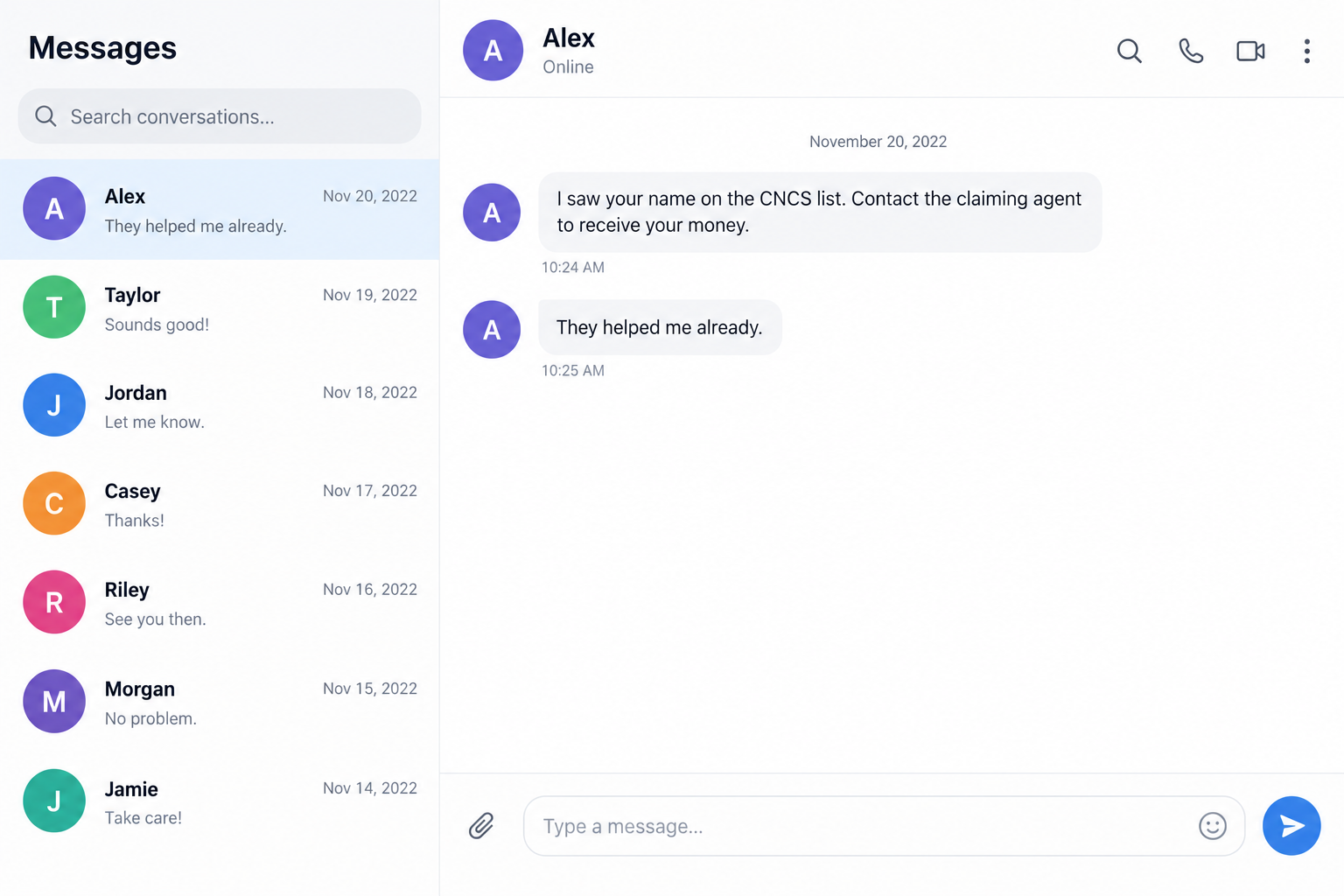
The pictured messages are invented examples of the approach. They contain no actual beneficiary list, official approval, real friend conversation, or payment instructions to follow.
Why a Friend’s Recommendation Feels Different
The recipient borrows trust from an existing relationship
An unknown advertisement invites skepticism. A message from someone you know arrives with an existing history, perhaps years of ordinary conversation.
The scam benefits when that history is transferred to an unfamiliar agent. The friend introduces the story, but the stranger receives the information and payment.
Those are two separate relationships. Trusting your friend does not mean the agent has been checked, employed by the government, or authorized to handle funds.
You can investigate without accusing anyone. Tell your friend that a suspicious offer arrived under their name and ask whether they actually sent it.
If they did send it, ask how they verified the program. A screenshot of another chat is still part of the same unverified chain.
The promise addresses a real financial worry
An offer described as help for retired, widowed, disabled, or financially pressured people sounds compassionate. It can fit a problem the recipient genuinely needs to solve.
That does not make the recipient foolish. The pitch is designed to connect an understandable need with an apparently simple, immediate solution.
Separate the need from the proposed route. Needing help does not obligate you to use an unsolicited agent or pay for an unexplained approval.
A legitimate assistance question can be pursued independently. It should not require surrendering the ability to verify the organization before discussing money.
How the AmeriCorps Grant Scam Works
Step 1: A familiar contact introduces the supposed list
The opening message may say the sender received funds and noticed your name among eligible recipients. This makes the offer feel personal rather than randomly distributed.
A claim that your name appears on a list is not an eligibility determination. A stranger can insert a name into a message or image without checking anything.
Do not supply more information just to discover whether the list is real. That can turn a vague approach into a detailed profile of your circumstances.
Ask your friend about the message using a route you already know. Keep the original conversation intact while you verify who is speaking.
If the friend cannot explain the offer independently, do not contact the suggested agent as a way of resolving the uncertainty.
Step 2: An agent adopts the language of official administration
The contact may use a government name, an official-looking profile, or a title such as claiming agent. The presentation invites deference before establishing authority.
A copied agency emblem, document header, or administrator’s name does not demonstrate employment. Someone can reproduce those details in an ordinary chat.
AmeriCorps’ alert describes impersonators using its officials and programs. It does not make every similarly named account an official communication channel.
Record the claimed identity, but avoid publishing it as the name of a proven perpetrator. Real officials can themselves be impersonated.
Reach the agency from its independently located website. Do not let the agent choose the person or number that supposedly verifies the agent.
Step 3: Simple questions create the appearance of an application
The agent can ask for a name, address, employment status, or identification. Completing a form makes the promise feel more substantial.
Information collection is not evidence of a real program. It can give the sender useful personal details while producing no genuine administrative record.
Be especially cautious when a private chat requests identification images or account access. Ask why the information is necessary and how the agency officially collects it.
A legitimate form should be reached through a verified organization, not authenticated solely by an agent saying it is the right form.
Do not send a document containing someone else’s information as part of checking the offer. Protect family members’ details as carefully as your own.
Step 4: Approval becomes conditional on sending money
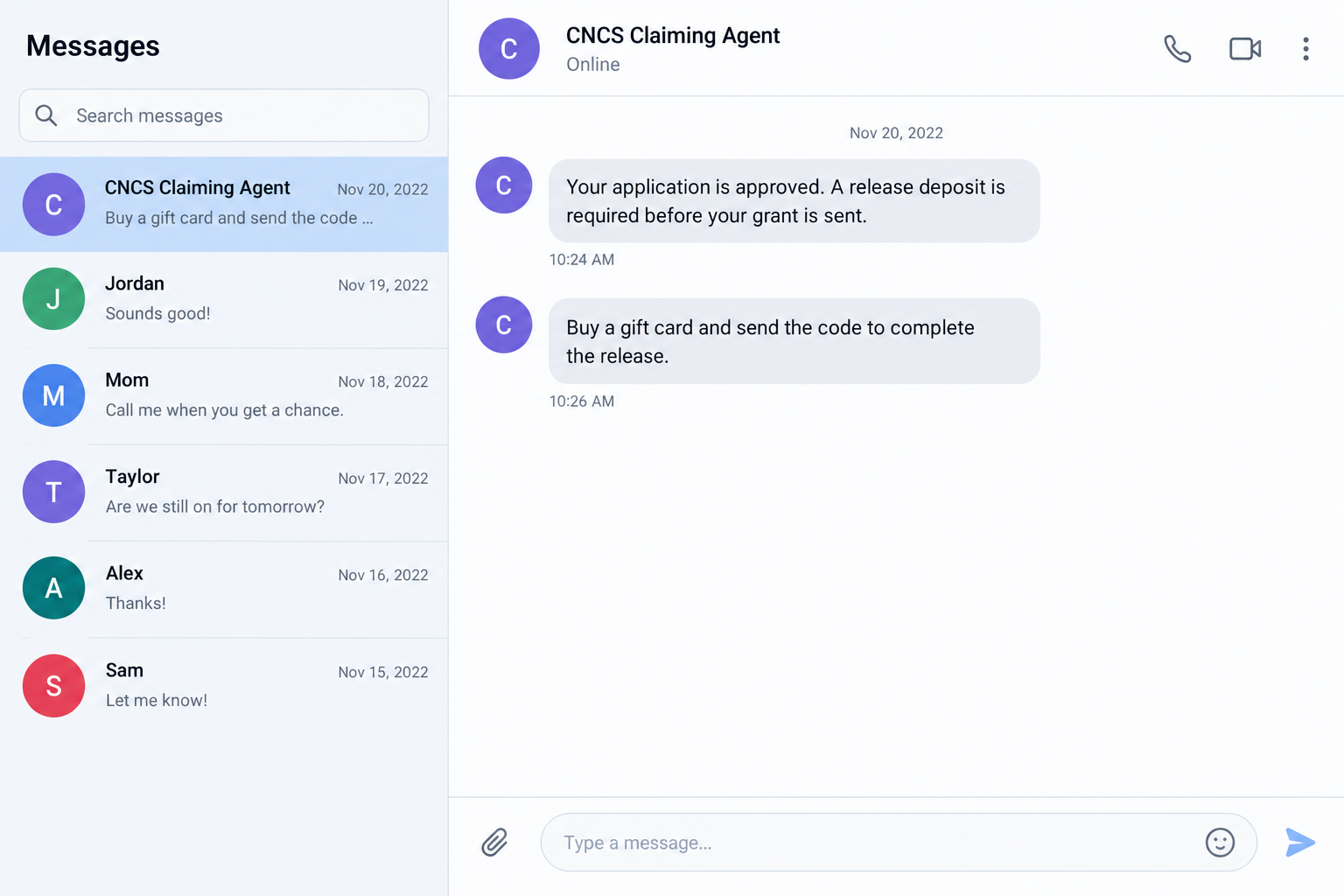
The supposed award is now approved, but a release deposit or administrative fee stands between you and the funds. The story changes from receiving help to paying.
The explanation may promise that the deposit will be returned. That reassurance does not establish who holds the money or why a gift card would be necessary.
The FTC’s grant-scam guidance identifies advance-fee and personal-information requests as key parts of bogus government grant offers.
The fictional agent screen below illustrates this payment turn. It is not an authentic agency chat or a direction to buy a card.
If you encounter the same request, stop before sending the code, receipt, or transfer. Proof of purchase can be exactly what the sender needs to use the value.
Step 5: Another condition keeps the recipient involved
After a payment, a new problem may appear. The agent can describe an additional release step, an incomplete file, or a different fee.
That is a possible escalation, not a fixed sequence that occurs in every case. Do not wait for a second request to treat the first deceptive demand seriously.
The recipient may feel that stopping would waste the payment already made. The next payment does not make the earlier promise more credible.
Keep a complete record of amounts and instructions. Ask the payment provider about available protective measures without letting the agent supervise that call.
Step 6: Silence or a recovery offer replaces the promised grant
The money may never arrive, and the agent can stop replying. Another contact may then promise to recover the grant or refund the deposit.
A recovery message can reuse details from the first conversation. Knowing the amount you lost is not proof that the new caller is an investigator.
Do not pay to move to the front of a refund queue. A new approval screenshot should not override the same requirement for independent verification.
Work through the payment provider and appropriate reporting channels. The scammer is not a safe source of advice about correcting the scam.
Real Programs and Fake Personal Awards Are Different
A public organization is not a private claiming agent
A real agency can have genuine programs and published application processes. That does not validate a stranger’s promise of cash through a social-media conversation.
Keep public grants, service-related benefits, and ordinary financial assistance separate. Different programs can have different eligibility rules, recipients, and purposes.
This article does not determine whether you qualify for legitimate help. It identifies a false route that should not be used to pursue it.
If you are searching for assistance, start with an independently verified agency or official benefits resource. Ignore a claim that only this agent can access your entitlement.
A sender’s address is useful context, not a guarantee
Public email accounts do not establish government employment. A copied official-looking display name provides even less assurance about who sent the message.
The agency’s older alert includes guidance about official email identity. Do not turn that historical note into a permanent list of every authorized modern sender.
Also, familiar-looking domains can be displayed misleadingly. Verify the offer itself through the organization rather than approving it because an address looks plausible.
Be cautious about sending identification to a reply address. Opening the official website separately is a better start than accepting the email’s own authentication story.
A real friend’s belief is not proof of payment
Your friend may genuinely believe the offer. They could have received a misleading balance image, an unrelated payment, or instructions to recommend the program.
Do not ask them to publish bank statements to convince you. The question is whether the agency recognizes the program and agent, not whether a private screenshot looks impressive.
You can be kind and still decline. Explain that you will only discuss the offer after checking the agency through a channel you chose yourself.
What to Do if You Have Fallen Victim to This Scam
-
Refuse the next payment or document request. Leave the agent’s conversation. Do not accept another clearance fee as the necessary final step.
Keep the messages before blocking the contact. Save the original profile link and any claimed program name so the impersonation can be described accurately.
-
Tell the genuine friend what happened. Contact them through an established number or another independently trusted route, not a new contact supplied in the chat.
Explain that an offer used their identity. Avoid blaming them before determining whether the message was sent, forwarded, copied, or posted from a compromised account.
They may need to review their own account security. Do not become a second person requesting their password or security code.
-
Contact the company handling your payment. For a gift card, preserve the card and purchase receipt. For a transfer, keep the transaction reference.
Describe the government impersonation and request a fraud review or any available reversal. Act promptly without assuming a hard-to-reverse method has a guaranteed refund.
Use the provider’s independently verified support. A telephone number sent by the agent can lead back to someone involved in the same operation.
-
Secure accounts whose information you disclosed. Change any exposed or reused password through the actual service. Review recovery contacts and unfamiliar account activity.
If banking credentials were shared, tell the bank that access information is involved, not merely a disputed payment. Ask what immediate protection it recommends.
Do not approve fresh security prompts while speaking with the agent. A request called verification can still authorize an action you did not intend.
-
Address identity-document exposure separately. List the personal information and document images you sent. Keep this private record separate from a public warning post.
For U.S. identity-theft concerns, IdentityTheft.gov can guide appropriate reporting and recovery. Follow steps that match the information actually exposed.
Sharing a name is not the same as sharing a Social Security number or an identification image. Avoid either minimizing or exaggerating the incident.
-
Examine technical exposure only if it occurred. If the agent sent a download or remote-access request, stop using that route and obtain trusted help.
Malwarebytes can help inspect suspicious software or continuing device symptoms. AdGuard can reduce malicious-ad exposure, but it cannot recover a grant fee.
A message appearing in your inbox does not alone establish malware infection. Do not buy a cleanup service from someone who approached you after the loss.
-
Report the impersonation with a concise chronology. Include how the contact began, the agency name used, the payment method, and any reference numbers.
The FTC’s response guidance explains payment-specific next steps. Its reporting process can help document the deceptive government offer.
Use the social platform’s reporting controls for the exact profile or message. Do not identify an impersonated official as the person who stole the money.
-
Keep recovery promises outside your plan. Someone offering guaranteed reimbursement after a new fee may be exploiting information from the first scam.
The FTC warns about this second approach. Continue with providers and agencies you reached yourself, even when the unsolicited helper sounds sympathetic.
Frequently Asked Questions
Is AmeriCorps itself a scam?
No. The warning concerns people impersonating the organization to demand deposits or information. A private claiming agent does not become legitimate by using the agency’s name.
Does appearing on a CNCS list prove I qualified?
No. A name in a message or image is not an official eligibility decision. Verify any genuine program directly through the organization responsible for it.
Could my real friend have sent the message?
Yes, they might have forwarded an offer they misunderstood. A copied or compromised account is another possibility. Check independently without assuming your friend intended fraud.
Can the release fee be legitimate because it is refundable?
A promise to return the fee does not verify the offer. The agency’s warning specifically addresses impersonators who require money before providing supposed compensation.
What if the agent uses a real official’s name?
That name can be copied. Contact the organization independently and do not accuse the real official solely because someone used their identity in the chat.
Does this article announce a new AmeriCorps benefit?
No. It explains a historically documented impersonation pattern. It does not establish current benefits, applications, approval lists, or eligibility for any reader.
The Bottom Line
The AmeriCorps grant scam uses a familiar contact and the CNCS name to make an advance-payment demand feel like official assistance. The claimed list does not establish entitlement.
Do not pay the claiming agent. Verify the organization independently, protect information already shared, and contact the payment provider promptly if money has moved.








