

A casino balance can look like money long before it becomes money. On PGPH88-style betting pages, a small deposit may turn into an exciting win, but the withdrawal button leads to another condition instead of a payout.
The next request is often framed as the last obstacle. Understanding how that sequence works can keep a disappointing loss from becoming a much larger one.
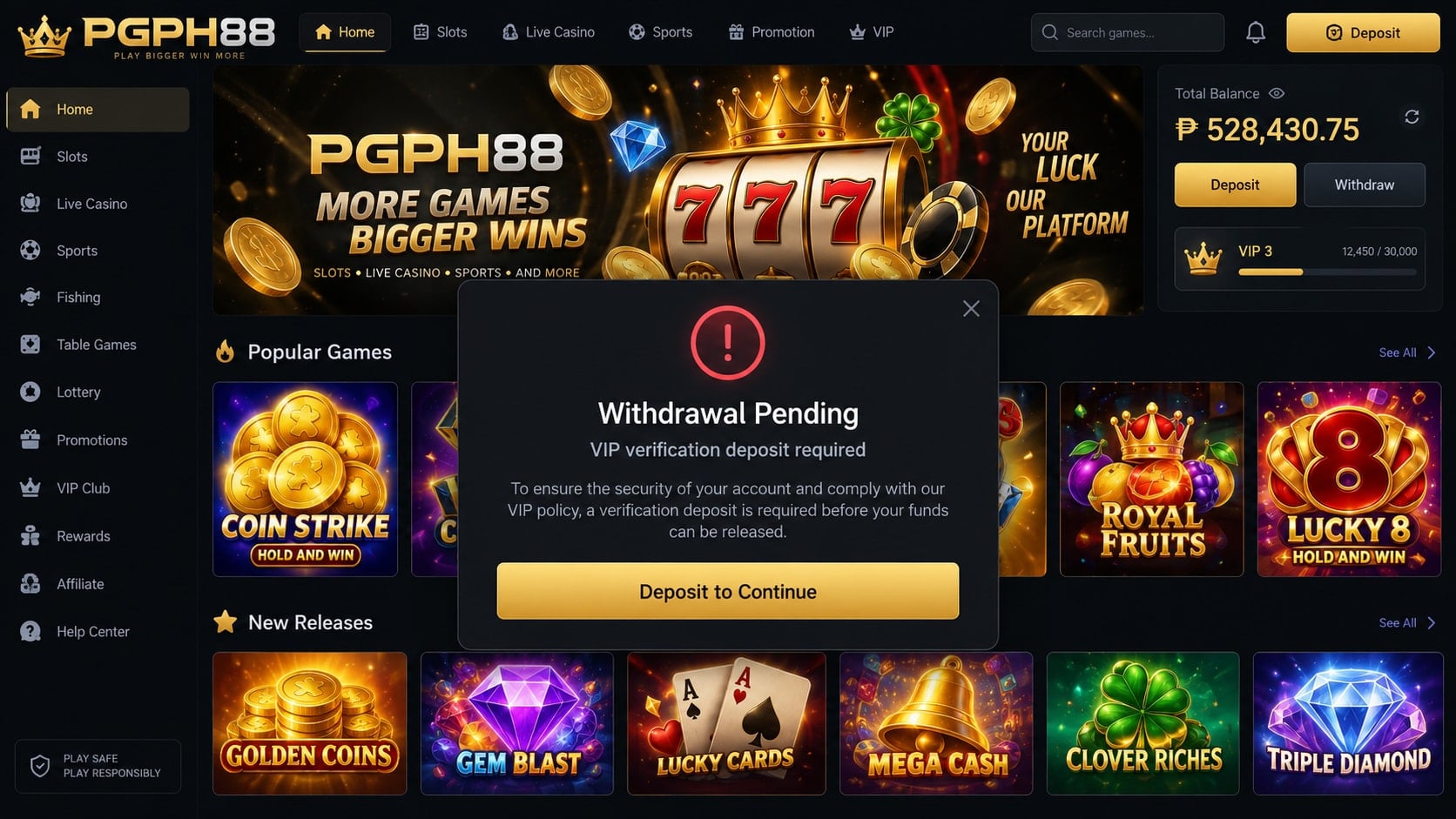
Overview
What is the PGPH88 scam?
PGPH88 has been described in consumer warnings as an online casino that attracts players with bonuses and apparent winnings, then demands additional deposits before withdrawals can proceed. Reported explanations include account upgrades, VIP activation, taxes, turnover requirements, and payment-channel errors.
The central warning is an advance-fee pattern: money displayed in an online balance is used to justify sending real money. Each payment supposedly clears the final barrier, yet a new barrier appears. A balance controlled entirely by the site is not proof that withdrawable funds exist.
Why does the casino look convincing?
A polished lobby can show slot games, live tables, jackpot counters, promotions, and a customer-service chat. The site may display a gaming certificate or use the name and imagery of a regulator. Those elements are easy to reproduce and do not establish a valid license.
Social-media recruiters and private messages add a human layer. A promoter may help with the first deposit, celebrate a win, and explain every delay. That attention makes the platform feel supervised even when the operator’s legal identity remains unclear.
Which warning signs matter most?
- You must deposit more money to withdraw an existing balance.
- A supposed tax must be paid to the casino before release.
- The account needs a paid VIP upgrade after you request withdrawal.
- Support blames GCash or another payment service but provides no traceable record.
- The gaming license cannot be confirmed on the regulator’s own website.
- Terms change after a win or are visible only inside the account.
- Support insists that splitting or repeating payments will unlock the funds.
Online gambling rules vary by country and region. A legal license in one place may not authorize an operator to accept players elsewhere. Verify both the operator and its authority to serve your location rather than relying on a badge displayed by the casino.
How the PGPH88 Scam Works
Step 1: A promoter offers a generous reason to join
The invitation may arrive through Facebook, Telegram, WhatsApp, TikTok, or a referral group. It advertises a large welcome bonus, unusually easy games, or proof that other members were paid. A referral code creates the impression that access is limited or personally recommended.
Promotional screenshots show large balances and successful transfers, but a screenshot can be edited or taken from an unrelated account. Comments may come from coordinated profiles. Check whether the people praising the platform have a believable history outside casino promotions.
A small minimum deposit lowers resistance. Losing that amount may feel acceptable, so the player opens an account before identifying the company that will hold the money.
Step 2: Early play produces an encouraging balance
The account may win quickly, receive a bonus, or show unusually favorable results. Because the operator controls the interface, the displayed outcome does not demonstrate that a real game provider processed the wager or that the balance is backed by accessible funds.
Some schemes allow a small early withdrawal. A successful test payment can be a deliberate trust-building expense that encourages a much larger deposit. Judge the platform by its verifiable license and stable terms, not by one favorable transaction.
Bonuses may also carry wagering requirements. Legitimate operators disclose those conditions before acceptance. A questionable platform reveals them only after withdrawal, changes the calculation, or refuses to identify which bets counted.
Step 3: The first withdrawal triggers a new requirement
When the player tries to cash out, the site marks the request as pending or rejected. Support may say the account level is too low, the bank details need validation, or the player must deposit a fixed portion of the winnings.
This reverses the normal direction of payment. Reasonable identity checks may be part of regulated gambling, but sending more money should not be confused with proving identity. A legitimate operator should explain its documented verification process and applicable terms.
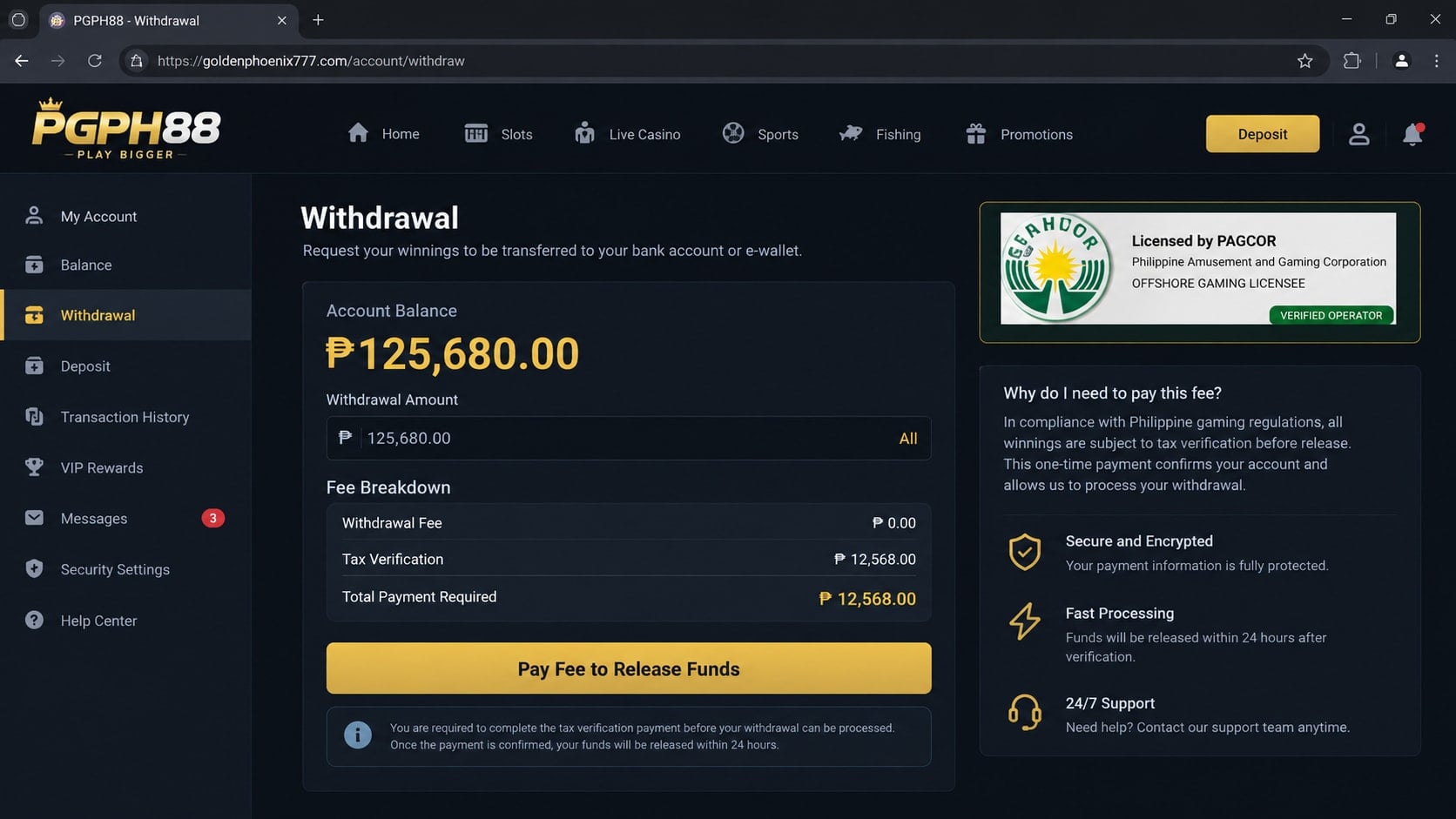
Do not let a large displayed win determine the decision. If a screen says you won ₱500,000 but demands ₱25,000 to release it, the only confirmed amount is the money you are being asked to send.
Step 4: A fake license or tax explanation removes doubt
Support may present a PAGCOR-style certificate, registration number, or official-looking seal. The document can be copied, altered, expired, or assigned to another company. Verify it with the regulator rather than through a link controlled by the casino.
The Philippine Amusement and Gaming Corporation has warned the public about fake gaming certificates and maintains channels for checking license questions. PAGCOR has also warned that unauthorized gambling sites misuse official-looking material to gain trust.
The reconstructed withdrawal page below illustrates a fake regulatory-style badge and a separate “tax” demand. It is an educational reconstruction, not an authentic PAGCOR certificate or a screenshot from a verified government system.
Step 5: Every payment creates another problem
After a VIP fee, support discovers an anti-money-laundering hold. After the hold is paid, the transfer supposedly fails because a GCash number is wrong. The player is told to fund another correction, insurance charge, wallet activation, or reprocessing fee.
The explanations can sound technical but remain unverifiable. A genuine payment error should produce a traceable transaction reference and a clear reversal route. It should not require repeated transfers to personal accounts whose names do not match the operator.
Each new charge exploits the money already lost. Walking away feels like abandoning the visible winnings and all previous fees. That sunk-cost pressure is the mechanism keeping the scheme alive.
Step 6: Support uses threats or special deals to keep the victim engaged
If the player hesitates, support may threaten account closure, legal action, forfeiture, or a credit problem. Alternatively, a “manager” offers to reduce the next fee if it is paid immediately. Both approaches preserve urgency and prevent independent verification.
The casino may claim that only an agent can communicate with finance. Direct company details remain unavailable, while every answer comes through the same chat. That structure gives the victim no independent route for checking what the agent says.
Once payments stop, the account can be frozen or the contact may disappear. A new person may later offer to recover the balance for an upfront fee. That recovery pitch often targets the same loss and should be treated as a separate scam risk.
How to Verify a Casino, License, and Withdrawal Claim
Identify the legal operator
Find the company name, registered address, license number, and contractual terms before depositing. The brand name in a logo may not be the legal entity holding player funds. Compare the entity across the footer, terms, payment recipient, and regulator record.
If the payment goes to changing personal accounts or unrelated merchants, ask why. Do not accept “payment gateway” as a complete explanation without an operator that can be independently contacted and held accountable.
Check the license at the regulator
Do not click the certificate to verify itself. Navigate independently to the named regulator and search its official license list or contact its licensing channel. Compare the domain, company, license status, and permitted activity.
PAGCOR provides official information about authorized operators and has publicly warned about fake certificates. A copied seal, QR code, or signature is not a substitute for a matching record controlled by the regulator.
Read withdrawal and bonus terms first
Save the terms that applied when you joined, including wagering calculations, identity requirements, limits, and fees. A legitimate condition should not appear for the first time after you win. Watch for clauses allowing the operator to change rules without meaningful notice.
Ask whether withdrawals require another deposit. That is a decisive question. Taxes, where applicable, should follow real law and documented processes, not a chat agent’s demand to transfer money to an unexplained wallet.
Verify payment instructions separately
Confirm that the named recipient belongs to the licensed operator or its disclosed processor. Keep transfer receipts and transaction references. A payment screenshot sent by support is not confirmation from GCash, a bank, or another independent provider.
Contact the payment service through its official app or website if support claims a technical hold. Do not use a telephone number or chat link supplied by the casino for that verification.
What to Do if You Have Fallen Victim to This Scam
- Stop sending withdrawal fees.
Do not pay another deposit, tax, VIP upgrade, validation charge, or recovery fee. A new transfer rarely releases the earlier money in an advance-fee scheme. It gives the operator a fresh reason to keep the conversation going.
Do not borrow money to preserve a displayed balance. Treat the balance as unverified until funds have cleared into an account you control.
- Preserve the full account record.
Capture the profile, balance, withdrawal history, terms, chat messages, payment instructions, URLs, and any license image. Save transaction receipts and the names or numbers of recipients. Record dates in a simple timeline.
Export information before confronting support if you can do so safely. Questionable sites may restrict access once a dispute begins.
- Contact the payment provider immediately.
Use the official GCash, bank, card, or cryptocurrency-platform support channel. Explain that the payment relates to a suspected fraudulent gambling or advance-fee operation. Ask what recall, freeze, dispute, or recipient-reporting options are available.
Recovery is not guaranteed, especially for authorized transfers or cryptocurrency, but speed can matter. Keep reference numbers and do not pay an outsider who claims to have a private connection with the provider.
- Secure exposed accounts and documents.
Change any reused password and enable strong authentication. If you uploaded identification, note exactly which documents and details were exposed. Watch for new credit, SIM-swap, account-recovery, or impersonation attempts.
If you installed an app from the casino, remove it and run a Malwarebytes scan. Review accessibility, notification, overlay, and device-administrator permissions before assuming the app is gone.
- Report the operator and license claim.
For a claimed Philippine license, use PAGCOR’s official website to find current verification and reporting routes. Provide the exact domain and certificate details. Report unauthorized gambling to the appropriate authority for your location as well.
Describe what happened without overstating evidence. A precise report of deposits, withdrawal demands, and unverifiable licensing is more useful than a general statement that every game was rigged.
- Reduce further exposure.
Block the promoter and suspicious support accounts after preserving evidence. Remove browser notification permission for the casino domain. AdGuard can reduce some malicious ads and tracking, but it cannot validate a gambling license or recover a transfer.
Watch email and messaging accounts for follow-ups. Details from the original dispute may be reused to create a believable recovery or regulator impersonation.
- Get support for the financial impact.
Tell a trusted person what happened, particularly if the pressure led to borrowing or repeated deposits. Secrecy benefits the operator. A clear second opinion can stop the next payment when the displayed winnings remain emotionally difficult to abandon.
If gambling itself is becoming hard to control, use a reputable local gambling-support service. Fraud reporting and gambling support address different parts of the situation, and both can be appropriate.
Frequently Asked Questions
Is PGPH88 licensed by PAGCOR?
Do not rely on a badge shown by the casino. Check the exact legal operator and domain through PAGCOR’s current official records or licensing contact. Consumer warnings have reported questions about PGPH88’s authorization, so independent verification is essential.
Do I need to deposit money to withdraw casino winnings?
A demand to send fresh money simply to release a balance is a major warning sign. Legitimate fees or withholding should be documented in applicable terms and law, not improvised through repeated chat requests.
Can PAGCOR recover my payment?
A regulator may receive reports and investigate licensing issues, but it does not guarantee reimbursement. Contact the actual payment provider promptly and ask about its recovery options while also filing relevant reports.
Why did the games let me win?
A displayed win keeps a player engaged and can justify larger withdrawal fees. Without a verifiable operator and game provider, the interface itself cannot prove that a legitimate wager or payable prize exists.
Is a successful small withdrawal proof the casino is legitimate?
No. A small payment may build trust before larger deposits. Licensing, legal identity, stable terms, and a consistent withdrawal record are stronger evidence than one early transaction.
Can AdGuard or antivirus make the casino safe?
Security tools can block some harmful pages, ads, and files. They cannot determine whether a casino will honor a withdrawal, whether its license is valid, or whether a displayed balance represents real money.
The Bottom Line
The PGPH88 scam pattern turns a number on a screen into leverage. The larger the apparent win becomes, the easier it is to frame one more deposit as a small price for getting everything back.
Do not evaluate the next fee against the promised balance. Evaluate the operator, license, terms, and payment route independently. If those checks fail, stop paying, preserve the record, and report the transactions quickly.








