

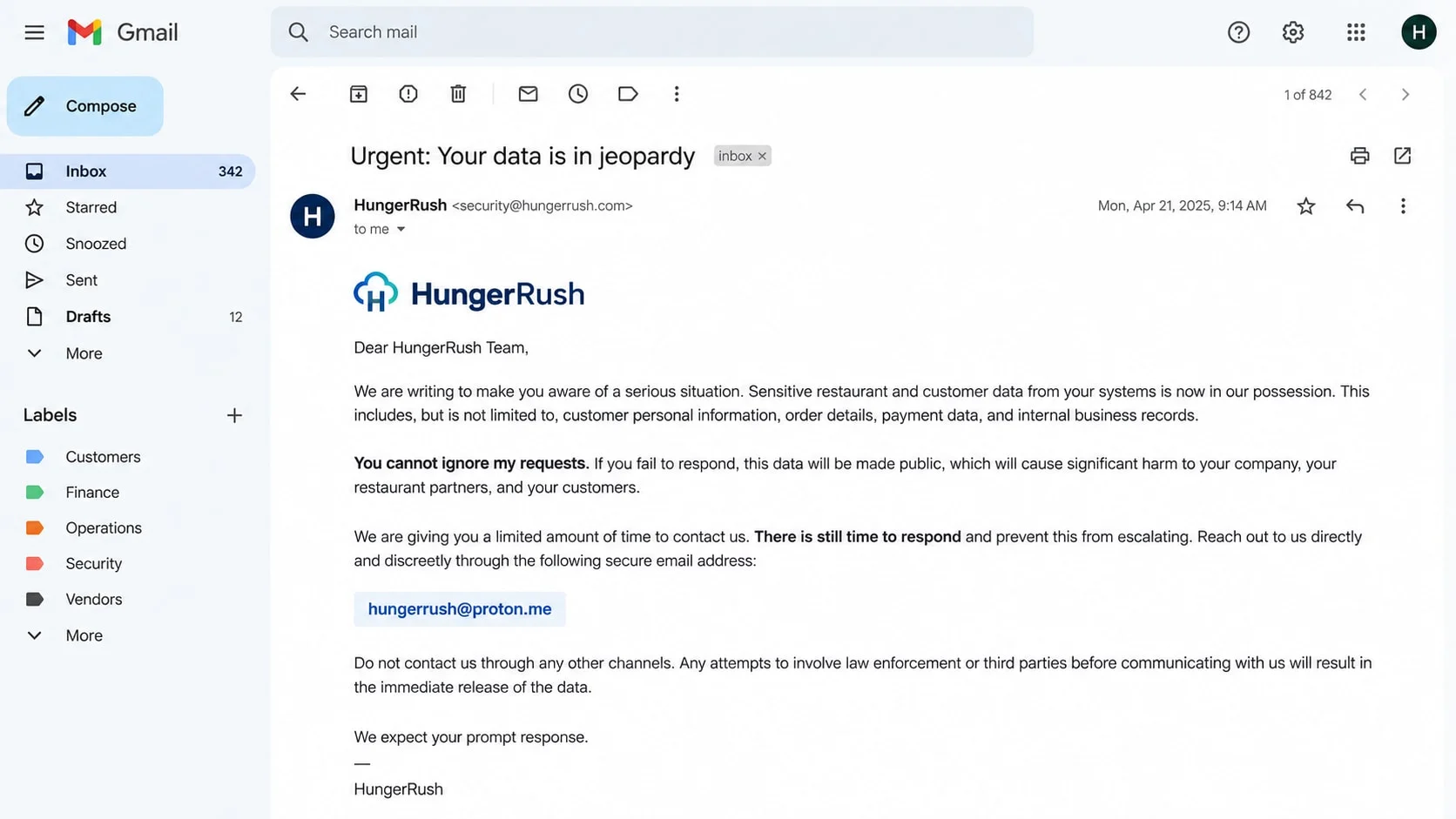
A message carrying the HungerRush name says customer data has been taken and warns that ignoring the sender will make the situation worse. It is written to feel personal, hostile, and too urgent to leave unanswered.
Before replying, paying, or warning customers, separate what the email claims from what it actually proves. That distinction is the safest place to begin.
Overview
What is the HungerRush threat email scam?
The HungerRush threat email scam is an unsolicited extortion or intimidation message that uses the name of HungerRush, a restaurant technology provider. The sender claims to possess customer or business data and pressures the recipient to make contact, follow instructions, or pay to prevent disclosure.
The email may appear to come from a HungerRush-related address while directing replies to an unrelated mailbox, including an encrypted email provider. The brand reference is not proof that HungerRush sent the message, that its systems were breached, or that the sender holds the data described.
What does the message establish?
By itself, the email establishes only that someone can send a threat. A sender may use spoofed headers, public business information, reused breach data, or a fabricated story. Even a sample containing real information does not automatically reveal where that information came from.
There is no responsible basis for announcing a HungerRush breach solely because an extortionist says one occurred. A business should verify systems, logs, affected records, vendors, and official notices before drawing conclusions or making public claims.
Which warning signs deserve attention?
- The sender demands secrecy or an immediate reply.
- The display name and Reply-To address belong to different domains.
- The message makes broad claims but supplies no verifiable incident details.
- A payment request uses cryptocurrency or another hard-to-reverse method.
- The sender threatens publication on a fixed deadline.
- An attachment or link is presented as proof of stolen data.
- The contact route cannot be confirmed through HungerRush’s official support channels.
A threatening email should not be dismissed simply because it may be fake. Treat it as an unverified security report: preserve it, contain any immediate risk, and investigate through trusted people and systems without negotiating from the inbox.
How the HungerRush Threat Email Scam Works
Step 1: The sender chooses a believable business connection
Restaurants and related businesses use outside platforms for ordering, loyalty programs, payments, and customer communications. A criminal can mention a recognizable provider such as HungerRush and rely on the recipient’s uncertainty about which systems hold which data.
The email may be sent to an owner, manager, general support address, or employee found on a public website. It does not need inside access to create anxiety. Restaurant locations, staff names, technology partners, and customer-facing email addresses are often visible online.
A campaign can also target people who have no HungerRush relationship. Broad distribution is inexpensive, and some recipients will have enough connection to the brand for the story to feel plausible.
Step 2: The message makes a serious but vague claim
The sender says customer records, order histories, phone numbers, or internal files have been obtained. The language may avoid exact dates, affected systems, file names, or counts. Vagueness lets the same text fit many businesses and prevents easy contradiction.
A subject such as “Your customer data is in jeopardy” is designed to be forwarded quickly to decision-makers. The body may say, “You cannot ignore my requests,” framing silence as an active danger rather than a sensible pause for verification.
Do not ask the sender to provide more sensitive samples to an ordinary inbox. If specialists decide that evidence must be assessed, they should use a controlled process that protects customers and preserves a chain of custody.
Step 3: Sender details create a false trail
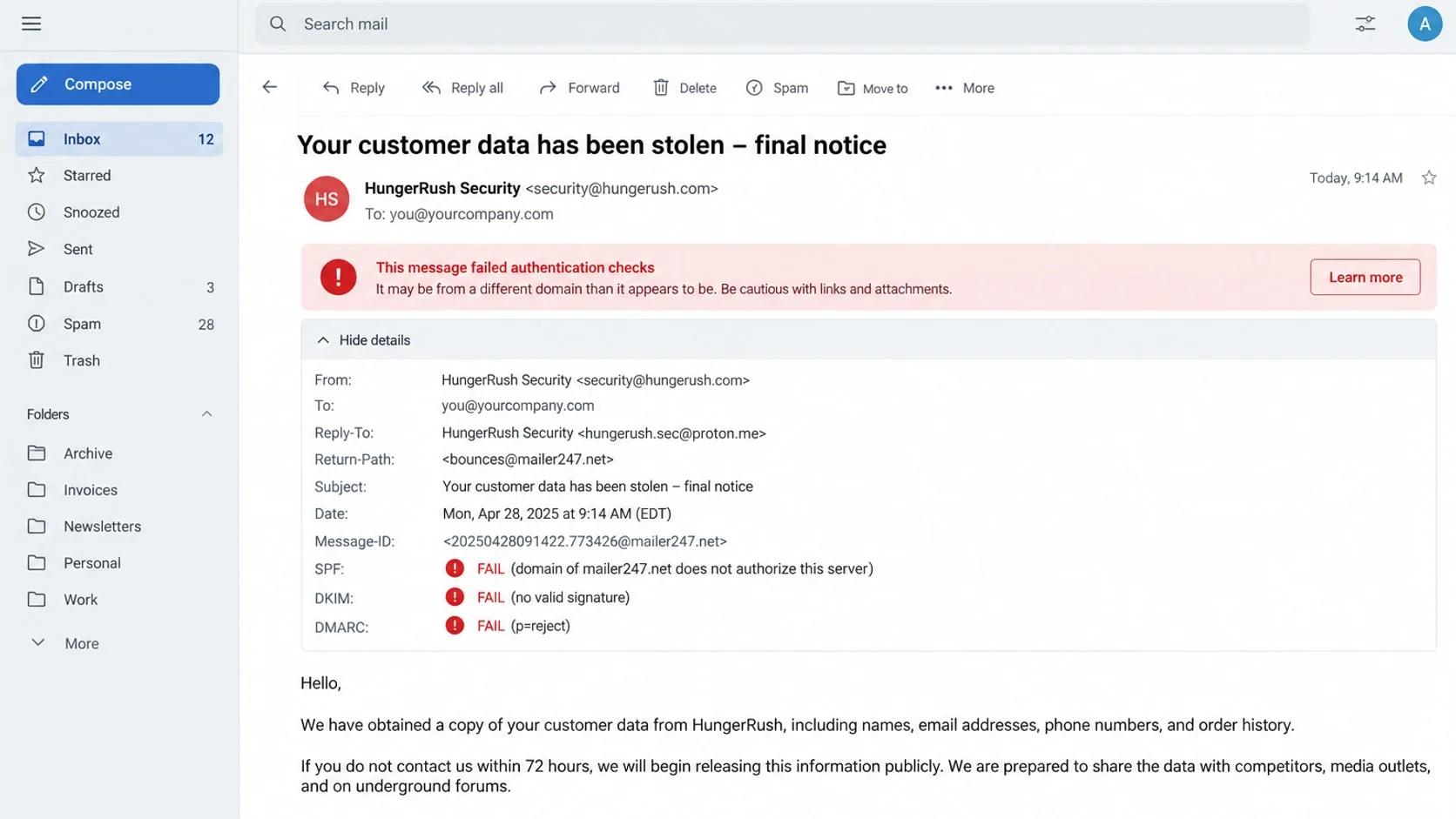
The visible From line may contain HungerRush’s name or a familiar-looking address. Email display names are not identity documents, and some technical From values can be spoofed when authentication controls do not stop or quarantine the message.
Expanding the headers may reveal a different Reply-To or Return-Path. A Proton Mail address is not suspicious by itself; many legitimate people use privacy-focused email. The concern comes from an unexplained mismatch combined with an extortion claim and no verifiable business channel.
The reconstructed header view below illustrates those clues. It is not a real HungerRush message and does not document an actual breach, wallet, or payment demand.
Step 4: The threat forces a short decision window
The sender may promise to release data, contact customers, notify competitors, or damage the company’s reputation within 24 or 72 hours. A deadline makes a recipient more likely to reply before involving legal counsel, an insurer, law enforcement, or an incident-response provider.
Replying can confirm that the address is monitored and that the threat reached someone with authority. It may also expose names, job roles, internal concerns, and the company’s willingness to negotiate. Preserve the message without giving the sender information unnecessarily.
Do not let the deadline dictate public statements. Prematurely naming a vendor or claiming a breach can misinform customers and complicate a real investigation. Communicate verified facts and legal obligations, not the extortionist’s narrative.
Step 5: A link, file, or sample raises the stakes
The email may link to a cloud folder, paste site, encrypted archive, or supposed leak page. Opening it on a normal work device can expose credentials, record the visitor’s address, or deliver malware. An attachment can be disguised as a list of affected customers.
Security teams can examine material in an isolated environment and compare samples with known records. A match may show that some data is real, but further work is needed to identify its age, source, and whether current systems were accessed.
Public breach collections and earlier compromises are frequently repackaged. A criminal may combine old customer information with current business details to make a new demand appear connected to a recent intrusion.
Step 6: Payment is presented as the only safe outcome
The sender may demand cryptocurrency in exchange for deletion, silence, or technical details. There is no enforceable assurance that copies will be destroyed. Payment can invite a larger demand or identify the organization as willing to respond.
Extortion decisions carry legal, sanctions, insurance, and operational considerations. They should not be made by an employee acting alone under email pressure. Escalate through the organization’s documented incident process and obtain qualified advice.
A fake recovery or investigation contact may follow later, claiming it can identify the sender for a fee. Treat unsolicited helpers as a new verification problem. Real professionals can explain their identity, scope, contract, and limits without promising a guaranteed result.
How to Verify the Sender, Threat, and HungerRush Connection
Preserve and inspect the complete email
Keep the original message with full headers rather than relying only on a screenshot. Record when it arrived, which mailboxes received it, whether anyone clicked, and what security gateway actions occurred. Do not repeatedly forward the live content around the company.
Have a qualified person review SPF, DKIM, DMARC, originating infrastructure, links, and attachment hashes. These details can identify spoofing or campaign relationships, but none alone proves who is behind the threat.
Contact HungerRush independently
Use HungerRush’s official support portal or contact details reached from the company’s official website. Do not reply to the threatening message to ask whether it is genuine, and do not use a telephone number contained only in that email.
Provide the relevant headers and wording through the channel HungerRush designates. Ask whether it recognizes the communication and whether any official notice applies to your account. Keep the support case number.
Check your own systems and vendor access
Review relevant authentication logs, administrator changes, exports, unusual API activity, and email access. Identify which systems actually contain the categories of data named in the message. That inventory helps distinguish a plausible claim from generic language.
Also check integrations and former staff access. The source of exposed data, if any, might be a restaurant account, another vendor, an old export, or an unrelated breach. Avoid fixing on the first brand named by the attacker.
Verify any sample without spreading it
Use a controlled workspace and limit access to people involved in the investigation. Compare a small sample against authoritative records, noting fields, formatting, age, and inaccuracies. Do not upload sensitive customer data to public scanning services.
Consult legal counsel about notification, evidence preservation, and contact with law enforcement or regulators. Requirements depend on location, data type, and what the investigation confirms, not merely on the existence of a threatening email.
What to Do if You Have Fallen Victim to This Scam
- Do not negotiate from the inbox.
Stop direct replies unless your incident team and advisers establish a controlled communication plan. Do not send money, credentials, internal screenshots, or customer lists. Preserve every message, including later replies from the same sender.
If an employee already responded, record exactly what was disclosed. A reply is not proof that systems were compromised, but the new information can shape follow-up social engineering.
- Activate the incident-response process.
Notify the person responsible for security, leadership, legal review, and relevant insurance according to your organization’s plan. Assign an incident owner so separate teams do not contact the sender independently.
Classify the event initially as an unverified extortion claim. Update that status as evidence develops. This language supports urgent work without announcing conclusions that have not been established.
- Contain any interaction with links or files.
If somebody opened a link, submitted credentials, or ran an attachment, isolate the affected device as your security team directs. Reset exposed credentials from a trusted system, revoke sessions, and review authentication logs.
Run an endpoint scan, including Malwarebytes where it fits the organization’s approved tools. A clean scan does not settle whether credentials were phished or cloud data accessed, so continue the account and log review.
- Verify with HungerRush and other involved providers.
Open a case through the official HungerRush support route and provide the original email details securely. Contact any payment, hosting, or email provider through independently obtained information if its service appears in the evidence.
Do not assume the named vendor is the source. Ask focused questions about the account and indicators while investigating your own environment in parallel.
- Preserve evidence and assess the claim.
Retain headers, gateway logs, authentication records, affected device images where appropriate, and a timeline of decisions. Limit changes that could destroy useful logs, while still taking necessary steps to protect active systems.
Have qualified responders assess any sample in isolation. Document what is confirmed, what is contradicted, and what remains unknown. That separation keeps the attacker from defining the incident for you.
- Handle reporting and notification responsibly.
Seek legal advice about law-enforcement reports, regulatory duties, contractual notifications, and customer communication. If there is no confirmed breach, say so accurately rather than repeating the threat as fact.
If a breach is confirmed, communications should explain known scope, protective steps, and updates without exposing investigative details that create more risk.
- Reduce future email exposure.
Review domain authentication and inbound anti-spoofing controls. Train staff to expand sender details, report threats, and avoid moving conversations to unverified addresses. AdGuard can reduce some web-based malvertising exposure, but it does not authenticate email or replace mail-gateway controls.
Use a documented route for security reports so legitimate researchers and concerned customers do not need to guess where to write. Clear internal escalation also keeps a frightening message from sitting unnoticed in one mailbox.
Frequently Asked Questions
Does the email prove HungerRush suffered a data breach?
No. A claim in an unsolicited message is not proof of a breach or its source. Verification requires evidence from systems, providers, records, and official communications. Avoid attributing an incident before that work is complete.
Is a Proton Mail reply address proof of a scam?
No. Proton Mail is a legitimate service used for many purposes. An unexplained reply-address mismatch is one clue, especially in an extortion message, but the threat, headers, evidence, and official verification must be considered together.
Should I open the attached sample to see if it is real?
Not on a normal personal or work device. Treat attachments and links as potentially harmful. Qualified responders can inspect them in an isolated environment and compare any data without unnecessarily spreading sensitive records.
Should a business warn every customer immediately?
Follow applicable law and qualified legal advice. A premature warning based only on an unverified email may spread incorrect information. A confirmed incident, however, may create specific notification duties and should be handled promptly.
Will paying guarantee that the data is deleted?
No. A criminal can keep copies, sell them, or demand more. Payment decisions also involve legal and sanctions considerations. They should never be made from the email thread by one pressured employee.
What if the sender knows real customer details?
Treat the sample seriously but do not assume its source. The information may come from an old breach, a compromised restaurant account, another vendor, public records, or a current intrusion. Investigate the lineage and system evidence.
The Bottom Line
The HungerRush threat email is designed to make its own story feel like established fact. A recognizable provider, a hostile deadline, and a few plausible data categories can push a business toward a rushed reply or payment.
Preserve the message, verify through official channels, and investigate the evidence without publicly assigning blame too early. Calm, documented incident handling protects customers far better than letting an anonymous sender control the next step.

Join the discussion
0 commentsShare your experience or ask a question about this article.
Discussion
Start the conversation
Have a question or something useful to share? Add the first comment.