

If you found “Kaia Sydney” through an ad pushing a massive “ENDS TODAY” sale, you are not alone.
These sites are built to feel familiar and safe. Clean design. Lifestyle photography. A founder story about “three friends.” Badges like “secure payment,” “free shipping,” and “30-day money back guarantee.” Then the hook: luxury-looking items and recognizable branded bags at prices that feel too good to ignore.
That combination is exactly what makes this type of operation so effective.
Because once you believe the story, you stop questioning the mechanics. And that is where people get burned: not by a single obvious mistake, but by a carefully staged shopping experience that looks legitimate long enough to get a payment.
Below is a detailed breakdown of what’s going on, the red flags that matter, and what to do if you already placed an order.
Scam overview
Most people do not wake up planning to shop on a brand-new store they have never heard of.
They arrive through a social media ad, a “sponsored” post, or a retargeting banner. The pitch is nearly always the same:
- “Final day” discounts.
- “Up to 70% to 80% off.”
- A countdown timer.
- Low-stock alerts like “Only 4 left.”
- Review counts in the thousands.
- “Free shipping in Australia.”
- A clean returns promise.
The entire experience is engineered to lower your skepticism and increase urgency. It’s persuasion by environment.
1) The “ends today” urgency is usually manufactured
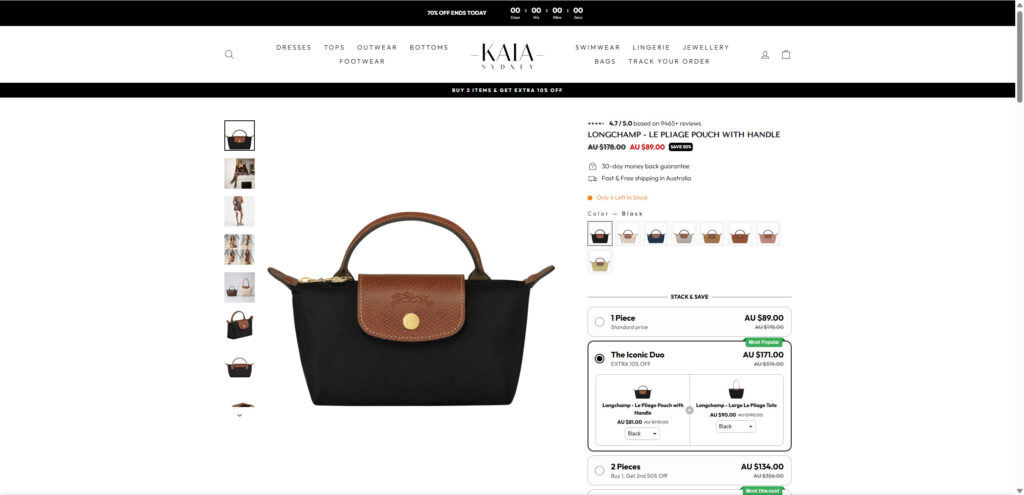
The site runs an “ENDS TODAY” theme and a countdown timer that hits zeros. That’s a classic pattern in scammy storefronts.
Legitimate retailers do run timers, but you can typically verify the sale elsewhere: email newsletters, social channels, consistent history, press coverage, store listings, or clear business registration info.
On these “sale scam” pages, the timer is not a scheduling tool. It’s a conversion lever.
Common behaviors:
- The timer resets when you reload.
- It reaches 0 but the sale continues.
- The banner is always present, on every product, all day.
That’s not a normal retail pattern. It’s a pressure tactic.
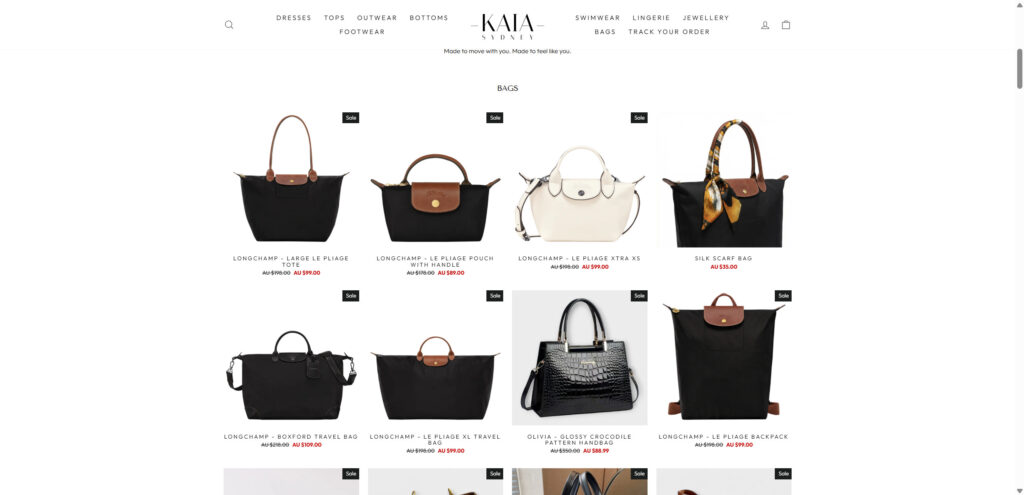
2) Branded items priced far below market value is the biggest red flag
The most damaging clue is the product mix.
When a site claims to sell recognizable branded bags (like Longchamp styles) at deep discounts, there are only a few realistic possibilities:
- Counterfeit or replica goods.
- Misrepresentation where the item delivered is not the branded product shown.
- A bait-and-switch where you receive something unrelated or extremely low quality.
- No delivery at all.
Legitimate authorized sellers of premium brands do not price popular items at “too-good-to-be-true” numbers day after day with no verifiable retailer credentials.
If the entire store’s main draw is “luxury items for cheap,” treat it as a high-risk purchase by default.
3) The review numbers are often inflated or untraceable
Badges like “4.7/5 based on 9465+ reviews” look comforting, but the key question is simple:
Where are those reviews actually hosted?
On many scam storefronts:
- The “reviews” are embedded on-page with no independent platform behind them.
- There’s no review profile on trusted marketplaces.
- Photos look generic, AI-generated, or lifted from other websites.
- The store has little to no external footprint matching the review volume.
A brand with thousands of happy customers leaves an obvious trail.
If you cannot independently verify that trail, the badge is just decoration.
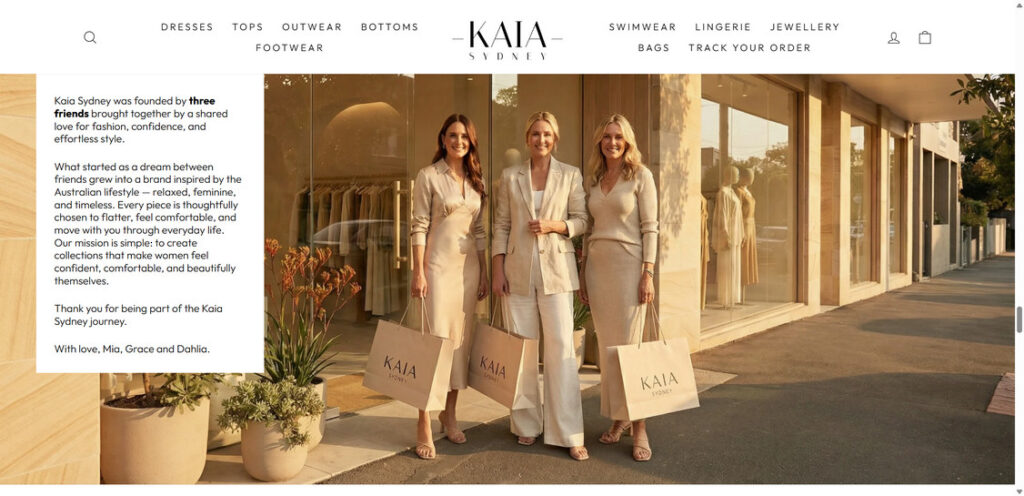
4) The “three friends” founder story is a common template, not proof
The site shows a friendly origin story signed by “Mia, Grace and Dahlia,” paired with high-quality lifestyle imagery.
This is a standard trust-building pattern used by many dropshipping and scam storefronts:
- A personal story to create emotional legitimacy.
- Names that feel relatable.
- A polished photo that suggests a real team.
- “Thank you for being part of our journey” language.
None of that confirms the business is real. It confirms the site was designed by someone who understands what buyers want to believe.
5) “Free shipping” and “money-back guarantee” do not mean refunds are easy
These operations often promise:
- “Fast & free shipping” (sometimes location-specific, like Australia).
- “30-day money back guarantee.”
- “No questions asked.”
The reality, when victims report issues with similar sites, is usually one of these outcomes:
- Shipping takes far longer than promised because the item ships from overseas fulfillment.
- Tracking numbers exist, but the package is delayed, vague, or mismatched.
- The delivered item is not what was advertised.
- Refunds require sending the item to China at the buyer’s expense, often with strict conditions.
- Customer support responds with stalling tactics or partial refund offers.
The “guarantee” is part of the conversion funnel. The enforcement is where things fall apart.
6) The pricing structure is built to increase cart size, not deliver value
The “buy 2 items get extra 10% off” and stacked savings bundles are not inherently suspicious on their own.
But in the context of:
- extreme discounts,
- heavy urgency,
- questionable product authenticity,
- and inflated social proof,
those offers serve a different purpose: getting you to spend more before you have time to verify legitimacy.
Scam storefronts often optimize for higher average order value because chargebacks and disputes are expected. They want the maximum payment before the customer realizes something is wrong.
How the Kaia Sydney sale scam typically works
Even when the brand name changes, these campaigns tend to follow a predictable sequence.
Step 1: You see an ad that triggers urgency and curiosity
The ad usually includes:
- “Final day” language
- a dramatic markdown
- a polished lifestyle visual
- a simple call-to-action like “Shop now”
The goal is to get you on-site. Once you land, the site does the rest.
Step 2: The website environment builds trust fast
You are hit with:
- professional layout
- “secure payment” icons
- big review numbers
- shipping and return promises
- a “real brand” story
This is the credibility layer. It’s designed so you feel safe enough to enter payment details.
Step 3: The product selection is chosen for impulse buying
These scams often use:
- trendy handbags
- “iconic” styles
- familiar silhouettes
- luxury brand lookalikes
If you recognize the items, your brain fills in trust that the store didn’t earn.
Step 4: The checkout is frictionless, the policies are not
Checkout is optimized.
Policies are optimized for ambiguity.
You will often see:
- vague business address details
- generic “contact” pages
- return language that sounds good but includes hidden conditions
This is where the trap is set.
Step 5: After payment, one of several outcomes happens
Common outcomes include:
- Long shipping delays
The order “processes” but fulfillment is slow. - A cheap substitute arrives
Material, stitching, sizing, and quality do not match the product photos. - A counterfeit-looking item arrives
Logos and hardware may be off, or the item is clearly not authentic. - No meaningful customer support
Emails bounce, replies are scripted, or the store keeps stalling. - Refund resistance
You are offered store credit, partial refunds, or told to ship internationally at your expense.
What to do if you already ordered
If you already paid, the goal is to reduce your losses and prevent follow-on fraud.
1) Document everything now
Save:
- order confirmation email
- order number
- product page screenshots
- pricing screenshots
- return policy page
- any chat logs or emails
You want a clean record for your bank dispute.
2) Check your payment method and act accordingly
If you paid by credit card:
Contact your card issuer and ask for a chargeback. Use language like “goods not as described,” “counterfeit concerns,” “non-delivery,” or “merchant unresponsive,” depending on your situation.
If you paid by debit card:
Call your bank quickly. Debit disputes can be harder, but early action helps.
If you used PayPal:
Open a dispute inside the resolution center and escalate if needed.
3) If you entered account credentials, change them
If you created an account on the site using a password you reuse elsewhere, change that password everywhere immediately.
4) Watch for follow-up scams
After purchases on suspicious stores, some people report:
- phishing emails pretending to be “shipping updates”
- fake “delivery fee” texts
- “customs payment required” messages
Do not click links from unexpected shipping notifications. Go directly to the carrier site manually.
5) Monitor statements for small test charges
Fraudsters sometimes run small “verification” charges before attempting larger ones.
If you see anything unfamiliar, report it and request a new card.
How to spot this type of shopping scam in the future
Use this checklist before buying from any “viral sale” storefront.
A) Treat extreme discounts on recognizable brands as a stop sign
If it looks like a premium brand product at a bargain price, assume high risk until proven otherwise.
B) Verify reviews off-site
On-site star ratings are not proof.
Look for independent footprints: retailer pages, consistent social accounts, real customer photos across time, and credible third-party mentions.
C) Read the return policy like a contract
Watch for:
- returns only to overseas addresses
- buyer pays return shipping
- short timelines with strict conditions
- vague language about “final sale” exclusions
D) Check contact legitimacy
A real business usually provides:
- a physical address you can verify
- a phone number that works
- consistent brand presence across channels
- a support email using the same domain
A blank “contact form only” setup is common on scam storefronts.
E) Reverse image search the product photos
Scam sites frequently reuse images from legitimate brands or other stores.
If the same image appears everywhere, that’s a major warning sign.
The bottom line
The “Kaia Sydney” bags sale pages show multiple hallmarks of a high-risk retail scam pattern: manufactured urgency, inflated review claims, and implausible pricing on recognizable branded items.
That does not prove every order will fail. But it does mean the risk profile is unacceptable for most buyers, especially when refunds and returns are typically where these operations become evasive.
If you already ordered, shift into documentation and dispute mode quickly. Time helps the merchant, not the customer.
FAQ
Is Kaia Sydney a real Australian brand?
Some pages present themselves as an Australian brand, but a polished site and local shipping claims are not proof. The key is verifiable business identity: traceable company details, consistent long-term footprint, and independently verifiable reviews.
Why are the discounts so huge?
Because urgency sells. “Up to 70% to 80% off” combined with an “ends today” timer is a common tactic to push impulse purchases before people research the store.
Are the bags authentic?
If the site is offering recognizable branded styles at unusually low prices, authenticity is doubtful. In many similar cases, buyers receive low-quality substitutes or items that do not match the listing.
What if I receive something, but it’s not what I expected?
That’s a prime dispute scenario. Document the differences with photos and screenshots, then file a chargeback or payment dispute as “not as described.”
The site says “30-day money back guarantee.” Doesn’t that protect me?
Not necessarily. Many scammy stores advertise easy returns but enforce them through costly international shipping, strict conditions, or unresponsive customer support.
I entered my card details. What should I do now?
Monitor your statements closely. If you see suspicious activity, contact your bank, cancel the card, and request a replacement. If you reused a password on the site, change it everywhere.
Should I wait for shipping before disputing?
If the store becomes unresponsive, gives vague tracking, or misses promised timelines, you should not wait indefinitely. Disputes have time limits, and earlier filings are often easier to win.
How do I report the site?
You can report suspicious storefronts to your payment provider, your bank, and your country’s consumer protection channels. Reporting the ad platform that served the promotion can also help limit further victims.
Can a legit store still look like this?
Some legit stores use aggressive marketing. The difference is verifiability: real company identity, consistent presence, and pricing that makes sense for the products claimed. When multiple red flags stack together, treat it as high risk.

Join the discussion
0 commentsShare your experience or ask a question about this article.
Community experiences
Did this happen to you?
Your experience could help someone recognize the same scam. Submit a private report for our team to review.
I experienced this tooReports are reviewed before publication. Sharing publicly is always your choice.
Discussion
Start the conversation
Have a question or something useful to share? Add the first comment.