

Something unusual has been happening around a charming online shop called Laera & Cole. The site appears almost too perfect at first glance, wrapped in warm knitwear, nostalgic family stories, and images that seem to capture decades of craftsmanship. It promises heritage, tradition, and heartfelt handmade pieces that feel impossible to resist.
But the more shoppers look beneath the surface, the more questions begin to rise. The story sounds inspiring, yet certain details don’t quite add up. And as customers share their experiences, a much larger picture starts to form.
If you’ve been thinking about placing an order, or you’re simply curious about what’s really going on, keep reading. What follows is a detailed investigation into Laera & Cole that every online shopper should see before making a decision.
Scam Overview
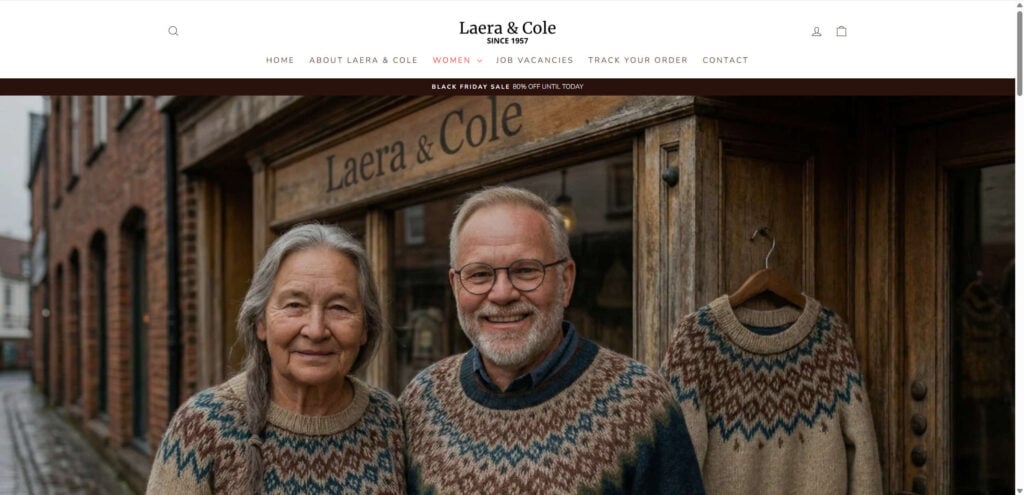
Laera & Cole presents itself as an Icelandic family business founded in 1957, supposedly passed down through generations. The website uses warm imagery, emotional writing, and a classic knitwear aesthetic that feels trustworthy. The homepage features older adults standing outside a rustic store, smiling warmly as if welcoming visitors into a real workshop. There are shelves full of sweaters in the background, and the company narrative talks about years of craftsmanship and heritage. At first glance, everything feels genuine.
But the story collapses almost instantly once you begin to examine it more closely.
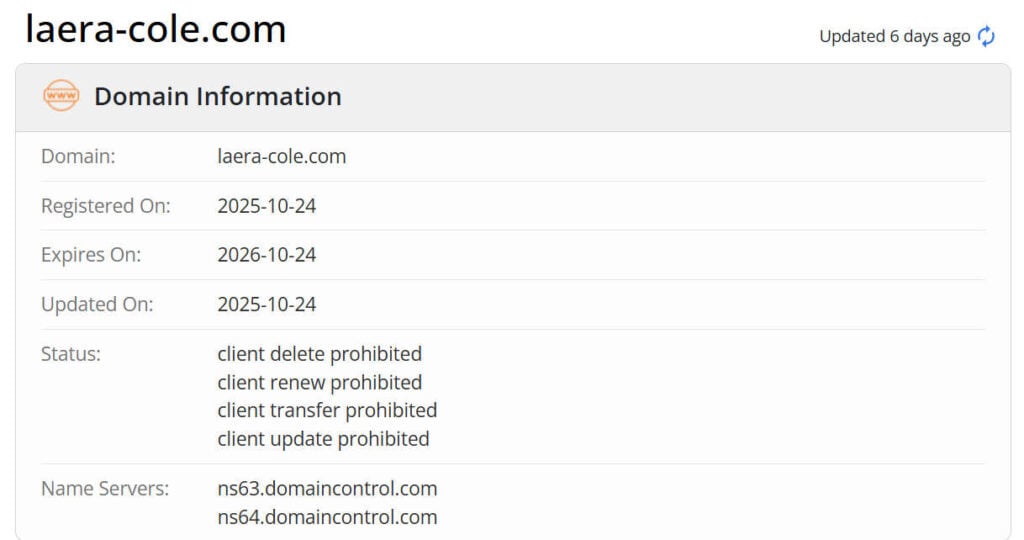
The domain was registered extremely recently, only a few days before the ads started spreading. A store claiming to exist for more than sixty years does not suddenly register a new domain out of nowhere without any history. Legitimate long standing brands have older domains, media records, or customer reviews. Laera & Cole has none of this. In fact, the WHOIS information shows the site was created in late 2025, showing zero connection to any real company.
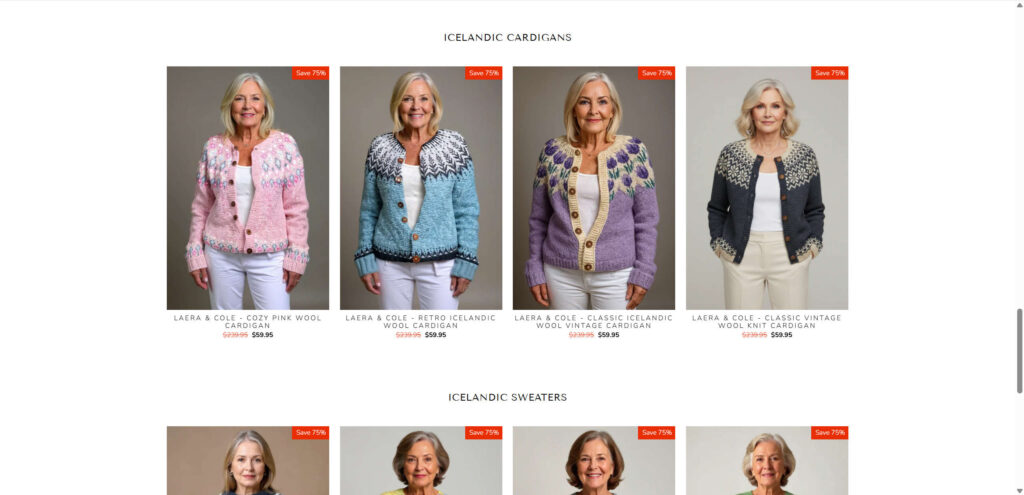
The imagery used throughout the site also raises concerns. Many of the photos show models wearing sweaters in perfect studio lighting. The colors are unusually vivid, the stitches look excessively clean, and many of the scenes have the unmistakable aesthetic of AI generated photography. There are unrealistic backgrounds, lighting inconsistencies, and facial textures that resemble high end synthetic images rather than natural portraits. Scammers often use AI generated photos to create the illusion of handcrafted quality without needing any real products.
The pricing structure also reveals something suspicious. Almost every product is allegedly marked down from about $239.95 to only $59.95. The number is identical across dozens of items, which is a known tactic used by fraudulent stores. They create an illusion of deep savings on expensive goods to increase the likelihood of impulse purchases. Real brands do not discount every single product by 75% without a clear reason, without seasonal history, and without stock transparency.
The overarching narrative is built around a false closing down sale. According to the story, the founder or family member passed away or the store can no longer continue operations. As a final gesture, they are giving customers a last chance to purchase their treasured knitwear. Scammers often use emotional closings or anniversaries because they trigger fast decision making. People feel sympathy and urgency, which leads to quick purchases without deeper research.
Shipping information also raises red flags. Although the site attempts to appear local to Iceland or the United States, the shipping routes and processing times indicate Chinese fulfillment. Many victims who purchased from similar scam networks report receiving their packages with Chinese labels, long delays, and items that look nothing like the product photos. The sweaters appear cheap, factory made, thin, and made from synthetic fibers instead of wool. Some customers never receive anything at all.
The return and refund process is where the scheme becomes even clearer. Buyers trying to request returns are told they must ship the product back to China, often to a warehouse that is not even related to the supposed brand story. Shipping back a sweater internationally can cost more than $60, which is more than the price paid for the product. Instead of offering a real refund, scammers provide a classic response: asking the customer to keep the item and accept a partial refund of only 20% or 30%. This is a known manipulation technique, because they know the customer will spend more money returning the item than they could ever recover.
Even the customer support email appears questionable. There is no phone number, no physical address, and no real evidence of a company behind the name. Most legitimate businesses provide clear contact details, but fraudulent stores intentionally avoid this transparency.
When analyzing the broader scam network, patterns emerge. Laera & Cole mirrors the structure of many Chinese operated scam sites that appear under different names every few weeks. They use AI photos, overly emotional brand stories, fake family heritage, dramatic closures, and deep discounts. Once enough negative reviews accumulate, the scam operators close the website and launch a new one under a different name. This cycle has been repeated across thousands of domains.
The goal is simple: use deceptive marketing to lure buyers with urgency, collect payment, ship low quality goods or nothing at all, and then vanish before law enforcement or payment processors intervene.
The entire operation is built around manipulating emotions, creating urgency, and mimicking credible brands through believable but fake storytelling. The more authentic the scam appears, the more effective it becomes. And Laera & Cole is a textbook example of how modern fraudulent ecommerce networks operate.
How The Scam Works
Understanding the step by step structure of the Laera & Cole scam helps consumers recognize similar networks. These scams follow a predictable pattern that has been refined over the years to maximize profit and minimize accountability.
Step 1: Create an emotional narrative that sounds authentic
The first step is crafting a believable story. Scammers choose themes that evoke trust and nostalgia. Laera & Cole uses an elderly couple, a workshop full of wool sweaters, and a six decade legacy. The description feels personal and heartfelt. People feel like they are supporting a small family business struggling to survive.
This tactic works because shoppers often prefer supporting small artisans over large corporations. The scam leverages this emotional bias, using AI enhanced images to present a family that appears real. The models are smiling, the sweaters look beautiful, and the entire brand identity feels warm and inviting.
Step 2: Launch highly targeted ads on social media
Fraudulent stores buy cheap ads on Facebook, Instagram, and TikTok. They target users interested in crafts, knitting, handmade goods, folklore clothing, or sustainable fashion. These ads show stunning images of knitwear that looks handcrafted. The discounts appear incredible. With phrases like last chance, closing sale, or limited stock, they create strong urgency.
Thousands of users click because the ads appear repeatedly across different accounts. Scammers often run dozens or even hundreds of ads at the same time. If an ad account gets banned, they simply activate another one.
Step 3: Use AI generated or stolen images to create product pages
Many of the sweater images used by Laera & Cole look artificially enhanced or entirely generated. The faces are highly uniform, the sweaters look digitally perfect, and the scenes resemble idealized studio photographs that rarely exist in real life. Scammers use AI tools to create endless variations of sweaters at no cost.
Other photos may be stolen from genuine artisans, photographers, or brands. Scammers rely on buyers not performing image searches or not knowing where the images originated.
Step 4: Set unrealistic discounts to force impulse buying
Products are priced around $239.95 and then discounted to $59.95. The crossed out price is always identical across dozens of sweaters, which is suspicious. Real stores vary their prices based on materials, labor, and brand history. But scam shops use uniform discounts because the goal is to convince buyers they are getting a once in a lifetime deal.
The entire site is designed to encourage speed over careful consideration. Buyers feel like they might miss out if they do not order immediately.
Step 5: Add trust badges, fake return guarantees, and false shipping promises
Laera & Cole displays claims of free UPS shipping, craftsmanship guarantees, and 30 day money back assurance. These additions create a sense of safety even though they mean nothing in practice.
Fake stores know that buyers often look for reassurance before purchasing. By adding familiar logos and guarantees, they bypass skepticism. But once money is paid, the guarantees disappear.
Step 6: Process payments through third party gateways linked to scam networks
Payments often go through processors associated with Chinese networks. The transaction may be listed under a strange company name unrelated to Laera & Cole. This is a common tactic to hide the real operators.
Customers rarely notice this small detail because they are focused on completing checkout.
Step 7: Delay shipping or send low quality items
Victims report two primary outcomes:
- The package eventually arrives but contains a cheap, thin, synthetic sweater with incorrect colors, wrong patterns, and poor construction.
- No package arrives at all.
Those who do receive something often notice Chinese shipping labels or customs forms. This completely contradicts the story of Icelandic craftsmanship.
Step 8: Block or ignore refund requests
Once customers complain, scammers begin the standard manipulation cycle:
- They claim the product looks different due to lighting.
- They blame the customer for ordering the wrong size.
- They ask for detailed photos of the product.
- They delay replies for many days to exhaust the buyer.
- They offer a small partial refund of 20% to 30% if the customer keeps the item.
The purpose is to avoid refunding the full amount.
Step 9: Force victims into costly international returns
If the buyer insists on a full refund, scammers demand they ship the item back to China at their own cost. This is intentionally designed to discourage returns. International shipping may cost more than the sweater itself.
Once the item is shipped back, scammers often:
- Claim they never received it
- Claim it arrived damaged
- Claim it was delivered to the wrong warehouse
- Stop replying entirely
The customer loses both the item and the refund.
Step 10: Shut down the site and launch a new one
Once enough complaints accumulate, Laera & Cole will likely disappear completely. The operators then launch new domains with similar names, new AI models, new emotional stories, and new fake discounts.
This cycle continues endlessly.
What To Do If You Have Fallen Victim to This Scam
If you already bought something from Laera & Cole, here are the steps to take right now.
1. Contact your bank or card provider
Ask for a chargeback. Explain that the store is fraudulent, that the domain was recently created, and that the product images are not real representations of goods. Chargebacks are often successful if you act quickly.
2. Keep all evidence
Save your order confirmation, emails, screenshots of the site, ads, product images, and shipping information. This documentation helps your bank process your claim.
3. Do not ship the item back to China
You will likely lose more money. Scammers rely on customers giving up after seeing the shipping cost.
4. Report the scam
You can report the site to:
- Your local consumer protection authority
- FTC (if you are in the United States)
- Action Fraud UK (if you are in the United Kingdom)
- The platform where you saw the ad
Reporting helps others avoid the same trap.
5. Change your passwords and monitor your accounts
If you used the same email and password combination elsewhere, change it immediately. Some scam networks attempt credential theft.
6. Install protective tools
Use trusted digital security tools such as Malwarebytes Browser Guard, Malwarebytes Premium, or AdGuard. These tools help block malicious sites, prevent deceptive advertising, and warn you before opening suspicious pages.
The Bottom Line
Laera & Cole may look like a warm family owned business filled with heritage and craftsmanship, but everything about the brand falls apart under inspection. From the newly registered domain to AI generated photos, from identical discounts to deceptive return policies, the evidence strongly suggests that this is another fraudulent store operating through a well known cross border scam network.
The heartfelt closing story is not real. The sweaters shown in the ads do not exist. The products shipped are low quality imitations from cheap suppliers. And once customers ask for refunds, they are faced with impossible return requirements and manipulated into accepting tiny partial refunds.
Learning to spot these scams is essential because they are becoming more sophisticated, more emotional, and more convincing. Laera & Cole is only one version of a much larger ecosystem of fake ecommerce stores.
FAQ
Is Laera & Cole a legitimate store?
No. Multiple red flags confirm that Laera & Cole is not a legitimate business. The domain is newly registered, the story about a decades old family shop is fabricated, the product photos appear to be AI generated, and many buyers report receiving cheap items or nothing at all.
Why are Laera & Cole’s products so cheap?
The large discount is used as a psychological trigger to push fast purchases. Scammers use identical price drops on all products to create urgency and make shoppers believe they are getting a rare opportunity.
Where do Laera & Cole orders actually ship from?
Although the website implies a Nordic or US based business, customer reports show that packages come from China. This contradicts the brand’s story and is a common sign of a scam shop.
Can I return an item to Laera & Cole?
In practice, returns are almost impossible. The store demands that customers ship items back to China at their own expense. International shipping often costs more than the product itself, which discourages returns.
What refund does Laera & Cole usually offer?
Victims often report that the store offers a partial refund of only 20% or 30% and tells them to keep the item. This is a known tactic used by cross border scam networks to avoid giving full refunds.
How can I get my money back?
The best option is to contact your bank or card provider and request a chargeback. Provide screenshots showing the new domain registration, misleading ads, and the item received.
How can I avoid scam stores like Laera & Cole in the future?
Always check domain age, verify the existence of the business, search for independent reviews, and look for inconsistencies in the story. Install tools such as Malwarebytes Browser Guard and AdGuard to block suspicious shops and misleading ads.








