

Lazy Motor is being promoted as a fun motorized inflatable float that supposedly lets you cruise across pools, lakes, beaches, and calm water without paddling.
The ads make it look like the perfect summer gadget.
But there are serious red flags.
The product appears to be pushed through flashy social media ads, AI-generated or heavily edited visuals, and exaggerated lifestyle marketing. Buyers risk receiving a cheap product that does not perform as advertised — or receiving nothing at all.
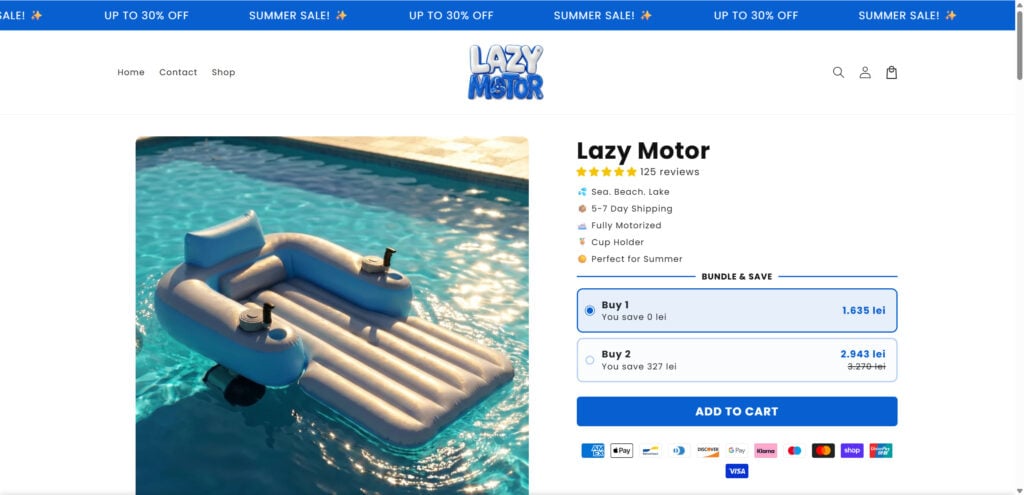
What Is Lazy Motor?
Lazy Motor is sold through LazyMotor.com as a motorized inflatable pool and lake float. The website claims it has electric propulsion, joystick-style control, a cup holder, and a motor system that can move the float at up to 3 mph. It also says the product is made with reinforced PVC and can support up to 330 lbs. (Lazy Motor)
The site lists the product at $349, marked down from $457, and displays 125 customer reviews. (Lazy Motor)
On paper, that sounds appealing.
But the problem is simple: the marketing does not provide enough proof that the product works as shown, ships reliably, or performs safely in real water conditions.
The Biggest Red Flag: AI-Style Marketing
One of the biggest concerns is the way Lazy Motor is being promoted.
Products like this are often sold through viral social media videos that look exciting but may be AI-generated, staged, edited, or exaggerated. The goal is to make the product look effortless, fun, and almost too good to resist.
That does not prove the product is real.
That does not prove the product is safe.
That does not prove the product performs as advertised.
With a water product that uses batteries and motors, buyers need real proof: independent reviews, unedited customer videos, safety testing, clear motor specs, battery details, and transparent company information.
Lazy Motor does not provide enough of that.
The Product Claims Need Proof
Lazy Motor claims to be a “fully motorized” float built for pools, lakes, reservoirs, slow rivers, and beaches. The website says it uses built-in electric propulsion and rechargeable lithium-ion batteries. (Lazy Motor)
That is not a small claim.
A motorized floating product needs durable construction, waterproof electronics, sealed batteries, safe charging, strong seams, reliable controls, and proper safety instructions.
But the product page mostly relies on lifestyle language, social-proof blocks, and sales copy.
There is not enough hard evidence.
No detailed battery capacity.
No clear motor rating.
No safety certification details.
No real manufacturer address.
No convincing independent testing.
That is a major concern.
The Reviews Look Too Convenient
The site shows 125 reviews and several glowing customer comments. It also displays social-style testimonials from people claiming the product worked great at the lake or pool. (Lazy Motor)
But reviews shown directly on a product page are not enough.
Questionable stores can easily add fake review blocks, fake names, fake ratings, and fake social media-style comments to create trust quickly.
Unless those reviews are independently verified, linked to real buyers, and supported by real customer videos, they should not be trusted blindly.
Weak Company Information
The contact page gives only one email address: info@lazymotor.com. It does not show a full business address, company registration details, phone support, or clear ownership information. (Lazy Motor)
That is a problem.
A company selling a motorized water product should provide strong support details. Buyers should know who they are buying from, where the company is located, how warranty claims work, and where returns go.
With Lazy Motor, the public company information is thin.
That makes disputes harder if something goes wrong.
The Return Policy Has Risky Fine Print
Lazy Motor says it has a 30-day return policy, but the item must be unused, with tags, and in the original packaging. The policy also says the buyer is responsible for return shipping unless the item is faulty or damaged. It also states that sale items cannot be returned. (Lazy Motor)
That matters because the product is advertised as being on sale.
So buyers may think they have a normal return window, but the policy language creates potential problems.
With suspicious ecommerce products, refund promises often sound better than they are. Sellers may delay replies, reject returns, require expensive shipping, or claim the product is not eligible.
Third-Party Trust Scores Are Concerning
Independent safety-checking sites also raise concerns.
ScamAdviser gives LazyMotor.com a trust score of 0 and says the website has a rather low trust score. It also notes that the domain is very young and has hidden WHOIS data. (ScamAdviser)
Gridinsoft gives the site a 45/100 trust score and says the evidence is not strong enough to treat the site as fully established. It also reports that the domain was registered only recently. (Gridinsoft LLC)
Scam Detector gives LazyMotor.com a 21.8/100 score and labels it “Suspicious. Unsafe. Doubtful.” (Scam Detector)
These tools are not final proof of a scam.
But when a new site, weak company details, aggressive marketing, and questionable product claims all appear together, buyers should be very cautious.
You May Receive a Cheap Product — Or Nothing
The biggest risk is that the product shown in ads may not match what arrives.
Buyers could receive a cheap inflatable float with weak motors.
They could receive a product that barely moves in water.
They could receive something unsafe, poorly built, or completely different from the advertising.
They could wait weeks with no reliable tracking.
They could receive nothing at all.
That is the common pattern with viral ecommerce products: exciting ads, polished visuals, big promises, and disappointing results.
Why You Should Not Order Lazy Motor
Lazy Motor has too many red flags:
The marketing appears heavily edited or AI-driven.
The product claims are not backed by enough proof.
The reviews are not independently convincing.
The company details are weak.
The website is very new.
The return policy may be difficult to use.
Third-party trust scores are poor.
There is a real risk of receiving a cheap product that does not perform as advertised — or receiving nothing.
That is enough reason to avoid ordering.
Final Verdict: Do Not Order Lazy Motor
Lazy Motor looks like a risky viral summer product being sold with flashy social media marketing and weak proof.
A motorized inflatable float may sound fun, but this offer does not provide enough transparency, testing, or buyer protection to feel safe.
Do not order Lazy Motor.
Until there are real independent reviews, verified customer videos, clear company details, proper safety information, and reliable proof that the product works as advertised, this is not a product worth risking your money on.
If you want a real motorized water float, buy from an established brand with verified reviews, proper warranty support, and clear safety documentation.
Lazy Motor looks less like a proven summer gadget and more like a risky online offer designed to attract impulse buyers.
What To Do If You Already Ordered
If you already bought Lazy Motor, act quickly.
Save screenshots of the product page, social media ad, checkout page, order confirmation, refund policy, and all emails.
Contact the seller and request tracking details.
If tracking does not update, the seller ignores you, or the product arrives completely different from the ads, contact your bank, credit card company, or PayPal and open a dispute.
Do not wait too long.
FAQ
Is Lazy Motor legit?
Lazy Motor looks highly risky. The website is new, the company information is limited, and third-party trust scores are poor.
Is Lazy Motor a real motorized float?
The website claims it is, but there is not enough independent proof that it performs as advertised.
Why should I avoid Lazy Motor?
Because you may receive a cheap product that barely works, something different from the ads, or nothing at all.
Are the ads real?
The ads appear highly polished and may use AI-generated or heavily edited visuals. They should not be treated as proof.
Does Lazy Motor really move at 3 mph?
That is the website’s claim, but buyers should not trust it without independent testing.
Can Lazy Motor support 330 lbs?
The website claims a 330-lb weight limit, but there is no strong independent proof shown.
Should I order Lazy Motor?
No. Based on the red flags, Lazy Motor is too risky to recommend.

Join the discussion
0 commentsShare your experience or ask a question about this article.
Discussion
Start the conversation
Have a question or something useful to share? Add the first comment.