

If you have been seeing Lipovia GLP-1 Patches pop up in ads, the pitch is hard to ignore.
A “once-a-day” patch that supposedly works automatically, reduces cravings, supports blood sugar balance, boosts metabolism, and helps your body “burn what it stores” sounds like the effortless version of what a lot of people want.
But when a product borrows the language of a real medical category (GLP-1) and pairs it with dramatic, low-friction promises, you should slow down and verify what you are actually buying.
Based on what Lipovia claims on its website (transdermal delivery, “GLP-1 activating” plant extracts, big review counts, and a 60-day weight loss guarantee), there are multiple red flags that make this a “proceed with caution” purchase, not an easy recommendation.
This article is for consumer education only and is not medical advice. If you have diabetes, prediabetes, or take any medications, talk with a licensed clinician before trying weight-loss supplements or “metabolic” products.
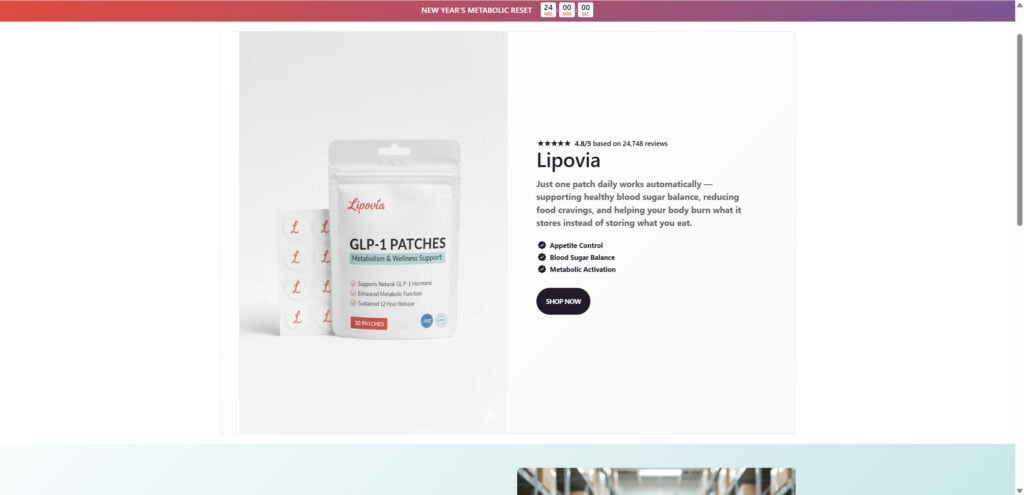
What Lipovia GLP-1 Patches Claim to Do
On the product page, Lipovia GLP-1 Patches are positioned as an effortless daily system:
- One patch daily that “works automatically”
- Appetite control and fewer cravings
- Blood sugar balance support
- “Metabolic activation”
- Sustained delivery (the site highlights a 12-hour sustained release in one section and also describes 24-hour continuous patch effects in the FAQ area)
- “No pills or injections”
The site also leans heavily on credibility signals that are common in high-pressure weight loss marketing:
- A large star rating and a very large review count displayed on the page
- A medical-looking image of a clinician holding the product
- “Clinically proven” phrasing
- A bold “60-day weight loss guarantee”
- Bundles and “best value” pricing that nudges you toward buying several months at once
- Scarcity language such as “sold out” cycles and “final restock” messaging paired with low inventory claims and countdown timers
None of these automatically mean a product is fraudulent. But together, they are a familiar pattern in aggressive direct-response marketing, especially in the GLP-1-themed supplement space.
Quick Bottom Line: Should You Buy Lipovia GLP-1 Patches?
For most people, no.
Not because “patches” are automatically bad, but because the specific story Lipovia tells raises key trust issues:
- It implies GLP-1-like results without offering the kind of evidence you would expect for that level of claim.
- It relies on vague “clinically studied” language without clear, verifiable study details tied to the finished patch product.
- It uses big review numbers on-page, but that alone is not independent proof.
- The mechanism is questionable: getting meaningful “GLP-1 activation” from plant extracts delivered through skin is a major claim that requires strong, transparent validation.
If you still want to try it, treat it like a high-risk purchase: buy the smallest option, document everything, and understand the return and refund process before you pay.
Why “GLP-1” in the Name Matters
GLP-1 is not just a trendy buzzword.
It is a real hormone involved in appetite regulation and blood sugar control. The reason GLP-1 is everywhere right now is because prescription GLP-1 drugs and GLP-1/GIP drugs have strong clinical evidence for weight loss and blood sugar management.
That creates a marketing opportunity: products can borrow the GLP-1 label and imply similar results, even when the product is not a prescription medication and does not contain a GLP-1 drug.
So the core consumer question becomes simple:
Is this actually comparable to medical GLP-1 therapy, or is it branding that piggybacks on the trend?
Lipovia positions itself as “activating” your body’s natural GLP-1, not replacing it with a drug. That is a softer claim than “it is Ozempic in a patch,” but it still suggests major physiological impact.
Extraordinary outcomes require extraordinary proof.
The Biggest Red Flags on the Lipovia Page
1) The “works automatically” promise is doing a lot of work
When weight loss marketing emphasizes “automatic,” it is usually trying to bypass your skepticism.
Real weight loss interventions are not magical. Even the most effective options involve tradeoffs, side effects, dosing, monitoring, and lifestyle context.
A patch that “just works” with no meaningful caveats should immediately trigger deeper verification.
2) The mechanism is unclear and feels stitched together
Lipovia’s story blends multiple ideas:
- Transdermal delivery “bypasses digestion”
- Sustained release
- “Clinically studied ingredients”
- “GLP-1 activating” formula with plant extracts
- Appetite control + blood sugar + metabolism + energy
Individually, some plant compounds have limited evidence for certain metabolic markers in certain contexts.
But the jump from “some ingredients are studied” to “this patch reliably triggers GLP-1 effects and noticeable weight loss” is huge.
If the site does not clearly show:
- exact ingredient dosages in the patch,
- how much actually absorbs through skin,
- and clinical data on the finished patch product,
then the claim remains marketing, not proof.
3) The “clinically proven” vibe without clinical transparency
The site uses authority language like “clinically proven” and “clinically studied.”
What you want to see is something concrete:
- study titles, authors, and links,
- whether the study tested the finished Lipovia patch (not just individual ingredients),
- sample size and duration,
- measurable outcomes,
- and whether the data is independently published.
If those details are missing, “clinical” becomes a mood, not evidence.
4) Review count and star rating shown on the page are not independent
A large review count displayed on a product page can be real.
It can also be easy to manufacture or reuse if the reviews are not hosted and verified by a reputable third-party platform, or if there is no way to validate review sources.
If a brand claims tens of thousands of reviews, you would typically expect to find a meaningful footprint elsewhere, not just on the brand’s own site.
5) Credibility imagery that may not be tied to the product
A clinician holding the product in a bright, medical-looking environment is a classic conversion booster.
But it does not automatically mean:
- a real doctor endorses it,
- a real clinic stocks it,
- or any medical institution is affiliated.
If the site does not name the clinician, credentials, and a verifiable endorsement relationship, treat it as marketing imagery, not medical validation.
6) Scarcity and urgency cues everywhere
Countdowns, “final restock,” repeated “sold out” cycles, low inventory claims, and bundle nudges are designed to create fear of missing out.
That does not prove a product is illegitimate.
But it does increase the odds you will buy before you fully understand what you are signing up for.
What Lipovia Says Is Inside the “GLP-1 Activating Formula”
The website highlights plant ingredients and specific GLP-1-related claims, including phrasing like:
- Berberine extract (with a bold “increases GLP-1” type claim)
- Green coffee bean (positioned as activating GLP-1 receptors)
- Bitter melon extract (positioned as stimulating GLP-1 release)
- Ceylon cinnamon (positioned as enhancing GLP-1 sensitivity)
It also references a blend that includes L-glutamine and pomegranate extract in another section.
Here is the problem: even if each ingredient has some research behind it in some form, you still need answers to the questions that matter most:
- What is the exact dose of each ingredient in each patch?
- How much of it actually makes it through your skin and into circulation?
- Is the patch designed with proven transdermal penetration enhancers?
- Are there safety disclosures for interactions and contraindications?
- Is there a published clinical trial on the finished patch product?
Without those details, the ingredient list reads more like a persuasive story than a verifiable formula.
The Transdermal Question: Do “Metabolism” Patches Usually Work?
Transdermal delivery can be real.
Certain medications and compounds are effectively delivered through the skin using patches, but they are chosen specifically because they can cross the skin barrier at consistent, measurable doses.
For a supplement-style patch that claims broad metabolic effects, the biggest practical issue is absorption.
Skin is designed to keep things out.
So when a product claims it “bypasses digestion” and therefore is “maximum absorption,” that is not automatically true. It is a sales claim unless backed by pharmacokinetic data (blood-level testing showing what is absorbed over time).
If Lipovia does not provide absorption data for its patch, you are left trusting the marketing.
The “No Pills or Injections” Hook
This line is effective because it taps into a real pain point: many people want GLP-1-like results without medical appointments, injections, side effects, or cost.
But “not an injection” also means “not a prescription GLP-1 drug.”
So the real comparison should be:
Is this patch a modest wellness product with small, incremental effects for some people?
Or is it being marketed as a shortcut to serious GLP-1-level outcomes?
The copy leans toward the second impression, especially with claims about stubborn belly fat, continuous suppression of appetite, and noticeable weight loss in a short guarantee window.
Pricing and Bundle Psychology
From the pricing shown on the site, Lipovia pushes multi-month purchases with “most popular” and “best value” labels, plus crossed-out prices that make the discount feel dramatic.
This is a common tactic:
- The 1-month option exists, but it is priced to feel “not worth it.”
- The 3-month and 6-month options are framed as the smart choice.
- Extra “secret gift” add-ons make it feel like you are losing value if you do not buy bigger.
If you are uncertain, bundling is the opposite of what you want. Bigger upfront purchases create more friction if the product is ineffective or the refund process becomes difficult.
The 60-Day Weight Loss Guarantee: Helpful or a Trap?
A “no questions asked” guarantee sounds consumer-friendly.
But guarantees only matter if the company honors them quickly and consistently, with clear instructions and a reliable support channel.
Before trusting any guarantee, look for:
- A clear return address (not just an email form)
- A clear refund timeline
- Whether you must return unopened products only
- Whether you must pay return shipping
- Whether there is a restocking fee
- Whether you must request an RMA number
- Whether they refund shipping charges
- The exact definition of “60 days” (from order date, delivery date, or something else?)
In many problematic ecommerce setups, the guarantee exists mainly to reduce purchase anxiety. Then the actual process becomes slow, confusing, or expensive enough that many people give up.
What to Check Before You Buy Anything Like This
If you are investigating Lipovia (or any GLP-1 patch product), use this checklist.
Verify the company identity
- Is there a real business name and registration you can confirm?
- Is there a physical address that matches the brand, not a random mailbox?
- Are there working phone numbers, not just a contact form?
Verify independent reputation
- Are there third-party reviews you can cross-check?
- Are reviewers describing the same product, pricing, and shipping experience?
- Do complaints repeat themes like refund problems, non-delivery, or unexpected charges?
Read the policies like a skeptic
- Returns, refunds, subscriptions, shipping, chargebacks
- Look for vague language that gives the company broad discretion to deny refunds
Look for real evidence, not “evidence-flavored” design
- Published studies on the finished patch product
- Dosages and absorption data
- Transparent safety warnings and contraindications
If those are missing, you are not looking at a medically validated “GLP-1 alternative.” You are looking at a marketing funnel.
Are There Safety Concerns?
Potentially, yes.
Even “natural” ingredients can cause issues, especially for people who:
- take diabetes medications,
- take blood pressure medications,
- take anticoagulants,
- are pregnant or breastfeeding,
- have liver or kidney disease,
- have sensitive skin or allergies,
- have a history of disordered eating or extreme dieting.
Also, patches can cause local skin reactions: irritation, rashes, contact dermatitis, or burns if adhesives or penetration enhancers are harsh.
If a product is light on safety warnings, that is not reassuring. It is a sign the marketing is prioritized over responsible labeling.
What I Would Do Instead
If your goal is real, sustainable weight loss or better blood sugar control, you usually get better results by choosing one of these routes:
1) Talk to a clinician about evidence-based options
If GLP-1 therapy is appropriate, it should be supervised. That includes dosing, side effects, contraindications, and monitoring.
2) Use proven basics that actually move the needle
Not glamorous, but consistent:
- Protein-first meals
- Fiber intake
- Walking and strength training
- Sleep and stress management
- Tracking calories for a short period to recalibrate portion sizes
3) If you want a supplement, choose transparency
Look for brands that:
- disclose full dosages,
- have third-party testing,
- do not lean on miracle language,
- and do not hide behind vague “clinically proven” claims.
If You Already Bought Lipovia GLP-1 Patches
If you have already placed an order, here is the practical playbook to protect yourself.
1) Save everything
- Order confirmation page
- Emails
- Receipts
- The return policy page (screenshots)
- Any shipping updates
2) Watch your payment method
Check for:
- unexpected “subscription” charges,
- additional shipments you did not authorize,
- multiple transactions close together.
3) If it does not arrive, document the timeline
If shipping drags on, keep notes. If you need a dispute later, dates matter.
4) If you want a refund, follow the policy exactly
Even if it is annoying:
- request the return within the stated window,
- keep proof of contact,
- use tracked shipping if you return anything.
5) If support is unresponsive, escalate
If you cannot resolve it:
- dispute the charge with your payment provider (card issuer or PayPal)
- provide documentation showing policy promises versus what happened
FAQ
Are Lipovia GLP-1 Patches the same as Ozempic or other GLP-1 medications?
No. Prescription GLP-1 medications are regulated drugs with extensive clinical testing. Lipovia is marketed as a patch using plant extracts and “GLP-1 activation” messaging, which is not the same thing.
Can a patch really “boost GLP-1” and cause noticeable weight loss?
It is a major claim. To trust it, you would need transparent clinical evidence on the finished patch product and absorption data showing the active ingredients reach meaningful levels in the body. Without that, you are relying on marketing.
Why does the website show such a high review count?
Big review numbers can be real, but when reviews are displayed mainly on a brand’s own website, they are not automatically independent. Look for verifiable third-party review footprints and consistent customer experiences.
Is the 60-day weight loss guarantee reliable?
It depends on whether the company honors it smoothly. Before buying, read the full return policy details and confirm what “no questions asked” actually means in practice, including shipping costs, timelines, and eligibility rules.
Are there side effects from metabolism patches?
Patches can cause skin irritation or allergic reactions. Also, ingredients marketed for blood sugar or appetite can interact with medications or health conditions. If you have any medical concerns, ask a clinician first.
What is the safest way to try it if I still want to?
If you decide to take the risk, buy the smallest option, use a payment method with strong buyer protection, avoid bundles, and screenshot the policies on the day you order.
Final Verdict
Lipovia GLP-1 Patches are marketed with big, GLP-1-adjacent promises and strong persuasion signals: huge review counts, “clinically proven” phrasing, authority imagery, urgency timers, and a generous-sounding guarantee.
But the evidence you would need to confidently trust those claims is not clearly presented.
If your goal is real GLP-1-level results, this is unlikely to be the substitute the marketing implies. For most people, it is smarter to skip it and choose an evidence-based path that does not depend on hype.
If you want, paste the Lipovia return policy text (or a screenshot of it) and I will rewrite and simplify it into a clear “what you must do to get your money back” checklist.








