

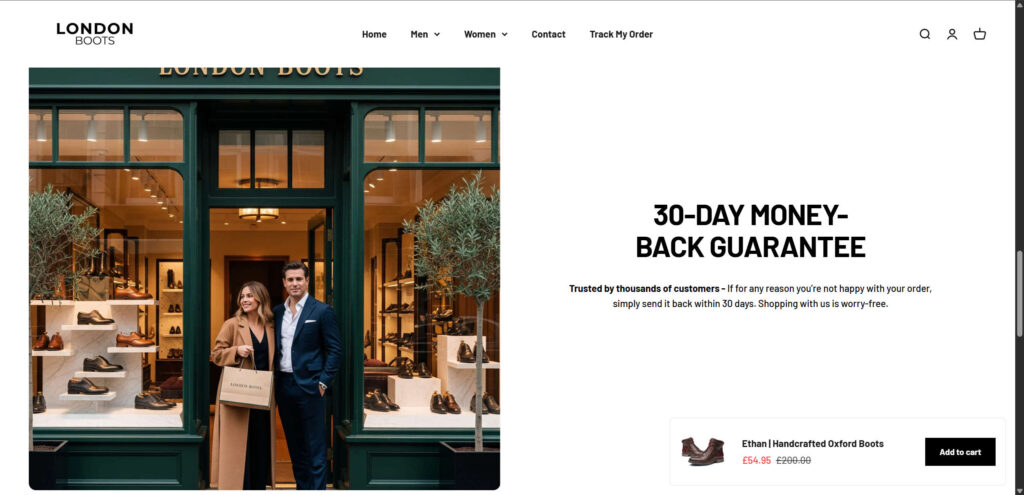
The “London Boots Closure Sale” might look like an incredible opportunity to snag premium footwear at unbeatable prices. Ads are circulating widely on Facebook, Instagram, and TikTok, claiming that the store is shutting down and liquidating inventory with discounts of up to 90% off. The website london-boots.com looks polished, complete with a professional storefront image, money-back guarantee claims, and alluring product photos.
However, behind this slick marketing campaign lies a sophisticated online shopping scam. Shoppers who fall for these ads often receive nothing at all or are sent a cheap random item like a bracelet or pair of sunglasses instead of the premium boots they thought they bought. Others never receive any response after making a payment.
This article provides a comprehensive investigation into the London Boots Closure Sale scam, exposing how it works, how to recognize it, and what to do if you’ve already fallen victim.
Scam Overview
The London Boots Closure Sale scam follows a well-established playbook used by international fraud rings to target unsuspecting shoppers:
- Fake social media ads are placed on major platforms like Facebook, Instagram, and TikTok.
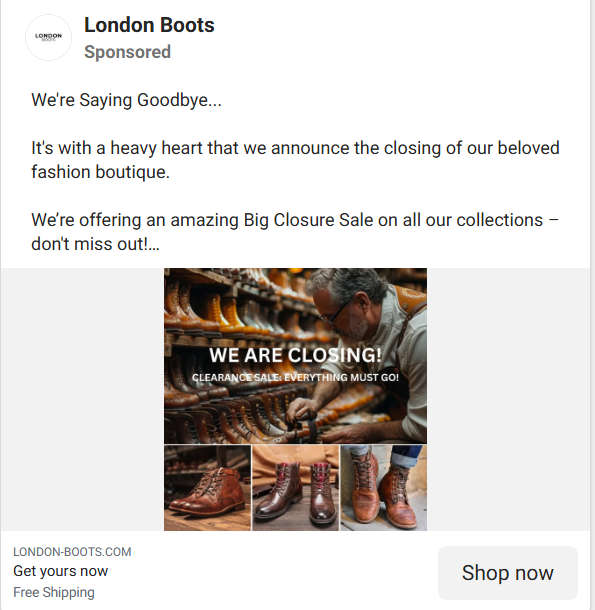
- These ads use emotional triggers such as “We’re Closing Down,” “Big Clearance Sale,” or “Everything Must Go” to create urgency and FOMO (fear of missing out).
- The website is designed to look like a legitimate, established store. It often includes:
- A professional-looking homepage.
- Fake “About Us” stories featuring older craftsmen or a family business.
- “30-Day Money-Back Guarantee” claims.
- Countdown timers and banners showing limited stock.
- A fake “Track My Order” page.
- Once you make a purchase, the scammers either:
- Send no product at all, and disappear.
- Send a cheap counterfeit item or something entirely unrelated (e.g., sunglasses instead of boots).
- Provide fake tracking numbers that lead nowhere or show irrelevant shipments.
- Attempts to contact the company usually lead nowhere:
- Customer support emails are either non-functional or scripted.
- Physical addresses listed on the site are often fake or unrelated locations.
- No legitimate phone number or company registration is available.
- The website uses stolen product photos from real brands or stock image libraries.
- The domain name is recently registered — a major red flag.
- There’s no real social media presence except for the paid ads.
These elements combine to create a convincing illusion of legitimacy while hiding the fact that this is nothing more than a “store closing” scam scheme designed to steal your money.
How the Scam Works
Step 1: Targeting Through Paid Social Media Ads
Scammers invest heavily in targeted ads on Facebook, Instagram, and TikTok to reach users interested in fashion, boots, shoes, or clearance sales.
The ads typically feature:
- Professional images of leather boots.
- Emotional language like “We’re saying goodbye,” “Family business closing after 35 years,” or “Clearance Sale – Everything Must Go.”
- Extreme discounts, sometimes showing products reduced from £200 to £49.95.
- Phrases like “Free shipping,” “Limited time offer,” “Hurry before stock runs out.”
This creates a sense of urgency, pushing the potential victim to click through.
Step 2: Landing on a Fake but Professional Website
Clicking the ad leads to london-boots.com — a fake online shop built on a common dropshipping scam template. The website looks professional:
- It displays a high-end storefront photo (often stolen from unrelated retailers).
- An “About Us” section tells a touching story about handcrafting shoes in London for decades.
- There’s a 30-day money-back guarantee prominently shown.
- Product pages list huge discounts and appear to have customer reviews (which are fake).
- A fake shop interior photo or AI-generated image of a craftsman adds to the illusion.
Everything is designed to lower your guard.
Step 3: Creating Urgency and Trust
Scammers understand buyer psychology. They use:
- Countdown timers suggesting limited-time deals.
- “Only 4 items left” stock counters.
- “Flash Sale” banners.
- Fake trust signals like:
- “Secure checkout.”
- “30-day return policy.”
- “Trusted by thousands of customers.”
These elements are purely for show and have no real support behind them.
Step 4: Collecting Victims’ Payments
Victims enter their credit card details or use PayPal at checkout. The scam site collects this payment:
- If card payment is used, the scammers can charge multiple times or sell the card information.
- If PayPal is used, scammers try to delay responses to make disputes more difficult.
Once payment is made, victims receive:
- An order confirmation email with a fake order number.
- Sometimes a fake shipping confirmation with a tracking link that leads to nowhere.
Step 5: Ghosting the Victim
After payment:
- The scammers stop responding.
- Emails either bounce or get automated replies.
- There’s no customer service phone number that works.
- Physical addresses on the site are fake or copied from real businesses unrelated to the scammers.
- Any refund request is ignored.
Step 6: Vanishing Act
Once enough victims are scammed:
- The domain disappears or goes offline.
- The scammers rebrand and open a new fake site using a different domain (e.g., “boots-london.com” or “londonbootssale.com”).
- The same images and ads are reused.
This cycle of deception allows them to scam thousands of people globally without ever delivering a product.
Red Flags that Indicate the London Boots Closure Sale is a Scam
- Recently created domain – Most scam domains are only a few months old.
- Unrealistic discounts – Boots worth £200 supposedly reduced to £49.95 is a classic lure.
- No verifiable business information – No real company name, registration number, or contact details.
- No social media presence – Legitimate businesses usually have Facebook pages, Instagram profiles, or LinkedIn listings.
- Fake “About Us” stories – Emotional narratives about family-owned workshops or skilled shoemakers are often AI-generated or plagiarized.
- Stolen product photos – A reverse image search often reveals the same images used on multiple unrelated sites.
- Poor grammar and spelling mistakes in some parts of the site.
- Too-good-to-be-true prices – Genuine retailers rarely offer 90% off new merchandise.
- Lack of secure payment options – Some scam sites use insecure gateways.
- Fake reviews and trust seals – These are copied or generated automatically.
Common Tactics Used by Scammers
- Emotional Advertising: “Family business closing,” “Support small businesses.”
- FOMO (Fear of Missing Out): “Everything must go!” “Only a few items left!”
- Stolen branding: Using high-quality images from real shops.
- AI-generated personas: Fake founders, craftsmen, or customer service agents.
- Free shipping promises: To make the deal look even better.
- Fake guarantees: “30-day money-back guarantee” that is impossible to claim.
What to Do If You Have Fallen Victim to the London Boots Closure Sale Scam
If you already made a purchase or shared your payment details, take immediate action to minimize the damage:
1. Contact Your Bank or Credit Card Company
- Immediately report the transaction as fraudulent.
- Request a chargeback.
- Ask your bank to block further transactions to that merchant.
- If you used a debit card, act fast to prevent additional withdrawals.
2. File a Dispute with PayPal (if applicable)
If the purchase was made with PayPal:
- Go to Resolution Center.
- Select “Report a problem.”
- Choose “Item not received” or “Significantly not as described.”
- Attach screenshots of the scam website and ads.
PayPal often sides with buyers in such cases.
3. Monitor Your Accounts for Suspicious Activity
Scammers may:
- Attempt further charges.
- Sell your card information.
- Try phishing attempts via email or SMS.
Keep a close eye on your accounts for the next several weeks.
4. Report the Scam Website
- Report the website to your local consumer protection agency.
- File a report with:
- Action Fraud UK (if in the UK)
- FTC (if in the USA)
- European Consumer Centres (if in the EU)
- Report the ads directly to Facebook, Instagram, or TikTok so they can be taken down.
5. Change Your Passwords
If you created an account on the fake store, change the password immediately. Do not reuse the same password on other sites.
6. Warn Others
- Post about your experience on forums, social media, or consumer protection sites.
- Inform family and friends so they don’t fall for the same scam.
- Share the scam domain name and screenshots if possible.
7. Check Scam Reporting Platforms
Search for the domain on:
- Scamwatch
- Trustpilot
- Whois
- ScamAdviser
These can give you a good indication of a site’s trustworthiness.
Why Scammers Use the “Going Out of Business” Tactics
The “Closing Sale” narrative is one of the most effective ways scammers trick consumers. Here’s why:
- It creates urgency: People feel they need to act fast before the sale ends.
- It reduces skepticism: A store that’s closing might plausibly offer 90% discounts.
- It adds emotion: “Support a small family business one last time” tugs at the heartstrings.
- It attracts bargain hunters: Especially during times of inflation, extreme discounts are irresistible.
This tactic has been repeatedly used in other scams like:
- Big Lots fake outlet
- Ray-Ban sunglasses scams
- Outdoor gear clearance scams
- Appliance liquidation scams
The London Boots Closure Sale scam is just the latest iteration of this formula.
Technical Analysis of the Scam Website
A quick check of london-boots.com reveals:
- Domain age: Recently registered (a few months old).
- No registered company information.
- No privacy policy or terms of service that comply with GDPR or consumer law.
- Stock photos and text copied from other websites.
- Fake Trustpilot logos embedded in page footers.
- No social media icons linking to real accounts.
The website is likely operated from overseas, not from the UK as implied by the branding.
Other Similar Scam Patterns to Watch For
Scammers often replicate the same website structure under different names. Watch out for sites with:
- “London,” “Boots,” “Outlet,” or “Clearance” in the domain name.
- The same product images.
- Similar text like:
- “We’re saying goodbye”
- “Everything must go”
- “Warehouse clearance”
- “Aniversary sale”
- Fake physical store photos (often AI-generated or stock).
How to Protect Yourself from Store Closing Sale Scams
- Always check domain age: Use WHOIS lookup to see when the site was created.
- Search for reviews: If no real customer reviews exist, that’s a red flag.
- Verify contact information: Check if the address and phone number are real.
- Be wary of huge discounts: If it seems too good to be true, it probably is.
- Avoid direct bank transfers: Use secure payment methods with buyer protection.
- Look for HTTPS: While not foolproof, lack of HTTPS is a warning sign.
- Reverse image search product photos: If the same image appears on many sites, it’s likely fake.
- Check return and refund policies: Scammers often have vague or non-existent policies.
- Report suspicious ads: Help get them taken down faster.
Why It’s Important to Report These Scams
Every time a fake store like London Boots is reported, it helps:
- Shut down the domain faster.
- Alert other consumers.
- Reduce scammer profits.
- Make it harder for the same criminals to operate new scams.
Reporting scams to authorities and platforms creates a digital paper trail, which can lead to the scammers being blacklisted or taken down.
Real Victim Experiences
Across consumer forums, Trustpilot, and Reddit, users have reported similar experiences:
- “I ordered boots and got a cheap plastic bracelet.”
- “I received no product and the email bounced back.”
- “The tracking number they sent me doesn’t exist.”
- “I checked the address and it was a random office building unrelated to the store.”
These patterns confirm that London Boots is not a legitimate retailer but part of a coordinated scam operation.
How to Verify if a Store Closing Sale Is Legitimate
Before making a purchase:
- Search the store name + “scam” on Google.
- Look for official social media accounts with a posting history.
- Check for authentic business registration information.
- Look for real customer reviews with photos on multiple platforms.
- Call the listed phone number or search the physical address on Google Maps.
- Use reverse image search on the product photos.
Legitimate businesses are transparent. Scams rely on speed and deception.
The Bottom Line
The London Boots Closure Sale Scam is a classic example of a fake going-out-of-business sale designed to deceive shoppers with emotional stories, huge discounts, and fake professional branding.
- The site london-boots.com is not associated with a real London-based store.
- All product images and content appear to be stolen or AI-generated.
- Victims who make purchases risk losing their money, receiving junk products, or exposing their payment information to criminals.
Always verify a website before making a purchase, especially when deals seem too good to be true. If you’ve been scammed, act quickly by contacting your bank or PayPal, filing a dispute, and reporting the scam.
Key Takeaways
- London Boots is a fake store using a store closing sale narrative to lure victims.
- They advertise aggressively on social media platforms like Facebook, TikTok, and Instagram.
- Victims are either scammed out of their money or receive worthless junk items.
- No real contact information or company exists behind the website.
- Always check domain age, reviews, and contact details before buying online.
Frequently Asked Questions (FAQ)
Is London Boots a real store?
No. London Boots (london-boots.com) is not an authentic or registered retail store. It is a fake website set up to scam online shoppers through fake closing sale ads.
Why do scammers use “store closing” sales?
Because it creates urgency and emotional appeal, pushing people to buy quickly without verifying legitimacy.
How do I get my money back if I was scammed?
Contact your bank or PayPal immediately and initiate a chargeback or dispute. Provide screenshots, receipts, and emails.
Are the products really discounted by 90%?
No. These discounts are fake. Scammers use extreme discounts to attract buyers.
Why is there no phone number or physical address?
Because the store is not real. The contact information listed is fake or non-functional.
I received a cheap item instead of my order. What now?
File a dispute for “item not as described” with your payment provider. Provide proof and screenshots.
Can I report this scam?
Yes. Report it to your local consumer protection agency, Action Fraud (UK), FTC (USA), or relevant EU authority. Also, report the ad on Facebook or TikTok.
How can I avoid scams like this in the future?
Verify the store before purchasing:
- Check domain registration date.
- Look for real company info.
- Search for reviews and customer experiences.
- Beware of extreme discounts and emotional marketing.
What happens to scam websites after they’re reported?
Many get taken down, but scammers often reopen under a different name. That’s why widespread reporting and public awareness are crucial.
Final Word
The London Boots Closure Sale scam is part of a widespread pattern of fraudulent e-commerce operations. These scams are designed to look trustworthy and urgent, but they have one goal: to take your money. Always research before you buy, especially when the deal looks too good to be true.
Stay informed. Share this article with others. And if you ever come across a suspicious store, report it — you may save someone else from becoming a victim.








