

Lately, you’ve probably seen the Loona Ortho Walk Shoes everywhere — in Instagram reels, Facebook ads, YouTube Shorts, and even TikTok videos promising instant foot pain relief. The ads claim these sneakers can “help you walk pain-free again” and “feel like walking on clouds.”
At first glance, they seem like a miracle for anyone suffering from plantar fasciitis, bunions, or chronic foot pain. They’re marketed as podiatrist-approved, orthopedic-designed, and trusted by thousands worldwide.
But when you look closer, things stop adding up. The website only launched a few months ago. The listed “doctors” don’t exist. The address isn’t real. And identical shoes are being sold on Alibaba for under $4, while LoonaSlides.com charges nearly $60 — claiming they’re a medical-grade innovation.
This article takes a deep dive into LoonaSlides, the company behind these shoes, and uncovers the dropshipping operation behind their marketing — a system built on deceptive ads, fake endorsements, and misleading health claims.
If you’ve been thinking about buying Loona Ortho Walk Shoes, read this first.
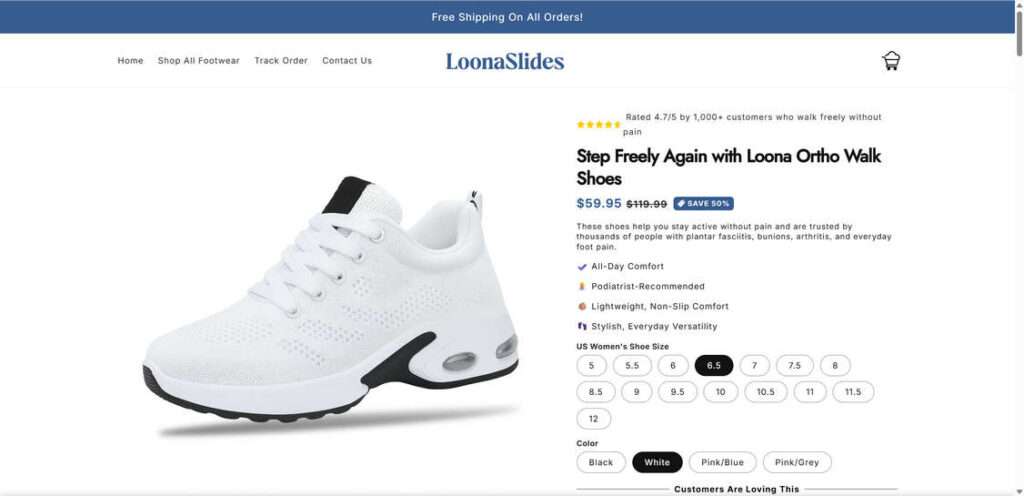
Overview: What Are Loona Ortho Walk Shoes?
Loona Ortho Walk Shoes are advertised as orthopedic walking shoes designed to relieve pain and improve posture. The product page is filled with big promises and emotional language — all crafted to convince people with chronic pain that these shoes will finally end their suffering.
Here’s how the company describes them:
“Step freely again with Loona Ortho Walk Shoes. These podiatrist-recommended shoes help you stay active without pain and are trusted by thousands of people with plantar fasciitis, bunions, arthritis, and everyday foot pain.”
They’re priced at $59.95, allegedly discounted from $119.99. The site proudly displays a “SAVE 50%” banner that never expires — a classic tactic used by dropshipping stores to create false urgency.
Claims Made by LoonaSlides
- All-day comfort: “Designed for 24-hour pain-free walking.”
- Podiatrist recommended: “Trusted by foot specialists worldwide.”
- Lightweight and breathable: “Engineered for long-lasting comfort.”
- Orthopedic arch support: “Built-in heel cup and arch for proper alignment.”
- Stylish design: “Looks like regular sneakers, feels like medical footwear.”
The site even shows alleged medical endorsements from “Dr. Jeremy Campbell” and “Dr. Anthony Ratkovic,” who supposedly evaluated the shoes’ benefits. The two “doctors” are presented with professional portraits and testimonials about Loona’s “biomechanical benefits.”
But here’s where the cracks begin to show.
Red Flags on the Website
1. The Website Is Brand-New
A WHOIS lookup shows that loonaslides.com was registered on July 18, 2025 — making it a few months old. Yet, the site claims “thousands of satisfied global customers.” For a brand-new domain with no trace before that date, those numbers are impossible.
This short lifespan is a common sign of dropshipping stores, which are often created, promoted heavily for a few months, and then shut down once negative reviews pile up.
2. Fake Medical Endorsements
The supposed doctors — “Dr. Jeremy Campbell” and “Dr. Anthony Ratkovic” — are not listed in any official databases of physical therapists or podiatrists. A reverse image search shows their photos appear on stock photo websites used by marketers.
The “testimonials” attributed to them are identical to those found on other shoe scam websites like OllieComfort.com and SoleEase.com, both of which also sell cheap rebranded sneakers.
3. Unrealistic Discounts
Every single item on LoonaSlides — from shoes to ankle sleeves — is discounted by exactly 50%. Real orthopedic brands like Brooks or Asics don’t run permanent site-wide half-off sales. This tactic is meant to make shoppers feel like they’re getting an exclusive deal, but in reality, these “sales” are permanent bait offers.
4. Generic, Copied Text
Sections like “Still Living with Foot Pain?” and “Why Everything Else Failed You” use identical copy found on multiple fake footwear websites. The paragraphs are emotional but vague — intentionally written to trigger empathy and urgency rather than convey facts.
The same layout and text blocks can be found across numerous domains selling identical shoes under different names (e.g., “Loona Comfort Pro,” “OrthoEase Walkers,” and “CloudRelief Shoes”).
5. No Real Contact Options
The only listed contact method is an email — support@loonaslides.com — with no phone number, physical office, or live chat. The listed address, “1401 Greengrass Drive, Houston, TX 77008,” leads to a residential area, not a business.
When users attempt to reach support, most report receiving generic copy-paste replies or no response at all.
6. No Verified Reviews
The site claims a “4.7/5 rating from 1,000+ customers,” but there are no real reviews on platforms like Trustpilot, SiteJabber, or BBB (Better Business Bureau).
For a supposedly popular global brand, that’s impossible. It’s another indicator of a store fabricated entirely for a short-term profit window.
Fake Doctors, Fake Testimonials, Fake Credibility
The “Trusted by Medical Professionals” section on the site is perhaps the most deceptive.
It features two well-dressed men in lab coats, complete with captions:
- “Dr. Jeremy Campbell – Licensed Doctor of Physical Therapy”
- “Dr. Anthony Ratkovic – Practicing Chiropractor”
Underneath, the text claims:
“Through their research, they determined that Loona Ortho Walk Shoes provide effective structural support for chronic plantar fasciitis pain.”
None of these claims are verifiable.
Neither “doctor” exists in any medical board database in the U.S. or U.K.
Their images are AI-generated composites of stock models used on dozens of other shoe and back-pain product pages.
This misuse of fake credentials and images violates FTC rules against deceptive health claims, which prohibit implying medical endorsement without proof.
Identical Alibaba Products for $3
Perhaps the biggest giveaway that LoonaSlides is a dropshipping operation is the product’s source.
Identical shoes — same sole design, same mesh upper, same air-cushion heel — are available on Alibaba and AliExpress for $2.75–$3.99 per pair. Sellers even offer OEM branding options, meaning anyone can print their own logo (like “LoonaSlides”) and resell them.
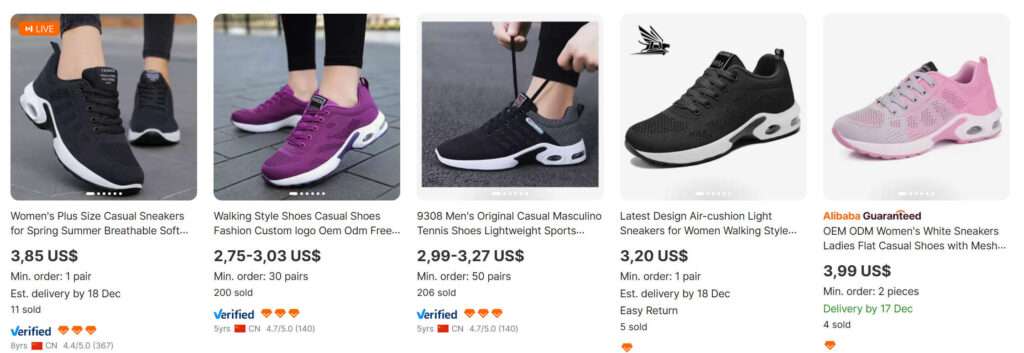
Some of these listings are literally titled:
- “OEM Women’s Orthopedic Sneakers with Air Cushion Sole”
- “ODM Lightweight Walking Shoes for Foot Pain”
- “Plus Size Breathable Orthopedic Shoes for Women”
All are manufactured in Guangzhou and Quanzhou, China, by generic footwear suppliers.
This means LoonaSlides isn’t designing or manufacturing anything. It’s simply dropshipping these shoes at a 1500% markup.
How the Dropshipping Operation Works
The operation behind LoonaSlides follows a predictable and profitable pattern. It’s a textbook case of emotional manipulation + paid advertising + false credibility.
Step 1: Identify a Pain Point
The marketers pick a common chronic issue that affects millions — in this case, foot pain. They target conditions like plantar fasciitis, bunions, or arthritis, which are emotionally charged and difficult to treat.
This ensures their ads resonate with people who are desperate for relief.
Step 2: Rebrand a Cheap Product
Next, they source an inexpensive product from Alibaba — one that looks medical but costs less than $5.
They rebrand it with a Western-sounding name (“LoonaSlides”) and create a sleek Shopify store using professional templates.
Then they invent a backstory:
“We were tired of expensive shoes that didn’t work, so our founder spent three years designing the perfect orthopedic sneaker.”
This fake origin story appears word-for-word on multiple dropshipping footwear sites.
Step 3: Build a Fake Brand Identity
The site is filled with authority cues — logos, “podiatrist-approved” badges, and emotional customer testimonials.
They include “verified customer reviews” with profile pictures, but the photos are easily found on stock websites or reused across unrelated stores.
Countdown timers and banners like “Sale ends tonight!” or “Only 5 left in stock!” reset every few hours.
All these elements are intended to push visitors toward impulse buying before they can research the brand.
Step 4: Run Social Media Ads
The operation then launches a flood of Facebook, Instagram, and TikTok ads, targeting middle-aged audiences (especially women over 40) with interests in wellness, joint pain, or orthopedics.
These ads show actors or voiceovers describing “how these shoes gave me my life back.” The videos often use dramatic storytelling:
“I used to wake up in pain every morning, gripping the nightstand just to stand up… but now I walk freely thanks to these shoes!”
Every ad links directly to the Shopify product page.
Step 5: Fulfillment via AliExpress or CJ Dropshipping
Once the order is placed, the seller doesn’t ship from the U.S. — despite the website’s claims. Instead, orders are forwarded to Chinese suppliers, who ship via YunExpress, 4PX, or China Post, taking 2–4 weeks.
The product arrives in a generic plastic bag, often with Chinese labeling and no brand packaging.
Step 6: Refund Barriers
If you try to return the shoes or ask for a refund, you’ll likely be met with generic emails or ignored entirely. The refund policy is vague, often requiring you to ship the item “to our overseas warehouse,” which makes returns cost-prohibitive.
Many buyers never see their money again.
When complaints grow, the domain goes offline — only to reappear under a new name, such as LoonaSteps, ComfortEaseWalkers, or OrthoFlowShoes.
Fake Urgency and Scarcity Tactics
The LoonaSlides website uses a range of psychological tricks:
- Permanent discounts (“SAVE 50% OFF — today only!”)
- Fake stock counters (“12 sold in the last hour!”)
- Fear-of-missing-out language (“Limited quantities remain — order now!”)
In reality, the “sale” never ends. The fake counters reset with each visit. These tactics are commonly used to push impulse purchases and exploit people searching for quick relief from chronic pain.
Deceptive Advertising Practices
LoonaSlides’ marketing violates several principles of fair online advertising:
- False medical claims – claiming “doctor-recommended” or “podiatrist-approved” without real certification.
- Unverified testimonials – using AI-generated or stock images as “verified buyers.”
- Fake location claims – pretending to be a U.S.-based company while operating out of China.
- False scarcity and countdown timers – misleading consumers into rushed purchases.
- Lack of business transparency – no company registration number, tax ID, or legitimate address.
All of these tactics fall under FTC deceptive advertising violations.
What to Do If You Bought Loona Ortho Walk Shoes
If you’ve already purchased from LoonaSlides.com, you may still be able to recover your money or at least report the transaction to protect others.
1. Document Everything
Take screenshots of:
- The product listing and sale page
- The checkout confirmation
- Your bank or PayPal transaction
- All emails exchanged with the seller
2. Contact the Seller
Email support@loonaslides.com immediately and request a refund. Be firm and cite “false advertising and product misrepresentation” as your reason. Keep all correspondence for proof.
3. File a Dispute
If they don’t respond within a few days:
- Credit card: Contact your bank and request a chargeback under the reason “merchandise not as described.”
- PayPal: File a dispute under “item not received or not as described.”
Include screenshots and tracking information as evidence.
4. Report the Website
Report the store to:
- FTC – reportfraud.ftc.gov
- Facebook Ads – if you saw the ad there
- Shopify Abuse Team – if the store runs on Shopify (they often do)
- Scamwatch.gov (Australia) or Action Fraud UK
5. Warn Others
Post your experience on:
- Trustpilot
- Reddit (r/Scams)
- BBB Complaint Portal
Public reports help alert future shoppers before they lose money.
6. Block Future Charges
If you used a debit or credit card, monitor your statement closely. Many of these stores share payment processors, and unauthorized rebilling can occur. Contact your bank to block recurring transactions.
The Bottom Line
Loona Ortho Walk Shoes are not an orthopedic breakthrough — they’re part of a dropshipping operation built around deceptive marketing. The shoes are mass-produced, low-cost sneakers from Alibaba, rebranded with fabricated medical endorsements and sold at 15 times their original price.
From the fake doctors to the manipulated “4.7-star ratings” and permanent discounts, every element of LoonaSlides.com is designed to mimic legitimacy while hiding its true nature.
If you truly suffer from chronic foot pain, consult a licensed podiatrist or invest in proven, medically supported footwear from legitimate brands.
Don’t fall for emotional storytelling and discount countdowns — especially from a website that didn’t even exist six months ago.
Final Verdict:
Loona Ortho Walk Shoes are not the miracle cure they claim to be. They’re another dropshipping scam disguised as an orthopedic solution, and your wallet — not your feet — is the one carrying the pain.








