

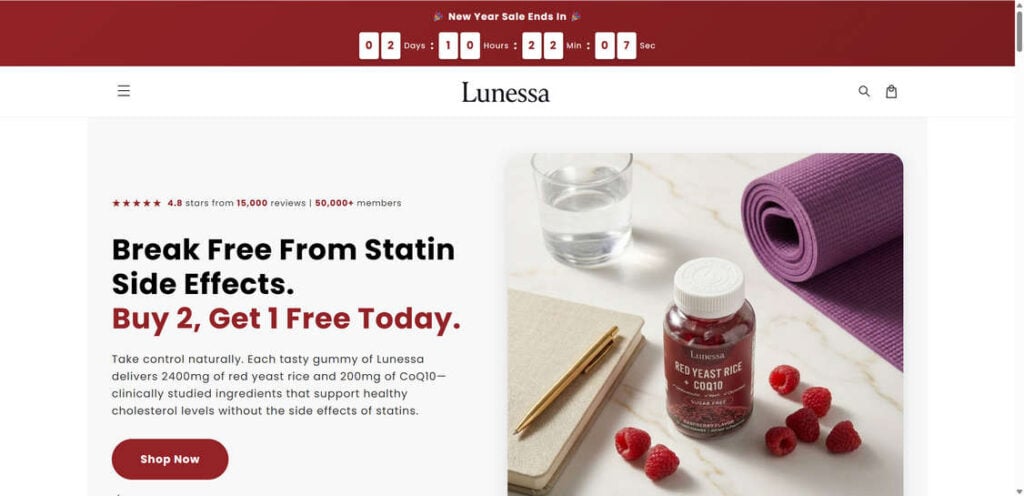
Lunessa Gummies are marketed like a breakthrough: a “natural” alternative to prescription statins that supposedly supports healthy cholesterol while avoiding the side effects people fear most.
The pitch is polished. There’s a doctor-style endorsement, a sleek comparison chart (“Lunessa vs. prescription statins”), and emotional testimonials that read like a turning point story.
Then come the pressure levers: a pop-up discount, a “limited-time” offer, and bundle pricing designed to make you buy more than you planned.
If you’re here, you’re probably asking the right question: is Lunessa a genuinely differentiated supplement, or a common formula packaged as a premium solution and sold at a steep markup?
This review walks through what Lunessa claims, what the core ingredients can and cannot do, and the red flags that matter most before you spend money or change anything about your health routine.
Overview
What Lunessa Gummies are actually selling
At its core, Lunessa appears to be a red yeast rice + CoQ10 supplement in gummy form.
That combination is not new.
Red yeast rice is widely marketed for cholesterol support, largely because it can contain monacolin K, a compound that is chemically the same as the active ingredient in the prescription statin lovastatin.
CoQ10 is commonly bundled alongside “statin alternative” products because statins can reduce CoQ10 levels in the body, and marketers use that fact to imply CoQ10 will prevent fatigue or muscle symptoms.
So the core formula is familiar.
What changes from one brand to the next is not the concept, but the execution: ingredient quality, standardization, contaminant testing, manufacturing controls, transparency, and whether the brand provides credible documentation.
That’s where many direct-to-consumer supplement brands become more marketing than substance.
The central issue with red yeast rice: “natural” does not mean simple
Red yeast rice is often sold with a “plant-based” halo, but its most important cholesterol-related compound behaves like a statin.
That matters because it implies two things at the same time:
- If the product contains meaningful monacolin K, it may lower LDL cholesterol for some people, but it also carries statin-like risk considerations.
- If the product contains little or no monacolin K, you may be paying for a promise without the active component that makes the promise plausible.
This is not speculation. Reputable medical sources note that monacolin K has the same chemical structure as lovastatin and can cause similar side effects, including potential liver, muscle, and kidney issues.
European regulators have also raised safety concerns. The European Food Safety Authority (EFSA) concluded that exposure to monacolin K from red yeast rice can lead to serious adverse effects, including muscle-related harms.
So the supplement exists in an awkward reality: it is sold like a gentle wellness product, but it can behave like a medication in the body, while being regulated and quality-controlled very differently than prescription drugs.
The second issue: inconsistent potency and contaminant risk
Even when two bottles say “red yeast rice,” they may not be comparable.
Potency can vary widely across supplements, and contamination is a known industry concern.
One contaminant that matters a lot is citrinin, a toxin that can appear in poorly made red yeast rice products. Some brands claim “citrinin-free,” but that only matters if the company provides credible third-party testing.
This is why “third-party tested” as a badge is not enough. It needs to be testable in the real world: a batch report, a certificate of analysis, a lab name, and a way to confirm it.
If Lunessa does not provide verifiable documentation, you are left with marketing trust, not product certainty.
What about CoQ10? Helpful, but not a magic shield
CoQ10 is a reasonable supplement in some contexts, but it is frequently used as a marketing bridge: “statins deplete CoQ10, so take this to feel better.”
The actual evidence on CoQ10 for statin-associated muscle symptoms is mixed.
Some research suggests CoQ10 may help some people, while other controlled studies have found no meaningful reduction in muscle pain.
That does not mean CoQ10 is useless. It means you should be cautious when a brand implies CoQ10 makes the whole “statin alternative” story safer or universally comfortable.
The “doctor recommended” problem: credibility requires verification
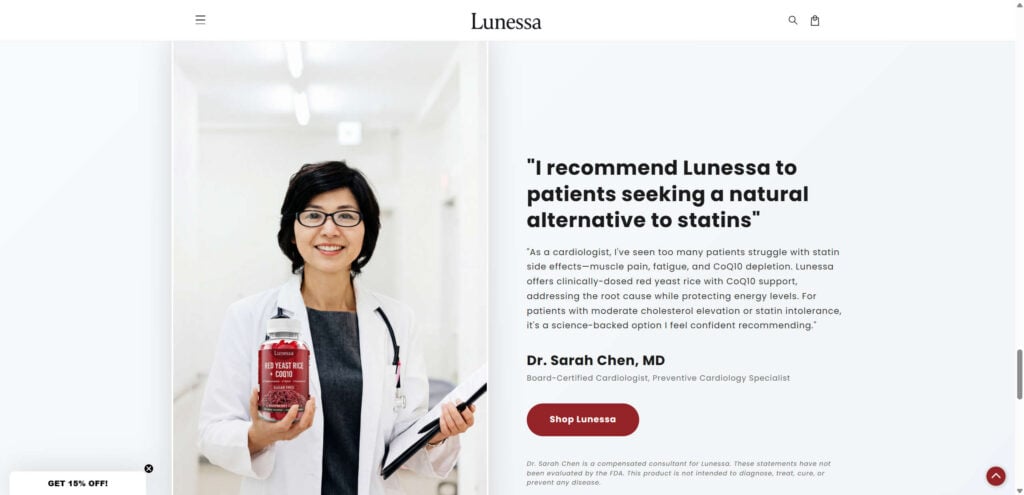
When a product page uses a doctor figure, it is doing more than adding a face.
It is borrowing authority.
If the page does not provide:
- a verifiable full name,
- credentials you can confirm,
- a real clinic or hospital affiliation,
- and clear disclosure of compensation,
then it is not a medical recommendation in any meaningful sense. It is marketing copy wearing a white coat.
You also flagged something important: the “doctor” image appears AI-generated, and the testimonial images appear AI-generated as well.
The China supply chain signal: private-label import cues
You asked to make this explicit.
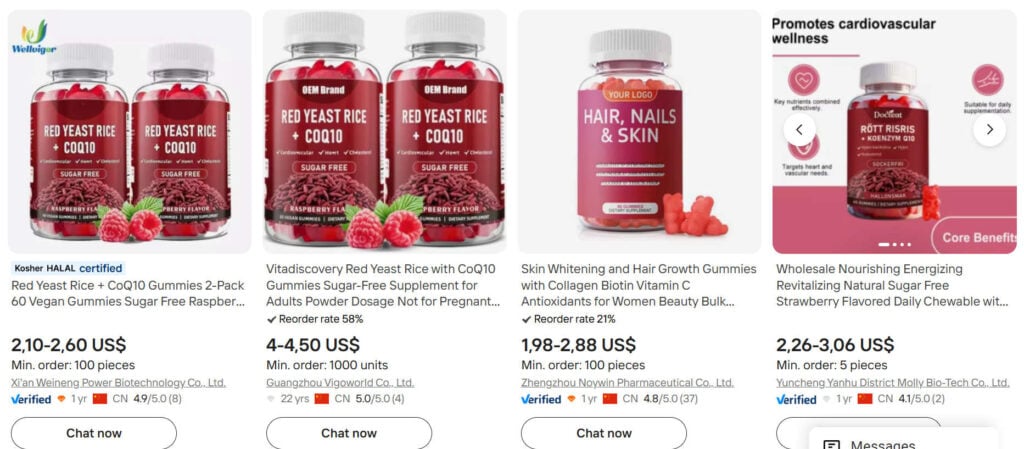
Based on the wholesale-style listings you shared, products matching the “red yeast rice + CoQ10 gummies” concept appear widely available from Chinese manufacturers at very low per-unit costs.
That does not automatically prove Lunessa is shipped from China, but it strongly supports a common pattern:
- A factory produces a generic formula (often “OEM” or private label).
- A marketer wraps it in a premium brand story.
- The retail price is raised dramatically.
- The marketing focuses on urgency, authority cues, and fear-of-statin side effects.
When consumers pay $20+ per bottle (often more through bundles), but the underlying product category is available wholesale for a few dollars, you are not paying for ingredients.
You are paying for the funnel: the ads, the branding, and the margin.
Returns and refunds: why overseas fulfillment changes everything
Here’s the practical point most people learn too late:
If a brand is fulfilled overseas, returns are often difficult even when the policy claims they are “risk-free.”
Common problems include:
- Return addresses that are overseas (often China), making shipping expensive.
- Refunds conditioned on unopened packaging or strict timelines.
- Customer service delays that push you past the return window.
- Return shipping costing so much that it is not worth it.
So if you are considering buying, the most important step is not reading the headline guarantee.
It is checking the return process details and the actual return address before you order.
If it requires shipping to China, the “guarantee” becomes a psychological safety net, not a practical one.
How the operation works
This section explains the playbook because once you see it, you start spotting it everywhere.
Step 1: Start with a commodity formula that already has a story
Red yeast rice already comes with a built-in narrative:
- “Natural cholesterol support”
- “Statin alternative”
- “Plant-based solution”
CoQ10 adds a second narrative:
- “Energy”
- “Vitality”
- “Support for people who struggle with statins”
That is why this combo appears so often. It is not just formulation, it is storytelling.
Step 2: Build a premium brand identity around the same core product
Next comes the brand packaging:
- a clean site design,
- a medical-style color palette,
- clinical words like “clinically dosed,” “lab tested,” and “third-party tested,”
- and a comparison chart that frames the product as the smarter choice.
This is where the consumer’s attention shifts.
Instead of asking, “What exactly is in this and how do I verify it?” the page pushes you to ask, “Should I choose this instead of statins?”
That is a huge leap.
And it is very profitable if the page can get you to make it.
Step 3: Add authority cues that feel like proof
Authority cues often include:
- “Doctor recommended” messaging without verifiable details
- a doctor portrait that looks like a stock or AI-generated image
- a disclaimer that quietly admits the endorsement is compensated
- and general claims like “clinically studied ingredients” rather than product-specific clinical trials
This matters because “clinically studied ingredients” is not the same as “this exact product was clinically tested.”
A single ingredient can be studied in isolation, in a different form, at a different dose, in a different population, and still be used in marketing as if it proves the finished product works.
Step 4: Use emotional testimonials as the engine of belief
Your screenshots show the kind of testimonials often used in these funnels: dramatic outcomes, strong emotional relief, and simple cause-and-effect storytelling.
When the images look AI-generated or stock-like, and the identities are not verifiable, the testimonials function as persuasion, not evidence.
The goal is to bypass analysis:
- “It worked for her.”
- “She looks real.”
- “My problem sounds like her problem.”
- “I should try it.”
That is how impulse purchases happen for supplements.
Step 5: Trigger urgency and maximize cart size
Then the pricing tactics appear:
- constant “limited-time” discounts
- countdown timers
- bundle offers like “Buy 2 Get 1 Free”
- “Most popular” badges and “best value” framing
- pop-up codes like “Get 15% off”
- sometimes subscriptions or hidden continuity language
This is not about giving you a deal.
It is about increasing the average order value and reducing the chance you will pause and research.
Step 6: Fulfillment reality: long shipping, unclear origin, complicated returns
This is where the customer experience often breaks.
If the product is shipped from overseas (commonly China or via international fulfillment hubs), you may see:
- longer delivery times than expected
- limited tracking clarity
- difficulty reaching support
- return instructions that are slow, strict, or expensive
Even when a site promises a “risk-free” trial, the fine print can make refunds hard to execute in real life.
If returns require shipping back to China, most people do not follow through.
That is the economic design.
Step 7: The markup is the business model
When a supplement category is available wholesale for a few dollars per unit, but is sold retail for $20+ per bottle, the margin is doing the work.
The product may not be counterfeit.
It may not be illegal.
But the business model is still the same: a generic product, premium framing, and heavy persuasion to justify a price far above what the underlying item typically costs.
That is why the marketing feels so intense.
The economics require it.
What to do if you bought Lunessa Gummies
If you already ordered, the goal is to protect your health first and your money second, in that order.
- Save everything now (before you email support).
Screenshot the order confirmation, product page claims, return policy, and any guarantee language. Save tracking emails and invoices. - Check the return policy for the return address.
If the address is in China (or overseas), calculate the shipping cost before you agree to anything. In many cases, return shipping can wipe out the refund. - Contact support in writing and keep it simple.
Ask for:- the return address
- return authorization steps
- whether they provide a prepaid label
- what conditions apply (opened, unopened, time window)
- If they delay, set a hard deadline in your next message.
Example: “If I don’t receive return instructions within 48 hours, I will dispute the charge with my payment provider.” - If the return is impractical, consider a dispute.
If the product was misrepresented, the delivery is delayed, or the return process is unreasonable, contact your bank or card issuer and ask about a chargeback. Use your screenshots as evidence. - Do not change medications without a clinician.
This is critical. Red yeast rice can act like a statin because monacolin K is chemically the same as lovastatin.
If you are on cholesterol medication, or you have liver issues, kidney issues, or unexplained muscle pain, talk to a clinician before using any red yeast rice product. - Stop use and seek medical advice if you notice warning signs.
Potential red flags include unusual muscle pain or weakness, dark urine, severe fatigue, or symptoms that feel “statin-like.” EFSA and clinical sources highlight that monacolin exposure can cause serious musculoskeletal effects in some cases. - If you decide to use it anyway, insist on transparency.
Look for proof of:- standardized monacolin content (not vague labeling)
- citrinin testing
- credible third-party lab documentation
If a brand cannot provide it, you are trusting marketing.
- Report misleading ads when appropriate.
If you saw “doctor approved” claims without verifiable information, or heavily edited outcomes presented as typical, report the ad on the platform where you saw it.
The bottom line
Lunessa Gummies are built on a familiar formula and an even more familiar playbook.
Red yeast rice can behave like a statin because it may contain monacolin K, which is chemically the same as lovastatin, and regulators and medical sources have raised real safety concerns around monacolins and adverse effects.
That makes “natural statin alternative” marketing inherently tricky. It can be both plausible and risky, depending on potency, purity, and your health situation.
What pushes Lunessa into “don’t buy without caution” territory is not just the ingredient concept. It’s the surrounding signals:
- authority cues that are hard to verify (including doctor-style imagery that appears AI-generated)
- testimonial visuals that look manufactured rather than independently credible
- pressure-based discounting that never seems to end
- and a private-label import pattern that suggests you are paying a premium price for a product that is widely available at low wholesale cost
If you want to explore red yeast rice, do it like an adult medical decision, not a checkout-page decision. Get clinician input, verify testing, and treat “risk-free” guarantees as marketing until the return process proves otherwise.

Reviews & discussion
8 commentsShare a firsthand experience, or ask a question.
Community reviews
Lunessa Gummies
Moderated reader experiences, not an editorial verdict.
Reviews
Be the first to review
Approved reviews for this site or product will appear here.