

If you have ever searched for a “natural statin alternative,” you have probably seen ads like this.
A bottle of red gummies. A reassuring doctor quote. A neat comparison chart that makes prescription statins look harsh and outdated.
Then the hook: a big discount, a limited-time deal, and testimonials claiming dramatic cholesterol drops in weeks.
Lunessa Red Yeast Rice + Coq10 Gummies sit right in the center of that playbook.
And the question is not “can red yeast rice and CoQ10 be relevant ingredients?” The better question is: are you buying a carefully formulated, transparently tested supplement, or a high-markup product sold through aggressive marketing and hard-to-verify claims?
This review breaks down what Lunessa Red Yeast Rice + Coq10 Gummies appear to be, what the ingredients can and cannot do, how the operation typically works, and what to do if you already ordered.
Overview
What Lunessa Red Yeast Rice + Coq10 Gummies claim to be
Lunessa Red Yeast Rice + Coq10 Gummies are marketed as a two-ingredient cholesterol support product built around:
- Red Yeast Rice, positioned as a “natural” solution for cholesterol
- CoQ10, positioned as support for energy, muscle comfort, and statin-related depletion
The messaging usually targets people who:
- Have elevated cholesterol numbers
- Have concerns about statin side effects
- Want an easier, “no prescription needed” option
On the surface, this is a familiar supplement pitch. The details are where things start to matter.
The key problem: supplement claims versus drug-like effects
Red yeast rice is not just “a vitamin-like ingredient.” It can contain monacolin K, a compound that is chemically identical to lovastatin, a prescription statin drug.
That matters for two reasons:
- Efficacy can vary wildly
If a product contains meaningful monacolin K, it may have a stronger cholesterol-lowering effect. If it contains little or none, it may do very little. The amount is often inconsistent across products, and not always clearly disclosed. - Safety and regulation are not simple
The U.S. Food and Drug Administration has taken the position that red yeast rice products with significant or enhanced monacolin K are considered unapproved new drugs and cannot be sold legally as dietary supplements.
Separately, the European Food Safety Authority has issued a safety opinion noting that exposure to monacolin K from red yeast rice can lead to adverse effects, including potentially severe ones.
So, when a brand sells red yeast rice as a soft, “natural” alternative, it is often smoothing over the complicated part: if it works like a statin, it can also carry statin-like risks and interactions.
Why CoQ10 gets added
CoQ10 is frequently paired with statin-related products because statins can reduce CoQ10 levels in the body, and some people use CoQ10 to support muscle comfort.
That does not automatically make a product good or bad.
But it does explain why the marketing is so effective: it frames the product as a complete “statin alternative system,” not just a supplement.
The marketing red flags that matter
Several credibility issues stand out.
1) “Doctor recommended” visuals that are hard to verify
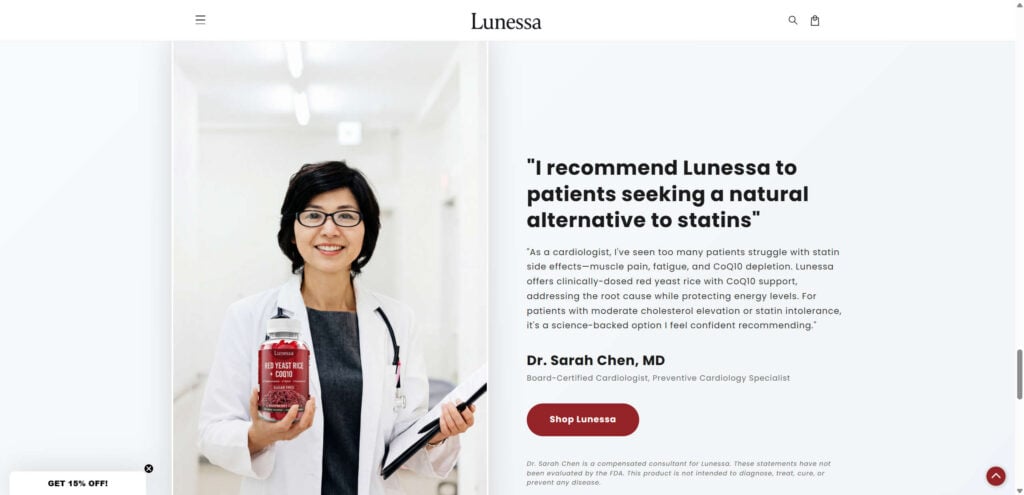
Some pages use a doctor’s headshot, a name, and a strong endorsement.
The problem is that the presentation often looks like a polished marketing asset rather than a verifiable medical professional tied to an actual clinic, license, or published work.
In many cases like this, the “doctor” image appears to be either stock photography or AI-generated.
That is not a courtroom claim. It is a credibility issue. If a brand leans on medical authority, it should be able to back it with real identifiers: licensing details, a clinic affiliation, and a verifiable footprint outside the sales page.
If none of that exists, treat the endorsement as marketing copy, not medical validation.
2) Testimonials that function like sales assets, not evidence
The testimonials are often presented in a very specific format:
- Full-face photos
- Confident claims
- Precise numbers and timeframes
- Strong emotional relief language
That is exactly what converts in ads.
But it is also the easiest thing to fabricate using stock photos, AI-generated portraits, or paid UGC-style creators reading a script.
When you cannot find consistent, independent reviews on neutral platforms, the safest assumption is that the testimonials are not reliable evidence of typical results.
3) “My cholesterol dropped X points in 90 days” style claims
A claim like “47 points in 90 days” is persuasive because it feels medical and measurable.
But if a supplement is going to imply results that look like drug outcomes, you should demand drug-level transparency:
- exact active compound amounts
- batch testing
- adverse event disclosures
- real-world consistency
Most of these funnels do not deliver that level of proof.
4) The pricing structure signals high markup
This category commonly uses:
- “Buy 2 get 1 free” bundles
- a “most popular” tier
- subscription checkboxes
- high anchor pricing to make the discount feel urgent
It is not automatically wrong. But it is a strong signal that the business model is conversion-first.
The China and private-label reality
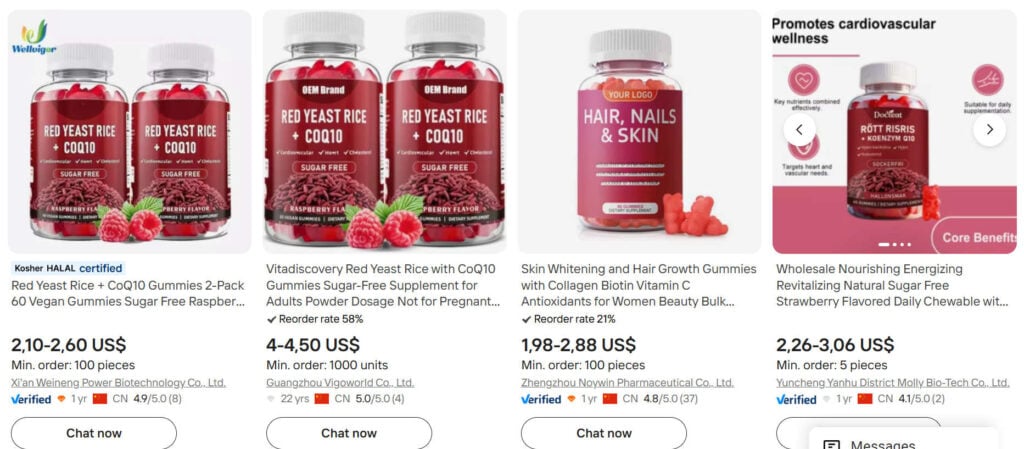
On chinese sites, there are wholesale marketplace listings for red yeast rice + CoQ10 gummies at very low per-unit prices offered by manufacturers and suppliers based in China.
That does not prove that Lunessa is the same factory, the same formulation, or the same quality control.
What it does suggest is this:
- Products in this exact category are widely available as private-label goods from Chinese manufacturers.
- A storefront brand can buy or rebrand a near-identical product, then sell it at a much higher price using a premium narrative.
This is one of the most common patterns in supplement and gummy dropshipping: the “brand” is primarily the sales page, the creatives, and the funnel.
If you want a higher confidence purchase, you look for:
- clear manufacturer identity
- real third-party lab reports that include batch numbers
- transparent dosage and safety details
- realistic claims that do not depend on urgency tactics
Safety issues consumers rarely hear about
There are two safety topics that credible sources repeatedly mention with red yeast rice supplements:
- Monacolin K equals lovastatin, with similar risk profile
This is why the regulatory and safety discussion exists in the first place. - Contamination concerns, especially citrinin
Some red yeast rice supplements can contain citrinin, a toxin that can harm the kidneys.
This is why “third-party tested” should not be a vague badge. It should be a real report you can inspect.
If a sales page does not show credible lab documentation and relies mostly on marketing reassurance, you are taking unnecessary risk.
What the “should you buy it” answer comes down to
A fair, practical decision rule looks like this:
- If you want to experiment with red yeast rice for cholesterol, do it with medical guidance and a product that is transparent about testing and quality.
- If a brand relies on unverifiable endorsements, staged testimonials, urgency funnels, and vague safety details, you are not buying “better health.” You are buying marketing.
In that context, Lunessa Red Yeast Rice + Coq10 Gummies raise enough red flags that most people should pass.
How The Operation Works
This section explains the typical funnel behind products like Lunessa Red Yeast Rice + Coq10 Gummies, step by step.
Even if small details differ, the structure is consistent across many high-markup supplement brands.
Step 1: Targeted ads find the right fear and the right hope
The ads are usually built around:
- fear of heart events
- frustration with statins
- desire for a “natural” option
- hope for quick, measurable progress
They often use strong contrast:
- “statins” framed as harsh
- the product framed as gentle and modern
The goal is not education. The goal is emotional alignment.
Once that happens, the click is easy.
Step 2: The landing page creates urgency and authority
The page usually stacks conversion tools in a specific order:
Urgency tools
- countdown timers
- “sale ends tonight”
- “limited stock”
- discount anchors like “save 64%”
Authority tools
- doctor endorsements
- medical-looking charts
- “clinically studied” language
- lab badges that are not fully explained
Social proof tools
- testimonials with numbers and timeframes
- video tiles that look like real customers
- big “trusted by thousands” claims
Each element serves one purpose: reduce hesitation.
Step 3: The comparison chart reframes the buyer’s decision
This is a common trick.
Instead of asking “Does this product work and is it safe?” the page asks:
“Do you want statins with side effects, or a natural alternative with benefits?”
That is not a balanced comparison.
It is a forced-choice framing device.
Real decisions are more nuanced:
- some people benefit from statins
- some people cannot tolerate them
- some supplements can help modestly
- quality and dosing matter
- risks and interactions are real
Step 4: The product becomes a “system,” not a bottle
You will often see a narrative like:
- supports heart health
- supports energy
- supports antioxidant protection
- supports muscle comfort
- supports vitality
This is classic benefit stacking.
It makes one bottle feel like a complete solution.
But without strong documentation, those benefits are marketing categories, not guarantees.
Step 5: Pricing tiers push you into the largest bundle
The checkout is structured to make the biggest purchase feel rational:
- strongest discount is usually the 3-5 bottle bundle
- a “most popular” label nudges herd behavior
- the single-bottle option looks overpriced on purpose
This is not about customer value. It is about maximizing average order value.
Step 6: Subscription toggles and post-purchase upsells can appear
Many funnels add:
- subscription savings checkboxes
- post-purchase add-ons
- “limited-time” upsells after checkout
If you do not read carefully, you can end up paying more than expected or enrolling in recurring shipments.
This is why people report “I ordered one, but got charged for more” across this category of products.
Step 7: Fulfillment often looks like a brand, but behaves like a reseller
Here is where your China point becomes operationally important.
When a product is sourced through overseas manufacturers or fulfillment partners, the customer experience often includes:
- longer shipping windows
- limited tracking detail
- customer support that feels templated
- refund processes that require persistence
Step 8: Returns can be expensive, slow, or impractical
You asked for this made clear:
In many private-label operations that source product from China, returns are frequently routed to an overseas address or require international shipping, sometimes back to China.
That can create a practical barrier:
- shipping costs can be high
- delivery confirmation can be hard
- timelines can exceed refund windows
- customer support can stall until the window closes
Without seeing the exact return address for Lunessa orders, the correct way to say it is:
Expect that returns may be difficult and may involve international shipping, potentially back to China, which can make refunds harder than the “money-back guarantee” suggests.
That is the risk profile buyers should assume until proven otherwise by clear return documentation.
Step 9: The long-term moat is not the product, it is the ad machine
Brands like this typically do not build loyalty through formulation innovation.
They build it through:
- new creatives
- retargeting
- fresh testimonials
- updated landing page copy
- rotating discount claims
If performance drops, the brand name changes, the layout changes, and the funnel continues.
That is why the safest decision is to separate the ingredients from the marketing.
What To Do If You Have Bought This
If you already ordered Lunessa Red Yeast Rice + Coq10 Gummies, you still have options.
Here is a practical, calm checklist.
- Save proof of everything
- Order confirmation email
- Receipt and invoice
- Product page screenshots (claims, guarantee, pricing)
- Any subscription terms shown at checkout
- Check for subscriptions immediately
- Review the checkout page and confirmation email for “subscribe and save”
- Check your bank statement for pending or recurring charges
- If you see recurring billing you did not intend, move fast
- Email support and request a refund in writing
- Keep it short and direct
- Ask for the return address and the refund timeline
- Ask them to confirm whether you are subscribed to recurring shipments
- If they require international returns, calculate the real cost
- If the return shipping is more than the product is worth, decide strategically
- Sometimes a partial refund is offered to avoid returns
- If you cannot get a clear resolution, contact your card issuer
- If you believe the charges were misleading or the terms were not clear, request a dispute
- Provide your documentation
- Ask your issuer what evidence they want for a “goods not as described” or “subscription not authorized” case
- Do not keep taking it if you feel side effects
Red yeast rice products can have statin-like effects depending on monacolin K content.
Stop and talk to a clinician if you experience muscle pain, unusual fatigue, dark urine, or other concerning symptoms. - If you are on other medications, be cautious
This is especially important if you are already on a statin, blood thinners, or other medications that can interact with liver metabolism. - Consider getting your cholesterol checked on a real timeline
If you started this product, do not rely on testimonials for expected outcomes.
Get labs done and use objective data, ideally with medical guidance. - Report misleading ads where you saw them
If the marketing uses fake medical endorsements or manipulative claims, report the ad on the platform.
It may not fix your purchase, but it helps reduce reach.
The Bottom Line
Lunessa Red Yeast Rice + Coq10 Gummies are marketed as a clean, science-backed “natural statin alternative,” but the sales approach raises the wrong kind of confidence.
The red flags are not subtle: urgency discounts, polished authority cues, testimonials that look staged, and a doctor endorsement that is difficult to verify.
On the product side, red yeast rice is complicated. It can contain a statin-like compound, and reputable sources warn about safety concerns, product variability, and contamination risks.
Combine that with the reality that similar gummies are widely available from Chinese suppliers at low cost, and the simplest conclusion is this:
You are likely paying a premium for the funnel, not the formulation.
If your goal is cholesterol management, you will get a higher confidence path by working with a clinician and choosing a product with transparent testing and realistic claims.
If your goal is avoiding regret, this is a “don’t buy” for most people.








