

A clear-skin promise can feel especially persuasive when you have already tried products that made no difference. Lysa Ritual offers a gummy and a reassuringly simple routine.
Before making it part of yours, look closely at the choices beside the price. The details matter more than the bright packaging suggests.
Overview
The product and the promise
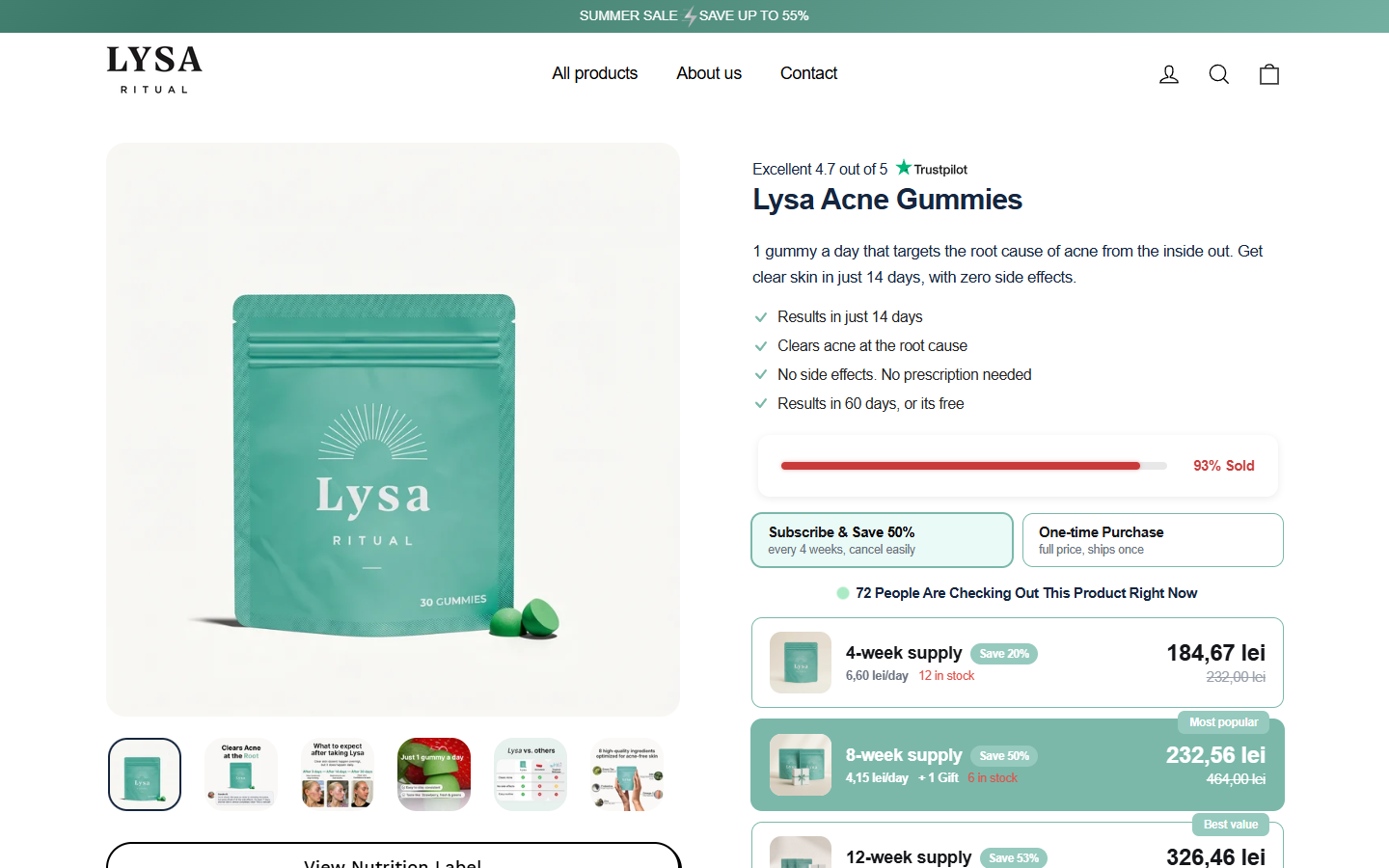
Lysa Ritual sells acne gummies alongside creams and bundled routines. Its current gummy page describes one daily serving and says clearer skin can appear in fourteen days.
The same page promises no side effects and presents the product as addressing acne at its root. Those are the seller’s claims, not findings from our testing.
We did not buy the gummies, examine a batch certificate, or follow users through a controlled trial. A photograph of a package cannot establish clinical performance.
Two ways to buy can lead to different obligations
The offer places Subscribe & Save beside a one-time purchase. The subscription language specifies another delivery every four weeks and a lower displayed price.
Recurring delivery is disclosed on the page. It is not accurate to say every Lysa order secretly becomes a subscription.
The risk is a buyer treating the discounted total as a single transaction while missing the recurring selection. A familiar purchase button does not explain future charges.
The refund promise has important conditions
Lysa advertises a 60-day satisfaction promise. Its FAQ tells disappointed customers to contact support within eighty days of delivery.
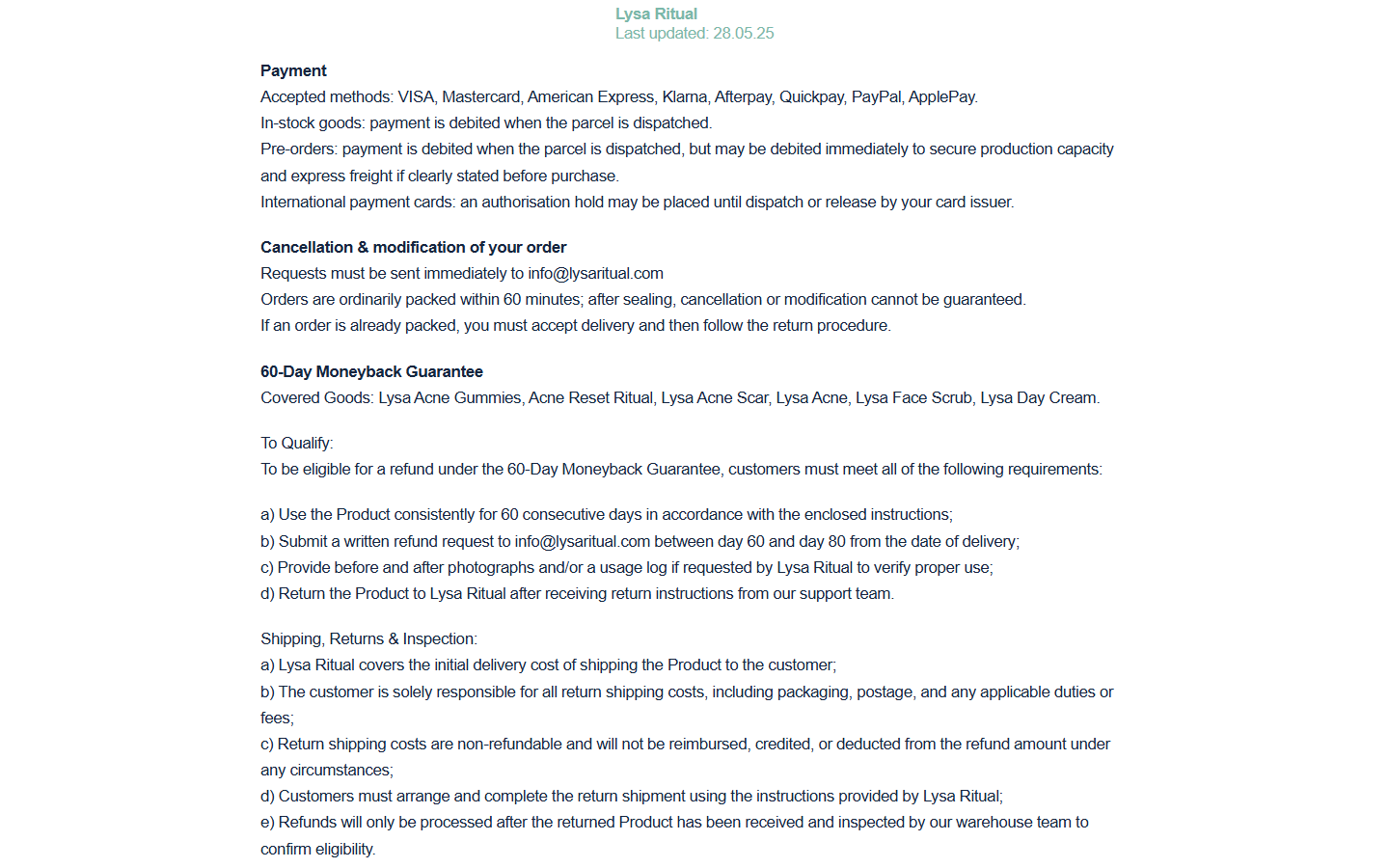
The formal return policy adds requirements: use the product for sixty consecutive days, request a refund between days sixty and eighty, and return it at your expense.
It also says the seller may request photographs or a usage log. That is a more demanding process than a casual reading of “money back” might suggest.
- The reviewed sales page offered recurring four-week deliveries and a one-time option.
- It claimed clearer skin in fourteen days and no side effects.
- Subscription cancellation does not necessarily stop an already processed order.
- The performance-guarantee request window starts only after sixty days of use.
- Ordinary withdrawal is described separately as a fourteen-day right.
- Customers pay return postage under the written performance-guarantee terms.
This is a review of health marketing and purchasing terms. We have not established that Lysa is a fake product or that every customer experiences a billing problem.
What the Clear-Skin Story Leaves Out
Acne does not have one universal cause
Acne can involve hormones, oil production, clogged follicles, inflammation, medication, genetics, and individual skin conditions. One short sales message cannot diagnose a stranger.
The gummy page compresses that complexity into a root-cause promise. It invites the reader to imagine that a daily chewable addresses what topical treatments missed.
That framing is emotionally effective. Someone who has spent months experimenting may welcome a routine that feels easier than another appointment or prescription.
But the product page does not show a trial of this exact formula proving that buyers generally clear acne within fourteen days.
Testimonials may describe real experiences, yet they do not tell readers how many users saw no change, stopped taking the product, or used other treatments.
Before replacing care, ask a clinician or dermatologist what kind of acne you have and which treatments have evidence for that condition.
“No side effects” is stronger than a simple ingredient description
The page’s sweeping safety language deserves scrutiny. Even familiar supplement ingredients can affect individuals differently, especially people with allergies or concurrent medication.
A vegan label, natural ingredients, or a pleasant gummy format does not make every formula suitable for every person or age group.
Read the complete ingredient and Supplement Facts information, including serving size, amounts, sweeteners, and warnings. Ask for it before paying if the label is unclear.
If acne suddenly worsens, produces scarring, or accompanies other symptoms, seeking medical advice is more useful than waiting on a guaranteed marketing timetable.
The FTC’s health-claims guidance requires appropriate substantiation for advertised outcomes. A dramatic guarantee does not substitute for evidence.
The “sold” meter is a sales device, not medical proof
Our product-page capture showed a high percentage sold, low-stock notes, and a message about shoppers viewing the offer. These figures appeared beside pricing choices.
They may reflect real commerce, or they may be dynamic promotional elements. We could not independently inspect inventory or verify the viewer count.
Neither number tells you whether the gummy works. It only increases the feeling that a decision must be made immediately.
Acne treatment usually requires patience. A twenty-second checkout decision should not override a careful look at repeat charges and refund eligibility.
How the Lysa Ritual Sales Journey Works
Step 1: The ad offers relief from a frustrating routine
A shopper can arrive after seeing before-and-after imagery, a skincare testimonial, or a promise that internal balance matters more than another cream.
We did not verify every advertisement circulating under the brand. The reviewed product page itself uses the same core message about root causes.
That message speaks to someone tired of trial and error. It presents one gummy each day as a manageable alternative to a complicated shelf of products.
Pause before treating a personal story as a prediction. Skin outcomes depend on diagnosis, other products, time, and the individual.
Step 2: The sales page makes the result feel close
Lysa’s page places fourteen-day results, no-side-effect language, a satisfaction promise, reviews, and a scarcity meter near the product photograph.
The grouping matters. Each reassurance reduces a different hesitation, while the stock language suggests that waiting could mean losing the deal.
Look for evidence tied to the exact gummy formula, not research on an ingredient category or the general gut-skin relationship.
Ask whether any study compares this product with a placebo, describes participants’ acne severity, and reports adverse effects and dropouts.
Step 3: A lower price encourages the subscription choice
The reviewed offer displayed Subscribe & Save prominently, with deliveries every four weeks. A one-time purchase was available but carried different pricing.
A subscription is not inherently deceptive when the seller clearly explains it. What matters is whether a specific buyer knowingly chooses future shipments.
Change the selection, then read the final order summary. Note the next billing date, amount, number of packages, shipping charge, and cancellation method.
Do not infer that an eight-week or twelve-week bundle postpones every recurring shipment by the same interval. Confirm how that exact option renews.
Take a screenshot of the selected plan and final checkout. An email receipt may omit the visual choice that appeared on the page.
Step 4: The larger bundle adds gifts and a stronger discount
The offer describes four-, eight-, and twelve-week supplies. Extra gifts and larger savings appear beside higher quantities.
Those extras can make the largest option seem sensible before you know whether the ingredients suit your skin or digestion.
Check the effective price per bottle and the total first payment. Then ask what happens if you dislike the product after one week.
Do not assume an advertised free gift is returnable, or that opening it has no effect on a bundle refund. The policy should answer that specifically.
Starting with a smaller one-time order may cost more per unit but exposes less money while you test delivery and support.
Step 5: Cancellation and order cancellation split apart
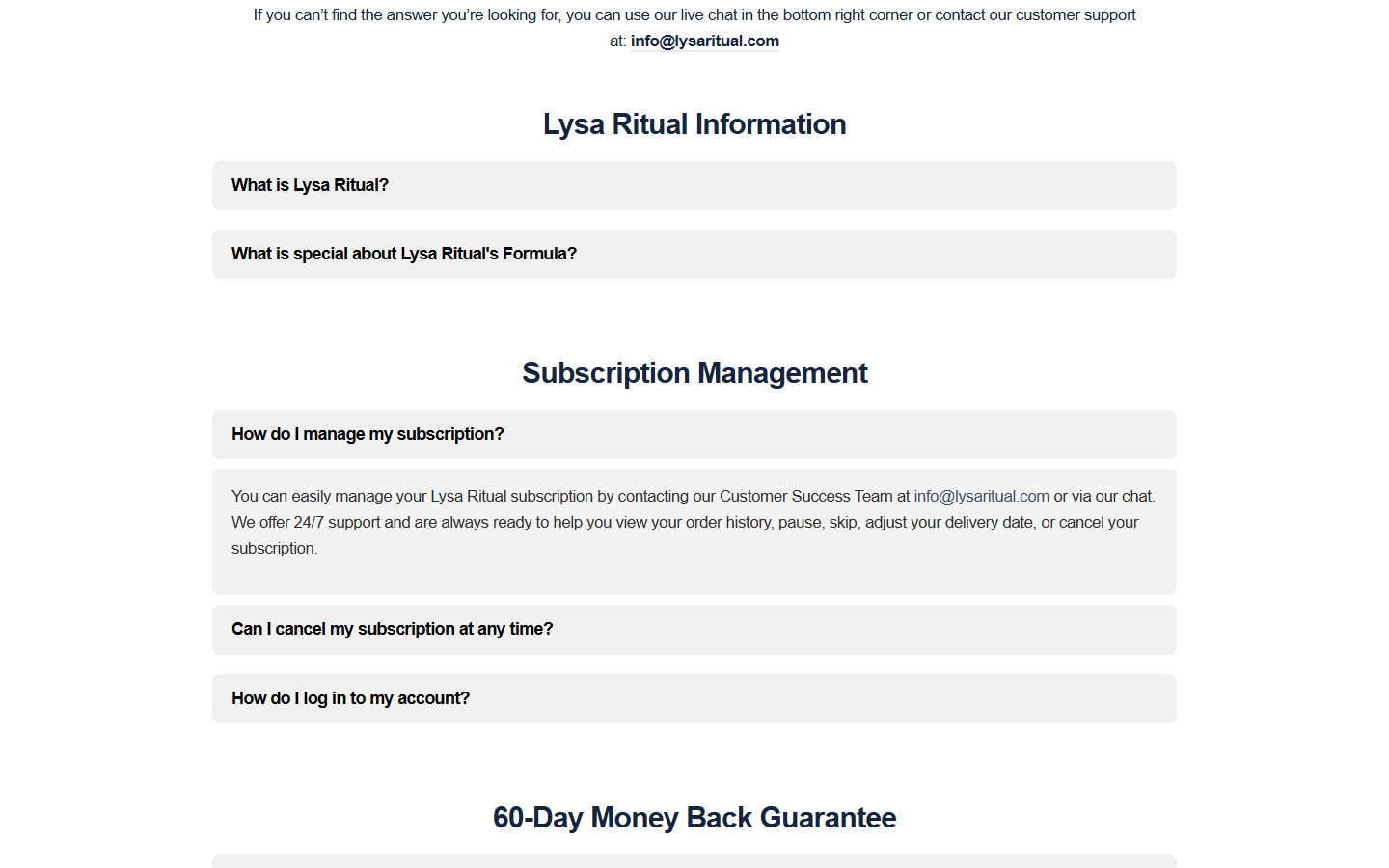
The FAQ says customers can pause, skip, adjust, or cancel through support or chat. That sounds flexible and may work as described.
It also warns that canceling a subscription does not automatically cancel orders already processed or in transit. The formal policy says packing can occur within sixty minutes.
These are separate events. Stopping the next renewal may leave today’s shipment, or a recently generated renewal, payable and headed to you.
Send a dated cancellation message identifying both the subscription and any unshipped order. Request a written answer to each part.
Watch for the next statement even after support confirms cancellation. It is the practical way to ensure no further renewal was charged.
Step 6: The guarantee becomes a documentation exercise
A buyer disappointed after two weeks might expect the “results in sixty days or free” slogan to work like an ordinary satisfaction return.
The written performance guarantee instead instructs continuous use for sixty days, a request during days sixty through eighty, and possible supporting photographs or a log.
Support must provide return instructions, and the customer bears return costs. The refund follows receipt and inspection, not the first email.
A separate fourteen-day withdrawal route appears in the policy. Understand which route applies before deciding whether to continue a full course.
Because the dates are narrow, set reminders from the confirmed delivery day. Save the policy version shown when you ordered.
Company, Manufacturing, and Fulfillment Questions
A polished brand is not a clinical certificate
Lysa describes Danish production and research collaboration. Those claims are worth investigating, but a brand story does not identify the batch you receive.
Request the manufacturer, batch number, country of production, independent testing details, and the complete active-ingredient amounts for the current formulation.
We did not verify a manufacturing facility or test a sample. We therefore cannot claim the gummies are contaminated or come from another country.
Likewise, seeing Shopify infrastructure or popular payment methods says little about whether the fourteen-day outcome claim is supported.
The seller should identify the party handling renewals
The name on the pouch may not match the legal entity or card descriptor. Check the terms, invoice, and card statement for the actual seller.
If a different name appears, ask support to explain the relationship. A processor or fulfillment partner can have a legitimate role, but clarity matters.
Keep the merchant descriptor so your bank can recognize a later recurring charge. Searching only “Lysa” may miss a transaction posted under another name.
Return destinations are supplied after contact
The formal policy directs customers to obtain instructions from support and send products to a nominated warehouse. It does not make the address optional.
Ask for the return country, recipient, postal code, customs wording, and estimated tracked-postage cost before sending any package.
International shipping can erode the value of a refund. The policy specifically places ordinary return postage, duties, and packaging on the buyer.
Never mail a parcel to a general contact address unless support confirms it is the authorized return destination for your order.
Support needs to answer more than a routine FAQ
Ask whether an opened pouch can qualify after sixty days of continuous use and what evidence the team expects. These are reasonable pre-purchase questions.
Also ask whether canceling a subscription immediately stops a renewal not yet shipped. The written answer is more useful than “cancel anytime” alone.
We did not make a test purchase or assess response time. A support address on a website is not proof of how a disputed refund will be handled.
What to Do If You Ordered Lysa Ritual
- Find the confirmation and identify whether you selected Subscribe & Save or a one-time purchase. Save the total, frequency, next charge date, and chosen supply.
- Save the offer and policy now. Capture the fourteen-day claim, sixty-day performance guarantee, FAQ cancellation wording, and the formal requirements.
- Decide whether you want the current order. If not, email support immediately with the order number and request cancellation before packing.
- Cancel future deliveries separately. Ask support to confirm that the subscription is closed and state whether another order has already entered fulfillment.
- Mark both refund routes on a calendar. The ordinary withdrawal window and days-sixty-to-eighty performance window are not interchangeable.
- If claiming the performance guarantee, document use honestly. Keep the package, instructions, dates, and any photographs the policy might require.
- Request an exact return address and authorization in writing. Use tracked shipping only after you understand the destination and your postage cost.
- Monitor the payment method for renewals. If an unauthorized charge posts after documented cancellation, give your card issuer the timeline and correspondence.
- Speak with a dermatologist if acne is painful, scarring, or worsening. Do not let a refund deadline determine your medical care.
Frequently Asked Questions
Is Lysa Ritual a confirmed scam?
We cannot establish that. The store openly offers a subscription and one-time option. Our concerns involve bold skin claims, recurring-order clarity, and detailed refund conditions.
Does every Lysa order renew automatically?
No. The reviewed page offered a one-time purchase. A buyer choosing Subscribe & Save should expect another delivery on the disclosed schedule unless canceled.
Can I cancel a subscription at any time?
The FAQ says customers can request cancellation. It also says already processed or in-transit orders are not automatically canceled by that action.
Is the 60-day guarantee unconditional?
No. The written policy requires sixty consecutive days of use, a day-sixty-to-eighty request, potential documentation, and a return at the buyer’s expense.
Will these gummies clear acne in fourteen days?
The sales page makes that claim. We did not find product-specific evidence establishing that result for typical buyers, so do not treat it as a guaranteed medical outcome.
What should I check before paying?
Review the full ingredient label, selected purchase type, renewal interval, first and future totals, cancellation procedure, and return postage destination.
The Bottom Line
Lysa Ritual sells a real-looking gummy offer with an explicit subscription choice. The bigger question is whether its speedy clear-skin promise and easy-sounding guarantee match the experience buyers expect.
The formal terms are narrower than the headline. Read them before ordering, keep evidence of your selection, and address persistent acne with appropriate medical advice.

Reviews & discussion
0 commentsShare a firsthand experience, or ask a question.
Community reviews
Lysa Ritual Acne Gummies
Moderated reader experiences, not an editorial verdict.
Start the conversation
Have a question or something useful to share? Add the first comment.