

A new email scam has emerged targeting unsuspecting individuals with promises of large cash donations from the famous Italian billionaire Maria Franca Fissolo. This fraudulent email, which claims to be from Mrs. Fissolo herself, tempts recipients with a multi-million dollar donation in exchange for a small fee or personal information. While the email may look legitimate at first glance, it is a complete scam designed to steal money and sensitive data from victims.
This article will provide an in-depth look at how the “Maria Franca Fissolo Donation” email scam operates, how to identify fraudulent emails, what to do if you receive one, and how to best protect yourself from falling prey to online scams. With the right information, individuals can avoid becoming victims and report these criminal operations to the proper authorities.
Overview of the Scam
The “Maria Franca Fissolo Donation” email scam is a new variant of the common “Nigerian Prince” or “Spanish Lottery” scams promising easy money. Criminals utilize publicly available information to create fake emails mimicking well-known, ultra-wealthy individuals like Mrs. Fissolo.
The scam email claims that due to her age, illness, and desire to donate to charity, Mrs. Fissolo seeks to gift a portion of her massive fortune to deserving individuals like the recipient. The message emphasizes her benevolent motivations and that recipients were specially selected through prayer or other chance encounters. This establishes a false sense of serendipity to lower suspicions.
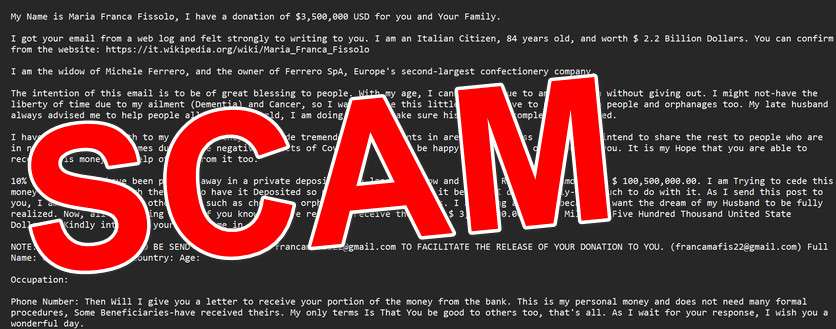
There are multiple versions of the “Maria Franca Fissolo” donation scam emails, but they all share common elements. These typically include a false claim of a large donation, an urgent request for personal information, and an attempt to build trust through fabricated details. Here’s a typical example:
My Name is Maria Franca Fissolo, I have a donation of $3,500,000 USD for you and Your Family.
I got your email from a web log and felt strongly to writing to you. I am an Italian Citizen, 84 years old, and worth $ 2.2 Billion Dollars. You can confirm from the website: https://it.wikipedia.org/wiki/Maria_Franca_Fissolo
I am the widow of Michele Ferrero, and the owner of Ferrero SpA, Europe’s second-largest confectionery company.
The intention of this email is to be of great blessing to people. With my age, I cannot continue to amass wealth without giving out. I might not-have the liberty of time due to my ailment (Dementia) and Cancer, so I want to use this little time I have to give out to people and orphanages too. My late husband always advised me to help people all over the world, I am doing this to make sure his dream is completely realized.
I have Part of my wealth to my sons and they have made tremendous improvements in areas of business .However, I intend to share the rest to people who are in need and in trying times due to the negative effects of Covid 19. I would be happy to cede part of it out to you. It is my Hope that you are able to receive this money and help others from it too.
10% of my worth I have been putting away in a private deposit for a long time now and It Has Reached an Amount of $ 100,500,000.00. I am Trying to cede this money in portions through the bank to have it Deposited so many can benefit from it because I don’t really-have much to do with it. As I send this post to you, I am sending also to others too such as churches, orphanages and foster homes. I am doing all this because I want the dream of my Husband to be fully realized. Now, all this Being Said, if you know you are ready to receive the funds $ 3,500,000.00 (Three Million, Five Hundred Thousand United State Dollars). Kindly introduce yourself to me in details:
NOTE: BELOW DETAILS SHOULD BE SEND TO THIS EMAIL: francamafis22@gmail.com TO FACILITATE THE RELEASE OF YOUR DONATION TO YOU. (francamafis22@gmail.com) Full Name: Contact Address\ Country: Age:
Occupation:
Phone Number: Then Will I give you a letter to receive your portion of the money from the bank. This is my personal money and does not need many formal procedures, Some Beneficiaries-have received theirs. My only terms Is That You be good to others too, that’s all. As I wait for your response, I wish you a wonderful day.
Faithfully, Maria Franca Fissolo
Once recipients show interest, scammers will request personal details and small “processing” payments to allegedly release the funds. Victims may pay thousands in fees over months before realizing it is a scam. The criminals then disappear with the money.
This particular email scam has already affected individuals globally, so awareness of its methods is critical. According to statistics, median losses from similar “advance fee” scams range from $500 to $1500 per victim. As this scam spreads, cumulative losses could easily exceed millions without intervention.
How the “Maria Franca Fissolo Donation” Scam Works
The “Maria Franca Fissolo Donation” scam operates in 5 key stages to convince and defraud victims:
1. Initial Contact
Criminals obtain email lists through both legal and illegal methods to target as many individuals as possible. Bulk messages are then sent using fake accounts portraying Mrs. Fissolo and her representatives.
The initial email introduces the scammers’ persona as the billionaire Mrs. Fissolo, provides fake background details, and explains her “charitable” desire to donate millions to the recipient. Flowery language professing divine providence aims to build trust and urgency.
2. Recipient Response
If interested, recipients will reply to the scam email with gratitude and requests for additional information. Scammers will then begin asking seemingly innocent questions to gather personal details later used against victims.
During this vetting process, they build rapport with recipients by appearing polite, pious, and dedicated to their fictional philanthropic goals. This further coaxes recipients to lower defenses.
3. Request for Personal Information
After warming up recipients, scammers will formally request personal information to allegedly process the donation payment. They may ask for full name, home address, telephone number, age, occupation, and copies of IDs like driver’s licenses or passports.
Victims are assured the details are simply for money transfer paperwork and attorney verification. In reality, scammers use them to steal identities and commit other types of fraud.
4. Payment of “Fees”
Once satisfied with collected details, scammers shift to manufacturing delays and fees blocking the fictitious donation. Recipients will be informed taxes, legal costs, or processing charges must be paid before funds can be released.
Initially, these fees start small, around 200to200 to 200to500. But over weeks of back-and-forth, victims end up paying thousands after being hammered with elaborately faked invoices and documents from fake lawyers, bankers, and government officials.
5. Disappearance with the Money
Eventually, after extracting sufficient funds, scammers cease communication and disappear with the money. They take advantage that victims already feel heavily invested after months of interaction. Angry recipients who demand their money back face threats of blackmail and violence.
The victimized individuals are left distraught at the deception and theft. Their stolen funds and information may be used to defraud others or sold on the black market. Because the criminals operate internationally, they are difficult to track down and prosecute.
Identifying Fraudulent “Maria Franca Fissolo” Emails
While scam messages may appear authentic, a trained eye can spot red flags that expose their true nature. Watch for these indicators:
- Broken English/Grammar Errors – Scammers often use English as a second language, leading to numerous errors.
- Gmail/Yahoo/Hotmail Email Addresses – Scammers rarely impersonate people using corporate or official email accounts.
- Unrealistic Claims – No billionaire is donating millions to random email recipients. Any promise too good to be true is.
- Sense of Urgency – Scammers try to rush victims into poor decisions before they can discover the scam.
- Requests for Money – No legitimate organization or person will demand upfront fees to release donated funds.
- Requests for Personal Information – Donors typically don’t require extensive personal and ID details for donations. This information feeds criminal activities.
- Anonymous Payment Demands – Scammers want wire transfers, gift cards, and cryptocurrency because they are difficult to reverse or trace.
Stay skeptical of any investment opportunity, lottery win, donation, or inheritance from strangers requiring payments upfront. Verify identities and claims before providing money or your personal information.
What to Do if You Received a “Maria Franca Fissolo” Scam Email
If a “Maria Franca Fissolo Donation” email appears in your inbox, follow these steps:
- Do Not Respond – Delete the email immediately without replying. Any response alerts scammers to an active target.
- Do Not Send Any Money – Never make payments to strangers promising donations over email, regardless of how official documents appear.
- Gather Evidence – Save a copy of the scam email with full headers and take screenshots for reporting purposes.
- Report the Email – Forward scam emails to your email provider’s abuse department to block the scammer.
- Alert Relevant Authorities – File reports about the scam with the FTC, FBI, and local law enforcement.
- Warn Contacts – Notify friends and family of new scam emails targeting donors. Share information so they can protect themselves.
Avoid embarrassment by limiting details shared with others about falling for the scam. Merely state that a criminal operation is circulating and to use caution with unexpected windfalls.
What to Do if You Already Fell Victim to the Scam
If you already interacted with scammers and suffered financial losses, take these steps:
- Cease All Contact – Cut off all communication with the scammers and block their accounts. Ignore threats or harassment.
- Report Your Losses – Alert your bank and payment providers so they can attempt to reverse fraudulent transactions.
- Cancel Compromised Accounts – If scammers gained access to accounts, cancel them immediately and change your passwords.
- Monitor Your Credit – Check your credit reports and set up fraud alerts in case of stolen identities.
- Dispute Fraudulent Charges – Work with banks and providers to contest unauthorized charges and withdrawals.
- Alert Authorities – File detailed reports on losses with the FTC, FBI, and local law enforcement to aid investigations.
- Seek Legal Counsel – Consult an attorney on possible civil action, depending on location of scammers and amount lost.
- Learn From the Experience – Take steps to improve online security and identify similar scams quicker. Share your story to prevent others from falling victim.
While losses may not be fully recovered, quick action can mitigate damages, halt further identity theft, and help bring scammers to justice.
Frequently Asked Questions About the “Maria Franca Fissolo” Donation Email Scam
The “Maria Franca Fissolo” donation email scam has been targeting unsuspecting individuals across the globe. This fraudulent scam promises large cash gifts in exchange for personal information and upfront payment of fees.
If you have received an email claiming to be from Italian billionaire Maria Franca Fissolo offering millions in charity donations, you likely have questions. Read on for answers to frequently asked questions about this scam.
What is the “Maria Franca Fissolo” Email Scam?
This is a variant of the classic “Nigerian Prince” and lottery scams promising easy riches. Criminals impersonate billionaire Maria Franca Fissolo and claim she seeks to gift inheritance money to you for charity purposes. The fake Maria claims you were chosen through prayer and research.
After building trust, scammers request personal details and payment of various “fees” to allegedly process the multi-million dollar donation. In reality, no money exists, and victims lose the payments sent to scammers.
Who is Maria Franca Fissolo?
Maria Franca Fissolo is an Italian billionaire businesswoman worth over $2 billion dollars. She is the widow of Michele Ferrero and owner of the European candy company Ferrero SpA.
Scammers reference Fissolo’s wealth and manufacture a story of her generously donating her fortune to random recipients like you. This is all fabricated to trick victims.
How Did Scammers Get My Email?
Scammers acquire email lists through both legal and illegal methods. Bulk emails are sent to millions of addresses at once, so recipients are chosen indiscriminately rather than “researched” as claimed.
Your email may have been sold, leaked in data breaches, harvested from websites, bought from other scammers, or obtained through malware.
Are the Maria Franca Fissolo Emails Real?
No, the emails are complete scams. Maria Franca Fissolo is not contacting strangers promising millions. The scam emails do not come from her real accounts. Ignore all emails claiming to be from wealthy individuals offering you part of their fortune.
What Information Do the Scammers Request?
If you respond to the scam email, the criminals will gradually ask for more and more personal details to steal your identity and assess you as a fraud victim. They want your full name, home address, phone number, age, occupation, IDs, and more.
Never provide sensitive information to strangers promising lottery windfalls or donations.
What fees Do Scammers Ask For?
Once satisfied with details provided, scammers create reasons you must pay fees before receiving the fake donation. These include processing fees, delivery costs, anti-terrorism fees, taxes, lawyer fees, bank fees, inheritance fees, conversion fees, and more.
Initial fees may be a few hundred dollars but eventually total thousands after months of manipulation. Pay no fee ever to receive a donation.
How Should I Respond to the Scam Email?
Do not respond. Delete the email immediately and block the sender. Any reply alerts scammers they can manipulate you. Never communicate with strangers promising free money in exchange for personal information and upfront fees.
Can the Police Trace the Scammers?
Scammers use fake names and accounts with international emails and IPs making them difficult to trace. Still, thoroughly document the scam and report to the FTC, FBI, and local police to aid investigations and prevent further victimization.
How Can I Recover Lost Money?
Contact your bank immediately upon realizing the fraud. Report unauthorized transactions. Banks can attempt to reverse transfers in progress. Stolen money is difficult to recover fully, especially cryptocurrency, wire transfers, and gift cards.
How Do I Avoid Falling for the Scam?
Be skeptical of emails offering large donations, lottery winnings, and other surprises from strangers. Look for grammar mistakes, urgent pleas, and fake names/details. Never pay fees to receive gifts – legitimate organizations won’t demand this.
The Bottom Line
The “Maria Franca Fissolo Donation” scam threatens to steal millions from unsuspecting recipients drawn in by the promise of easy charity funds. These criminal operations rely on convincing backstories and official-looking documents to fool victims into paying supposed “fees” and “taxes” to receive donations.
By understanding the scam’s deceptive stages and recognizing red flags, individuals can avoid being manipulated by these emails promising millions. Save, document, and report any scam messages to protect yourself and stop these fraudsters from ruining additional lives. Spread awareness so those vulnerable to false promises understand such donation offers simply do not exist.
Stay vigilant against scams by verifying strangers’ identities, confirming authenticity of windfalls, and refusing unreasonable demands for upfront money or personal details. Only by working together can we frustrate these criminal networks to discourage their deceptive trade in stolen money, data, and dreams.

Join the discussion
0 commentsShare your experience or ask a question about this article.
Discussion
Start the conversation
Have a question or something useful to share? Add the first comment.