

MindRemember presents itself as a calmer alternative to the loud memory supplement funnels that dominate social media.
Its ingredient panel and refund page look more complete than many competitors. There are still practical questions buyers should answer first.
Overview
What the MindRemember offer includes
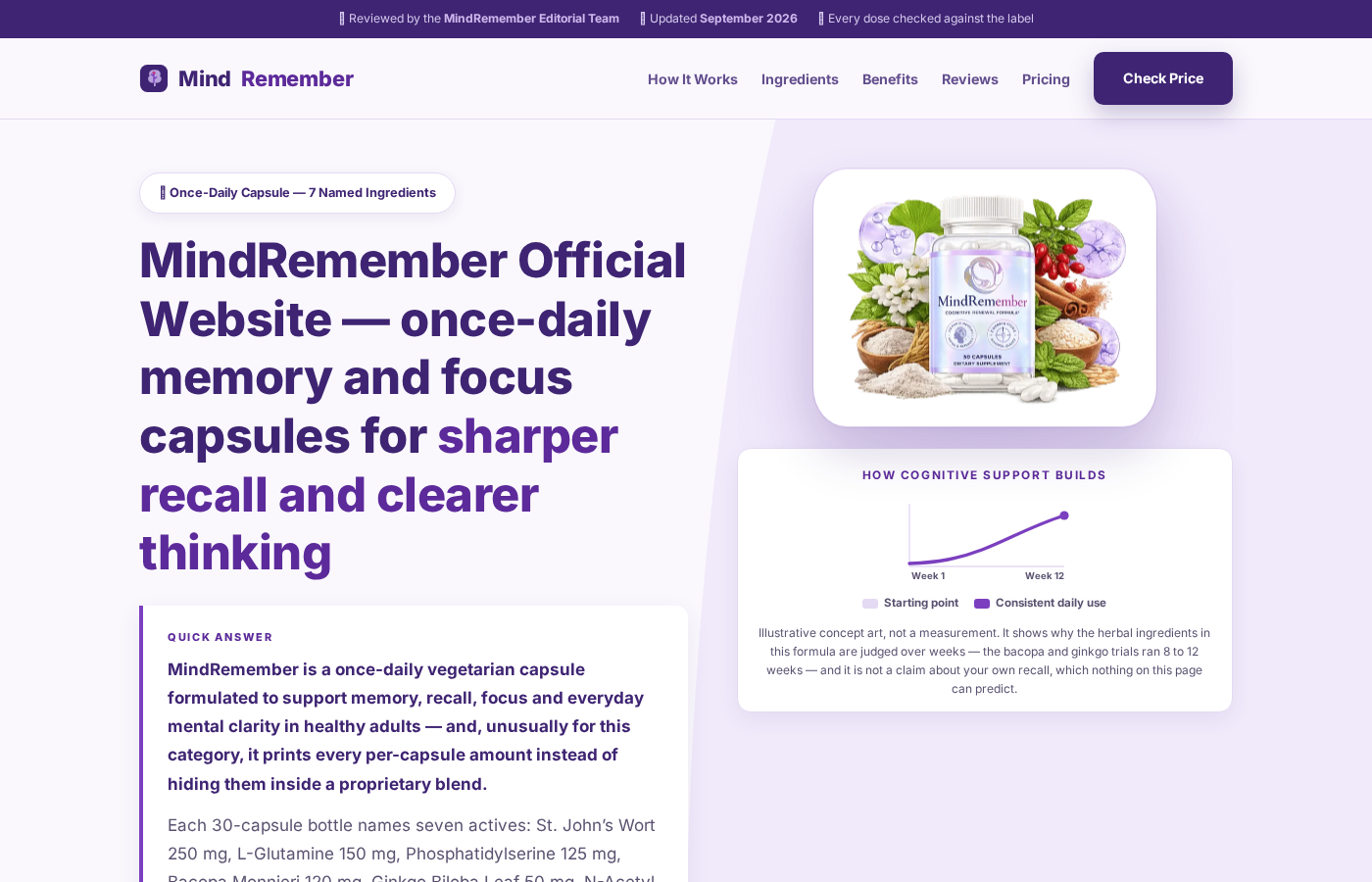
MindRemember is sold as a one-capsule-per-day supplement for memory, concentration, and mental clarity.
The page states that one bottle contains 30 capsules and identifies seven ingredients with individual amounts.
The listed formula includes St. John’s Wort, L-Glutamine, phosphatidylserine, Bacopa, Ginkgo, N-Acetyl L-Carnitine, and Alpha-GPC.
That level of label detail lets a shopper ask better questions than a vague proprietary blend would.
Why the product still requires caution
MindRemember makes broad cognitive-support claims without showing a clinical trial on the finished capsule.
St. John’s Wort is not a harmless decoration. It can change how the body processes many medicines.
The buying pages also rely on seller-controlled reviews and a guarantee that requires the customer to pay return postage.
Those details do not automatically make the product fraudulent, but they change the risk calculation.
What our investigation found
The offer looks more organized than a disposable landing page, yet its domains are recent and its fulfillment trail is shared with other campaigns.
- Mindremember.com was registered on June 15, 2026.
- Mindremembers.com was registered on August 5, 2026.
- The page lists exact ingredient amounts rather than hiding everything in a blend.
- The seller says it does not use automatic refills.
- BuyGoods is identified as the retailer.
- Returns go to 19655 E. 35th Drive, unit 100, Aurora, CO.
- The customer pays return shipping under the 60-day policy.
These findings support a measured review, not an instant scam label.
The strongest concern is the interaction risk created by the formula, not proof that the bottle never ships.
Is MindRemember Legit or a Scam?
MindRemember appears to be a functioning commercial supplement offer with more disclosure than many aggressive memory funnels.
We did not find enough evidence to call it a confirmed scam.
We also could not verify that its capsule produces the broad improvements suggested by the sales copy.
The exact label is useful, but ingredient transparency is not the same as clinical proof.
Buyers should treat the offer as a supplement purchase with medical and refund risks, rather than as a proven memory solution.
The Ingredient Panel Is a Mixed Signal
Exact amounts are better than a hidden blend
The label lists St. John’s Wort at 250 mg, L-Glutamine at 150 mg, and phosphatidylserine at 125 mg.
It also lists Bacopa at 120 mg, Ginkgo at 50 mg, N-Acetyl L-Carnitine at 50 mg, and Alpha-GPC at 5 mg.
Those numbers let consumers compare the product with studies and medication warnings.
They do not show whether the extracts are standardized or tested for identity and contaminants.
St. John’s Wort deserves special attention
St. John’s Wort can affect medicines for depression, birth control, blood clotting, transplant care, seizures, and other conditions.
People often view herbal products as gentle because they come from plants.
Plant origin does not remove pharmacological activity.
Anyone taking regular medication should ask a pharmacist before ordering or opening the bottle.
Ingredient studies are not finished-product trials
Bacopa, ginkgo, and phosphatidylserine have been studied in different populations and preparations.
The results cannot simply be added together to predict one capsule’s effect.
A trustworthy claim would identify the exact extract, dose, duration, and outcome measured.
MindRemember does not show a peer-reviewed trial on its complete seven-ingredient formula.
How the MindRemember Offer Works
Step 1: The page starts with relatable forgetfulness
The copy speaks to people who lose their train of thought, misplace items, or struggle to stay focused.
Those experiences can be frustrating without indicating a disease.
The story encourages visitors to connect ordinary lapses with a supplement purchase.
Step 2: A simple daily routine lowers resistance
One capsule per day sounds manageable, especially beside complicated lifestyle advice.
The easy routine can make a buyer overlook the need to review each ingredient.
Convenience is helpful, but it should not replace a medication check.
Step 3: A complete panel creates confidence
Exact amounts make the offer look more accountable than a product that lists only a proprietary blend.
The page uses that transparency to support a broader impression of scientific credibility.
Readers still need to ask whether the extracts have certificates and current lot testing.
Step 4: Social proof supports the emotional promise
Customer comments describe clearer thinking, steadier attention, and renewed confidence.
Testimonials may describe genuine experiences, but they do not control for expectation, placebo effects, or other changes.
Seller-hosted reviews should be treated as marketing evidence.
Step 5: Bundles frame the larger order as sensible
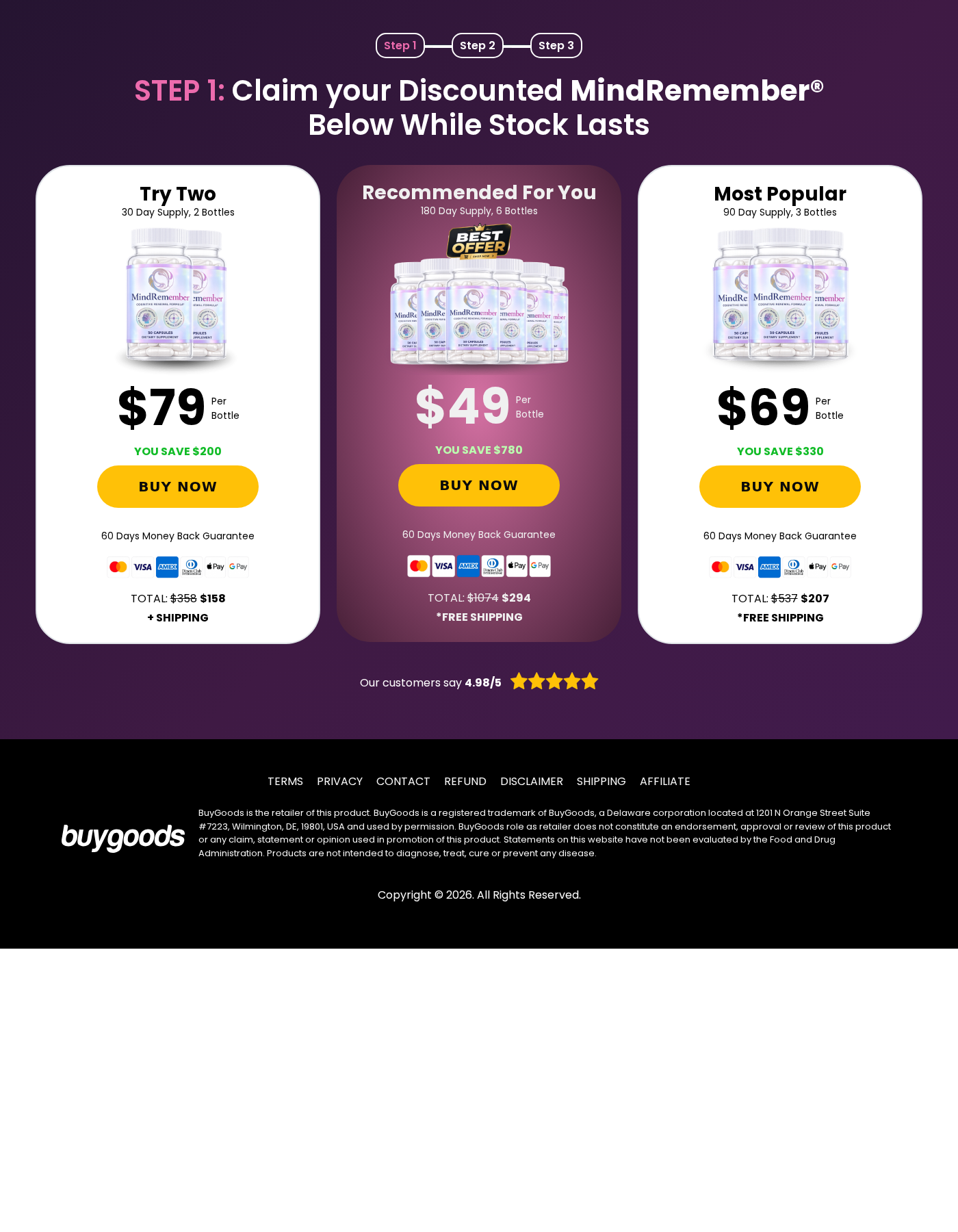
The page lists two bottles for $178, three for $216, and six for $294.
Bulk pricing makes the six-bottle option look economical per bottle.
It also delays the moment when a customer can judge tolerability and value.
Step 6: BuyGoods becomes part of the transaction
The site identifies BuyGoods as the retailer, which means the checkout and support experience may differ from the brand page.
Customers should save both the brand policy and the retailer receipt.
The statement descriptor may use the retailer or a related payment name.
Step 7: A refund request becomes a documentation exercise
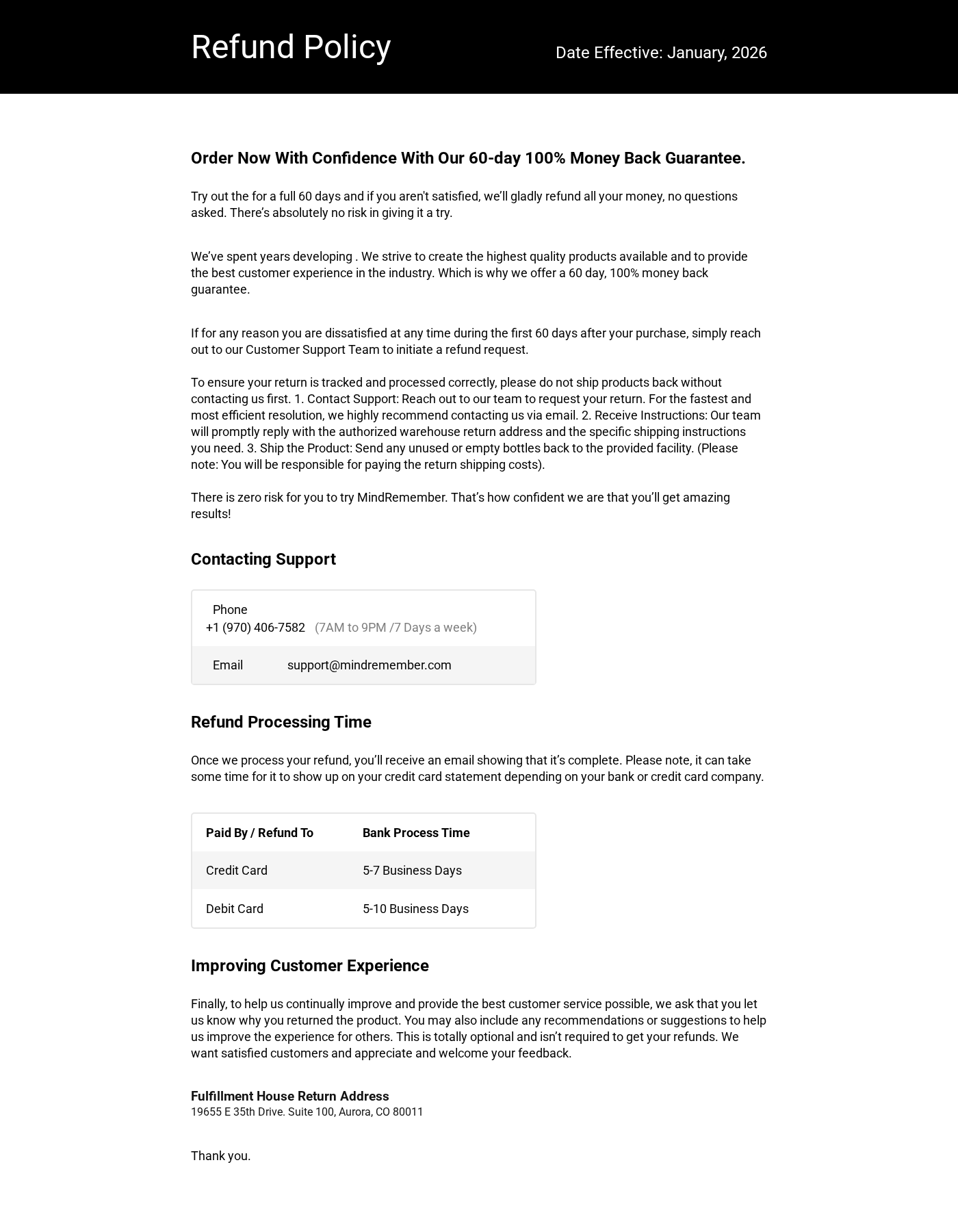
The guarantee lasts 60 days from purchase, but the customer must contact support first.
Return postage is the customer’s responsibility, and every communication should be preserved.
Clear records matter if the parcel is delayed or the refund is disputed.
Pricing, Returns, and Customer Support
The price changes substantially with the bundle
The six-bottle package costs $294, which is a meaningful commitment for a product without finished-formula clinical proof.
A lower unit price does not reduce the total amount at risk.
Consider starting with the smallest available order if a clinician agrees the ingredients are appropriate.
The seller says there is no automatic refill
The page states that orders are one-time purchases rather than recurring shipments.
Keep the confirmation because checkout language can change across affiliate links.
Monitor the card statement after delivery anyway.
The guarantee requires a timely request
Customers have 60 days from purchase to contact support and receive return instructions.
Waiting until the last week creates avoidable pressure if a response is slow.
Send the request as soon as the product is not wanted.
Empty bottles may be accepted, but postage is not free
The policy says unused or empty bottles can be returned after support authorizes the request.
Return shipping can cost more than expected when a six-bottle order is involved.
Use tracking and keep proof of delivery.
Company, Address, and Fulfillment Checks
The brand page is not the legal seller
MindRemember is the product identity, while BuyGoods is named as the retailer.
That distinction matters when a card statement or refund email uses a different name.
Save the legal and payment details before closing the checkout.
The Aurora address appears in other supplement operations
Returns are directed to 19655 E. 35th Drive, unit 100, Aurora, CO 80011.
A shared address can be a fulfillment center or returns processor.
It does not establish that the address is a laboratory or manufacturing facility.
The support details are available, but escalation remains limited
The refund page lists +1 (970) 406-7582 and support@mindremember.com.
Before paying, ask who owns the product, who processes the card, and where quality complaints should go.
Written answers are more useful than a reassuring phone conversation.
Manufacturing information is still incomplete
The public pages identify ingredients but do not provide a current lot certificate or a named manufacturing plant.
Buyers can request a certificate of analysis tied to the shipment.
Refusal to provide basic documentation is a reason to reconsider the purchase.
How to Read the MindRemember Label
Amount is only one part of quality
A listed milligram amount does not tell you whether an extract is standardized to the active compounds used in research.
For Bacopa and ginkgo, the extract ratio and marker compounds can materially change the product.
Ask whether the label refers to a raw plant, a concentrated extract, or a named standardized preparation.
That distinction is often missing from quick supplement pages.
Medication interactions can be easy to overlook
Customers may focus on memory benefits and miss the fact that St. John’s Wort affects liver enzymes and transport proteins.
That activity can lower or raise levels of medicines that appear unrelated to mental health.
Birth-control users should be especially cautious because reduced effectiveness can create a serious consequence.
A pharmacist can check the complete medication list faster than a marketing page can.
Customer stories do not reveal who should avoid it
Testimonials usually describe people who felt comfortable sharing a positive experience.
They rarely identify people who stopped because of interactions, headaches, mood changes, or no benefit.
Negative outcomes may never appear in a seller’s featured carousel.
That selection effect makes testimonials unsuitable for personal safety decisions.
The one-capsule routine can hide cumulative use
Taking one capsule daily sounds modest, but repeated use can maintain exposure to every active ingredient.
Do not combine the product with another memory formula without checking overlapping herbs or stimulants.
Keep a simple record of start date, dose, symptoms, and other supplements.
The record helps a clinician identify patterns that a sales page cannot see.
Returns are easier when expectations are realistic
Use the 60-day window as a deadline for a commercial request, not as a reason to keep taking a product that feels wrong.
Contact support as soon as you decide not to continue.
Ask whether opened bottles qualify and whether the address has changed since the policy was published.
Keep the parcel receipt until the refund clears your statement.
Questions to answer before the first capsule
Confirm that your clinician has seen the complete label, not only the product name.
List prescriptions, over-the-counter medicines, teas, and other supplements because interaction checks depend on the full picture.
Ask whether the St. John’s Wort dose is appropriate for your situation.
Check whether the bottle includes warnings about sunlight sensitivity, mood changes, pregnancy, surgery, and serotonin-related reactions.
Verify that the seal, lot number, and expiration date are intact on arrival.
Do not use a bottle if the label differs materially from the page saved at checkout.
Keep the smallest commitment possible until safety and support have been confirmed.
Large bundles may save money per bottle but increase waste when the formula is unsuitable.
A clear support response should identify the manufacturer and quality-testing process.
Generic statements about premium ingredients do not replace those records.
If the product causes unexpected effects, stop documenting marketing promises and start documenting symptoms and timing.
That information helps a healthcare professional make a safer recommendation.
Memory concerns that interfere with driving, medication use, or daily safety need medical assessment.
No satisfaction guarantee should delay that appointment.
A cautious buyer can appreciate the readable label while still declining an unsupported promise.
Transparency earns consideration, but it does not cancel the need for an interaction review.
Keep the review balanced: a readable label is useful, while an unsupported promise remains unsupported.
What to Do if You Bought MindRemember
- Check every ingredient against your medicines. Ask a pharmacist about St. John’s Wort before taking another capsule.
- Save the receipt and retailer name. BuyGoods may appear on your card statement instead of MindRemember.
- Record the delivery date. The 60-day refund period should be calculated from the stated purchase terms.
- Contact support early. Request written authorization and the exact address before shipping anything.
- Photograph bottles and lot details. Keep the parcel label, tracking number, and copies of every message.
- Dispute unauthorized charges quickly. Give your card issuer evidence of wrong quantities, duplicate charges, or a refused refund.
- Stop if symptoms appear. Seek clinical advice for mood changes, bleeding, allergic reactions, or unusual effects.
- Reduce advertising risk. Scan with Malwarebytes after a questionable redirect, then use AdGuard to limit aggressive scripts and popups.
Frequently Asked Questions
Is MindRemember a confirmed scam?
We did not find enough evidence to call it a confirmed scam. Its medical claims and interaction risks still justify caution.
Why is St. John’s Wort important?
It can change the effects of many medicines, including birth control, antidepressants, anticoagulants, and transplant drugs.
Does the exact label prove effectiveness?
No. It improves transparency, but only a trial on the finished formula could support product-level effectiveness claims.
Are automatic refills disclosed?
The seller says purchases are one-time orders. Save that statement and monitor your card after checkout.
Where do returns go?
The refund page lists 19655 E. 35th Drive, unit 100, Aurora, CO 80011, after support authorization.
Can I return empty bottles?
The policy says unused or empty bottles may qualify, but the customer pays return postage and must follow the authorization process.
The Bottom Line
MindRemember is more transparent than many rushed supplement funnels because it lists doses and identifies its retailer.
That does not make the broad memory promises clinically proven or remove the serious St. John’s Wort interaction issue.
Read the label with a pharmacist, protect the refund deadline, and judge the offer as a supplement purchase rather than a medical solution.








