

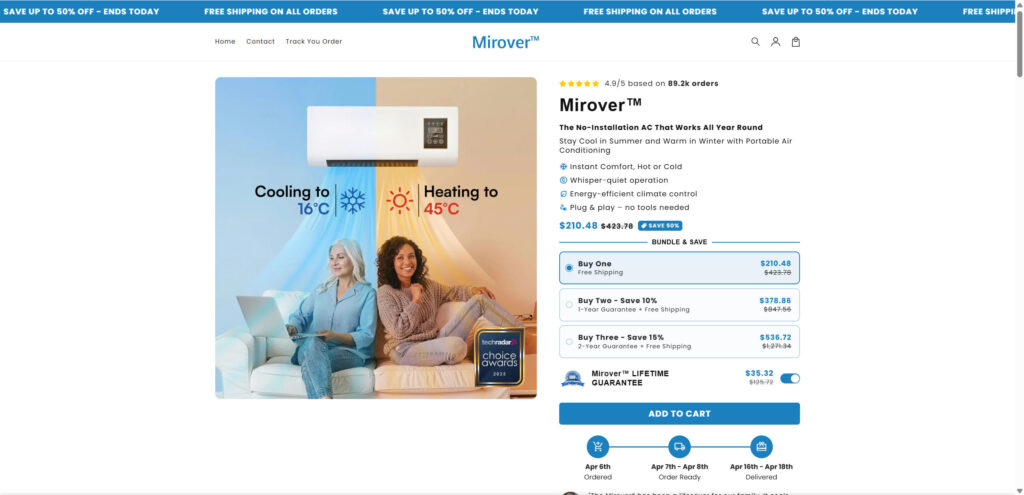
The Mirover Split Max AC is aggressively marketed as a plug-and-play air conditioner that cools and heats your room in seconds—no installation, no external unit, no hassle.
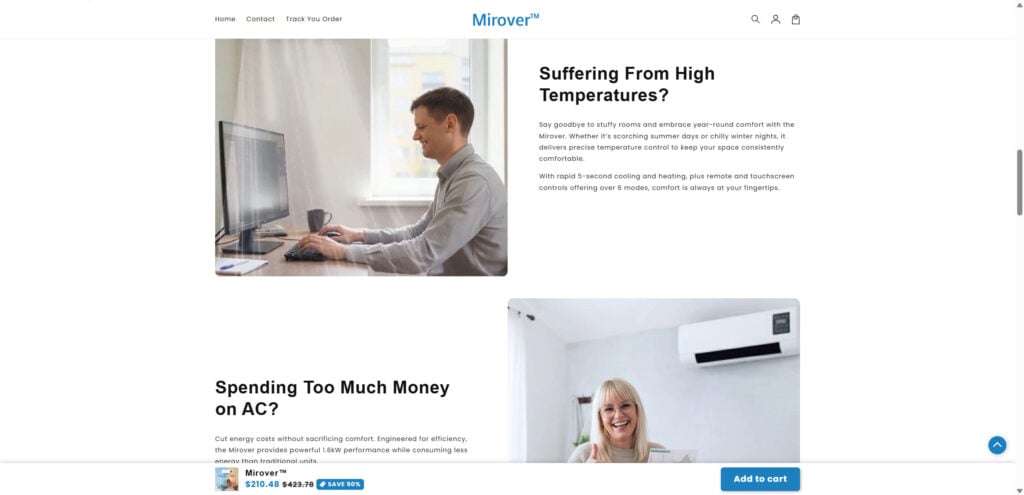
That claim alone is enough to stop and think.
Because what’s being sold here is not a breakthrough in cooling technology. It’s a familiar dropshipping pattern built around a product that cannot physically deliver what the ads promise.
Scam Overview
This is not a new concept. It’s a recycled funnel that shows up every summer under different brand names.
The model behind the product
- Source a cheap generic wall-mounted fan/heater
- Rebrand it with a premium name (Mirover)
- Market it as a “portable AC replacement”
- Use extreme claims (cooling + heating + savings)
- Add urgency (discounts, countdowns, “limited stock”)
- Sell it at a 10x–20x markup
What you’re told you’re buying
- A real air conditioner
- A cooling and heating system
- A replacement for expensive AC units
What you’re actually buying
- A small electric fan
- Possibly with a heating coil
- No real cooling system
This is not a misunderstanding. It’s a deliberate positioning gap.
The Physics Problem (This Alone Exposes the Product)
Let’s strip away the marketing and look at reality.
What a real AC must do
- Remove heat from a room
- Transfer that heat outside
- Use:
- Compressor
- Refrigerant
- Ventilation
What Mirover has
- No exhaust
- No external unit
- No compressor
- No heat transfer system
Conclusion
It cannot function as an air conditioner.
There is no workaround, no hidden technology, no “new method.”
If heat is not removed from the room, the room does not cool.
That is basic physics.
The “Feels Cool” Illusion
This is where many people get misled.
What these devices actually do
- Blow air across your skin
- Create a temporary cooling sensation
- Act like a fan
What they do NOT do
- Lower room temperature
- Remove heat from the environment
- Provide sustained cooling
This is the same principle as standing in front of a fan.
It feels cooler.
But the room temperature stays the same.
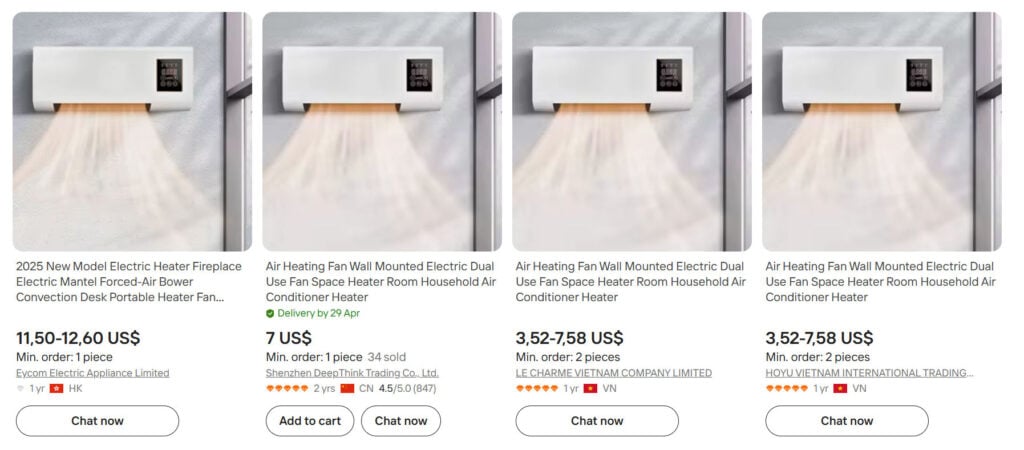
Wholesale Proof: This Is a Cheap Generic Product
Listings on Chinese sites expose the core of the operation.
Identical units are sold wholesale for:
- $3.50
- $7
- $12 max
These listings show:
- Same design
- Same airflow graphics
- Same “wall AC” concept
What Mirover charges
- ~$200+ per unit
What this means
- No proprietary technology
- No unique engineering
- No premium manufacturing
You are looking at a $5–$10 product sold as a $200 “solution.”
Major Red Flags (Stacked Together)
1. “AC Without Installation” Is a False Claim
There is no such thing as:
- A real AC
- That requires no exhaust
- That removes no heat
If it doesn’t expel heat, it doesn’t cool.
2. Impossible Temperature Claims
The product suggests:
- Cooling to 16°C
- Heating to 45°C
For a small plug-in device:
- These numbers are not realistic
- They are marketing figures, not real performance
3. Fake Comparison With Real AC Systems
The ads push a narrative:
- “Skip the $3,000 AC”
- “No installation needed”
- “Same results for a fraction of the cost”
This is not just exaggerated.
It is misleading.
A small fan device cannot replace a real cooling system.
4. Visual Manipulation
The product images show:
- Blue cold air streams
- Red heat zones
- Whole-room airflow
These visuals are designed to:
- Suggest performance that does not exist
- Trigger emotional buying decisions
5. Artificial Urgency
The page uses:
- “Save 50% – ends today”
- “Limited stock”
- Countdown timers
These are not indicators of demand.
They are pressure tools.
6. Inflated Social Proof
Claims like:
- “4.9/5 rating”
- “80,000+ orders”
Without external verification are not reliable.
This is standard in dropshipping funnels.
What Happens After You Buy
Best-case scenario
- You receive a small fan
- It blows air
- It may heat slightly
Most common outcome
- Cooling effect is minimal
- Does not cool the room
- Feels like a weak fan
- Disappointment
Worst-case scenario
- Poor build quality
- Delayed shipping
- Difficult returns
- Refund friction
Why These Products Keep Appearing
Because they work—financially.
The formula is simple
- Low cost product
- Strong emotional hook (heat discomfort)
- Big promises
- Minimal technical understanding from buyers
It targets people who
- Want a cheap alternative to AC
- Don’t understand how cooling systems work
- Are influenced by “quick fix” solutions
This Is Not Innovation—It’s Repackaging
There is no new cooling technology here.
No breakthrough.
No engineering advancement.
This is:
- A generic heater/fan
- Rebranded
- Repriced
- Repositioned
Is It a Scam?
Technically
- The product likely exists
- It may function as a fan/heater
Practically
- It does not do what is advertised
- It cannot deliver the promised results
Most accurate classification
A misleading product sold through deceptive marketing
Should You Buy It?
No.
Clear reasons
- Cannot cool a room
- Claims contradict physics
- Massive markup
- Misleading presentation
- High likelihood of disappointment
What To Do If You Already Ordered
Act immediately
- Save all product claims and screenshots
- Monitor your card for charges
- Test the device as soon as it arrives
If it underperforms
- Request a refund immediately
- Do not delay
- Escalate to your bank if needed
The Bottom Line
The Mirover Split Max AC is not an air conditioner.
It is a low-cost fan/heater device marketed as a high-performance cooling system.
The entire offer relies on one thing:
Convincing you that something simple can replace something complex.
It cannot.
You are not buying innovation.
You are buying a heavily marked-up generic product wrapped in misleading promises.








