

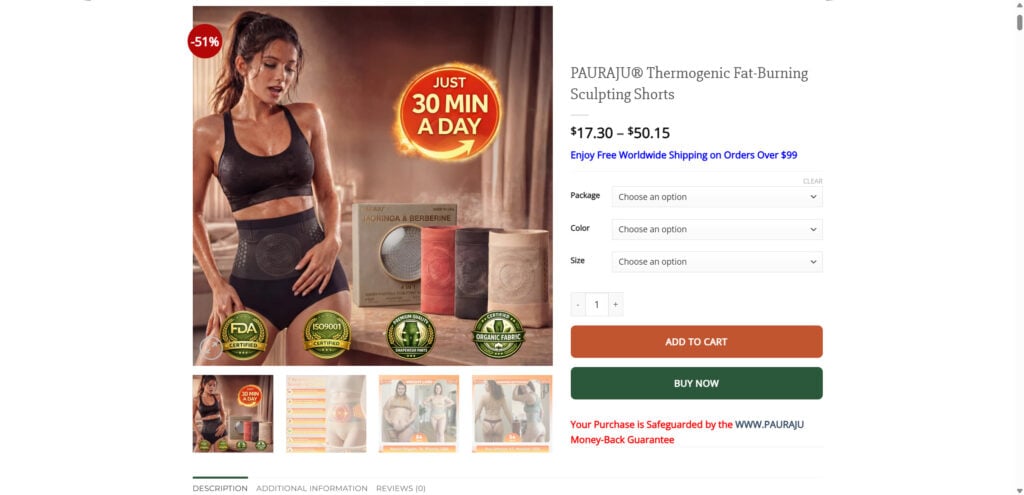
Moringa Berberine 4-in-1 Fat Burning Shorts are being promoted across social media as a wearable weight-loss shortcut that can burn belly fat, tighten the stomach, reduce cellulite, and “activate metabolism” in just minutes a day.
The product is sold under multiple names on different websites, often with the same images, same claims, and same aggressive sales tactics.
This review breaks down what these shorts really appear to be, why the claims are misleading, and what buyers should know before ordering.
Scam Overview
The Moringa Berberine 4-in-1 Fat Burning Shorts are usually advertised as advanced body-sculpting shapewear infused with ingredients like:
- Moringa
- Berberine
- Zeolite
- Thermal fibers
- “Nano bioactive” particles
- “Fat-burning” micro-technology
The marketing claims these shorts can create a thermogenic effect, activate fat burning, stimulate circulation, tighten loose skin, and help reshape the body without intense exercise.
That is the hook.
But the real product appears to be basic compression or sauna-style shapewear sold through a dropshipping model.
What the operation appears to be
- Cheap generic shapewear sourced from China
- Rebranded under different names
- Sold with exaggerated fat-burning claims
- Promoted using social media ads
- Marked up heavily
- Difficult or nearly impossible to return
- Sometimes linked to complaints about extra units or unexpected charges
The shorts may physically arrive.
The problem is that the marketing makes them sound like body-sculpting technology when they are more likely just ordinary compression clothing.
What the Ads Claim
Common claims include:
- Burns belly fat
- Activates metabolism in 5 minutes
- Works in only 30 minutes per day
- Tightens loose skin
- Reduces cellulite
- Helps with bloating
- Simulates exercise
- Burns calories while sitting
- Uses moringa and berberine through skin contact
- Helps reshape the waist, belly, hips, and thighs
These claims are designed to make the product feel scientific and effortless.
But they do not match how fat loss works.
The Truth: Clothing Cannot Burn Fat for You
A pair of shorts cannot directly melt fat through your skin.
At best, these shorts may:
- compress your waist temporarily
- make you sweat more
- create a warming sensation
- make your body look smoother while worn
But sweating is not the same as fat loss.
Most weight lost through sweating is water loss. It returns once you drink fluids again.
Major Red Flags
1. The “Fat Burning Fabric” Claim Is Not Proven
The biggest red flag is the claim that the fabric itself can activate fat burning.
Many ads use phrases like:
- “thermal fat activation”
- “bioactive slimming fabric”
- “nano-level permeation”
- “molecular fat-burning technology”
- “zeolite thermal sculpting”
- “moringa and berberine infused fibers”
These terms sound impressive, but they are usually not backed by real product-specific studies.
For this claim to be credible, the seller would need to prove:
- the ingredients are actually present in the fabric
- they remain active after manufacturing
- they transfer through the skin in meaningful amounts
- they reach fat tissue
- they cause measurable fat loss
- the exact shorts were tested in controlled human trials
Most of these sites provide none of that.
They use scientific-sounding words instead of scientific proof.
2. Moringa and Berberine Do Not Turn Shorts Into Weight-Loss Treatment
Moringa and berberine are ingredients commonly used in supplements.
But that does not mean wearing fabric supposedly infused with them can burn fat.
There is a major difference between:
- swallowing a measured supplement dose
- applying a tested topical medication
- wearing shapewear that claims to contain herbal ingredients
The ads blur that difference.
They want buyers to think the ingredients are doing something powerful through skin contact. But without real absorption data, dosage information, and clinical testing, this is just marketing.
3. Similar Slimming Garment Claims Have Already Been Challenged
This type of claim is not new.
The FTC previously acted against companies that sold caffeine-infused shapewear with claims that the garments could reduce cellulite, shrink body measurements, and slim the body. The FTC said those claims were false and not supported by scientific evidence, and the companies paid refunds to consumers.
That matters because the Moringa Berberine shorts use a similar idea:
A garment plus “active ingredients” equals fat loss.
Regulators have already treated this kind of slimming-clothing claim as highly questionable when not backed by strong evidence.
4. The Product Is Sold on Multiple Sites Under Different Names
This is a classic dropshipping red flag.
The same or very similar shorts are promoted under different names, such as:
- Moringa Berberine Fat Burning Shorts
- 4-in-1 Fat Burning Shorts
- Microparticle Fat-Burning Shorts
- Thermal Sculpting Shorts
- Bioactive Shaping Shorts
- Fat-Burn Compression Shorts
- Moringa & Berberine Sculpting Shorts
Different brand, same sales pitch.
That usually means the seller is not the manufacturer. They are likely using a generic product and building a new marketing page around it.
5. Cheap Product From China, Premium Price Online
Many of these products appear to be mass-produced shapewear items sourced from China.
The online sales page then adds:
- premium branding
- dramatic photos
- fake science
- before-and-after images
- urgency timers
- bundle deals
- fake “technology” claims
A product that may cost only a few dollars wholesale is then sold for much more.
The buyer is not paying for proven fat-burning technology.
They are paying for the funnel.
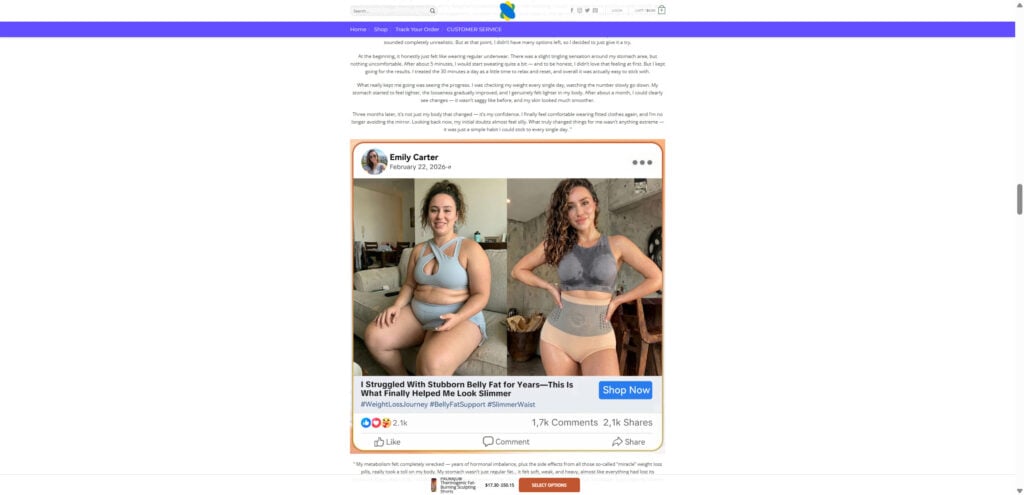
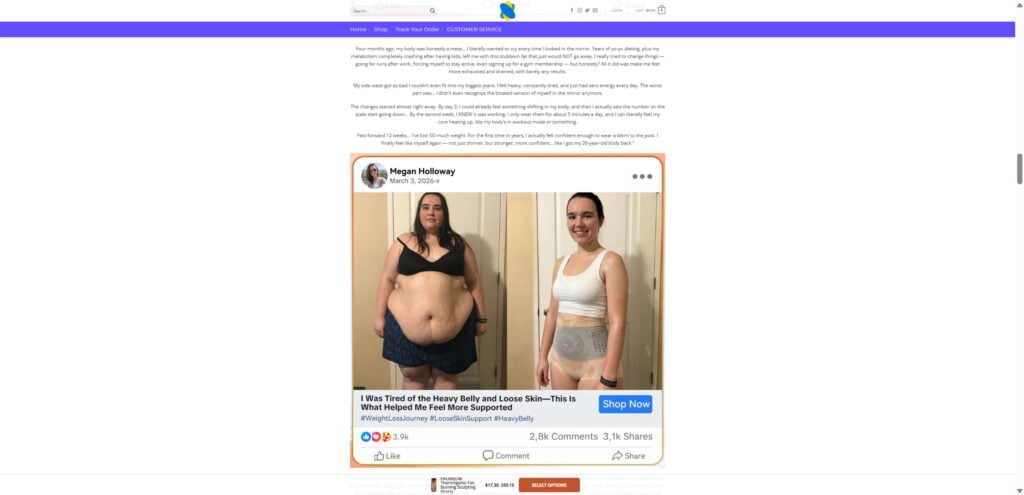
6. Before-and-After Photos May Be Edited or Misleading
Fat-burning shorts ads often rely on dramatic transformation images.
These can be misleading because results may come from:
- different lighting
- different posture
- stomach sucking
- compression effects
- shapewear worn in the “after” photo
- image editing
- filters
- AI-generated models
- stolen fitness transformation photos
Even if the images are real, they do not prove the shorts caused fat loss.
A person can look slimmer in seconds by changing posture, lighting, angle, or clothing.
7. Fake or Overhyped Testimonials
Many websites use testimonials that sound too perfect.
Common patterns include:
- “I lost inches without changing anything”
- “My belly started shrinking in days”
- “My cellulite disappeared”
- “I wear them 30 minutes a day and already see results”
- “I finally got my confidence back”
These stories are usually not independently verified.
Warning signs include:
- generic first names
- no real profiles
- stock-style photos
- repeated review text across different sites
- no independent review platform
- unrealistic timelines
- claims that sound like sales copy
Seller-controlled testimonials should not be treated as proof.
8. Fake Urgency and Countdown Timers
These stores often use pressure tactics such as:
- “70% off today only”
- “sale ends in 15 minutes”
- “only a few left”
- “someone just ordered”
- “limited batch”
- “buy now before price increases”
These tactics are designed to stop buyers from researching.
They create urgency around a product that is often available elsewhere under different names.
9. Reports of Buyers Being Charged for More Units Than Ordered
A common complaint with these sales funnels is that customers believe they selected one pair, but the final order includes multiple units.
This can happen through:
- preselected bundles
- confusing package options
- post-purchase upsells
- “Buy 2 Get 1 Free” layouts
- one-click add-ons
- unclear checkout totals
Some buyers report receiving more shorts than expected and being charged more than they intended.
That is a serious warning sign.
Always check the final checkout total before paying.
10. Returns May Be Practically Impossible
Many of these websites advertise a money-back guarantee, but the return process often becomes difficult after purchase.
Common problems include:
- returns must be shipped back to China
- buyer pays return shipping
- product must be unused and unopened
- return window is very short
- support replies slowly
- seller offers only a partial refund
- return shipping costs nearly as much as the product
- refund is denied after the item is worn
This is how a “guarantee” becomes almost useless.
If you need to ship low-cost shapewear internationally, most buyers simply give up.
What These Shorts Can Realistically Do
Possible real effects
The shorts may:
- compress your midsection
- make clothes fit smoother
- increase sweating
- feel warm while worn
- temporarily reduce water weight
- give a tighter appearance while wearing them
What they cannot realistically do
They cannot:
- melt belly fat
- burn fat through skin contact
- permanently tighten loose skin
- remove cellulite
- mimic exercise
- increase metabolism in a meaningful way
- reshape your body without lifestyle changes
- produce targeted fat loss
The FTC has also warned consumers to pass on products that promise weight loss or fitness results with no effort, noting that no garment, gadget, or cream will make someone slim and toned without real work.
How the Scam Works
Step 1: The ad targets insecurity
The ads focus on belly fat, cellulite, loose skin, bloating, and confidence.
They often show women struggling with weight, then presenting the shorts as a simple breakthrough.
Step 2: The product is made to sound scientific
The page uses terms like:
- bioactive fibers
- thermal induction
- metabolic activation
- microparticle matrix
- fat-burning cycle
- molecular permeation
This makes a simple garment sound advanced.
Step 3: The seller uses dramatic visuals
Ads show:
- glowing heat effects
- sweat
- thin models
- transformation photos
- fake diagrams
- lab-style graphics
These visuals create the illusion of real technology.
Step 4: The buyer is pushed into bundles
Instead of just selling one pair, the site pushes:
- Buy 2
- Buy 3
- Buy 5
- “Best value” packages
- free pairs
- extra discounts
This increases the amount charged.
Step 5: Returns become difficult
Once the buyer realizes the shorts do not work as advertised, they may discover:
- the seller is overseas
- return shipping is expensive
- customer support is slow
- worn items are not eligible
- only partial refunds are offered
That is why buyers need to be careful before ordering.
Is the Moringa Berberine 4-in-1 Fat Burning Shorts Scam Real?
The product itself may be real.
You may receive a pair of shorts.
But the scam is in the marketing.
The product is being sold with claims that go far beyond what compression shapewear can realistically do.
Most accurate verdict
Moringa Berberine 4-in-1 Fat Burning Shorts appear to be a high-risk dropshipping product promoted with fake science, exaggerated fat-loss claims, and return terms that may make refunds nearly impossible.
Should You Buy Them?
For most people, no.
Reasons to avoid them
- No proof they burn fat
- No proof moringa or berberine in fabric causes weight loss
- Same product appears under multiple names
- Likely cheap product from China
- Heavy markup
- Misleading before-and-after images
- Fake urgency tactics
- Reports of customers being charged for extra units
- Difficult returns requiring international shipping
If you still want them
Buy them only as ordinary compression shorts.
Do not buy them expecting:
- fat loss
- cellulite reduction
- skin tightening
- metabolism boost
- exercise-like results
- body transformation
What To Do If You Already Bought Them
1. Check your order confirmation
Confirm:
- how many units you were charged for
- what package you selected
- whether any upsells were added
- total amount charged
- merchant name on the receipt
2. Save all evidence
Take screenshots of:
- fat-burning claims
- moringa and berberine claims
- before-and-after images
- refund policy
- checkout page
- order confirmation
- support emails
3. Do not wear or wash them if you want a refund
Many sellers deny returns if the product is worn, washed, stretched, stained, or missing packaging.
4. Contact support immediately
Use a clear message:
I am requesting a refund for order #[number]. The product does not match the advertised fat-burning claims. Please provide the return address, return instructions, and refund timeline in writing.
5. Be careful with return shipping
If they require shipping back to China, calculate the cost first.
Do not spend more on return shipping than you can realistically recover.
6. Dispute the charge if necessary
If you were charged for more units than ordered, the product was misleading, or the seller refuses a reasonable refund, contact your bank or payment provider.
Use reasons such as:
- item not as described
- misleading advertising
- unauthorized charge
- charged for more items than ordered
The Bottom Line
Moringa Berberine 4-in-1 Fat Burning Shorts are not a proven weight-loss technology.
They appear to be ordinary compression or sauna-style shapewear sold through aggressive dropshipping ads, fake scientific language, dramatic testimonials, and inflated body-sculpting claims.
The product may make you sweat. It may temporarily smooth your waist while worn.
But that is not fat loss.
The safest conclusion is simple:
Moringa Berberine 4-in-1 Fat Burning Shorts look like a cheap rebranded product from China sold with exaggerated claims, confusing checkout tactics, and return terms that may make refunds practically impossible.









Iam just so sick and tired of false companies preying on women who only want to look the best they can especially as we get older. I thought I researched it enough but apparently not. The advertisement I responded to claim to be from the Mayo Clinic showing results from women who were nurses there.
I will never trust online shopping again. I feel like I have been taken. I hope other women read the facts and not fall for the crap.
Please do not be hard on yourself about the research – that ad was built specifically to defeat it. The Mayo Clinic branding is stolen, the “nurses” are stock photographs, and the fake endorsement is there because it borrows the trust of an institution you were right to trust. People with a great deal of experience fall for these; it is not a failure of judgement on your part.
Mayo Clinic has a public statement that it does not endorse supplements or skincare, and it takes reports of its name being misused. Two practical things: ask your card issuer to dispute the charge as misleadingly sold, and if there is any recurring element ask for a new card number rather than just a cancellation. Then file it at reportfraud.ftc.gov. And please do keep shopping online – just buy from the brand’s own site rather than from anything that arrives as an ad or a video.