

If a TikTok profile named “Mrs. Evan Kate,” “Evan Kate Billionaire,” or something similar has contacted you promising millions of dollars, do not send money, gift cards, banking details, or personal information.
This is not a real billionaire giveaway. It is a classic advance-fee scam using fake generosity, fake proof, and emotional manipulation to trick people into paying “small” fees for money that will never arrive.
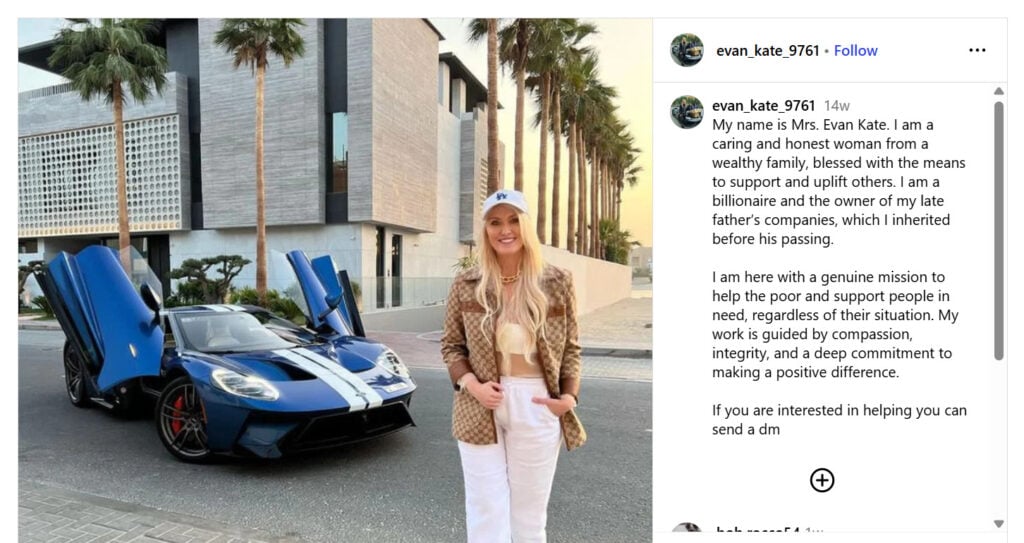
Scam Overview
The “Mrs. Evan Kate TikTok Billionaire Giveaway” is a social media scam where fraudsters pose as a wealthy woman or billionaire philanthropist who claims she wants to help poor people, single parents, struggling workers, debt-burdened families, or random followers online.
The scam usually appears on TikTok, Facebook, Instagram, Threads, Lemon8, WhatsApp, Zangi, Telegram, or other messaging platforms. The name may appear in different forms, including:
- Mrs. Evan Kate
- Evan Kate Billionaire
- Billionaire Evan Kate
- Kate Evan
- Evans Kate
- Mrs Evan Kate Foundation
- Evan Kate Giveaway
- Evan Kate Blessing
- Evan Kate $2.5 Million Giveaway
The exact profile name can change, but the story is almost always the same. A stranger contacts you and says they are rich, generous, honest, and looking for people to help. They may claim they inherited money, own companies, come from a wealthy family, or are doing a “giveaway” to bless people in need.
Then comes the hook: they say you have been selected to receive a huge amount of money. In many cases, the amount is $2.5 million, but some versions mention $100,000, $150,000, $500,000, or other life-changing sums.
The message may sound like this:
“Hello, I’m Mrs. Evan Kate. I’m a caring and honest billionaire woman. I’m here to help the poor and those who need financial assistance. What would you do if I deposited $2.5 million for you?”
At first, the scammer may not ask for money immediately. They may try to build trust by asking about your life, your bills, your family, your job, or your debts. This is intentional. The scammer wants you emotionally invested before revealing the payment demand.
Once you respond, they tell you the money is ready. They may claim it is being delivered by FedEx, a private courier, a bank officer, an attorney, a government agent, or a “delivery man.” They may send fake documents, fake certificates, fake payment approvals, fake screenshots, or fake photos of cash.
Then the scam begins.
You are told you must pay a fee before the money can be released. The excuse may be:
- Delivery fee
- Activation fee
- Tax fee
- Clearance fee
- Customs fee
- Processing fee
- Insurance fee
- Bank transfer fee
- Courier fee
- Attorney fee
- IMF fee
- Anti-money-laundering certificate fee
- Gift card activation fee
The requested fee may start small, such as $50, $100, $150, or $200. But once you pay, another problem appears. The courier has a flat tire. The bank needs another certificate. The package is stuck at the border. The FBI needs verification. The delivery driver needs gas. The payment system needs one more activation code.
This is how advance-fee scams work. The promised fortune is fake. The fees are real. The scammer keeps inventing reasons to make you pay again and again.
Why the Mrs. Evan Kate Giveaway Is a Scam
The biggest red flag is simple: real billionaires do not randomly message strangers on TikTok offering millions of dollars in exchange for gift cards.
No legitimate giveaway requires you to pay with Apple gift cards, Walmart cards, Visa prepaid cards, eBay cards, Steam cards, Cash App, Zelle, crypto, or wire transfers before receiving your prize.
If someone says you must pay first to receive a prize, donation, grant, inheritance, blessing, or giveaway, you are not dealing with a generous billionaire. You are dealing with a scammer.
Red Flag #1: You Did Not Enter a Real Giveaway
Most victims never entered any contest. They simply receive a message from a random profile claiming they were “chosen” or “selected.”
Real giveaways have clear rules, official organizers, eligibility requirements, deadlines, public winner selection, and no upfront fee. A random TikTok DM is not proof that you won anything.
Red Flag #2: The Amount Is Unrealistic
The scam often uses massive numbers like $2.5 million because the amount is meant to override skepticism.
The scammer wants you to think:
- “This could change my life.”
- “Maybe it’s worth risking $100.”
- “What if this is real?”
- “I can pay the fee now and solve all my problems later.”
That emotional pressure is the trap. The more desperate or hopeful someone feels, the easier it becomes for the scammer to convince them to ignore obvious warning signs.
Red Flag #3: They Ask for Gift Cards
Gift cards are one of the clearest signs of fraud.
Scammers like gift cards because they are fast, hard to reverse, and easy to drain. Once you buy the card and send the code or photo, the money is usually gone.
Common cards used in this scam include:
- Apple gift cards
- Google Play cards
- Walmart cards
- Visa prepaid cards
- eBay cards
- Steam cards
- American Express gift cards
- Vanilla Visa cards
- Mastercard prepaid cards
A real bank, charity, courier, attorney, billionaire, or prize organization will never require gift cards to release millions of dollars.
Red Flag #4: They Use Fake Proof
The scammer may send fake screenshots or documents that look official at first glance.
These may include:
- Fake payment approval letters
- Fake delivery receipts
- Fake bank transfer screenshots
- Fake courier tracking pages
- Fake certificates
- Fake ID cards
- Fake photos of cash
- Fake testimonials from “winners”
- Fake videos of people thanking Mrs. Evan Kate
Do not trust these. Scammers can create fake documents in minutes. They often reuse the same templates with different victim names, addresses, and payment amounts.
A document saying “Mrs. Evan Kate has approved $2.5 million” does not mean anything. It is just part of the script.
Red Flag #5: They Move You Off TikTok
Many scammers start on TikTok or Facebook but quickly push victims to WhatsApp, Telegram, Zangi, Signal, or text message.
They do this because private messaging apps make it harder for platforms to detect and remove the scam. It also helps the scammer isolate the victim from public warnings.
If someone promising money insists that you continue the conversation on another app, treat that as a major warning sign.
Red Flag #6: They Pressure You to Act Fast
Scammers do not want you to think, research, or ask someone for advice. They want fast action.
They may say:
- “Your payment is ready now.”
- “You must pay today.”
- “The delivery agent is waiting.”
- “Do not tell anyone.”
- “If you delay, you will lose the blessing.”
- “This is your only chance.”
- “The bank needs the fee immediately.”
Urgency is a manipulation tactic. Real financial assistance does not disappear because you ask questions.
How the Mrs. Evan Kate TikTok Scam Works
Although each version may differ slightly, most cases follow the same structure.
Step 1: The Fake Profile Appears
The scam begins with a social media account pretending to be a rich woman or billionaire named Mrs. Evan Kate.
The profile may contain:
- Stolen photos of a woman
- Luxury lifestyle images
- Cash photos
- Fake “winner” posts
- Religious or emotional language
- Claims about helping the poor
- Comments from fake accounts saying they received money
- Multiple posts asking people what they would do with millions
Some accounts may look active and convincing because scammers use copied content, fake engagement, and repeated comments to create the appearance of legitimacy.
But a profile with videos, followers, comments, and “testimonials” can still be completely fake.
Step 2: The Scammer Starts With a Friendly Message
The scammer usually opens with kindness and curiosity. They may say they are helping people because they are blessed, rich, lonely, generous, or trying to give back.
They may ask:
- “Are you a single parent?”
- “Do you need financial help?”
- “What are your debts?”
- “What would you do with $2.5 million?”
- “Do you believe in blessings?”
- “Can I trust you?”
- “Are you honest?”
This is not real generosity. It is screening. The scammer is trying to identify people who are hopeful, financially stressed, or willing to continue the conversation.
Step 3: You Are Told You Qualify for a Huge Payment
After you respond, the scammer says you have been selected.
They may claim the money will be sent through:
- A courier
- A bank transfer
- A prepaid card
- A gift card
- A delivery box
- A cashier’s check
- A diplomat delivery
- A private financial agent
- A foundation payment office
The story may sound dramatic and official, but it is fiction. The scammer’s goal is to make the fake payment feel real enough that you will pay the first fee.
Step 4: Fake Documents Are Sent
Next, the scammer may send a fake “approval” document. It may include your name, address, payment amount, and instructions to send a fee.
These documents often contain poor grammar, strange wording, formatting mistakes, and unrealistic claims. But even if the document looks polished, it is still not proof.
Scammers can generate fake PDFs, receipts, invoices, tracking pages, and approval letters easily.
Step 5: The First Fee Is Requested
The scammer then asks for a small payment. This is the first real goal of the scam.
They may say:
- “Buy a $150 Apple gift card.”
- “Send a $200 eBay card for approval.”
- “Pay the courier fee.”
- “Send a Visa prepaid card to activate the transfer.”
- “Pay tax before the money is released.”
- “Pay the delivery driver so he can bring the package.”
The fee is deliberately smaller than the promised reward. If someone believes they might receive $2.5 million, paying $100 or $200 may feel like a small risk.
That is exactly what the scammer is counting on.
Step 6: More Fees Keep Appearing
After the victim pays once, the scammer does not send the money. Instead, they invent another problem.
Common follow-up excuses include:
- The package is stuck
- The driver needs gas
- The driver has a flat tire
- The bank rejected the transfer
- The IRS needs tax clearance
- The FBI needs verification
- The account must be upgraded
- A new certificate is required
- A larger fee is needed because of the amount
- The victim made a mistake and must pay again
This cycle continues until the victim runs out of money, refuses to pay, blocks the scammer, or realizes the giveaway was fake.
Step 7: The Victim May Be Targeted Again
Once someone pays, scammers may mark them as a valuable target.
The victim may then be contacted by:
- Another “Evan Kate” account
- A fake delivery agent
- A fake bank officer
- A fake police officer
- A fake FBI agent
- A fake lawyer
- A fake recovery expert
- A fake hacker who claims they can recover the money
This is called a recovery scam. The second scammer claims they can get your lost money back, but they also require a fee. It is another trap.
Common Messages Used in the Scam
Here are examples of the type of language used in this scam. The exact wording may vary.
Fake Billionaire Message
“Hello, my name is Mrs. Evan Kate. I am a caring and honest billionaire woman from a wealthy family. I came here to help the poor and privileged people. What would you do if I blessed you with $2.5 million today?”
Fake Payment Message
“Your payment of $2.5 million has been approved. You only need to pay the activation fee so the bank can release your funds immediately.”
Fake Gift Card Message
“Go to Walmart and buy an Apple gift card of $150. Scratch the back and send a clear picture. This is for verification only. You will receive your money today.”
Fake Courier Message
“Your package is already on the way. The delivery agent is close to your location, but you must pay the delivery fee before he can release the box.”
Fake Urgency Message
“If you do not complete the payment now, your funds will be canceled. This is your last chance to receive your blessing.”
These messages are designed to sound personal, urgent, and official. But they all point to the same conclusion: the scammer wants your money.
What Happens If You Send the Gift Card Code?
If you send a gift card code, the scammer can redeem or resell it quickly. You do not need to physically mail the card. The code on the back is enough.
After that, the scammer may:
- Stop replying
- Claim the card did not work
- Ask for another card
- Say the fee was incomplete
- Invent a new release fee
- Threaten you
- Pretend the delivery is delayed
- Send you to another fake agent
Do not send additional money. Paying again will not unlock the promised funds. It will only increase your loss.
Is There a Real Mrs. Evan Kate Billionaire?
There is no verified evidence that a legitimate billionaire named “Mrs. Evan Kate” is randomly giving millions of dollars to strangers on TikTok.
The name appears to be used by scammers as a repeatable persona. Multiple fake accounts can use the same name, the same photos, and the same script. That does not mean there is one real person behind it. It means the name has become part of a scam format.
Scammers often reuse names because victims search for them after being contacted. If enough fake posts and fake testimonials exist, the scam can appear more believable to someone who is already hopeful.
Do not judge the offer by whether the profile has followers, videos, or comments. Judge it by the behavior:
- Randomly offers millions
- Asks for fees
- Requests gift cards
- Sends fake documents
- Pressures you to act fast
- Moves the conversation to private apps
That behavior is fraud.
Why People Fall for This Scam
It is easy to say, “Nobody would believe this.” But scams like this work because they target emotion, not logic.
Many victims are dealing with real problems:
- Debt
- Rent pressure
- Medical bills
- Family emergencies
- Job loss
- Loneliness
- Financial stress
- Hope for a better life
The scammer presents themselves as the answer to those problems. They may use kind words, prayers, compliments, or sympathy to build trust.
The victim is not stupid. The scammer is manipulative.
The most important thing is to stop the scam quickly, preserve evidence, and avoid sending more money.
What To Do If You Were Contacted
If a Mrs. Evan Kate account contacted you but you have not sent money, do this:
- Do not reply further.
- Do not click links.
- Do not send personal information.
- Do not send gift cards or payment.
- Screenshot the profile and messages.
- Report the account to TikTok or the platform where it contacted you.
- Block the account.
- Warn friends or family if the scammer found you through your social circle.
Do not argue with the scammer. Do not try to expose them in private messages. Do not send fake codes. The safest move is to document, report, and block.
What To Do If You Already Sent Money
If you already sent money, act quickly.
1. Stop All Contact
Do not send another payment, even if the scammer says you are “one step away” from receiving the money.
There is no $2.5 million. Every new fee is another loss.
2. Save Evidence
Take screenshots of:
- The profile
- Usernames
- Messages
- Payment requests
- Gift card receipts
- Gift card numbers
- Phone numbers
- Email addresses
- Bank details
- Crypto wallet addresses
- Fake documents
- Delivery claims
Do not delete the conversation yet. Evidence may help with reports.
3. Contact the Gift Card Company
If you paid with a gift card, contact the gift card issuer immediately. Tell them you were scammed and ask whether the card can be frozen or refunded.
Have the receipt and card number ready.
Gift card recovery is not guaranteed, but acting fast gives you the best chance.
4. Contact Your Bank or Payment App
If you paid by bank transfer, debit card, credit card, Cash App, Zelle, PayPal, Venmo, crypto, or wire transfer, contact the provider immediately.
Explain that you were tricked by an online giveaway scam. Ask if the transaction can be stopped, reversed, disputed, or flagged as fraud.
5. Report the Scam
Report the scam to:
- The platform where it happened
- The FTC if you are in the United States
- IC3 if you are in the United States and money was lost
- Your local police or cybercrime unit
- Your bank or payment provider
- The gift card company
Reporting may not instantly recover your money, but it helps platforms and authorities identify patterns.
6. Watch for Recovery Scammers
After being scammed, you may be contacted by people claiming they can recover your money.
They may say:
- “I know a hacker who can help.”
- “Message this recovery expert.”
- “I recovered my money through this person.”
- “Pay a fee and we will trace the scammer.”
- “We work with law enforcement.”
Be careful. Most “recovery experts” who contact victims online are scammers too. Do not pay anyone who promises guaranteed recovery.
How to Report the Account on TikTok
To report a suspicious TikTok account:
- Open the profile.
- Tap the three-dot or share/options menu.
- Choose “Report.”
- Select the reason that best fits the scam, fraud, impersonation, or suspicious activity.
- Submit the report.
- Block the account.
Also report any direct messages if the scammer used TikTok inbox to contact you.
How to Protect Yourself From Similar Giveaway Scams
The Mrs. Evan Kate scam is just one version of a broader social media giveaway scam.
Use these rules to protect yourself:
- Never pay money to receive money.
- Never send gift card codes to strangers.
- Never trust random “billionaire” DMs.
- Never share banking login details.
- Never share your Social Security number or ID with a stranger online.
- Never believe a courier story involving upfront fees.
- Never continue a money conversation on WhatsApp or Telegram with a stranger.
- Search the name plus “scam” before responding.
- Ask a trusted person before sending any payment.
- Treat urgency as a warning sign.
A real giveaway does not require secrecy, pressure, gift cards, or repeated fees.
The Bottom Line
The Mrs. Evan Kate TikTok Billionaire Giveaway is a scam. The accounts using this name are not giving away $2.5 million to random people. They are using fake wealth, fake kindness, and fake payment documents to trick victims into sending gift cards or fees.
If you receive a message from “Mrs. Evan Kate” or any similar billionaire giveaway account, do not engage. Screenshot it, report it, block it, and do not send money.
No legitimate billionaire, charity, bank, courier, or foundation will ask you to buy gift cards before receiving a prize.
If you already paid, stop immediately, preserve evidence, contact the gift card company or bank, and report the scam. Do not trust anyone who contacts you afterward claiming they can recover your money for a fee.
FAQ
Is the Mrs. Evan Kate TikTok giveaway real?
No. The giveaway is not legitimate. It is a scam where fake profiles promise large amounts of money and then ask victims to pay fees or send gift cards.
Who is Mrs. Evan Kate?
“Mrs. Evan Kate” appears to be a fake persona used by scammers. There is no verified evidence that a real billionaire by that name is giving millions of dollars to strangers on TikTok.
Why does the scammer ask what I would do with $2.5 million?
That question is used to make you imagine receiving the money. Once you emotionally picture the reward, you may be more willing to pay a “small” fee to claim it.
Why do they ask for Apple, Walmart, eBay, or Visa gift cards?
Scammers like gift cards because they are easy to redeem and difficult to reverse. Once you send the code, the money is usually gone.
Can a gift card really hold $2.5 million?
No. The claim is absurd. Scammers may say the money will be deposited onto a gift card or released after a gift card payment, but that is just part of the trick.
What if they sent me a certificate or payment approval document?
It is fake. Scammers often create fake documents to make the story look official. A PDF, screenshot, or certificate does not prove that money exists.
What if the delivery driver says they are near my house?
That is a pressure tactic. The scammer may pretend a courier is nearby so you feel rushed into paying a delivery fee. Do not send money.
What if I already sent a gift card code?
Contact the gift card company immediately, keep your receipt, report the scam, and stop communicating with the scammer. Do not send more cards.
Can I get my money back?
It depends on the payment method and how quickly you act. Gift card losses are difficult to recover, but you should still report the card to the issuer immediately. Bank, card, or payment app transactions may have dispute options.
Should I reply to the scammer to scare them?
No. Do not argue or threaten them. Save evidence, report the profile, and block the account.
Are all billionaire giveaways scams?
Not every public giveaway is fake, but random private messages offering life-changing money are almost always scams, especially if you are asked to pay first.
What should I do if another account says they can recover my money?
Be very careful. Recovery scammers target victims after the first scam. Do not pay anyone who promises guaranteed recovery.
10 SEO Title Ideas
- Mrs. Evan Kate TikTok Billionaire Giveaway Scam: Don’t Pay the Fake $2.5 Million Fee
- Is Mrs. Evan Kate Giving Away Money? TikTok Billionaire Scam Explained
- Evan Kate Billionaire Scam: Fake TikTok Giveaway Asking for Gift Cards
- Mrs. Evan Kate $2.5 Million Giveaway: Real or Scam?
- Beware the Mrs. Evan Kate TikTok Scam Promising Millions Online
- Evan Kate Giveaway Scam: How Fake Billionaire Profiles Trick Victims
- Mrs. Evan Kate Gift Card Scam: What To Do If You Were Contacted
- Fake Billionaire Giveaway Scam: The Truth About Mrs. Evan Kate on TikTok
- Did Mrs. Evan Kate Message You? Here’s Why It’s a Scam
- Mrs. Evan Kate TikTok Scam Exposed: Fake Money, Fake Documents, Real Losses

Join the discussion
0 commentsShare your experience or ask a question about this article.
Discussion
Start the conversation
Have a question or something useful to share? Add the first comment.